
Notifications
Clear all

12/01/2026 11:43 am
The issue of whether they should anyway be upgraded is separate, the concerning thing (if indeed they do need to be upgraded) is that this wouldn't have arisen had I not been considering islanding, and seriously there must be hundreds of thousands+ of houses with this arrangement.
Indeed. There are thousands of houses which have substandard electricity supplies!
Fault designations for electricity supplies to premises are covered on the MOCOPA Guide, as used by Meter Operators.
I suggest you download and keep a copy of that illustrated MOCOPA Guide, which can be understood by anyone dong a visual inspection.
The later/current version issued by the Retail Energy Code Company (RECC) has ceased to be a useful reference tool
and is now a set of written rules describing who is at fault when something isn't done correctly.
Save energy... recycle electrons!
Topic starter
12/01/2026 11:46 am
Whether the outer metallic braid of the mains incomer is covered by an insulated layer (Polyethylene or Bitumen), it remains the case that the actual location of the earth-tie is at the substation transformer.
Thanks. I know and can see that the tie from earth to neutral is at the local substation transformer.
However its not this that matters for safety, its the tie from the customer protective earth to actual earth. The point at which the customer earth is connected to actual earth will surely depend on the insulation of the incomer. If the incomer is insulated throughout its entire length (including any joints) and therefore the tie is is also at the substation transformer but the fault current isnt via the neutral, what is to prevent a situation (when the grid is connected) where the metallic braid has an interruption (eg at a joint) and thus the supply, but not the earth, remains connected? You would have no way of knowing this. Obviously this wont happen if the cable is cut, but if it corrodes or something disrupts continuity at a joint - what then?
And also in this case what is the material difference between TN-S and TN-C-S and is either actually ever satisfactory? Something still isn't quite making sense.
I dont disagree, btw, with your comments on the weakness of the current arrangement, (but both are easily fixed), however I have now developed an interest in getting to the bottom of understanding this. Dont feel obliged to answer!
This post was modified 2 months ago by JamesPa
4kW peak of solar PV since 2011; EV and a 1930s house which has been partially renovated to improve its efficiency. 7kW Vaillant heat pump.

12/01/2026 12:15 pm
I also found the reason for the multiple categorisations for our earthing arrangement. It is TN-S, but the head was upgraded as in TN-C-S, causing the confusion.
Please define what you're referring to as "the head".
When you used it previously I thought you were referring to the test point on the top protruding section of an earth rod.
But now I think you mean the Service Fuse - which is often called the Cut Out by DNO Engineers.
I used the term head like I heard the electricians use it. A year ago, I had some issue (some loose contact that was causing it to heat). I had to call the DNO myself and the sparky I had called (that I subsequently found out is not registered) told me to describe it as the head (referring to the fuse block).
I found what I hope is a useful summary of the regulation requirement for earthing arrangements in the website of an NICEIC registered electrical company. Unfortunately both EICR reports I had done last year lack these measurements. I reproduce them below. I plan to have it measured, but I believe the capacity of the DNO conductor to the supply point would also need to be considered?
External Earth Loop Impedance (Ze)
Regulation 313.1 requires a number of characteristics of the supply to an installation to be determined, including the nominal voltage to earth (U₀), the earth loop impedance of that part of the system external to the installation (Ze), and the prospective short-circuit current at the origin of the installation.
The value of external earth loop impedance (Ze) measured or otherwise determined in accordance with Regulation 313.1 may differ from the applicable typical maximum value declared by the electricity distributor, which is usually:
- 0.8 Ω for TN-S system
- 0.35 Ω for a TN-C-S system
- 21 Ω plus the resistance of the installation earth electrode for a TT system.
8kW Solis S6-EH1P8K-L-PLUS hybrid inverter; G99: 8kw export; 16kWh Seplos Fogstar battery; Ohme Home Pro EV charger; 100Amp head, HA lab on mini PC
12/01/2026 1:41 pm
On closer observation, I had missed that the latest EICR I had from December is showing a Ze of 0.17 Ω, so the installation is compliant. 🙂
Still, would the capacity of the DNO conductor to the supply point not need to be able to take 36.4Amps (8Kw) for safety?
8kW Solis S6-EH1P8K-L-PLUS hybrid inverter; G99: 8kw export; 16kWh Seplos Fogstar battery; Ohme Home Pro EV charger; 100Amp head, HA lab on mini PC
12/01/2026 2:48 pm
what is to prevent a situation (when the grid is connected) where the metallic braid has an interruption (eg at a joint) and thus the supply, but not the earth, remains connected? You would have no way of knowing this. Obviously this wont happen if the cable is cut, but if it corrodes or something disrupts continuity at a joint - what then?
Then you've just discovered the reason why Electricians put stickers on Distribution Boards which recommend a check every 10 years!
It all comes down to how your single-phase supply cable has its outer braided earth connected to the earth of the 3-phase cable 'in the road'.
If your electrician notices a marked increase in earth resistance since your previous test, then he'll notify the DNO.
They will send out a team to dig up the highway and inspect that joint.
There might've been a 'standard' brass connector which was used for connecting braided earths on cables of different diameters.
After all, we have such connectors for SWA cables today.
I don't know if TN-S supplies are installed any more.
The new-build estates all seem to have TN-C-S, which uses the Neutral to provide the earth.
Save energy... recycle electrons!
Topic starter
12/01/2026 3:11 pm
Thanks, I think I now get it. I am sorry its taken so long! I believe I now also understand why a local generator which is operating islanded needs a local earth. Im not sure I get why a vehicle charger may need a local earth, but thats for another day and another dive into protective earthing (a subject that has always mystified me TBH but which is now becoming much clearer).
During my off-forum research I found a good video here describing UK earthing systems https://www.electricaltestinglondon.co.uk/blog/types-of-earthing-systems--tn-s--tn-c-s--tt--it-compared which is consistent with everything else above so is presumably reliable. The presenter says that TN-S is no longer supplied because you cant get the cable. He also explains the advantages and disadvantages of the various systems in different scenarios.
4kW peak of solar PV since 2011; EV and a 1930s house which has been partially renovated to improve its efficiency. 7kW Vaillant heat pump.
12/01/2026 5:11 pm
@jamespa yes, useful to hear how the earthing is provided.
What I also experienced is when the RCDs (or RCBOs) have limitations to check for faults. The way I now see it, they are there detecting whether there is much loss of the live power to any earth connection, be it the building or the earthing arrangement. In case that loss is above the threshold, they will trip the circuit.
What happens when you have a separate source of power or devices that specifically deal with power could there perfectly reasonable cases where the RCDs would trip but there is no danger to the end user?
I am wondering since trying to use RCD on the circuits feeding my Solis was unsuccessful. I am not yet sure why, specially since my earthing arrangements are good.
8kW Solis S6-EH1P8K-L-PLUS hybrid inverter; G99: 8kw export; 16kWh Seplos Fogstar battery; Ohme Home Pro EV charger; 100Amp head, HA lab on mini PC
12/01/2026 7:14 pm
@batpred - you're venturing into an area of energy regulation which is governed by professional bodies.
Any proposals to change specifications would need to be submitted to the relevant organisation, accompanied by proper evidence.
RCDs and RCBOs already have tests which define the speed at which they respond to an imbalance between Live & Neutral.
If the trip is properly chosen for the apparatus it is intended to protect, then there shouldn't be any 'spurious tripping'.
There can be no such thing as a trip which operated despite there being 'no danger to the user'.
Therefore we have five possibilities
- the trip is itself faulty
- the apparatus (or protection devices within it) are faulty
- the mains wiring or earthing is incorrect
- the trip hasn't been properly selected - possibly because the electrician had insufficient information to do so (eg poor English in an installation manual)
- the trip is operating correctly and you're still alive because it functioned as required!
Electricians who fit these trips have test-gear which checks for such faults.
If this Topic veers off into such a discussion, then it is likely to end up with Members here challenging decisions or regulations which are being implemented by professional electricians and organisations, such as the IET, who write the Wiring Regulations. This Forum doesn't have the expertise to do so, and shouldn't be doing so.
Bodies such as IET and NICEIC have routes through which proposals and evidence can be submitted.
That's the right approach.
I have already used such a route to challenge certain aspects of PAS63100, which is a non-mandatory standard for installation of home storage batteries.
As was right, I received a response which showed me that my objections had been evaluated, and would be discussed by the authors for the next release of the Standard.
I have also used test-reports from others, such as BEAMA, to directly contact trip manufacturers and ask about the compliance of their devices.
These aren't issues where my correspondence would be made public on this Forum.
This post was modified 2 months ago by Transparent
Save energy... recycle electrons!
12/01/2026 8:52 pm
@batpred - you're venturing into an area of energy regulation which is governed by professional bodies.
Any proposals to change specifications would need to be submitted to the relevant organisation, accompanied by proper evidence.
Yes, certainly not enough could have been tested in any single installation to support a submission.
Bodies such as IET and NICEIC have routes through which proposals and evidence can be submitted.
That's the right approach.
Agreed, given the serious risks in case of misinterpretation, this forum is not appropriate.
I have been talking to the NICEIC but about aspects they can influence like guidance to electricians. And even then my comments are more useful as an interested and relatively informed consumer.
But I too developed an interest in getting to the bottom of understanding this. I will use every future opportunity to gain evidence and contact the manufacturer.
8kW Solis S6-EH1P8K-L-PLUS hybrid inverter; G99: 8kw export; 16kWh Seplos Fogstar battery; Ohme Home Pro EV charger; 100Amp head, HA lab on mini PC
1

13/01/2026 9:54 am
Hi, looking for help and advice as my installer is useless and Sunsynk have washed their hands of this.
I wanted a battery backup system, non solar, that we can run the house off during the day and then charge overnight on cheap rate. We have regular power cuts here and so I also wanted it to be a whole of house UPS so we dont notice the power cuts, whenever they happen.
The company I used installed the following system last month - Sunsynk 5kw hybrid inverter, 3 x 5kw batteries and Fox EPS. However, whenever the power cuts out, we’re noticing it as the FOX eps switches between grid and back up. The strange thing is that not everything cuts out when the grid goes - the clock on the oven, for example, never resets (where as previously with power cuts it would, it doesn’t have it’s own a battery back up in it either.)
The system isn’t making use of the Sunsynks UPS as I wanted whole of house backup and was told it wouldnt be possible without an EPS.
I’ve spoken to Fox about this and they say the cuts outs when switching are because their equipment isn’t compatible with Sunsynk. I’ve tried getting help from Sunsynk, but they’ve been useless, saying talk to the installer who planned the system and the installer…well, they’ve admitted there is a problem and want me to spend about £1000 to put it right.
Before I spend more money, I wanted to do my own research and find out the best option.
Does anyone have experience in this or how to put it right? If I got another Sunysnk inverter and put them in parallel, creating 10kw, would we then be better off using the UPS output for whole of house back up? Would getting an ATS switch just be the answer for the current setup? Should I just admit defeat and not have whole of house backup, splitting the consumer board and making use of the Sunsynk UPS?
Since the system was installed, peak is about 7KW at any one time.
I’m lost and would appreciate advice.
Thanks in advance.
13/01/2026 11:49 am
For the benefit of others, let me point out that we've already had some discussion of this issue elsewhere,
and now relocated to this topic which already covers overlapping matters.
I've already indicated my guidance which I posted here earlier:
The basic concept for deciding the number and size of of inverters and batteries is this:
If you need more power to run the home, then add inverters - that increases the kilowatts
If you need your stored energy to last longer, then add battery capacity - that increases the kilowatt-hours
The knub of this problem is that the Sunsynk inverter already has an inbuilt feature which allows mains circuits to be used when there's a power-cut.
Thus the inverter and the Fox EPS would appear to be doing the same job.
Assuming that this is a system-design and specification error by the Installer, it's likely to be best addressed through the Consumer Rights Act (2015)
which is administered by the Citizens' Advice Bureau, rather than the Small Claims Division of the High Court.
This Topic can provide 'evidence' that can be used in such a claim.
But, a note to other Members here, please don't give unsupported advice to @lostandconfused in what you write!
The Fox EPS device has a good technical overview on their own website:
That page starts with the observation:
1) EPS or no EPS, if there is a power cut, the inverter will shut down completely.
But that's clearly not the case with hybrid off-grid inverters such as the Sunsynk range.
The page goes on to describe modes of operating the Fox EPS, including a Whole House arrangement which would use a Manual or Automatic Change-over Switch.
Fox provide those diagrams, to which I've added a purple box around the EPS units for clarity:
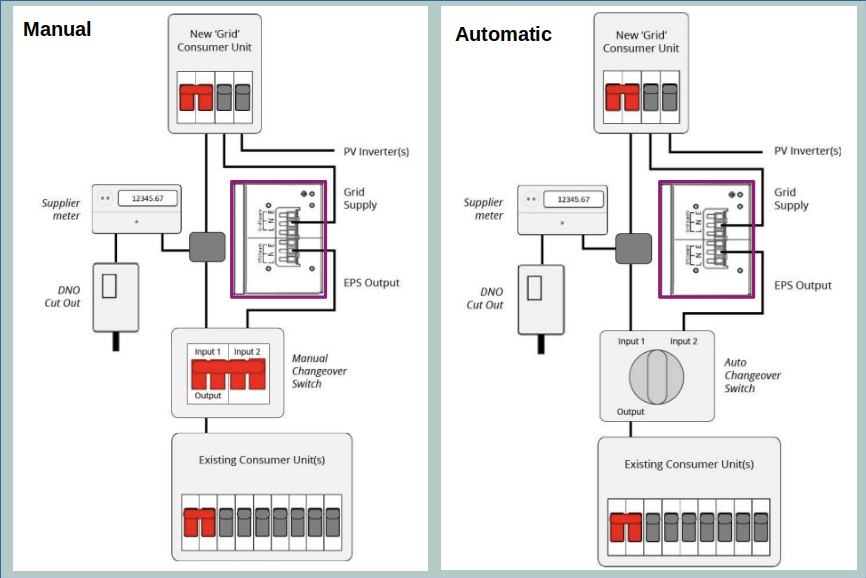
Fox then make a link to more technical descriptions and diagrams on their GitHub pages.
And this is where it can get confusing, because there is a diagram which combines the use of their own Fox ESS hybrid inverter and a Fox EPS device:
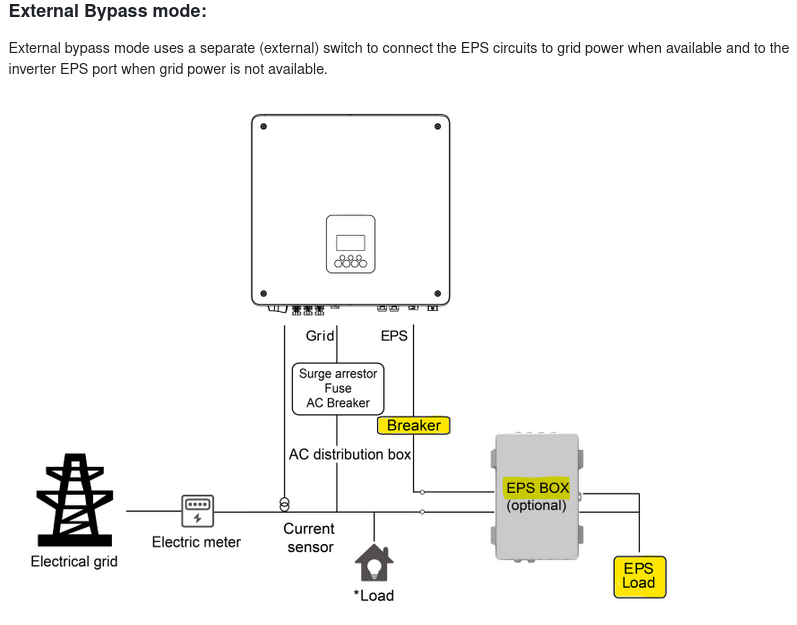
I need to spend a while longer reading that page.
It's possible that this is where the Installer assumed that a Sunsynk hybrid inverter and a Fox EPS would be used together.
Even so, there is good news for other readers here.
We can now add the Fox ESS to the Solis and Sunsynk inverters which have a maintained output that operates during a power outage.
This post was modified 2 months ago by Transparent
Save energy... recycle electrons!

13/01/2026 12:10 pm
Reposted query from another thread requested by @transparent
Slightly tangential query, but one that you can perhaps assist with as someone with both extensive knowledge of the electricity/grid structure and, specifically, the Sunsynk inverters and associated software.
My 5kW Sunsynk inverter is limited to G98 export limits, and the DNO have advised that there's no realistic prospect of increasing this via G99 due to the number of solar PV systems in proximity in our area (a suburb within Leeds), so 3.68kW is as good as it will get.
I'm trying to find a way within the settings to limit the grid export to 3.68kW, but to retain the 5kW inverter capability for other internal activity, such as solar PV charging to the batteries and general discharging of the batteries for consumption in the house. I believe that the Sunsynk inverters are capable of doing this (please correct me if I'm mistaken) but I can't apply this in the settings. Within the 'system mode' section of the settings, there's an Inverter Power Limiter setting that logically could be set to 5000W. Separately, within the Grid Settings section, there's a Export Power Limiter setting that logically has to be set to 3680W to prevent any risk of breaching the G98 limit.
As soon as I change the grid export setting, the overall inverter power limiter setting changes with it, and vice versa. If I set the export to 3680W, and then change the overall inverter power limiter to 5000W, the export setting increases with it.
At present it looks like a software restriction to me and, if so, potentially something I could follow up with Sunsynk directly. I don't have the technical knowledge to understand whether it's perhaps a more basic hardware restriction, and I'm trying to achieve something that isn't technically possible. I doubt there's a better informed person available anywhere to advise whether or not this is the case.
130m2 4 bed detached house in West Yorkshire
10kW Mitsubishi Ecodan R290 Heat Pump - Installed June 2025
6.3kWp PV, 5kW Sunsynk Inverter, 3 x 5.3kWh Sunsynk Batteries
MyEnergi Zappi Charger for 1 EV (Ioniq5) and 1 PHEV (Outlander)
User of Havenwise (Full control Jun-Dec 2025, DHW only from early Dec)
Subscriber to MelPump App data via CN105 Dongle Kit

Latest Posts
-

Out of interest, why did you buy the Aerona 3 R32, rath...
By GrahamF , 15 minutes ago
-
RE: Heat Pump vs New Gas Boiler for Inherited House - Worth the Extra Cost?
Hi @fretless6 Mike, I have experience with Taggas (Re...
By Old_Scientist , 58 minutes ago
-
RE: Peak Energy Products V therm 16kW unit heat pump not reaching flow temperature
Hi @bobflux thanks for pointing out the difference in t...
By DaveC , 1 hour ago
-
RE: Daikin Altherma 3 LT compressor longevity question
@bobflux With my limited HA skills I can't ad...
By Ubert767 , 2 hours ago
-

RE: Underfloor Heating Installation Issues with Heat Pump
I'm going to install Thermacome ACOSI+ radiant ceiling....
By bobflux , 4 hours ago
-
RE: Testing new controls/monitoring for Midea Clone ASHP
Now seems a good time to summarise the costs and effici...
By benson , 5 hours ago
-
RE: Tell us about your Solar (PV) setup
@mk4 Charge to 100%, discharge down to 10%.
By bobflux , 7 hours ago
-
RE: Connecting Growatt SPH5000 over wired ethernet rather than wireless
The simplest wired option is usually the Growatt Ethern...
By Jonatan , 12 hours ago
-
RE: Electricity price predictions
@jamespa And it seems some of the nasty public cloud...
By Batpred , 19 hours ago
-
RE: Jokes and fun posts about heat pumps and renewables
Technology is rapidly advancing. BBC News reported th...
By Transparent , 23 hours ago
-
What matters for flow and pressure drop is internal dia...
By bobflux , 23 hours ago
-

RE: Do Fridges and Freezers have COP ratings?
@editor Thank you all for your replies and submitted in...
By Toodles , 1 day ago
-
I know and yes. The secondary deltaT wont necessaril...
By JamesPa , 1 day ago
-
RE: Designing heating system with air to water heat pump in France, near Lyon
Just love the way you put it! 🤣
By Batpred , 2 days ago
-
RE: Safety update; RCBOs supplying inverters or storage batteries
Thank you for sharing. So it seems that your Schneid...
By Batpred , 2 days ago
-

RE: Forum updates, announcements & issues
@upnorthandpersonal thanks for the thoughtful, consider...
By Mars , 2 days ago
-
RE: Solar Power Output – Let’s Compare Generation Figures
@mk4 All 21 panels have their own Enphase IQ7a microinv...
By Toodles , 2 days ago
-
RE: Setback savings - fact or fiction?
Great, so you have proven that MELCloud is consistently...
By RobS , 3 days ago
-
RE: Mitsu PUHZ120Y 'Outdoor Temp 'error?
Thanks David & James It almos...
By DavidAlgarve , 3 days ago
-
RE: Surge protection devices SPDs
@trebor12345 - your original Topic about the right type...
By Transparent , 3 days ago
-
RE: Help needed with Samsung AE120RXYDEG
@tomf I’ve been sent this from a service engineer at Sa...
By Mars , 3 days ago
-
RE: Buying large amp bidirectional RCD and RCBO
Yes... I went through this particular headache and ende...
By bobflux , 4 days ago
-
O-oh! Let's take this as an opportunity to 'pass the ...
By Transparent , 4 days ago