Joining the Renewable Heating Hub forums is completely free and only takes a minute. By registering you’ll be able to ask questions, join discussions, follow topics you’re interested in, bookmark useful threads and receive notifications when someone replies. Non-registered members also do not have access to our AI features. When choosing your username, please note that it cannot be changed later, so we recommend avoiding brand or product names. Before registering, please take a moment to read the Forum Rules & Terms of Use so we can keep the community helpful, respectful and informative for everyone. Thanks for joining!
But worse than that for @robs you are using it as a weapon to discredit my valid posts. On several posts since page 14 of this topic you- Rob have systematically denigrated MELCloud and by default inferred my post uses shaky data. You have also denigrated energy claims I’ve made when you haven’t even asked how I had arrived at the values.
You are using hopelessly inaccurate data for your posts and as a result are posting factually inaccurate information. MELCloud is more or less garbage, it's temperature sensors are thermistors with +/- 0.5C accuracy so at a dT of 5C can introduce a +/- 20% inaccuracy (also these are installed by the installer, so the quality of the install could introduce further inaccuracy). It's flow meter is a vortex based Silka unit that is susceptible to turbulence in the water flow (so how accurate this can be is again dependant on the installer) and MELCloud's consumption values are just poor estimates (as my previous example shows). It is literally garbage in = garbage out.
Rob I hope Mitsubishi don’t see your comment here they may well have something to say to you.
I’m not sure what is making you so defensive and hostile about anyone who questions your energy review that you posted. You did after all ask if anyone could let you know if they could see anything that didn’t add up.
The important thing to know is how MELCloud adds energy prediction to account for unknown energy consumption from external/unknown pumps and the continuously active monitoring system. It would appear, RobS you would rather speculate and presume on your invented negative point scoring as you try to defend fairly minor mistakes in your post rather than understand how MELCloud actually works.
I have found MELCloud is consistent and I have a known value to correct it if I ever need it.
MELCloud adds fixed values to the estimated consumption value to account for external pumps, you can configure these fixed values in the installer settings to whatever values you want! I understand how MELCloud works but you don't seem to.
Consistent? In the last few days our MELCloud's energy consumptions figures have varied between 46% and 60% from the accurate figure.
And this "known value to correct it" is what? And how did you derive it?
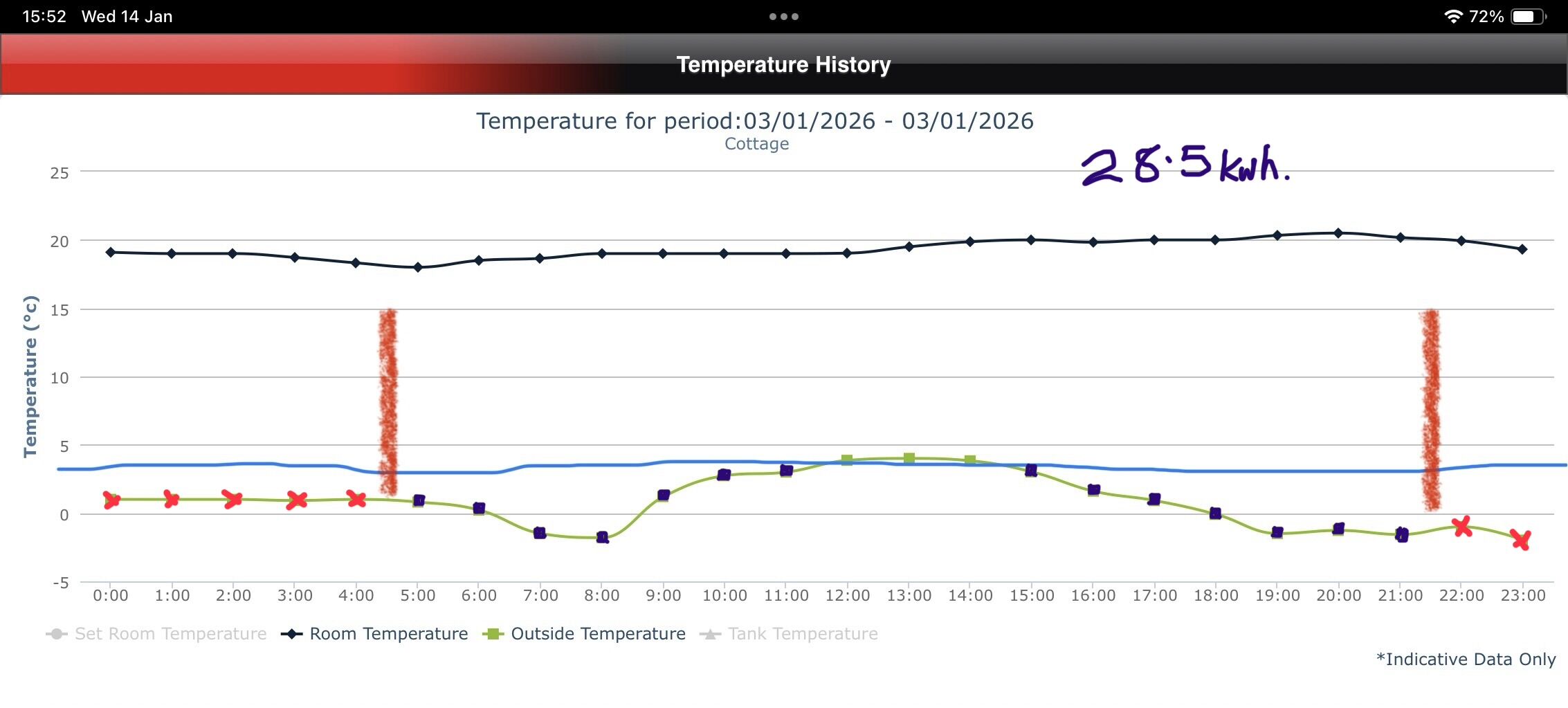
I don’t seem to be having the issues your new R290 system appears to be having. I see reports of startlingly similar outdoor temperatures and the corresponding consumption figures are likewise reassuringly similar. See below two different days. 3rd January 2026 and 10th January 2026
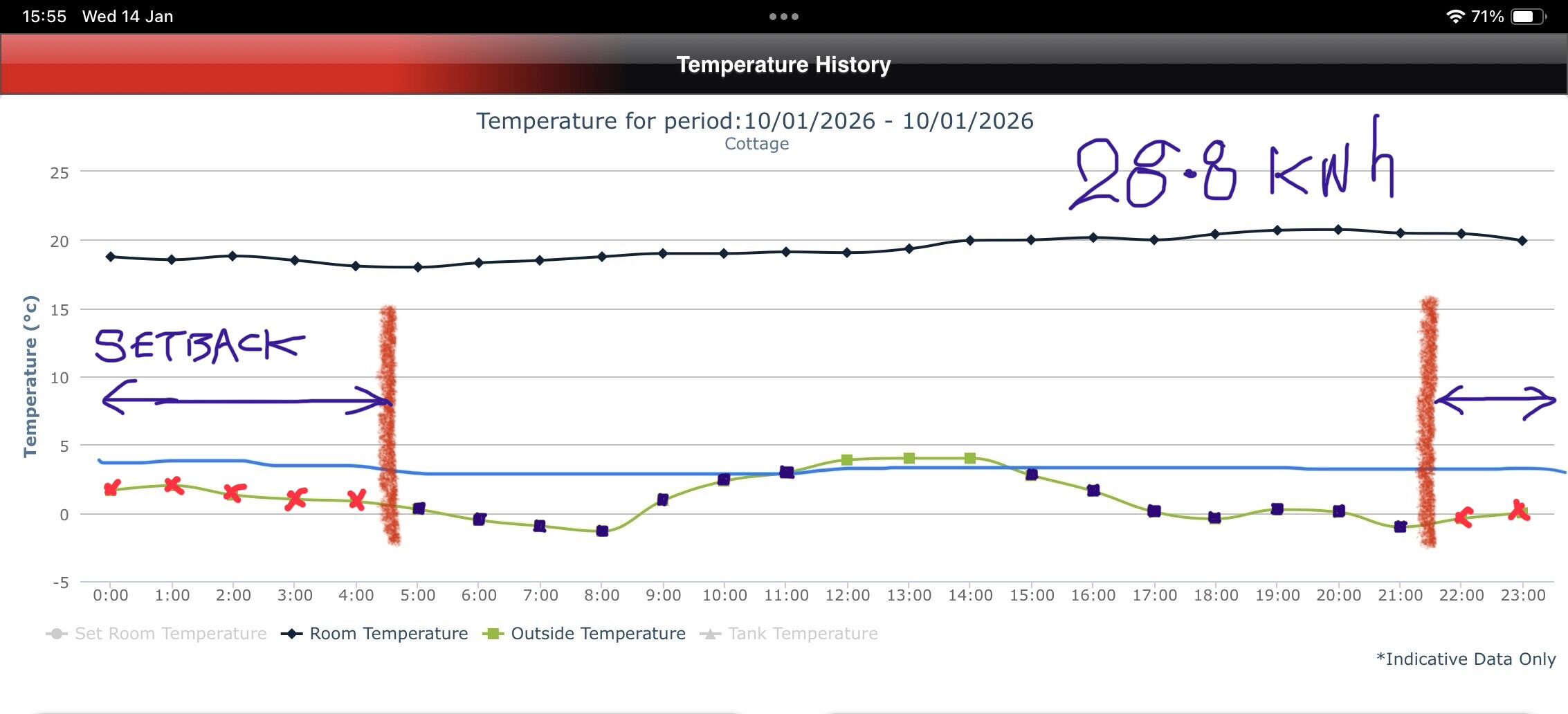
And 10th Jan chart
The problem I see with your annoyance with the MELCloud data reporting system is that you are possibly persuading others to invest in other third party systems which simply add to the cost of the installation yet the system it perfectly programmable without the extra paraphernalia and user monitoring time.
this website should be about helping ordinary people get to grips with their systems without creating doubts and dissatisfaction. People who don’t want to sit in front of a monitor analysing graphs just to get the heating on.
So as you can see there is nothing to hide it’s just the raw data.
OK, that is much clearer: the pie chart is the source of your energy consumed data. But it is not the raw data, the chart is clearly labelled Estimated Energy Usage, ie it is an estimate of the raw data, meaning we need some idea of how the estimate was done, all the more so as @robs has found significant differences between MELCloud estimates and metered values. You have described how you add a manual correction to account for circulating pump and monitoring equipment use, but that still leaves a question over how the rest of the estimate is determined.
I see reports of startlingly similar outdoor temperatures and the corresponding consumption figures are likewise reassuringly similar. See below two different days. 3rd January 2026 and 10th January 2026
The OAT shape may be similar, but the amplitudes are different. The 3rd Jan had more hours, and at lower temps, below zero than the 10th Jan, yet less kWh were used, which is odd. You might be able to do some sort of degree hour type calculation to get a better measure of how similar/dissimilar the OAT 'loads' are.
this website should be about helping ordinary people get to grips with their systems without creating doubts and dissatisfaction
We absolutely don't want to create spurious doubts and confusions, but at the same time we also want to avoid creating a sort of MELCLoud narcosis where everything is sweet when it is not.
Midea 14kW (for now...) ASHP heating both building and DHW
Rob I hope Mitsubishi don’t see your comment here they may well have something to say to you.
Why? Nothing that I've said Mitsubishi don't already know, their sensors are good enough to control a heat pump but are not good enough to measure efficiency (this is common to many/most manufacturers). And they don't install a sensor for electricity usage and just estimate it.
I’m not sure what is making you so defensive and hostile about anyone who questions your energy review that you posted. You did after all ask if anyone could let you know if they could see anything that didn’t add up.
The above has nothing to do with my analysis but has to do with your use of inaccurate data when trying to determine if setbacks save energy/money.
I don’t seem to be having the issues your new R290 system appears to be having. I see reports of startlingly similar outdoor temperatures and the corresponding consumption figures are likewise reassuringly similar. See below two different days. 3rd January 2026 and 10th January 2026
And 10th Jan chart
Great, so you have proven that MELCloud is consistently inaccurate! That doesn't prove in anyway that the estimated values from MELCloud are accurate, you need a third party source of information for that.
The problem I see with your annoyance with the MELCloud data reporting system is that you are possibly persuading others to invest in other third party systems which simply add to the cost of the installation yet the system it perfectly programmable without the extra paraphernalia and user monitoring time.
I haven't advocated buying anything, I have just pointed out the relative (in)accuracies of the sensors/systems and left people to make their own judgement.
this website should be about helping ordinary people get to grips with their systems without creating doubts and dissatisfaction. People who don’t want to sit in front of a monitor analysing graphs just to get the heating on.
It is difficult to help "ordinary people" with inaccurate information, such "help" is sometimes called misinformation.
I’m not sure what is making you so defensive and hostile about anyone who questions your energy review that you posted. You did after all ask if anyone could let you know if they could see anything that didn’t add up.
The above has nothing to do with my analysis but has to do with your use of inaccurate data when trying to determine if setbacks save energy/money.
RobS it has everything to do with your so called analysis. You have even called it an in depth analysis. Which is nonsense. What you have done is chosen a weak comparison of typical heat pumps, chosen a low temperature defrost which may even be a default defrost because frost levels haven’t been reached. This makes the “analysis”, as you call it completely non scientific. it is only a review and tedious dissection of energy data generated for you from your app.
you have omitted data from the start of the defrost dispite being given pointers by me that the true energy count starts much earlier than your review start. This would appear to suggest you have absolutely no idea of the complexities of a defrost prep. You are boastful about not needing to know these but your review only reveals ignorance on your part.
The problem I see with your annoyance with the MELCloud data reporting system is that you are possibly persuading others to invest in other third party systems which simply add to the cost of the installation yet the system it perfectly programmable without the extra paraphernalia and user monitoring time.
I haven't advocated buying anything, I have just pointed out the relative (in)accuracies of the sensors/systems and left people to make their own judgement.
You say you haven’t advocated buying anything yet you have posted the product name and posted a retailer where the products can be purchased with a link to the site in your post. This was not requested.
That is an unequivocal promotion to buying the product.
this website should be about helping ordinary people get to grips with their systems without creating doubts and dissatisfaction. People who don’t want to sit in front of a monitor analysing graphs just to get the heating on.
It is difficult to help "ordinary people" with inaccurate information, such "help" is sometimes called misinformation.
The issue of MISINFORMATION rests entirely with your failure to reassess your energy review and accepting that it isn’t truly representative of typical models of heat pumps in typical operating outputs and in typical defrost temperatures in truly cold conditions.
The premise for your claim is that heat pumps generally don’t use anything more than 100watt/hours to conduct a defrost. As you have missed off energy used in the preparation phase of a defrost you haven’t calculated the full energy requirement. Your assertion and subsequent hostile attitude to being asked for clarification means you are misrepresenting the true energy requirement for the broad range of installed heat pumps.
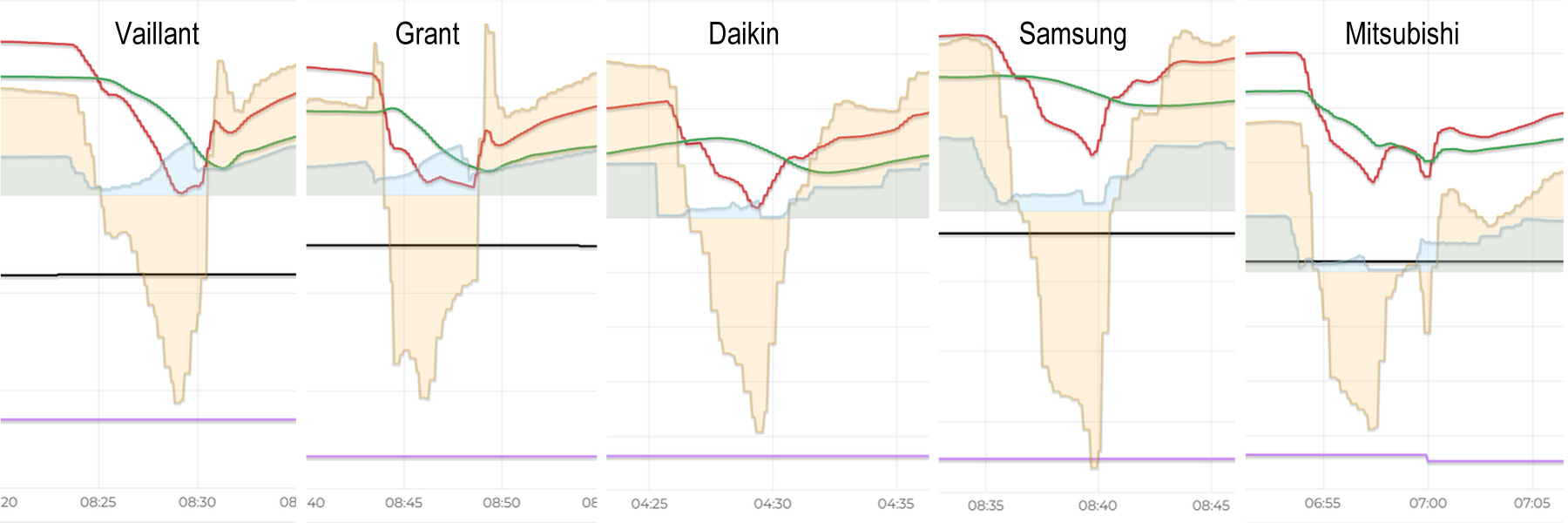
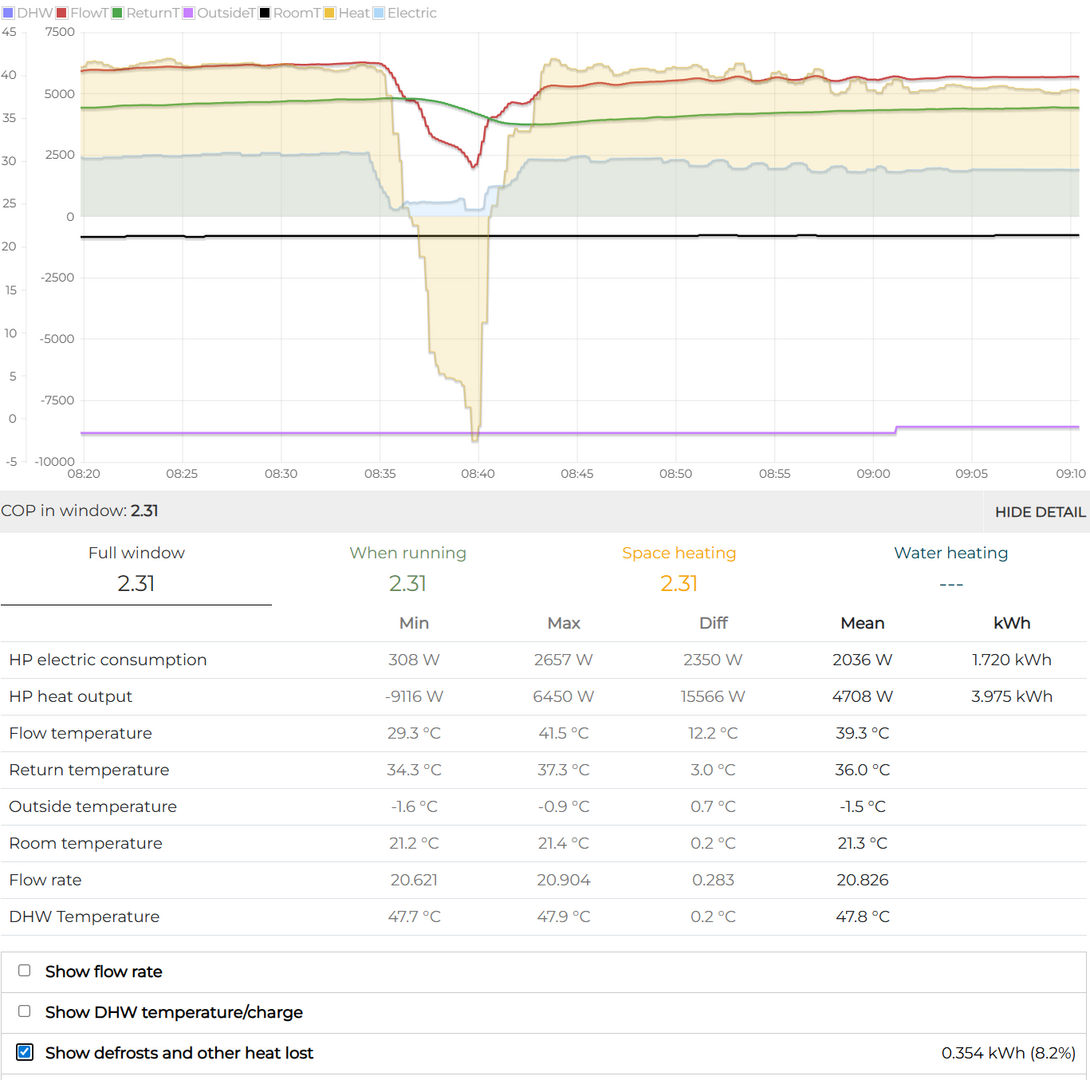
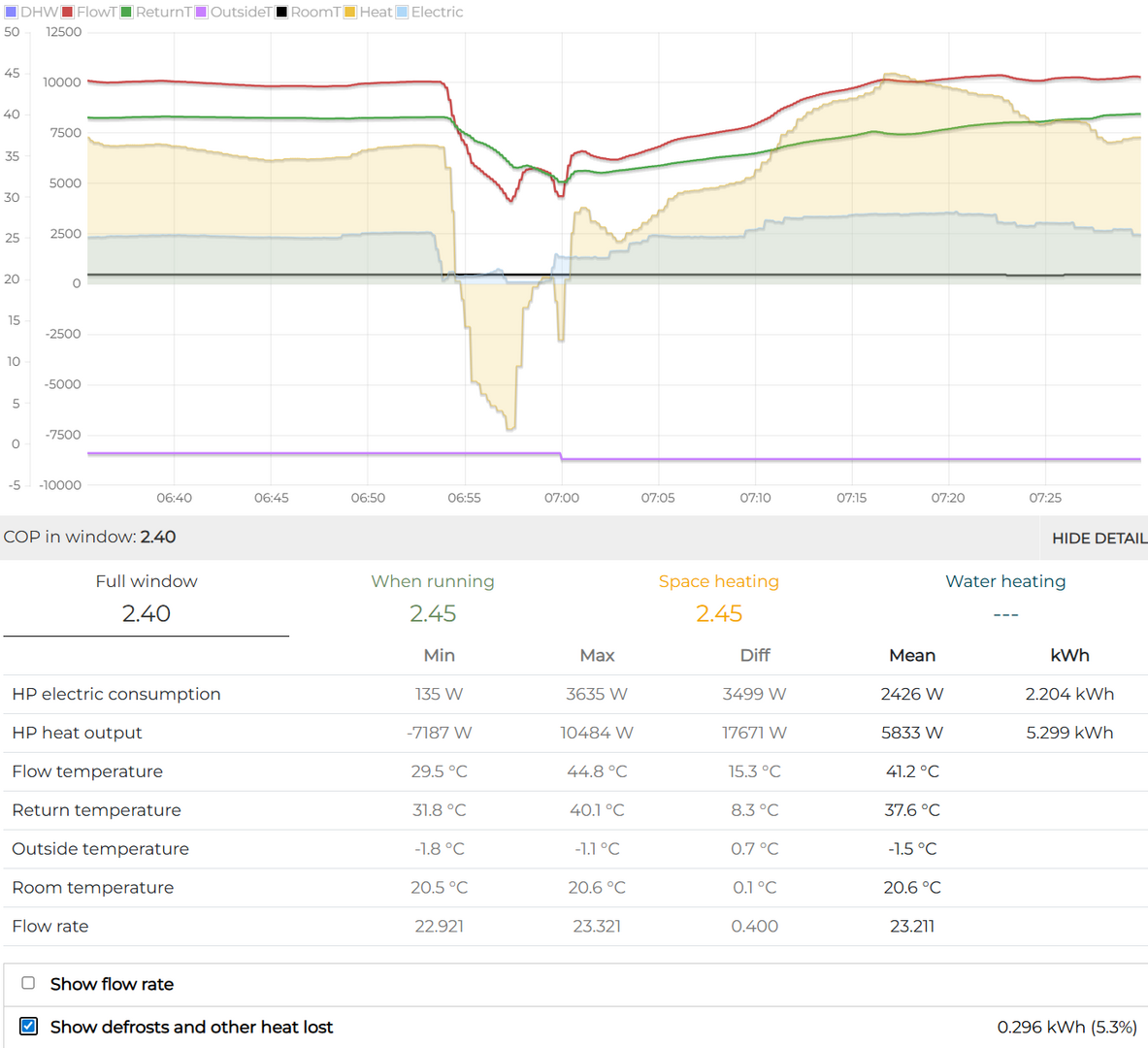
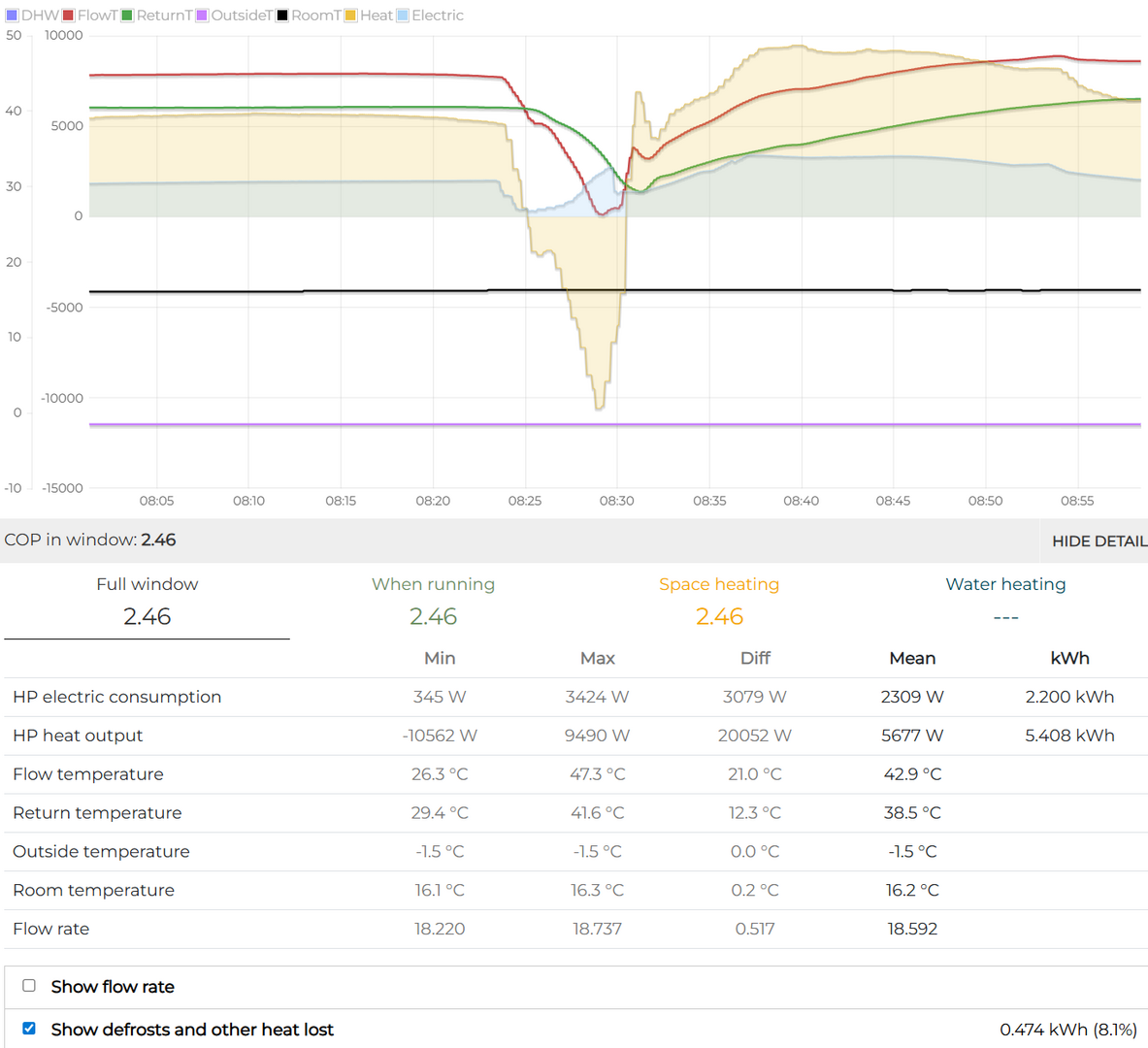
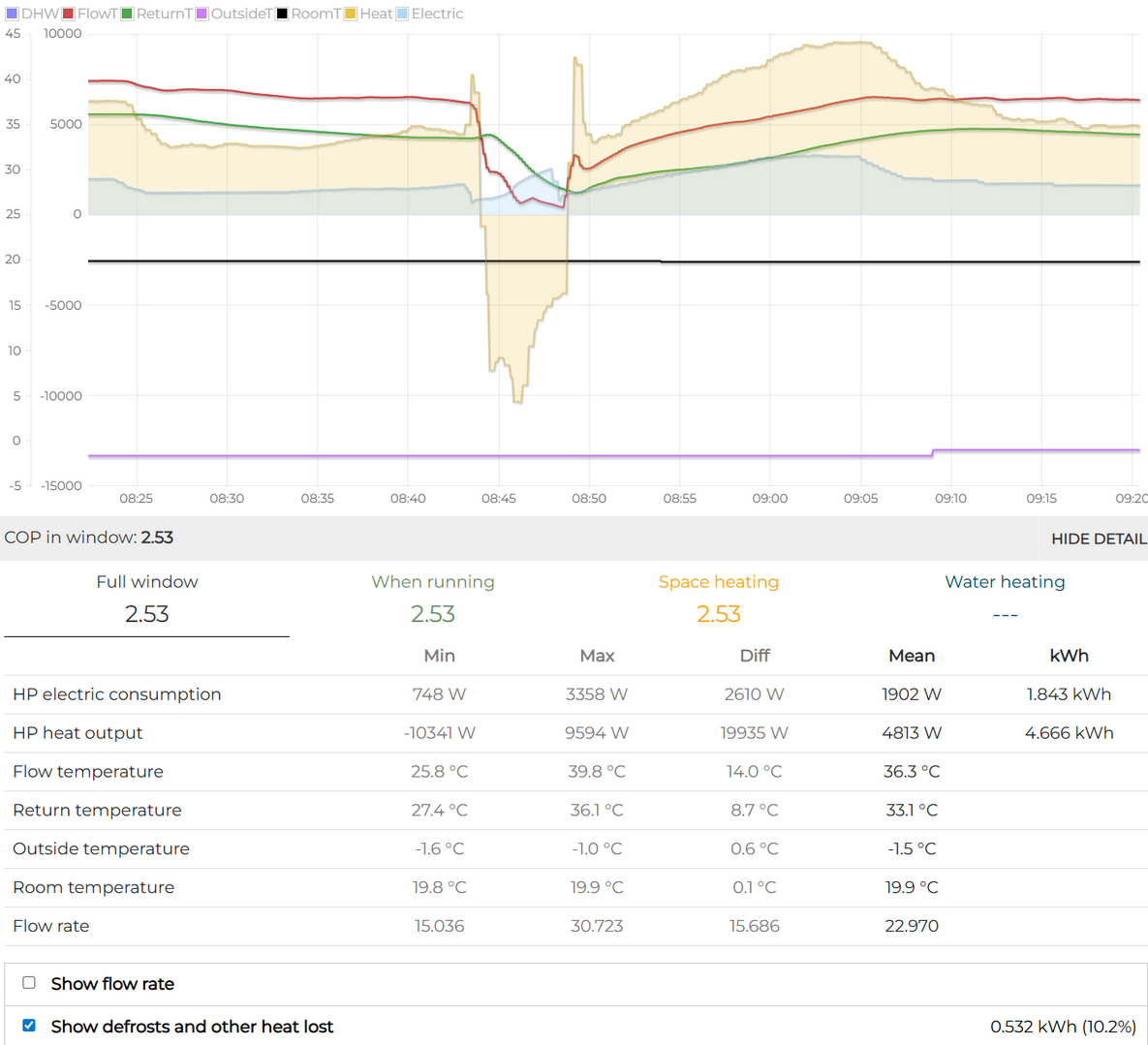
The heat pump brands shown below at an averaged defrost temperature of say + 1c would be a much better operating condition to truly evaluate the defrost burden. This range of HP brands show quite varied energy use, graphically, during the defrost period. There is also longer time spans for some brands. So it would be very useful to know how much each HP brand does consume during the defrost period.
In fuller detail shown below.
furthermore the correct energy appraisal which RobS has not done would then account for the preparation period before the defrost which is needed to prevent liquid refrigerant from getting into the compressor when the reversing valve changes the flow direction.
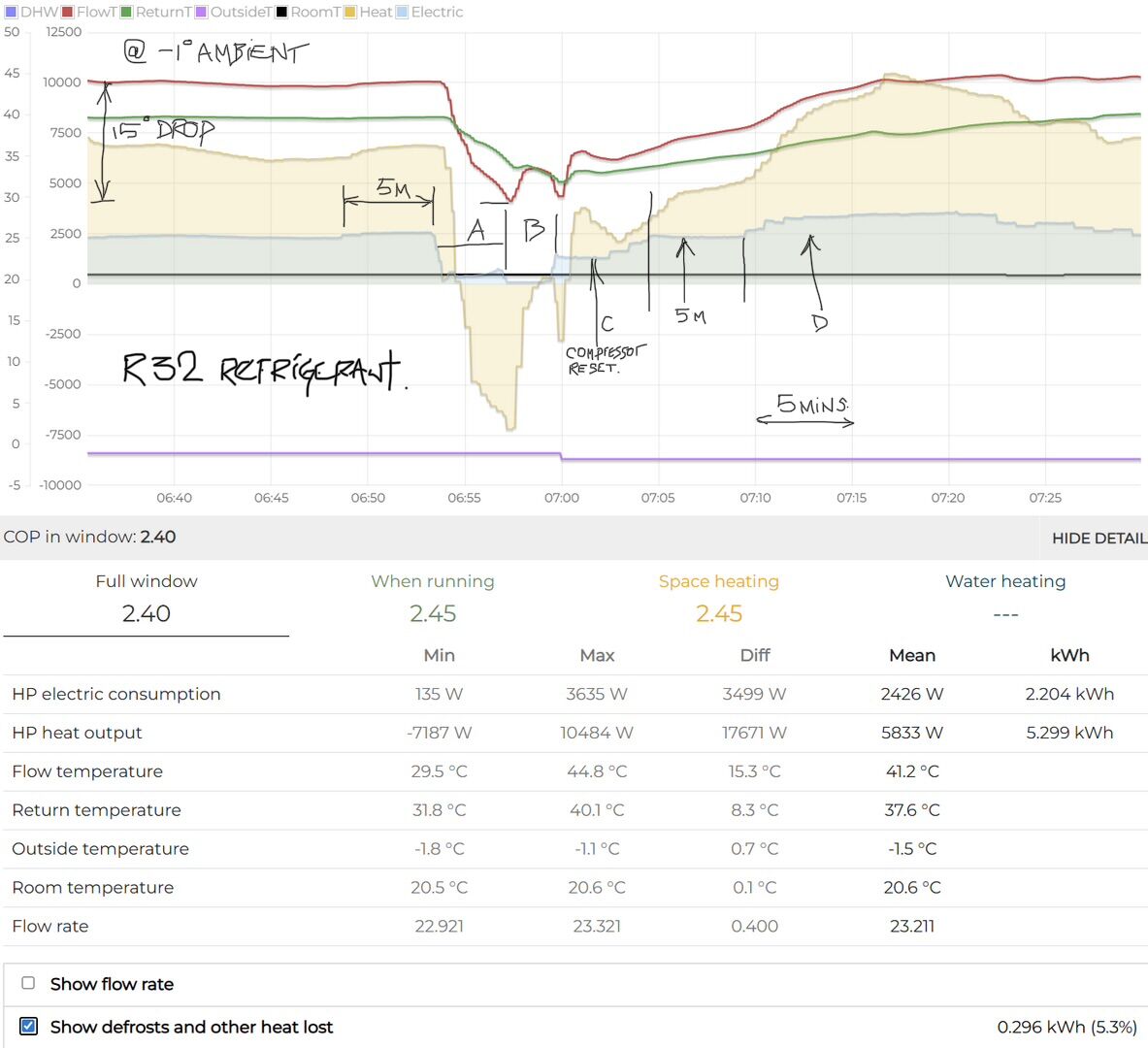
There is also no accounting for the fully compressed refrigerant liquid reservoir which continually takes energy which is particularly used as a conduit to execute the defrost while the compressor operates at a lower output to primarily circulate the hot gas. The graph below shows that when the preparation and reset times are added the full defrost operation period is more like 15 to 20 minutes and not the 11 minutes quoted by RobS.
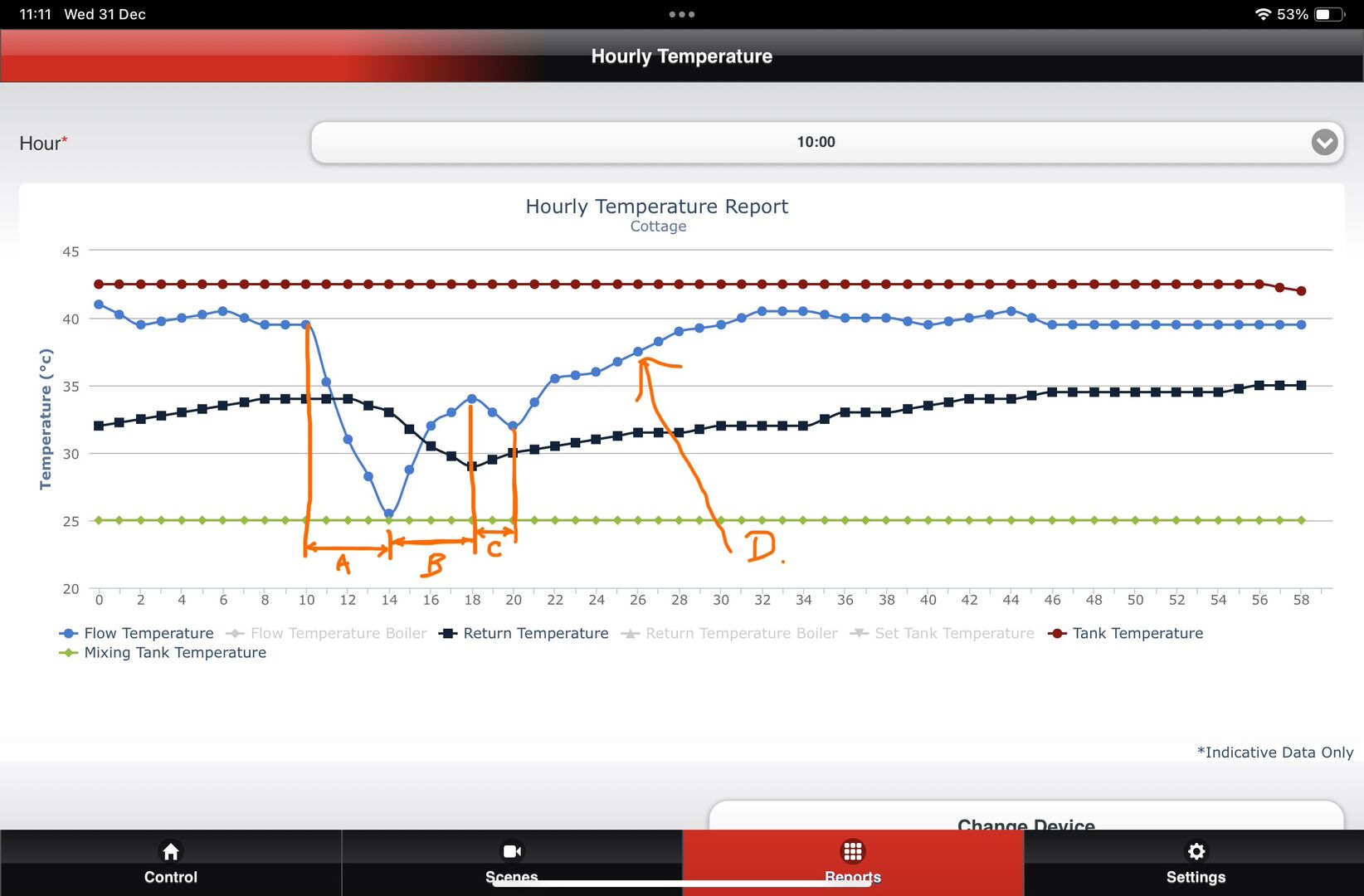
The above chart is of the Mitsubishi hp 8.5 R32 model which has a similar defrost signature to my own HP. I have marked up the step changes A, B, C and D which align with what our graphs show. But there are other periods which mark reset, monitoring and preparation periods. (ignore the walrus tusk heat loss which looks like it may be a timing error on the reversing valve)
There also appears to be a second preparation period after the defrost when we know that the flow reverses again. The energy specifically being used for liquid refrigerant separation as opposed to normal compressor heating would be difficult to quantify as solely for defrost purposes without scientific knowledge of the procedure. In any case that has not been accounted for or even recognised by RobS assessment.
The above graph is our own HP and shows some similarities to the defrost time phases to the above chart.
This post was modified 7 months ago 3 times by SUNandAIR
Great, so you have proven that MELCloud is consistently inaccurate! That doesn't prove in anyway that the estimated values from MELCloud are accurate, you need a third party source of information for that.
You misunderstand… this chart says I missed 7 defrosts during my setback saving oodles of cash compared to operating it 24/7.
Panic? Seriously? Wanting people to have accurate information isn't panicking.
I described you as panicking because you don’t appear to be able to debate in calm reasoned discussion. I have posed exploratory questions inviting discussion and you’ve jumped straight into defensive/attacking mode.
The issue of MISINFORMATION rests entirely with your failure to reassess your energy review and accepting that it isn’t truly representative of typical models of heat pumps in typical operating outputs and in typical defrost temperatures in truly cold conditions.
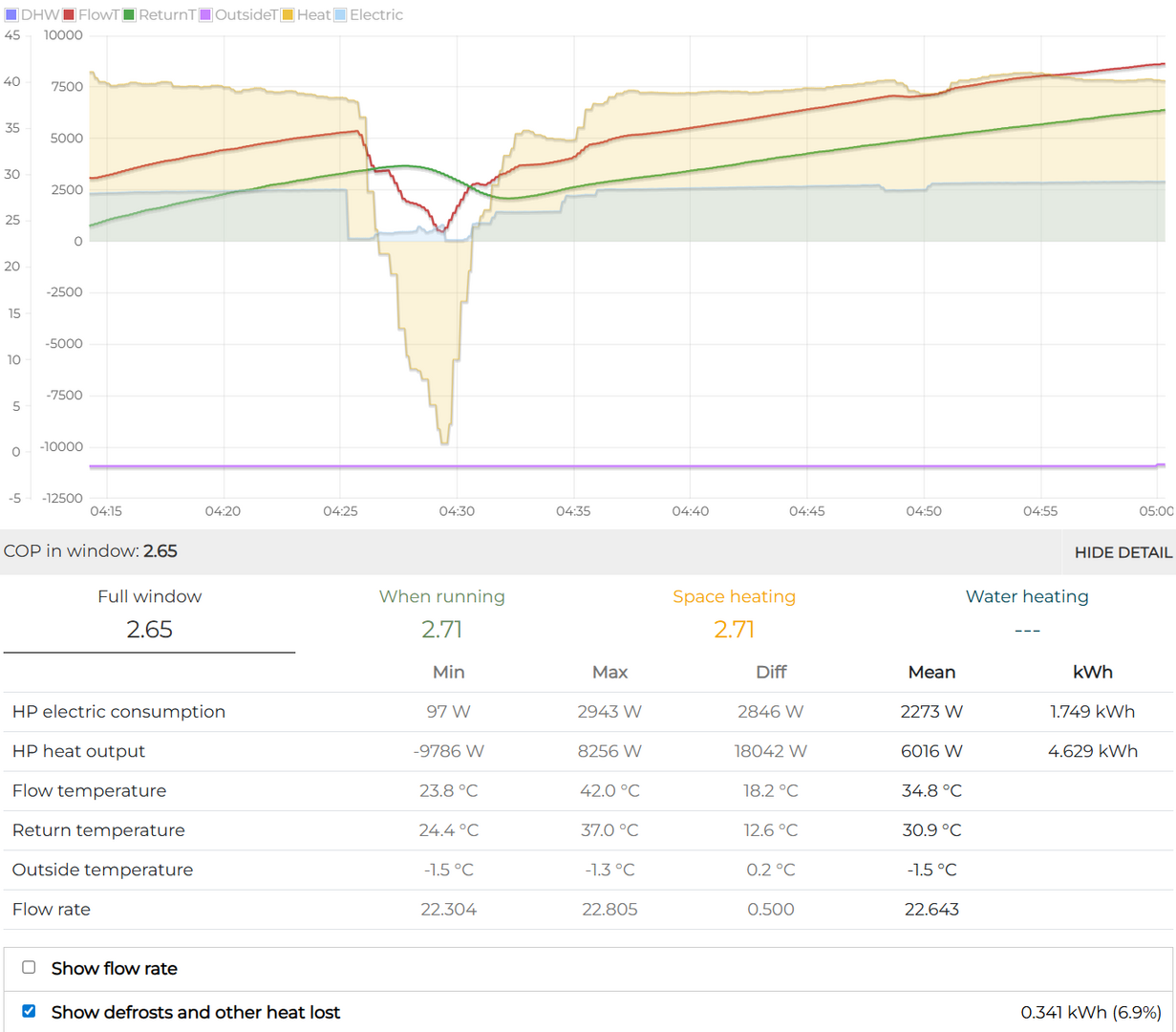
"...some of that heat (warm water) will be used by the defrost process (this can be seen in the analysis images as the yellow region below the zero line), is this is the electricity prior to the defrost that you refer to? If so then that adds an additional 0.06 kWh to the electricity deficit (0.254kWh was removed from the heated water and this was generated pre-defrost at a COP of 4.2), so the additional electrical input as a result of the defrost then becomes 0.081kWh - which is still very small."
My first post to this thread was an in depth example of a defrost, I didn't say my heat pump or heating system were representative of the average. And as I have said before, the defrost was picked because of the period of steady running prior to it and that the period of steady running could be used to calculate a baseline for the analysis of the defrost.
The premise for your claim is that heat pumps generally don’t use anything more than 100watt/hours to conduct a defrost. As you have missed off energy used in the preparation phase of a defrost you haven’t calculated the full energy requirement. Your assertion and subsequent hostile attitude to being asked for clarification means you are misrepresenting the true energy requirement for the broad range of installed heat pumps.
@cathoderay and I have found using our monitoring that defrosts don't use an excessive amount of extra electrical energy. Both of our monitoring systems have electrical energy meters/sensors and so both record the heat pump electrical energy use to a high degree of accuracy.