Joining the Renewable Heating Hub forums is completely free and only takes a minute. By registering you’ll be able to ask questions, join discussions, follow topics you’re interested in, bookmark useful threads and receive notifications when someone replies. Non-registered members also do not have access to our AI features. When choosing your username, please note that it cannot be changed later, so we recommend avoiding brand or product names. Before registering, please take a moment to read the Forum Rules & Terms of Use so we can keep the community helpful, respectful and informative for everyone. Thanks for joining!
You say you haven’t advocated buying anything yet you have posted the product name and posted a retailer where the products can be purchased with a link to the site in your post. This was not requested.
That is an unequivocal promotion to buying the product.
Of course I have mentioned the OEM heat pump monitoring system that I have, doing so gives context to what I write. I have posted links to OEM's website as it contains the data being discussed. But have I posted a link to the shop and said people should buy the heat pump monitoring kit? No.
Both of our monitoring systems have electrical energy meters/sensors and so both record the heat pump electrical energy use to a high degree of accuracy.
Yes and no for me. I do have meters and sensors, but most of them are Midea hardware. What I do is collect more of that data (ie more variables) at minute intervals than say the Midea apps do. I also have independent meters for energy in and flow rate (and a very rough and ready IR thermometer of LWT and RWT) that I use to check the Midea data but those are either spot readings (for flow rate and temperatures) or aggregates over long times frames (energy in) as they all require manual reading.
I think I have said before, I think if the energy in and out data is ranked for quality, then @sunandair's is the least robust, mine is in the middle, and @robs 's is the most robust.
Midea 14kW (for now...) ASHP heating both building and DHW
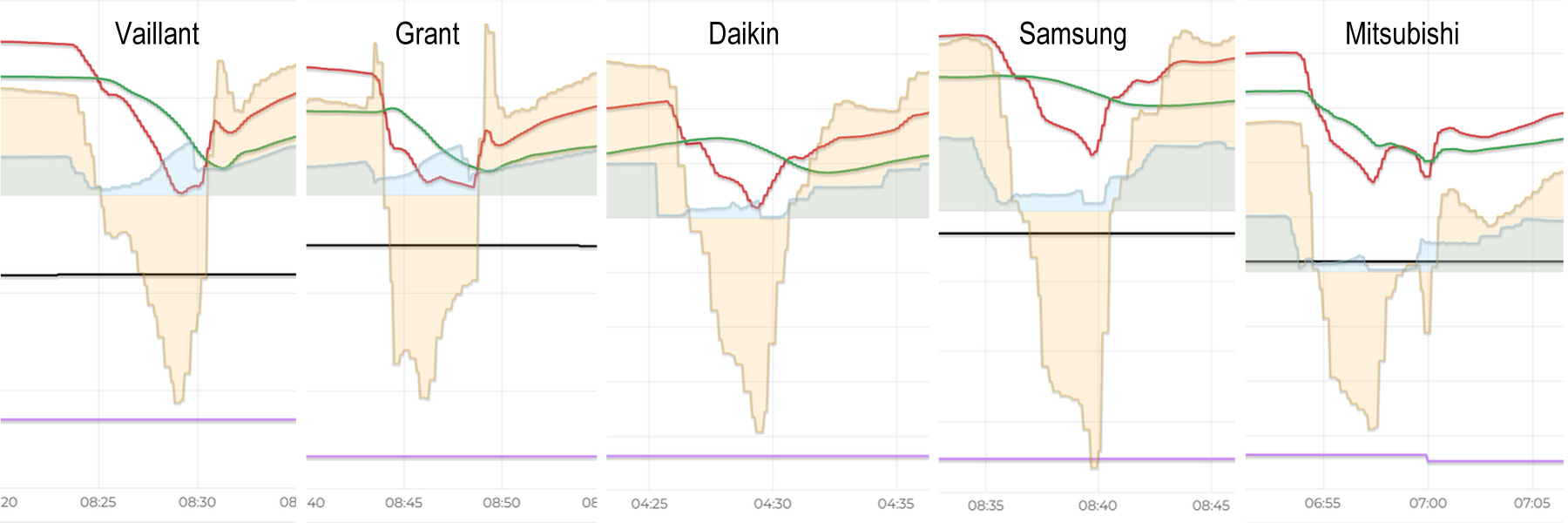
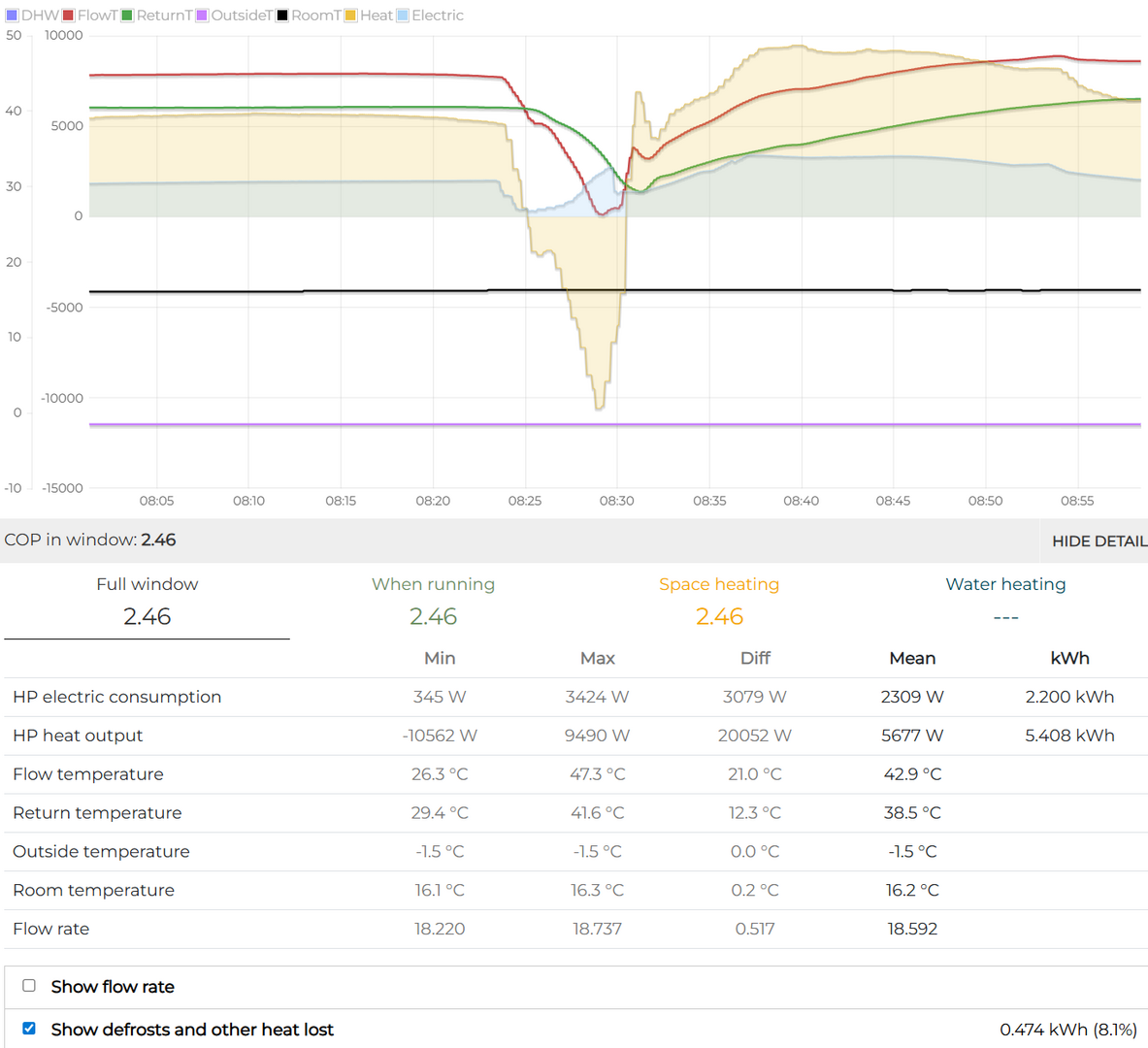
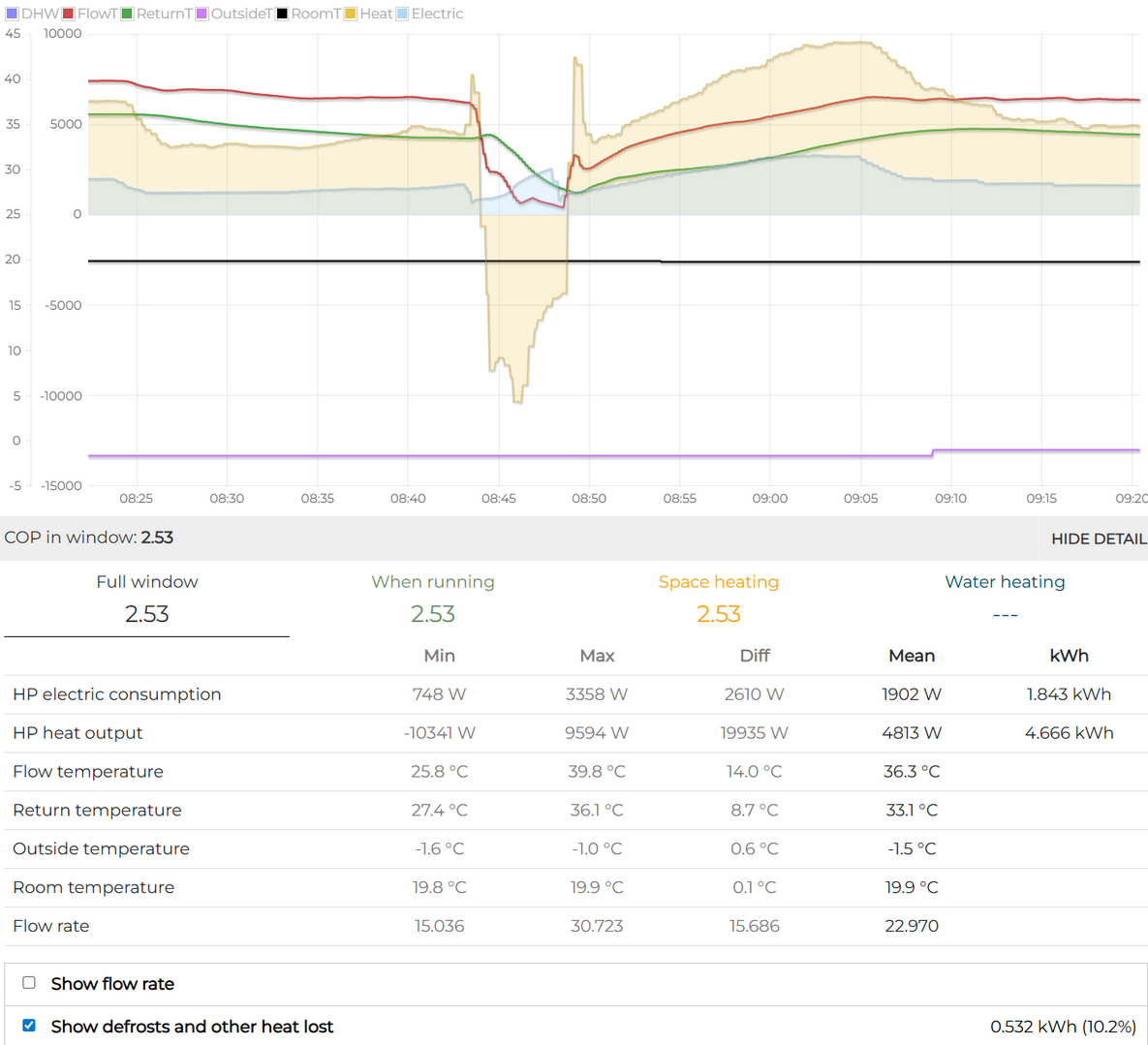
The heat pump brands shown below at an averaged defrost temperature of say + 1c would be a much better operating condition to truly evaluate the defrost burden. This range of HP brands show quite varied energy use, graphically, during the defrost period. There is also longer time spans for some brands. So it would be very useful to know how much each HP brand does consume during the defrost period.
In fuller detail shown below.
Thanks for posting my images again, the OAT in each of these examples was -1.5C. They were posted to show the differences and similarities in approach used by different manufacturers.
furthermore the correct energy appraisal which RobS has not done would then account for the preparation period before the defrost which is needed to prevent liquid refrigerant from getting into the compressor when the reversing valve changes the flow direction.
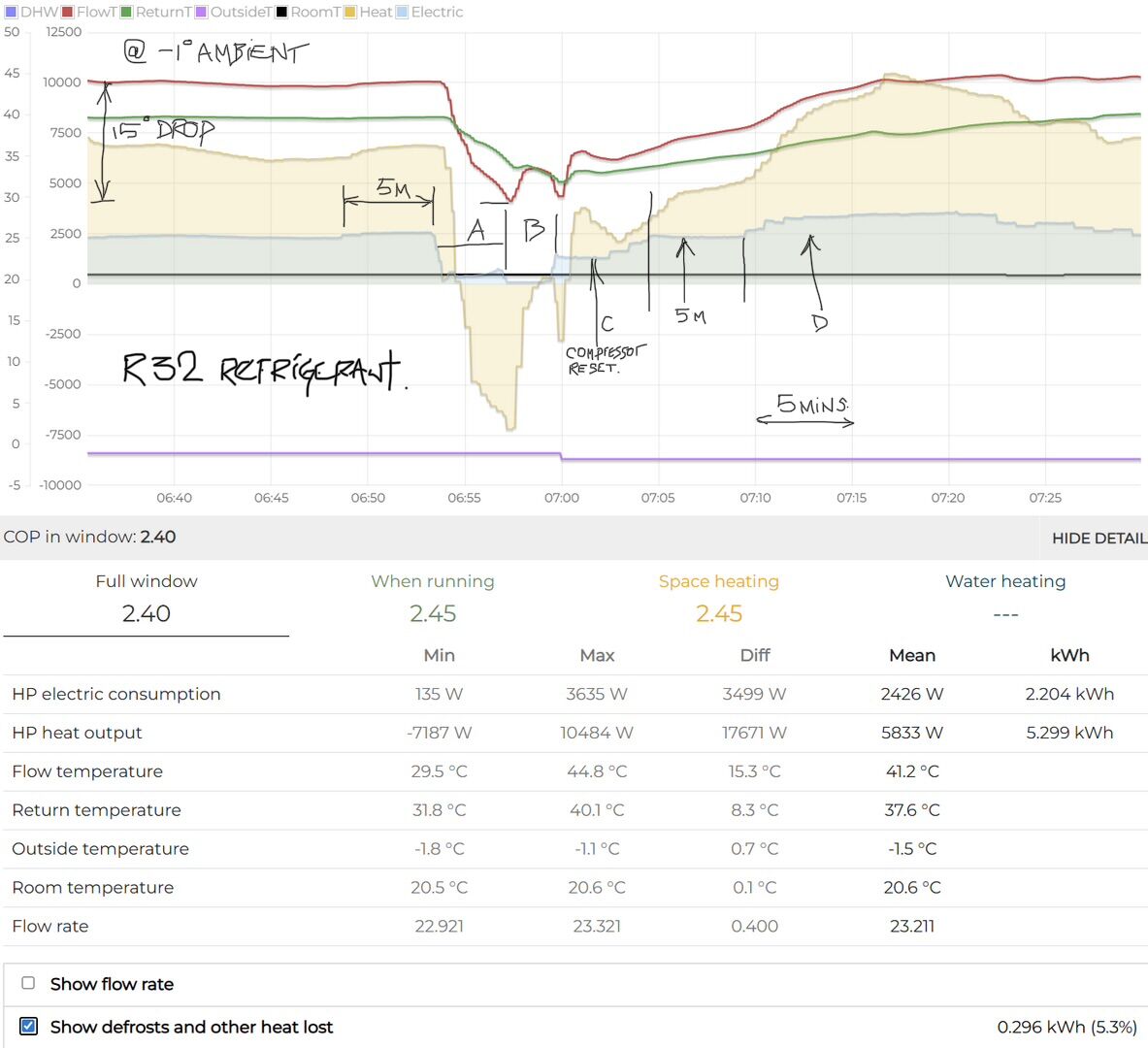
There is also no accounting for the fully compressed refrigerant liquid reservoir which continually takes energy which is particularly used as a conduit to execute the defrost while the compressor operates at a lower output to primarily circulate the hot gas. The graph below shows that when the preparation and reset times are added the full defrost operation period is more like 15 to 20 minutes and not the 11 minutes quoted by RobS.
"...adds an additional 0.06 kWh to the electricity deficit (0.254kWh was removed from the heated water and this was generated pre-defrost at a COP of 4.2), so the additional electrical input as a result of the defrost then becomes 0.081kWh - which is still very small."
The above chart is of the Mitsubishi hp 8.5 R32 model which has a similar defrost signature to my own HP. I have marked up the step changes A, B, C and D which align with what our graphs show. But there are other periods which mark reset, monitoring and preparation periods.
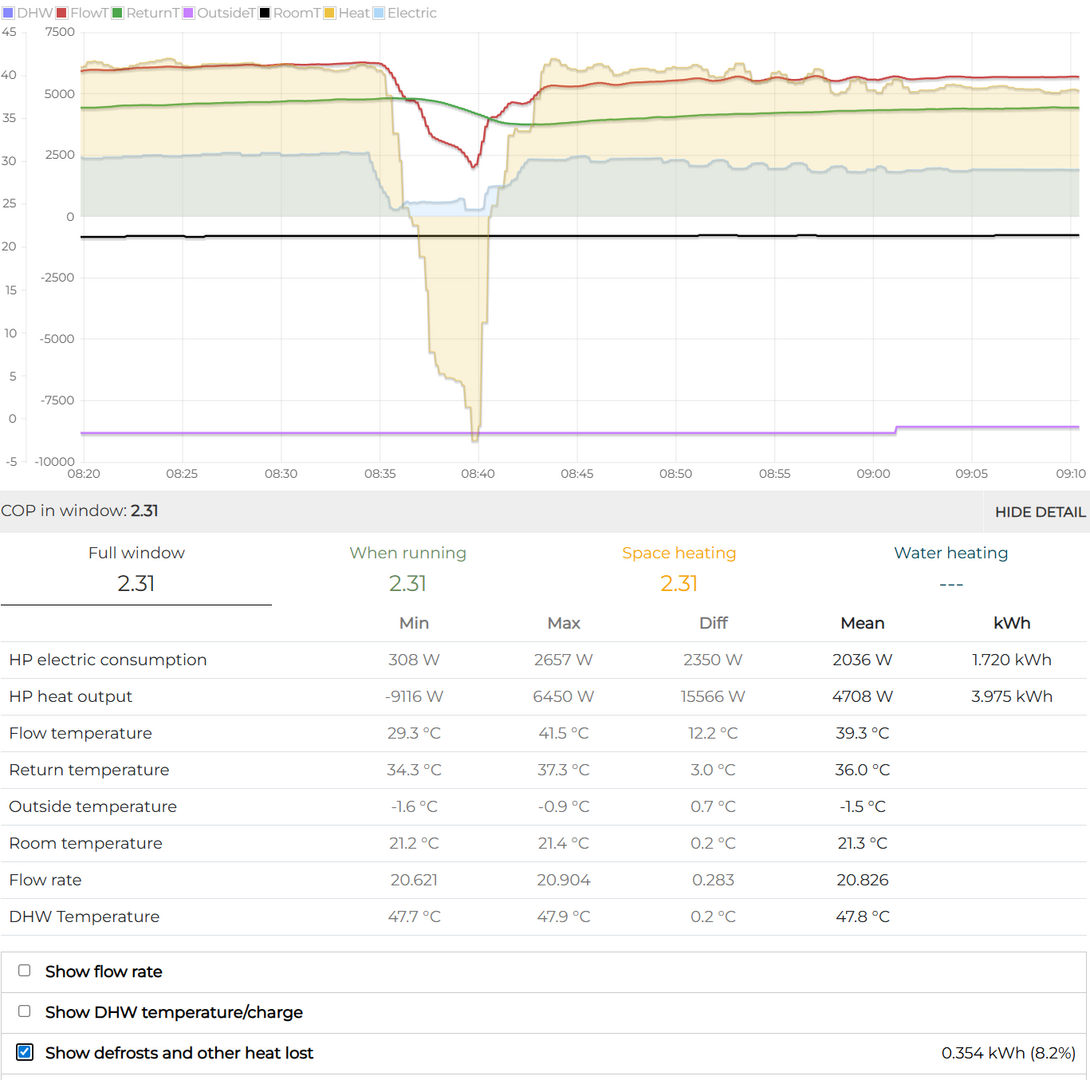
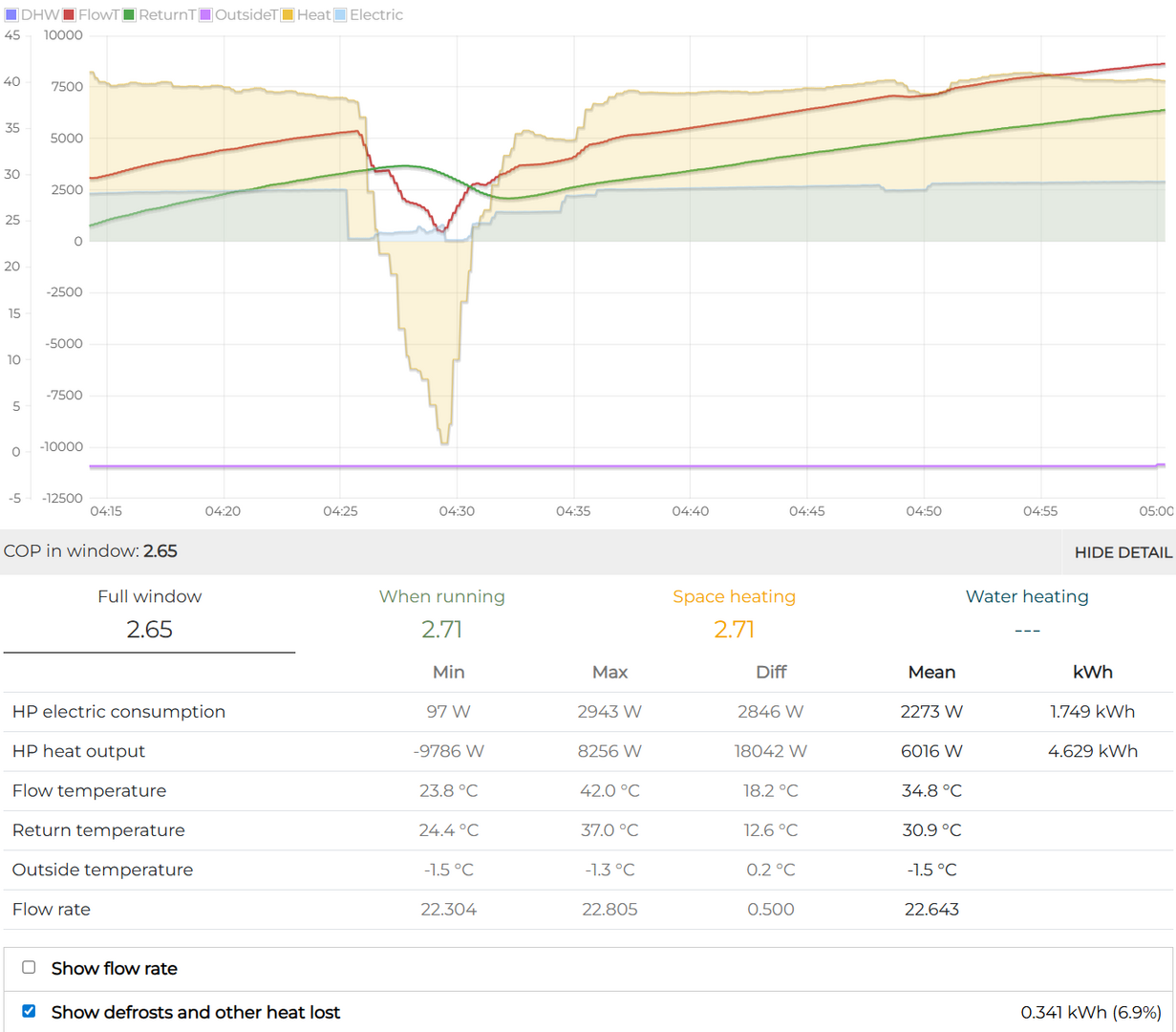
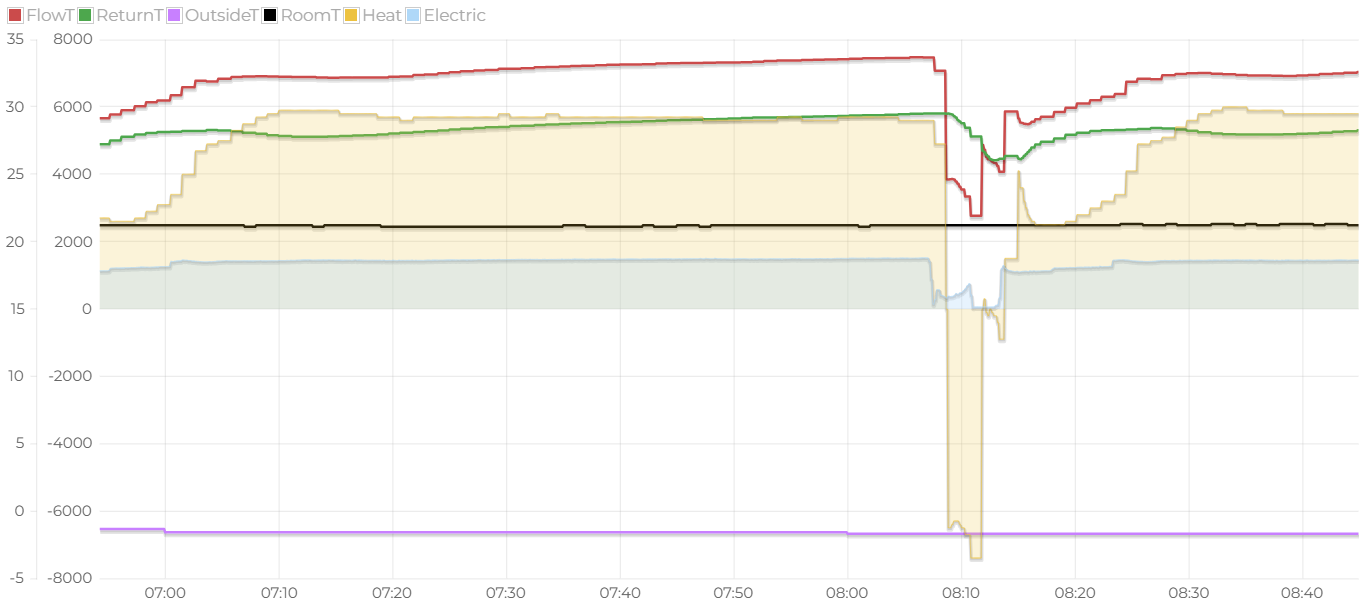
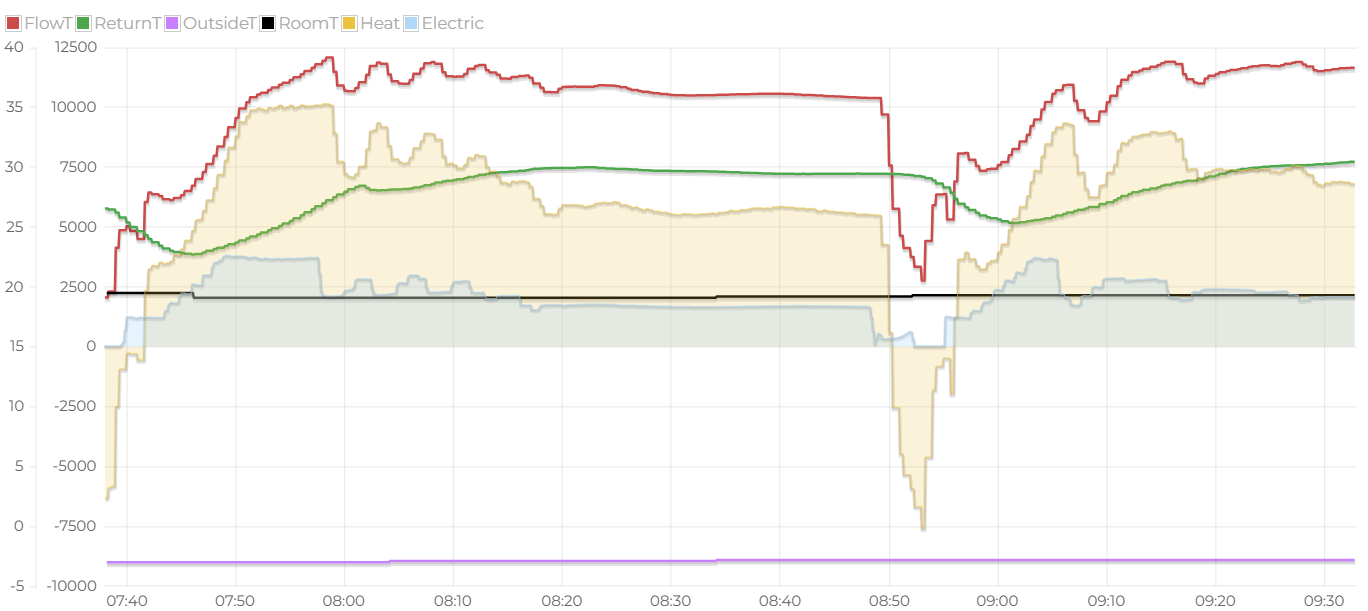
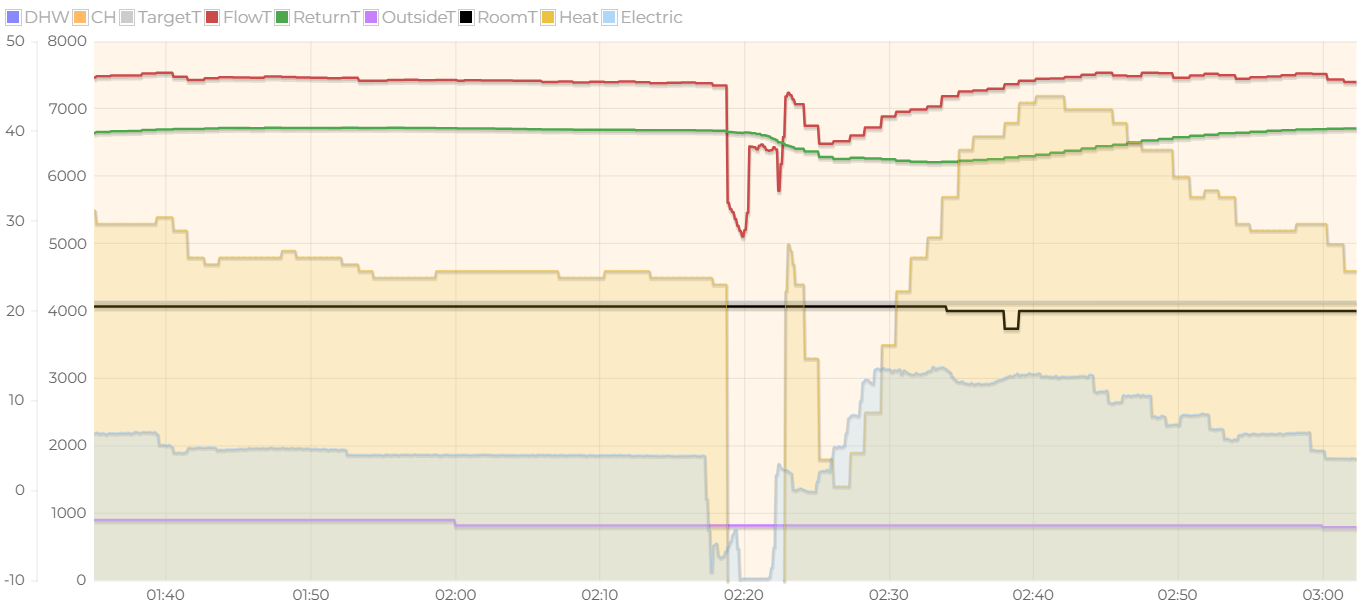
Here are three Mitsi 8.5kW R32s doing a defrost, but your 5 minute "preparation period before the defrost" seems to be missing, so maybe not a component of all defrosts:
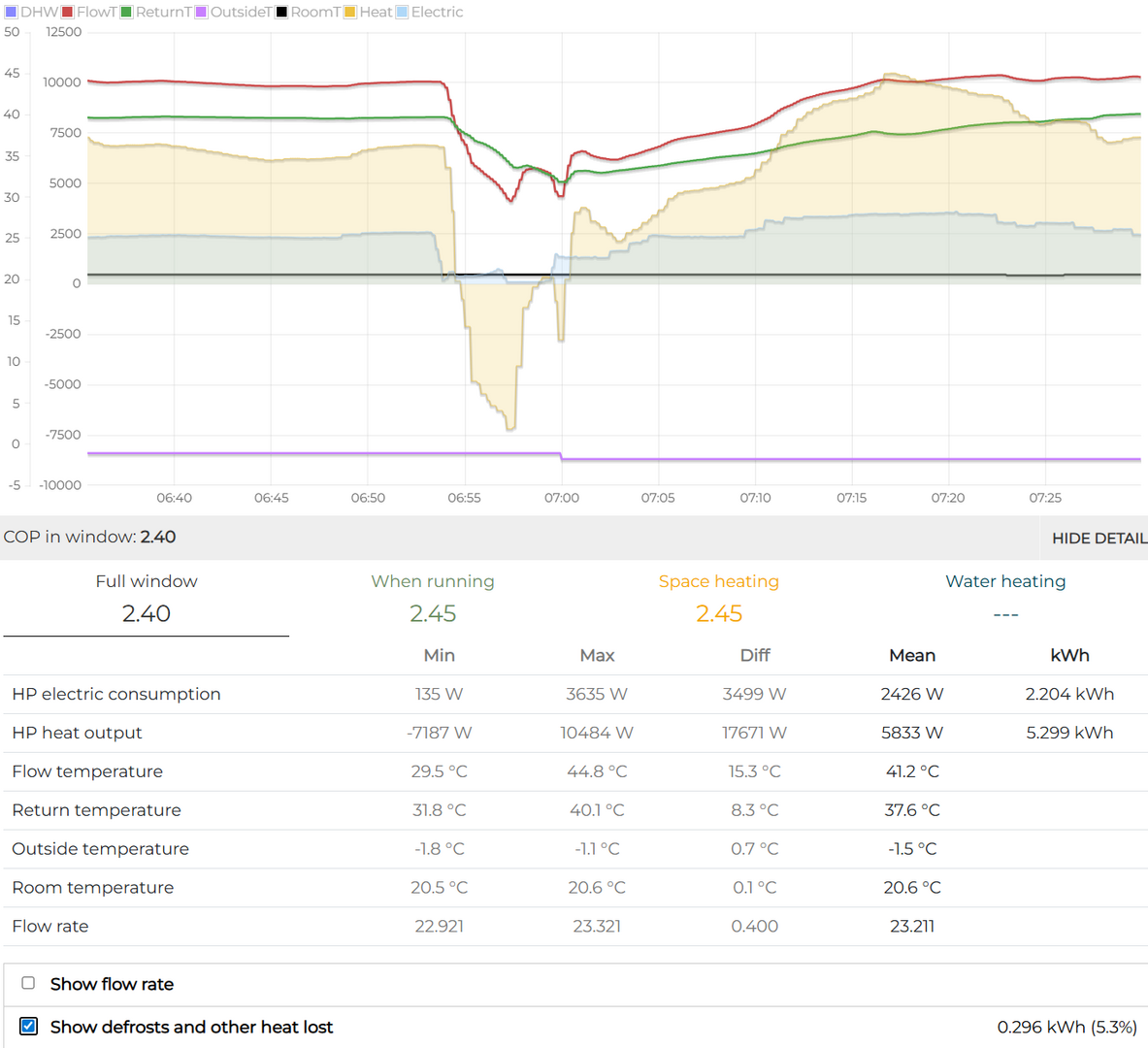
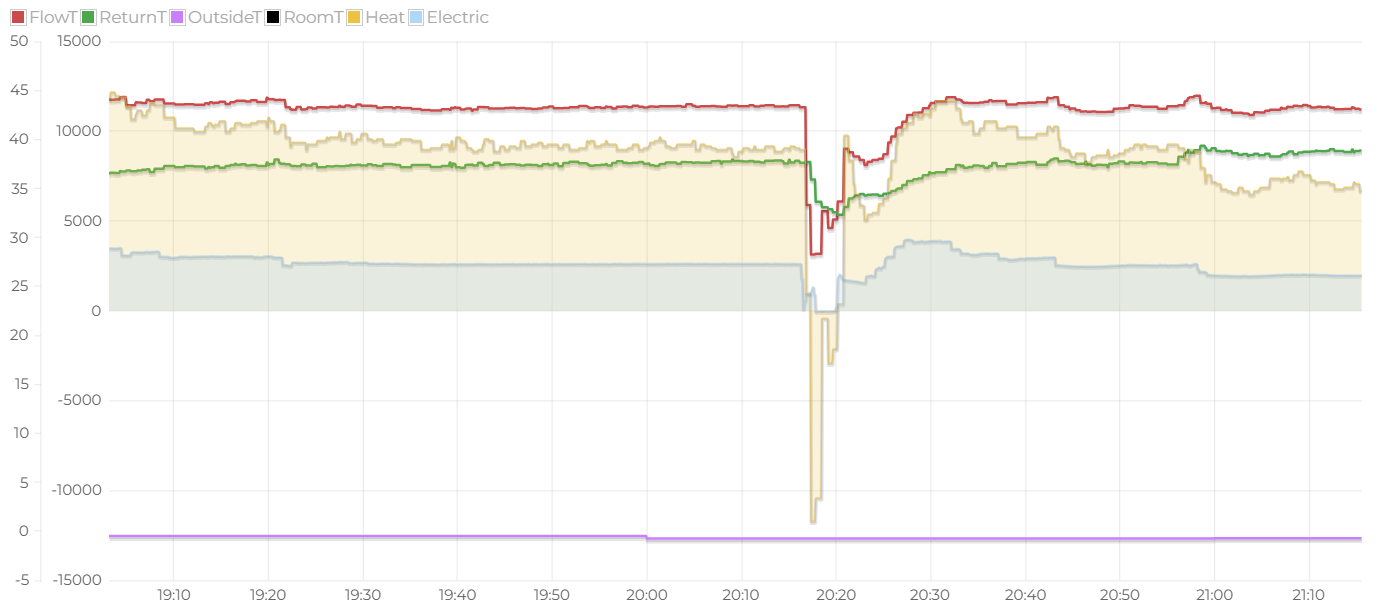
And here's a Mitsi 11.2kW R32 defrosting without a 5 minute "preparation period before the defrost":
Also, your example 5 minute "preparation period before the defrost" only consumed an extra 0.06kWh of energy. So again not a significant amount and not sufficient to be able to say that defrosts use a significate amount of additional electrical energy.
There also appears to be a second preparation period after the defrost when we know that the flow reverses again. The energy specifically being used for liquid refrigerant separation as opposed to normal compressor heating would be difficult to quantify as solely for defrost purposes without scientific knowledge of the procedure. In any case that has not been accounted for or even recognised by RobS assessment.
This electrify usage was included in the reheat part of my analysis.
RobS it has everything to do with your so called analysis. You have even called it an in depth analysis. Which is nonsense. What you have done is chosen a weak comparison of typical heat pumps, chosen a low temperature defrost which may even be a default defrost because frost levels haven’t been reached. This makes the “analysis”, as you call it completely non scientific. it is only a review and tedious dissection of energy data generated for you from your app.
I was replying to a post with no content relating to my analysis.
When I posted my analysis of one of our system's defrosts I didn't say it was representative of an average defrost. At 3C the evaporator of our heat pump will be frosting up, and the R290 Mitsubishis don't have defrosts on a timer and so don't instigate a defrost when it's not needed. Measuring energy flows allows us to measure what we pay for and so possibly answer the question @cathoderay posed in his/her first post.
you have omitted data from the start of the defrost dispite being given pointers by me that the true energy count starts much earlier than your review start. This would appear to suggest you have absolutely no idea of the complexities of a defrost prep. You are boastful about not needing to know these but your review only reveals ignorance on your part.
All of your contributions so far have added up to about 0.12kWh, which is about 3 pence per defrost.
No boasting just black box analysis , I don't need to know the detailed specifics of the fuel injectors in my car to measure fuel efficiency.
The heat pump brands shown below at an averaged defrost temperature of say + 1c would be a much better operating condition to truly evaluate the defrost burden. This range of HP brands show quite varied energy use, graphically, during the defrost period. There is also longer time spans for some brands. So it would be very useful to know how much each HP brand does consume during the defrost period.
In fuller detail shown below.
Thanks for posting my images again, the OAT in each of these examples was -1.5C. They were posted to show the differences and similarities in approach used by different manufacturers.
Your attention to detail is letting you down again. Read the first sentence of my post again. I’m saying the same models of heat pumps IF RECORDED AT an ambient of SAY 1degC would be a good average operating temperature to test defrosts and establish the average outputs of each brand.
your existing energy assessment that we have been discussing is invalid as it stands…. For the multiple reasons given.
The problem I see with your annoyance with the MELCloud data reporting system is that you are possibly persuading others to invest in other third party systems which simply add to the cost of the installation yet the system it perfectly programmable without the extra paraphernalia and user monitoring time.
I haven't advocated buying anything, I have just pointed out the relative (in)accuracies of the sensors/systems and left people to make their own judgement.
You say you haven’t advocated buying anything yet you have posted the product name and posted a retailer where the products can be purchased with a link to the site in your post. This was not requested.
That is an unequivocal promotion to buying the product.
so I have requoted the original post since your reply was ambiguous your reply to the above post now copied in full
Of course I have mentioned the OEM heat pump monitoring system that I have, doing so gives context to what I write. I have posted links to OEM's website as it contains the data being discussed. But have I posted a link to the shop and said people should buy the heat pump monitoring kit? No.
So as can be seen your statement “I haven’t advocated buying anything” is not true.
You posted a link to a person and named the retailer also, which anyone would know.
this kind of duicking and diving makes me feel I cannot trust anything you say.
This post was modified 7 months ago 4 times by SUNandAIR
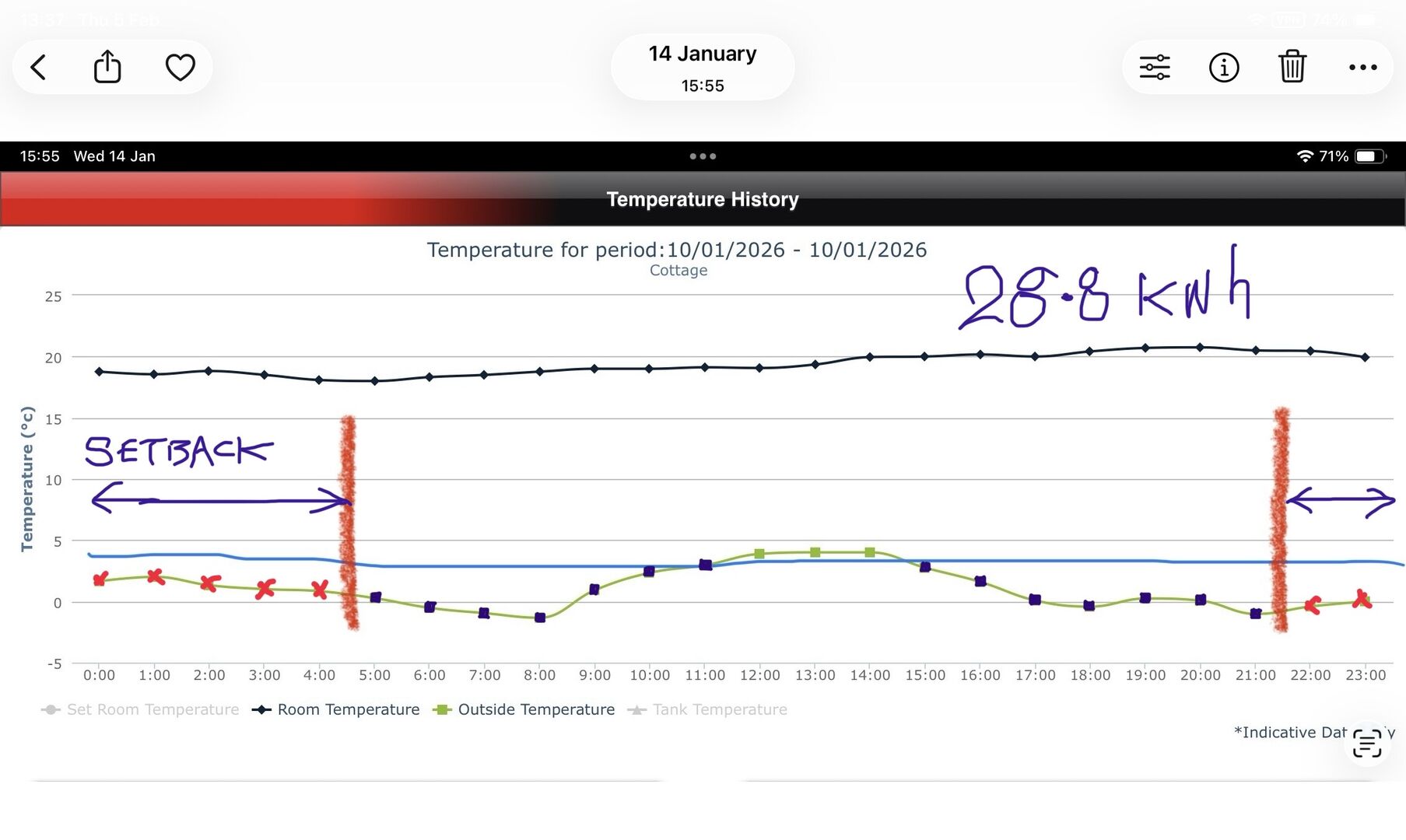
You misunderstand… this chart says I missed 7 defrosts during my setback saving oodles of cash compared to operating it 24/7.
Except there's little evidence that defrosts use a significant amount of extra electricity.
@robs … Again you make an ambiguous post distorting the facts. The energy saving is made not only because of defrosts although they do contribute, but mainly because the heat pump is off/and monitoring and therefore not using energy through the setback period. The setback period is all in defrost zone temperatures so the WCcurve heating demand is higher than when the outdoor temperature is above 3c. Hence there are energy savings as previously posted.
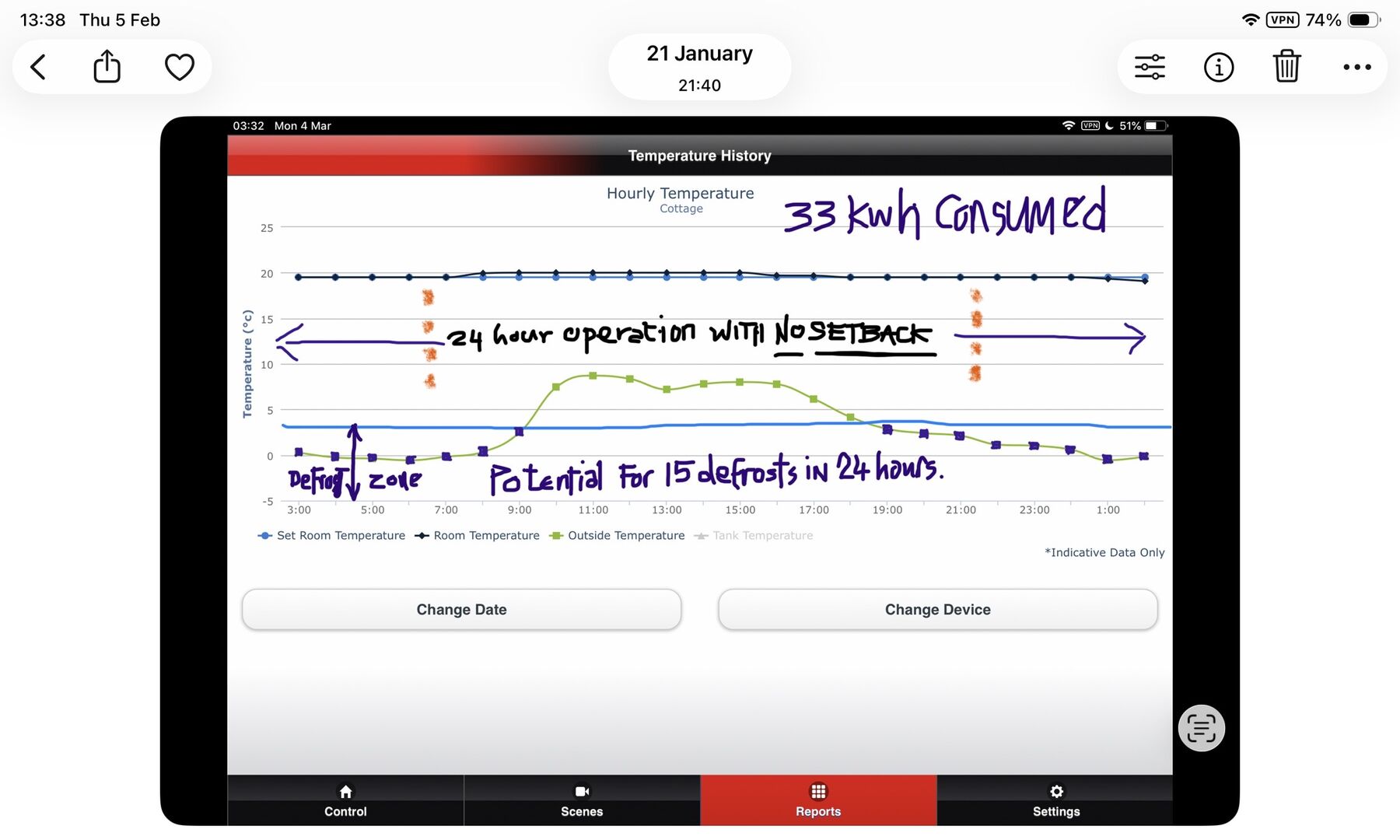
My original post quoted the approximate energy use of a 24 hour day with a night time setback period compared to a 24 hour continuous operation day. Both were working in mostly defrost temperatures however the setback day was almost entirely operating all the time in the defrost zone.
While the 24 hour continuous operation period shown below was actually operating for 8 hours at +9c. This obviously means the setback day above was a much colder 24 hour period yet the continuous operation day below recorded a much higher electrical demand for the same 24 hour period.
But then you knew all this if you saw my original post.
This post was modified 7 months ago 4 times by SUNandAIR
are three Mitsi 8.5kW R32s doing a defrost, but your 5 minute "preparation period before the defrost" seems to be missing, so maybe not a component of all defrosts:
And here's a Mitsi 11.2kW R32 defrosting without a 5 minute "preparation period before the defrost":
@robs just because your graphs don’t show it it doesn’t mean it’s not happening.
There is a lot of subtle but necessary activities going on to ensure the compressor doesn’t get damaged during flow reversal. If you’re only looking at electrical and energy data you may not be able to see the activity since the compressor may already be working at a high enough compression which may disguise the activity. It is necessary to remove any condensed liquid refrigerant which may accumulate and push it into the reservoir. This must be done when flow reverses to start the defrost and again when the outdoor coils have been defrosted and flows need to be reversed again back to normal heating mode. The compressor needs to operate gradually at both changeovers.
@robs … Again you make an ambiguous post distorting the facts. The energy saving is made not only because of defrosts although they do contribute, but mainly because the heat pump is off/and monitoring and therefore not using energy through the setback period. The setback period is all in defrost zone temperatures so the WCcurve heating demand is higher than when the outdoor temperature is above 3c. Hence there are energy savings as previously posted.
You said "this chart says I missed 7 defrosts during my setback saving oodles of cash compared to operating it 24/7." clearly implying that missing 7 defrosts was the reason you believe you saved "oodles of cash".
This entire thread is an attempt to answer the question of do setbacks save energy/money, as yet there is no definitive (or nearly so) evidence to support that they do or don't. The best test so far in this thread is the matched pairs experiment that @cathoderay is currently running.
My original post quoted the approximate energy use of a 24 hour day with a night time setback period compared to a 24 hour continuous operation day. Both were working in mostly defrost temperatures however the setback day was almost entirely operating all the time in the defrost zone.
While the 24 hour continuous operation period shown below was actually operating for 8 hours at +9c. This obviously means the setback day above was a much colder 24 hour period yet the continuous operation day below recorded a much higher electrical demand for the same 24 hour period.
But then you knew all this if you saw my original post.
And all of the consumption data used in the above are estimates from MELCloud, that are not accurate estimates, as I have posted about before.
are three Mitsi 8.5kW R32s doing a defrost, but your 5 minute "preparation period before the defrost" seems to be missing, so maybe not a component of all defrosts:
And here's a Mitsi 11.2kW R32 defrosting without a 5 minute "preparation period before the defrost":
@robs just because your graphs don’t show it it doesn’t mean it’s not happening.
There is a lot of subtle but necessary activities going on to ensure the compressor doesn’t get damaged during flow reversal. If you’re only looking at electrical and energy data you may not be able to see the activity since the compressor may already be working at a high enough compression which may disguise the activity.
So if "the compressor is already working at a high enough compression" then there is no additional electrical energy required to perform the defrost. Which is what my examples are showing, no additional electrical input and therefore no additional cost.
The problem I see with your annoyance with the MELCloud data reporting system is that you are possibly persuading others to invest in other third party systems which simply add to the cost of the installation yet the system it perfectly programmable without the extra paraphernalia and user monitoring time.
I haven't advocated buying anything, I have just pointed out the relative (in)accuracies of the sensors/systems and left people to make their own judgement.
You say you haven’t advocated buying anything yet you have posted the product name and posted a retailer where the products can be purchased with a link to the site in your post. This was not requested.
That is an unequivocal promotion to buying the product.
so I have requoted the original post since your reply was ambiguous your reply to the above post now copied in full
Of course I have mentioned the OEM heat pump monitoring system that I have, doing so gives context to what I write. I have posted links to OEM's website as it contains the data being discussed. But have I posted a link to the shop and said people should buy the heat pump monitoring kit? No.
So as can be seen your statement “I haven’t advocated buying anything” is not true.
You posted a link to a person and named the retailer also, which anyone would know.
this kind of duicking and diving makes me feel I cannot trust anything you say.
Some of the moderators of this forum post data from OEM, so I'm not the only one doing that. Other forum contributors have also stated that they own OEM monitoring kit, so I'm not the only one doing that too. Are some of the moderators and other contributors also advocating the buying of things from OEM?
You continue to use electrical consumption estimates that can be 40% to 60% inaccurate when trying to demonstrate a ~15% saving, and doing so after the inaccuracies in the estimates have been pointed out to you, like you have again today by reposting your 28.8kWh and 33kWh estimates, and you think I have a credibility problem?