

Notifications
Clear all
Joining the Renewable Heating Hub forums is completely free and only takes a minute. By registering you’ll be able to ask questions, join discussions, follow topics you’re interested in, bookmark useful threads and receive notifications when someone replies. Non-registered members also do not have access to our AI features. When choosing your username, please note that it cannot be changed later, so we recommend avoiding brand or product names. Before registering, please take a moment to read the Forum Rules & Terms of Use so we can keep the community helpful, respectful and informative for everyone. Thanks for joining!

13/01/2026 2:11 pm
the DNO have advised that there's no realistic prospect of increasing this via G99 due to the number of solar PV systems in proximity in our area (a suburb within Leeds), so 3.68kW is as good as it will get.
That's something which DESNZ isn't considering, and is possibly unaware of.
When several houses have rooftop solar which exports to the grid at the same local substation, this affects the export limitation levels.
The Secretary of State for ESNZ will soon be announcing a new initiative to expand the base of rooftop solar.
I wonder if he's also aware that his strategy conflicts with the outcomes that NESO has recently published on the result of their Connections Reform Process:
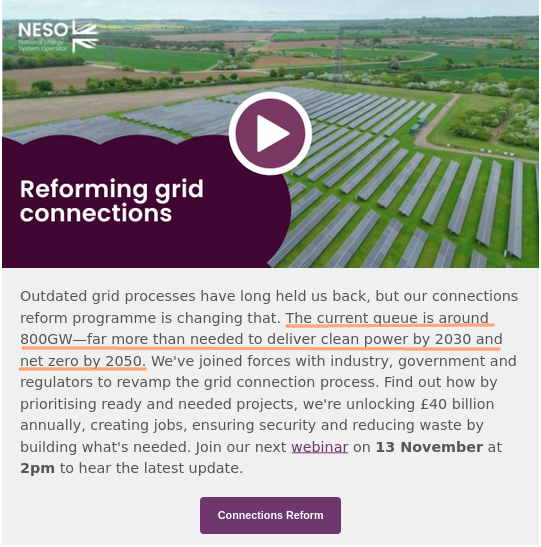
NESO have cut back considerably the amount of solar generation which will be allowed to connect to the grid:
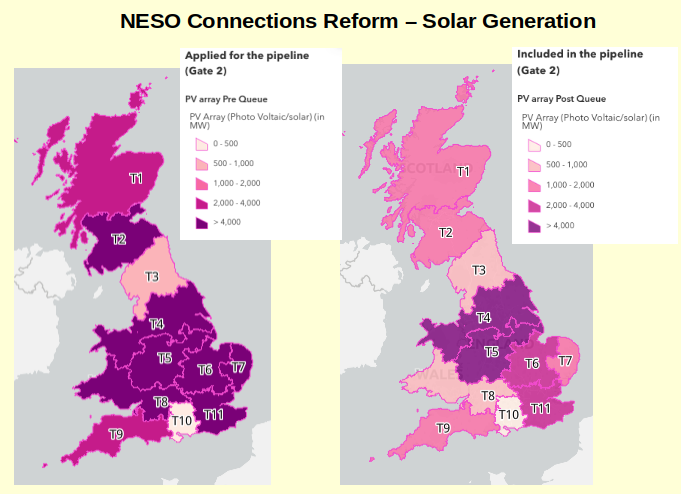
They also state with reference to the above maps:
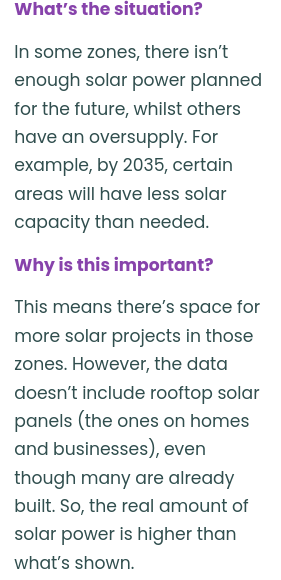
It's an odd moment to try and encourage more solar generation... unless it's specifically tied to in-home battery storage of course.
This post was modified 9 months ago by Transparent
Save energy... recycle electrons!

13/01/2026 2:22 pm
@transparent The default export limit of 3.68kW isn't a particular issue for me, as I can still export all of my excess at this rate, but the PV is subject to clipping at the peak solar periods. I doubt that the excess PV and storage would account for a huge amount financially, but it would be nice to unlock it. Having made enquiries in this regard via our original installers and seeing the reality for a suburban setup I read with some envy those with much higher export limits, most living in rural areas it seems.
The issue I really want to address is that, on the current settings at least, it turns the 5kW inverter into a 3.68kW inverter for everything it does, which intuitively seems like it's wasted capacity/opportunity within the house itself.
One option I've considered trying is to switch it to 5k until such time as the solar export limit is likely to be hit, as there's no prospect of breaching the export limit currently, but it feels intuitively 'wrong' to do so. I'm not sure of the consequence if I was accidentally caught out by a freak day where it breached the export limit, and it's not something I particularly want to introduce as a risk factor.
This post was modified 9 months ago 2 times by Sheriff Fatman
130m2 4 bed detached house in West Yorkshire
10kW Mitsubishi Ecodan R290 Heat Pump - Installed June 2025
6.3kWp PV, 5kW Sunsynk Inverter, 3 x 5.3kWh Sunsynk Batteries
MyEnergi Zappi Charger for 1 EV (Ioniq5) and 1 PHEV (Outlander)
User of Havenwise (Full control Jun-Dec 2025, DHW only from early Dec)
Subscriber to MelPump App data via CN105 Dongle Kit

13/01/2026 3:20 pm
As soon as I change the grid export setting, the overall inverter power limiter setting changes with it, and vice versa. If I set the export to 3680W, and then change the overall inverter power limiter to 5000W, the export setting increases with it.
At present it looks like a software restriction to me and, if so, potentially something I could follow up with Sunsynk directly. I don't have the technical knowledge to understand whether it's perhaps a more basic hardware restriction, and I'm trying to achieve something that isn't technically possible.
I agree this does not seem to make sense. It is perfectly reasonable that you may have an inverter able to generate 5kw AC and want it to enforce a lower limit on exporting. Any difference could be consumed by internal loads. Inverters use sensor/CT clamps to enforce the limit.
Worth raising it with the distributor and also in case of any lack of clarity regarding the expected location of the CT clamp.
With my Solis I suspect I had a somewhat similar issue related to a limit on import, but with all the firmware upgrades, etc that they applied, it went away.
Hope that helps!
8kW Solis S6-EH1P8K-L-PLUS hybrid inverter; G99: 8kW export; 16kWh Seplos Fogstar battery; Ohme Home Pro EV charger; Vaillant Arotherm Pro 7kW; 100Amp head, HA lab on mini PC
13/01/2026 3:54 pm
Within the 'system mode' section of the settings, there's an Inverter Power Limiter setting that logically could be set to 5000W. Separately, within the Grid Settings section, there's a Export Power Limiter setting that logically has to be set to 3680W to prevent any risk of breaching the G98 limit.
Here's that section of the Installation Manual:
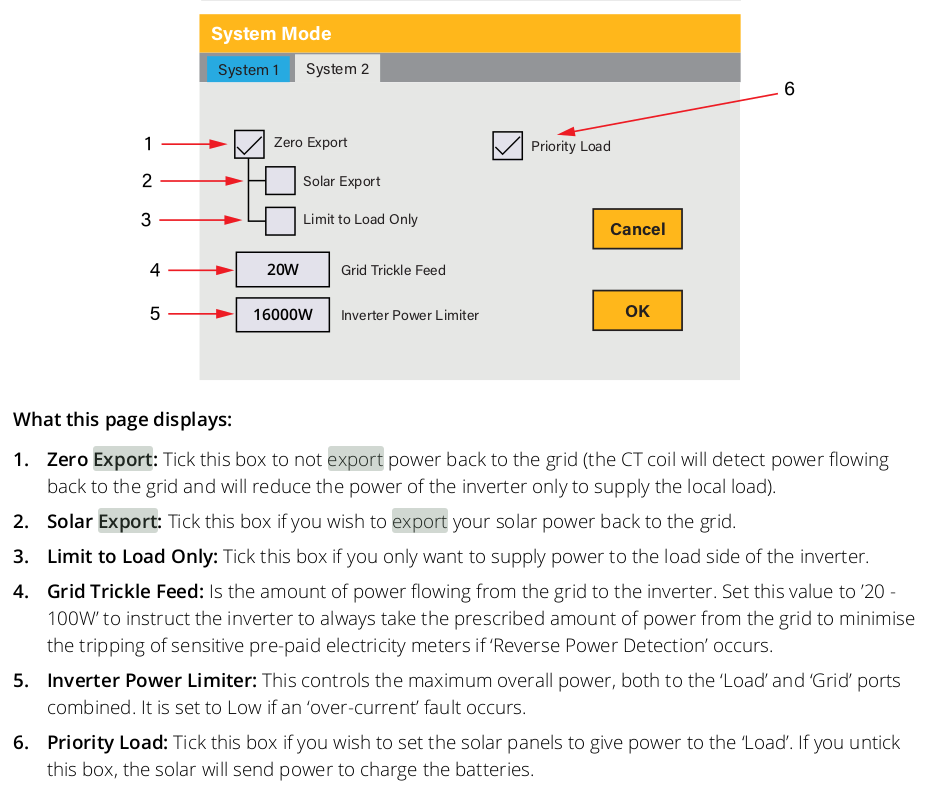
My understanding is that the Inverter Power Limiter parameter is referring to electricity output from the inverter.
The combination of the Firmware and the CT clamp will mean there's Zero export to the grid if/when Zero Export is selected.
This might be a feature which is locked into the Sunsynk inverters sold in UK, because we also have "G99/G100" in the Grid Mode field,
where "General Standard" is entered in the diagram below...
... in which case there could be differing advice being put forward on other online platforms from non-UK locations.
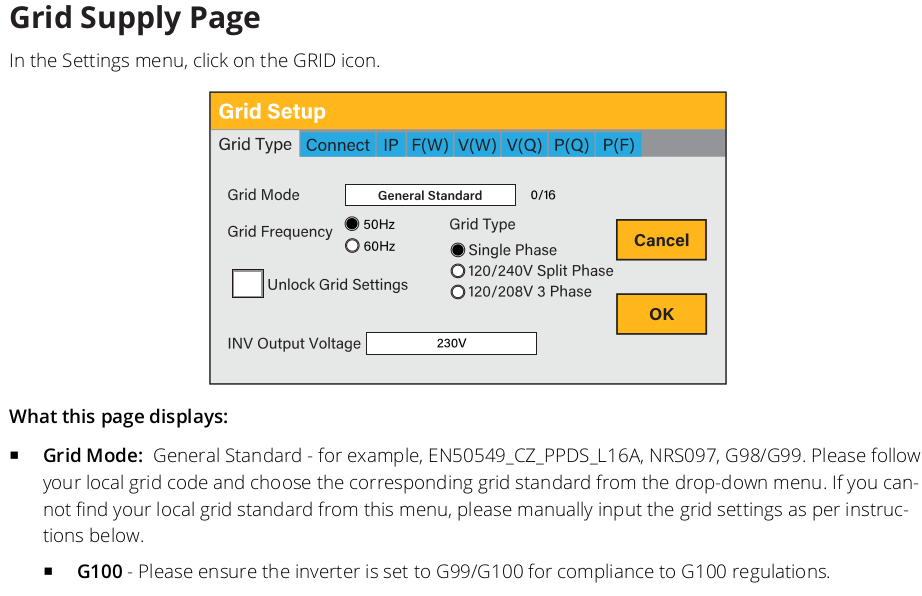
That leaves the outstanding question of what happens if we were to enter the Password to change parameters on the Grid Supply page,
and choose something other than G99/G100.
Yes, I realise that probably contravenes the G99 consent from the DNO, and I'm not suggesting that users set up their Sunsynk inverters like that.
This post was modified 9 months ago by Transparent
Save energy... recycle electrons!

13/01/2026 8:06 pm
That leaves the outstanding question of what happens if we were to enter the Password to change parameters on the Grid Supply page,
and choose something other than G99/G100.Yes, I realise that probably contravenes the G99 consent from the DNO, and I'm not suggesting that users set up their Sunsynk inverters like that.
From what I read, the Solis has a very long list of error codes it reports in situations where the grid input does not conform to the defined standard.
Clearly such tests are to be only done in a suitably isolated lab and could invalidate warranties.
8kW Solis S6-EH1P8K-L-PLUS hybrid inverter; G99: 8kW export; 16kWh Seplos Fogstar battery; Ohme Home Pro EV charger; Vaillant Arotherm Pro 7kW; 100Amp head, HA lab on mini PC

Topic starter
14/01/2026 3:17 pm
One more earthing question occurs to me. If, as now seems almost certain, the recommendation (requirement) with a TN-C-S or in practice a TN-S system is to install a local (TT) earth for use in islanding mode (we will call this 'islanded earth). Does the bonding cause a problem when not in islanding mode? I cant see that it would but just in case I thought it was worth asking.
My thought process goes like this:
- Various metal pipework in the house must be bonded to grid earth
- Presumably the same metal pipework must also be bonded to islanded earth
- It thus follows that, unless you switch out all the bonding connections when the grid goes down, grid earth is connected to islanded earth
- This being the case islanded earth may as well be bonded directly to grid earth thus avoiding two sets of bonded connections to the pipework
- The upshot is that, when the grid is connected, there are two earthing points in parallel, one local and one at the transformer, the precise detail depending on TN-C-S vs TN-S
Does it matter?
4kW peak of solar PV since 2011; EV and a 1930s house which has been partially renovated to improve its efficiency. 7kW Vaillant heat pump.
14/01/2026 6:33 pm
The issue of earth bonds to pipework doesn't yet seem to have been considered by any off-grid hybrid inverter manufacturers.
It's a valid point, and would benefit from being discussed here.
We will be 'working' ahead of the regulations.
So this is a matter of applying physics and common sense, rather than considering rules and standards.
My present assumption is that professional installers are most likely to have left pipework bonding connected solely to grid earth,
despite the home now having an off-grid inverter.
That means the bonding would be ineffective in an outage if the fault was with the local substation or its (TN-S) cable which supplied your house.
If a second fault occurred which then affected the in-home electricity circuits that supplied appliances which linked to gas & water pipework,
then it's technically possible for that pipework to 'go live' without causing a trip to operate.
The risk of that happening is extremely small.
You may add your own earthing rod to the earth provided by the DNO for a house supplied by TN-S or TN-C-S.
See this recommendation to electrical contractors, and this discussion on the IET Forum.
If you do this, then I'd recommend adding a label on your CU to state when it was done.
The integrity of that new earth would then be checked in future whenever an electrician makes alterations which require a Part-P certificate.
We should therefore consider the need for the relay when installing an off-grid inverter is solely for the purposes of providing an earth bond for the Neutral.
That relay is not integral to the unit in a Sunsynk Hybrid Inverter.
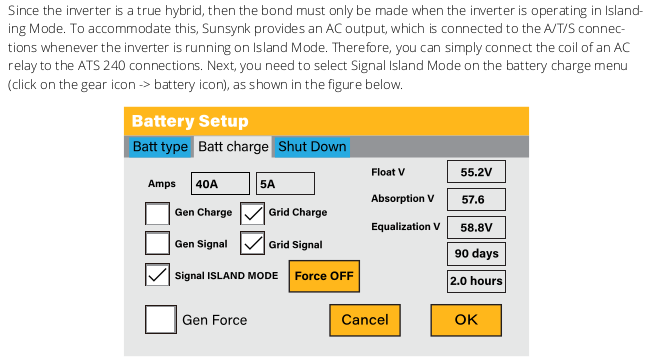
However, there are a pair of contacts marked ATS (Automatic Transfer Switch) which can be used to power the coil of a mains relay.
Those ATS contacts will only be made 'live' if the Installer also ticks the Signal Island Mode box on the configuration menu system.
This post was modified 9 months ago by Transparent
Save energy... recycle electrons!
14/01/2026 6:57 pm
The link you added on the Electrical Contractors Association is not working, I wonder if it is this link, for Installing an additional earth electrode in TN earthing systems?
The ATS signal may be available in inverters like the Solis S6 that do not need an external ATS:
The ATS240V terminal will output 230V AC voltage when inverter is connected to the grid and when inverter is connected to the generator, it will output 0V.
My interpretation in cases where the smart port is not used for a generator but instead as the input from a PV inverter, is that it will work similarly. But of course, in case the smart port is used as a second UPS/backup port, this would need to be checked.
This post was modified 9 months ago by Batpred
8kW Solis S6-EH1P8K-L-PLUS hybrid inverter; G99: 8kW export; 16kWh Seplos Fogstar battery; Ohme Home Pro EV charger; Vaillant Arotherm Pro 7kW; 100Amp head, HA lab on mini PC

14/01/2026 8:22 pm
Thanks @batpred. You'd identified the document I was referring to, and I've now changed the link in my previous post.
I use a system which strips out user-identifiers and URL-source information whenever I post a link here on the Forum.
In this case it was too aggressive, and removed essential data too!
Yes you're right to point out that some (all?) Solis hybrid inverters also have a port which can be used to operate a relay to earth the Neutral for off-grid operation.
But I'm unsure if the Solis inverters already have an internal relay which performs this function.
Wiring an external change-over relay should be avoided if possible because it's a mains device, and must therefore be installed by an accredited electrician.
Save energy... recycle electrons!
14/01/2026 8:25 pm
One more earthing question occurs to me. If, as now seems almost certain, the recommendation (requirement) with a TN-C-S or in practice a TN-S system is to install a local (TT) earth for use in islanding mode (we will call this 'islanded earth). Does the bonding cause a problem when not in islanding mode? I cant see that it would but just in case I thought it was worth asking.
My thought process goes like this:
- Various metal pipework in the house must be bonded to grid earth
- Presumably the same metal pipework must also be bonded to islanded earth
- It thus follows that, unless you switch out all the bonding connections when the grid goes down, grid earth is connected to islanded earth
- This being the case islanded earth may as well be bonded directly to grid earth thus avoiding two sets of bonded connections to the pipework
- The upshot is that, when the grid is connected, there are two earthing points in parallel, one local and one at the transformer, the precise detail depending on TN-C-S vs TN-S
Does it matter?
Great question, and I can only attempt to comment without the regulation considerations.
Whether the bonding could cause a problem if an inverter is working in islanding mode... my way of thinking about it is to focus on eliminating the most likely and severe risks.
Inside a Faraday cage, any electricity flowing outside it is harmless to an individual inside. So the main consideration is to ensure that, in the local site, any multiple points that an individual could simultaneously get in contact with are at a similar electrical potential. Bonding all the conductors maintains this, with or without islanding, etc.
Hence the mention of PME as a better earthing concept. The larger the M, the better... 🙂
And using RCD/RCBOs on as many electrical circuits as possible (including beyond regulations) will further enhance safety.
Of course one may still experience an electric shock touching an isolator like some types of carpet that can develop electric charges! Except if one is able to eliminate any such surfaces, some risk is still there. 🤪
This post was modified 9 months ago by Batpred
8kW Solis S6-EH1P8K-L-PLUS hybrid inverter; G99: 8kW export; 16kWh Seplos Fogstar battery; Ohme Home Pro EV charger; Vaillant Arotherm Pro 7kW; 100Amp head, HA lab on mini PC
14/01/2026 9:50 pm
Yes you're right to point out that some (all?) Solis hybrid inverters also have a port which can be used to operate a relay to earth the Neutral for off-grid operation.
But I'm unsure if the Solis inverters already have an internal relay which performs this function.
Wiring an external change-over relay should be avoided if possible because it's a mains device, and must therefore be installed by an accredited electrician.
The way I understood it from the info I pasted earlier, when a Solis S6 hybrid detects the grid power goes off, it bonds the backup earth to backup neutral, so they must have an internal relay. In my case the earth in the CU that provides the backup continues to be bonded to the rest of the home´s earthing. Since this is also bonded to pipes in the site, I do not see a risk.
8kW Solis S6-EH1P8K-L-PLUS hybrid inverter; G99: 8kW export; 16kWh Seplos Fogstar battery; Ohme Home Pro EV charger; Vaillant Arotherm Pro 7kW; 100Amp head, HA lab on mini PC

15/01/2026 1:36 am
@jamespa having read through this thread I will add a few comments that might help.
Fogstar now sell their 16.1kWh battery with fire suppression built in, might help any concerns over fire safety.
If you can find a local electrician who fits a lot of solar they would be able to do eveything you need and offer a lot of advice. The electrician who fitted our PV panels and inverter didn't wire the rest of the house but I wish I had used him for everything as he would have kept things more compact around the CUs and offered better advice on what to fit and how to set it up. When I was trying to find a company for the PV panels I found several small solar companies local to me that are run by electricians who don't only fit solar panels. He did say I would need an earth stake, but we already had one fitted.
1

SPONSORS

Degrees of Separation
Latest Posts
-

RE: Say hello and introduce yourself
Welcome in, @e-a-west. That sounds like an interestin...
By Majordennisbloodnok , 4 minutes ago
-
Mars asked for an update on progress so …. Out HP has...
By DavidB , 1 hour ago
-
RE: How much of your renewable and home setup would still work if the internet went down?
Yes I actually have a copy of a tool that whenever a ce...
By EtchedPixels , 2 hours ago
-
RE: How will removing the standing charge on gas bills benefit heat pumps?
The shoulder months are very difficult to judge COP on ...
By scrchngwsl , 4 hours ago
-
RE: Indevolt Batteries UK Support & Info Thread
@editor Hi, To resolve this, please tap on the A...
By Indevolt Tech , 10 hours ago
-
RE: Double or Triple Glazed Windows?
Posted by: @singlespeed With 9 years repairing windo...
By Rob of York , 1 day ago
-
@transparent we’re still running a secure version of PH...
By Mars , 1 day ago
-
RE: How quickly would you want/expect heat recovery to take from setback?
Much longer than that here. The heating isn't even on. ...
By bobflux , 2 days ago
-
RE: Passiv Smart Thermostat - Help & Forum Support
Obviously the weather is changeable but there's a defin...
By Singlespeed , 2 days ago
-
RE: The Changing Jet Stream Could Challenge UK Air Source Heat Pumps
@rob-of-york I must admit that when we had a Daikin hea...
By Toodles , 2 days ago
-
RE: Forum updates, announcements & issues
Get the Renewable Heating Hub heads-up on WhatsApp. I...
By Mars , 2 days ago
-
RE: Safety study for plug in batteries out to tender - looks like Q3 2027 at best before legal
@editor I pointed out to the one of the Fuse execs that...
By dansus , 2 days ago
-
RE: 15kw pump for 225m2 1990's house - over kill?
@seaviews As well as loft insulation, there are othe...
By Rob of York , 2 days ago
-
RE: BT cuts you off, Plusnet blames Openreach... welcome to “seamless” broadband switching
Both of which (in most cases) use Openreach for the las...
By JamesPa , 2 days ago





SPONSORS

