Joining the Renewable Heating Hub forums is completely free and only takes a minute. By registering you’ll be able to ask questions, join discussions, follow topics you’re interested in, bookmark useful threads and receive notifications when someone replies. Non-registered members also do not have access to our AI features. When choosing your username, please note that it cannot be changed later, so we recommend avoiding brand or product names. Before registering, please take a moment to read the Forum Rules & Terms of Use so we can keep the community helpful, respectful and informative for everyone. Thanks for joining!
Recommended home battery inverters + regulatory matters - help requested
@jamespa having read through this thread I will add a few comments that might help.
Fogstar now sell their 16.1kWh battery with fire suppression built in, might help any concerns over fire safety.
If you can find a local electrician who fits a lot of solar they would be able to do eveything you need and offer a lot of advice. The electrician who fitted our PV panels and inverter didn't wire the rest of the house but I wish I had used him for everything as he would have kept things more compact around the CUs and offered better advice on what to fit and how to set it up. When I was trying to find a company for the PV panels I found several small solar companies local to me that are run by electricians who don't only fit solar panels. He did say I would need an earth stake, but we already had one fitted.
Thanks. The frogstar is the one Im potentially looking at.
I do know a good electrician but I dont think he does solar. Whenever I have contacted solar companies in the past they seem to be rather specialist, which is why I have been thinking of going down the route of general electrician and asking him to do the inverter stuff. However your suggestion is very helpful, whilst the individual companies might be specialist the electricians they employ may not be so I will also explore that route thanks.
If its going to happen at all its all going to happen all at once, firstly because its the only way it has any chance of making the business case for the battery work and secondly because I don't want a mess of sub CUs. Its either (Battery inverter + EV Charger + circuit for Induction Hob + redo CU) or nothing as far as I am concerned. Nothing remains a distinct possibility; none of this is absolutely necessary for me, I dont have to have a battery, I can continue charging my EV on a granny charger and we may never swap out gas hob for an induction hob (even though we are paying the whole standing charge just to run the hob) as we attach some value to fuel diversity. That said ~£500-600 saving annually for an investment which hopefully is ~ £K5-6 is quite attractive.
This post was modified 9 months ago 4 times by JamesPa
4kW peak of solar PV since 2011; EV and a 1930s house which has been partially renovated to improve its efficiency. 7kW Vaillant heat pump.
Could you just get the electrician to fit the new circuit in your CU for the battery storage to and including the rotary isolator switch, which any electrician would be happy to do.
You can then just isolate that circuit and install the inverter and batteries yourself?
That would avoid the need for a "solar specialist" who will almost certainly charge you plenty for the pleasure.
EV first Nov 2024, charged on granny charger (still do)
Battery storage 15kwh (quickly added 30kwh more!)
New CU with RCBO's
HP now I have the battery storage
Lay the cable whilst the HP guys are here for an EV charger to be fitted in a month or so.
Then I'm done. All up to date and fingers crossed will run for many years to come.
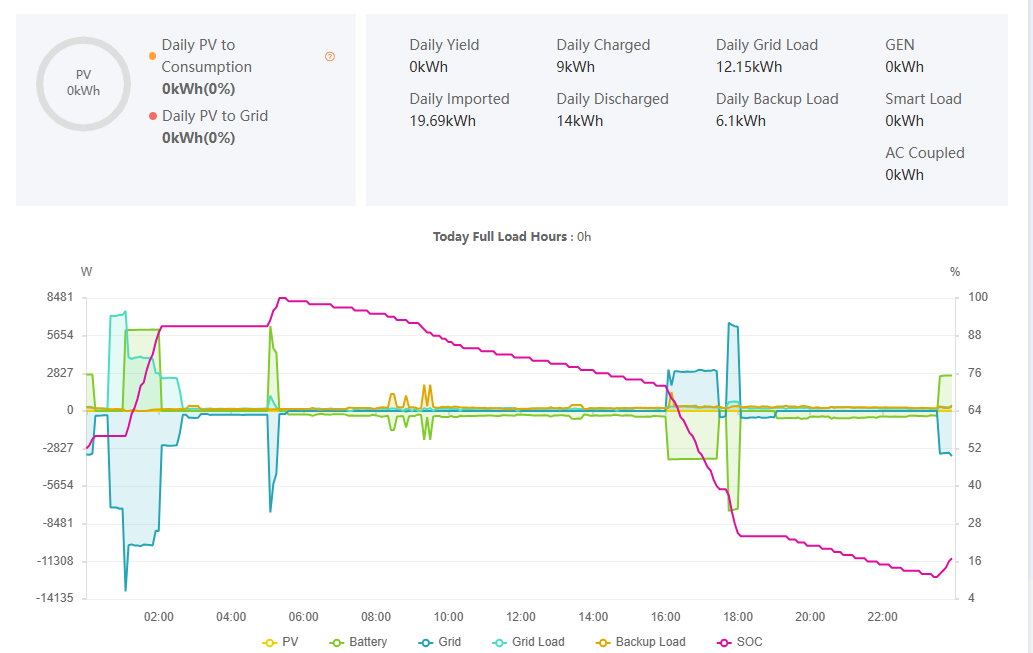
I'm nearly at the first year anniversary of the battery storage and without the HP yet, my battery usage data is showing c£1000 saved in peak electricity costs.
Fogstar now sell their 16.1kWh battery with fire suppression built in, might help any concerns over fire safety.
That's a good point.
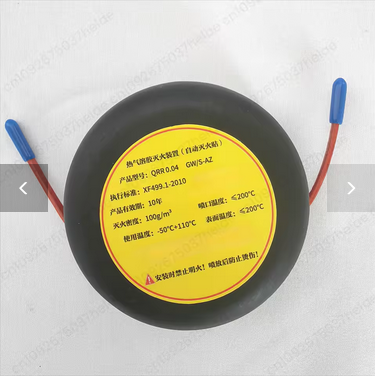
The majority of steel battery enclosures being manufactured and shipped direct from China have had such an aerosol fire suppressor fitted as standard for at least 6 months now. They are cheap, readily available from suppliers on Alibaba, and can be retro-fitted.
However, may I point out that the probability of there being a fire within a battery using LiFePO₄ technology is extremely remote. A battery cell would have to be physically damaged (with a pickaxe!) before it would heat up from an internal short-circuit. There is no self-ignition or thermal runaway with this battery chemistry... ... although I wouldn't want to breathe in the fumes which could be emitted.
Of the six main lithium battery technologies, it is LiMNC which self-combusts if over-charged or short-circuited. That's the one which has the highest storage capacity per Kg, and is employed where weight would be a factor.
Electric bikes, skateboards, DIY power tools and EVs are the main devices using LiMNC.
If there were to be a fault with a domestic storage battery system, it is far more likely to be within high-current electronics, and that's to be found within the inverter rather than the battery.
A faulty inverter could present a 'near short-circuit' to the battery, which could produce instantaneous currents of around 10kA (ten thousand amps).
The LiFePO₄ cells would quite happily supply that current and remain unaffected. The whole point of lithium battery design is that it can quickly offer high currents!
The inverter, however, would be on fire within a split-second, and should be regarded as the appliance which might benefit from fire suppression!
You need to have a (very) fast acting fuse between the battery and inverter to stop that current.
This issue isn't helped by the British media referring to 'lithium battery fires' without distinguishing either the cell chemistry, nor whether the battery was the seat of the fire.
Even the PAS63100 'standard' treats all lithium battery technologies as one 'class'. It stipulates that a battery mustn't be installed in an attic, for example, whilst failing to advise the same precaution for a solar inverter!
It's not a mandatory standard, but there may come a point when home insurers would need to be satisfied that it's been implemented. Members of the public should feel free to send feedback to BSI, highlighting issues which you might wish to see addressed in a future edition.
Finally, I will point out that common-sense should prevail here.
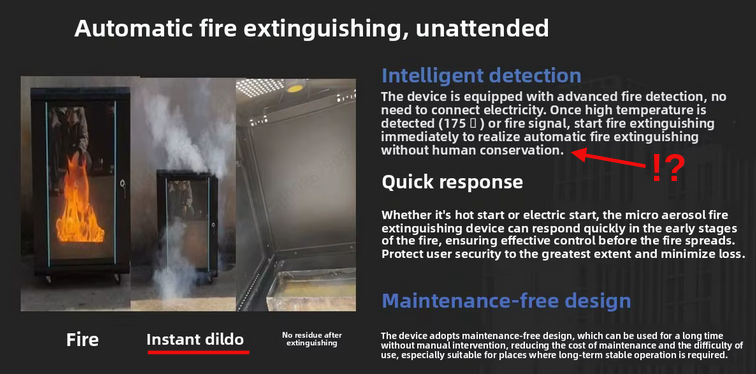
Some of the instructions and marketing materials for these aerosol fire suppressors contain erroneous and colourful use of the English language!
This post was modified 9 months ago 5 times by Transparent
Could you just get the electrician to fit the new circuit in your CU for the battery storage to and including the rotary isolator switch, which any electrician would be happy to do.
You can then just isolate that circuit and install the inverter and batteries yourself?
That would avoid the need for a "solar specialist" who will almost certainly charge you plenty for the pleasure.
We are of course speaking hypothetically about how a 'friend' might go about the job, aren't we? 😉
Fogstar now sell their 16.1kWh battery with fire suppression built in, might help any concerns over fire safety.
That's a good point.
Perhaps my greater concern personally is the battery acting as fuel or accelerant for a fire started elsewhere, whether in the inverter or in the house. I dont know (but would like to know) the extent that this is inhibited.
This post was modified 9 months ago 4 times by JamesPa
4kW peak of solar PV since 2011; EV and a 1930s house which has been partially renovated to improve its efficiency. 7kW Vaillant heat pump.
Thanks. The frogstar is the one Im potentially looking at.
I do know a good electrician but I dont think he does solar. Whenever I have contacted solar companies in the past they seem to be rather specialist, which is why I have been thinking of going down the route of general electrician and asking him to do the inverter stuff. However your suggestion is very helpful, whilst the individual companies might be specialist the electricians they employ may not be so I will also explore that route thanks.
If its going to happen at all its all going to happen all at once, firstly because its the only way it has any chance of making the business case for the battery work and secondly because I don't want a mess of sub CUs. Its either (Battery inverter + EV Charger + circuit for Induction Hob + redo CU) or nothing as far as I am concerned. Nothing remains a distinct possibility; none of this is absolutely necessary for me, I dont have to have a battery, I can continue charging my EV on a granny charger and we may never swap out gas hob for an induction hob (even though we are paying the whole standing charge just to run the hob) as we attach some value to fuel diversity. That said ~£500-600 saving annually for an investment which hopefully is ~ £K5-6 is quite attractive.
My export with Octopus was recently approved, I was my own installer. I only used electricians for the electrical work.
The fire suppressor with a lifepo4 lithium battery seem a good marketing ploy to create differentiation for the frogstar premium. Well done to them..
Anyway, getting back to your case, you already have the export approved. So what others may hesitate on, is not even a hurdle!
If it was me, I would:
1 - reach out to UKPN and confirm if they allow higher export with a G100 type-tested inverter (like the Solis S61H) and what paperwork they need
2 - have a simple diagram of what I are looking to have
3 - contact supplier of the inverter with that diagram (they are more likely to not insist on an "installer"). Confirm the sunnyboy could be rewired, etc.
4 - confirm the electricians and what they would do, ct clamp and all. To the point of leaving the inverter working (including wifi, etc), routing the power from the sunnyboy to the grid, creating the soliscloud account. Then I would get Solis to do the configuration.
5 - get the paperwork going with UKPN
6 - order all the kit
7 - get electricians to do the install, add a few more circuits, etc and issue building control certificate (even if in this case, I do not see any immediate value of the certificate )
8 - wire the battery and configure it in the inverter myself (easy to do on a Solis)
9 - once ready to adjust to the new export limit, change the config in the inverter. The Solis Engineers can also do this remotely.
It may be that a number of isolators and a small CU is the best way to get the electrical certificate.
8kW Solis S6-EH1P8K-L-PLUS hybrid inverter; G99: 8kW export; 16kWh Seplos Fogstar battery; Ohme Home Pro EV charger; Vaillant Arotherm Pro 7kW; 100Amp head, HA lab on mini PC
My export with Octopus was recently approved, I was my own installer. I only used electricians for the electrical work.
The fire suppressor with a lifepo4 lithium battery seem a good marketing ploy to create differentiation for the frogstar premium. Well done to them..
Anyway, getting back to your case, you already have the export approved. So what others may hesitate on, is not even a hurdle!
If it was me, I would:
1 - reach out to UKPN and confirm if they allow higher export with a G100 type-tested inverter (like the Solis S61H) and what paperwork they need
2 - have a simple diagram of what I are looking to have
3 - contact supplier of the inverter with that diagram (they are more likely to not insist on an "installer"). Confirm the sunnyboy could be rewired, etc.
4 - confirm the electricians and what they would do, ct clamp and all. To the point of leaving the inverter working (including wifi, etc), routing the power from the sunnyboy to the grid, creating the soliscloud account. Then I would get Solis to do the configuration.
5 - get the paperwork going with UKPN
6 - order all the kit
7 - get electricians to do the install, add a few more circuits, etc and issue building control certificate (even if in this case, I do not see any immediate value of the certificate )
8 - wire the battery and configure it in the inverter myself (easy to do on a Solis)
9 - once ready to adjust to the new export limit, change the config in the inverter. The Solis Engineers can also do this remotely.
It may be that a number of isolators and a small CU is the best way to get the electrical certificate.
Thanks. Thats pretty much my intended route if I do go ahead - still dependent on wife's view and electrician's quote. You have been very helpful in nailing the questions to ask and the design options thank you very much.
4kW peak of solar PV since 2011; EV and a 1930s house which has been partially renovated to improve its efficiency. 7kW Vaillant heat pump.
If there were to be a fault with a domestic storage battery system, it is far more likely to be within high-current electronics, and that's to be found within the inverter rather than the battery.
So I should be keeping the batteries inside in the warm and installing the inverter outside if I want to minimise the risk of fire. Our reason to move it outside would be the noise of the fans once it is charging/discharging over about 3kW.
It is interesting that I was told by some installers I would need to fit a fire door to the room where the battery is before they would sign it off but if I fitted the battery myself after they had finished that would be up to me. The inverter wasn't mentioned at all.
The noise of the Solis is nothing very significant I find, but I think any model above 6kw would need to use the fans depending on temperature etc. In our case the kettle triggers the limit for low noise. It is nothing like a drier or a washing machine...
The inverter can be kept outside but not under direct sun, etc
In my view, the lifepo4 batteries we are talking about are perfectly safe, but the misinformation is strong!
8kW Solis S6-EH1P8K-L-PLUS hybrid inverter; G99: 8kW export; 16kWh Seplos Fogstar battery; Ohme Home Pro EV charger; Vaillant Arotherm Pro 7kW; 100Amp head, HA lab on mini PC
This is the first day when the Solis was engaged in some contributing - it will still be optimised to smooth avoidable peaks.
Unfortunately I am finding the fan useful - to spot when our current EV charger decides to go wild..
8kW Solis S6-EH1P8K-L-PLUS hybrid inverter; G99: 8kW export; 16kWh Seplos Fogstar battery; Ohme Home Pro EV charger; Vaillant Arotherm Pro 7kW; 100Amp head, HA lab on mini PC
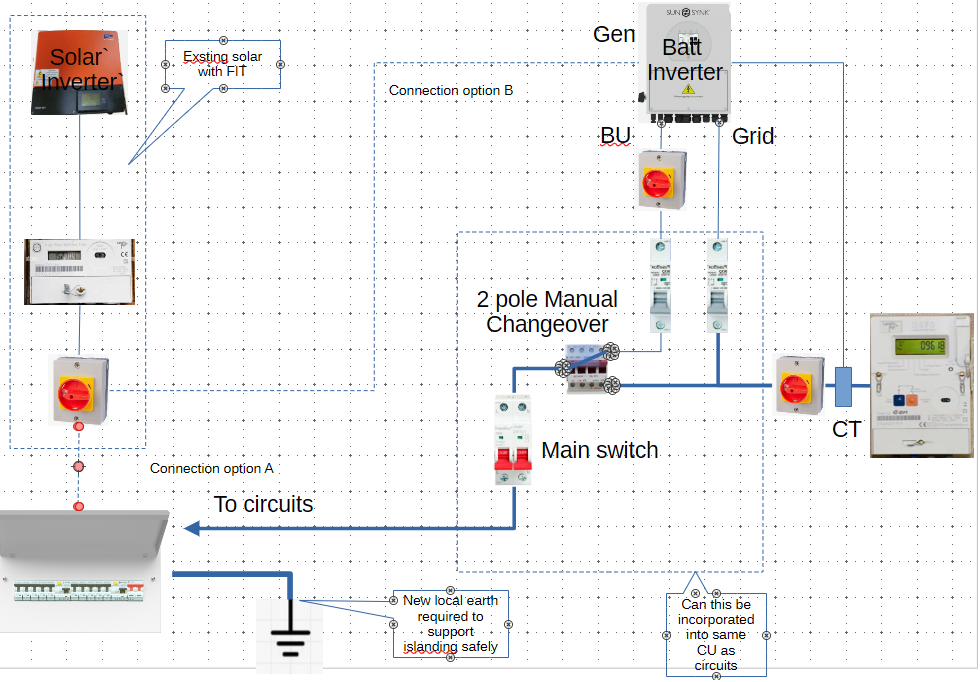
After a lot of discussion earlier on this thread, with much help from @batpred and @transparent, I have come to the diagram below as my 'strawman' arrangement for a solution that
incorporates my existing solar (which benefits from a generous FIT so needs to be metered separately)
allows islanding with manual changeover but does not require me to predetermine which circuits will be run in islanding mode.
has a safe earth arrangement
There are some niggles/points:
There are two possible connection points for my existing solar, which have different implications for the regulatory notifications/applications and inverter configurations. Which I choose if I go ahead will depend on what my DNO says. Opt B assumes that the inverter provides the necessary grid reference frequency when islanded, and accepts input from the generator/backup port when grid connected. This needs to be checked and may rule the option out.
I am replying here since this is the second and most technical thread we discussed this, @jamespa . And I am not complaining, happy to help!
Re the point above, I am 99% sure the Solis S6 Smart port will do this, as it supports AC coupled inverters on that port.
Although the way islanding is done does not require me decide up front which circuits to support in a power cut, it does mean that I will need manually to shed load if the consumption when islanded would otherwise exceed the capacity of the battery inverter.#
With connection option B, the Solis 8kw can use the PV inverter power and provide 50A on the backup port 😉 (but limited to 36.4 from other sources).
Im not sure whether the switch/breaker arrangement in the dotted box can be incorporated into the main CU or an electrician will insist on it being in a separate CU
Yes, on an EICR test report, they list it as amber if not from the same brand as the CU.
If you need the electrician to issue a certificate for the end to end circuit, he will be very strict I suspect, as there can be a lot of thick cables going into the new CU..
After much discussion the conclusion was reached above that, as my supply does not already have a LOCAL earth (because is it TN-S, same would also apply to TN-C-S) then a new local earth is required for islanding, to guard against cable disconnection also disconnecting the earth provided by the grid. The new local earth can be connected to grid earth and existing bonding arrangements remain intact
The diagram assumes that the inverter itself separates the neutral when islanded from the grid neutral
The Solis S6 expects to have a separate neutral and handles it without issues.
The CT clamp is the one that the inverter provides to limit export/ensure zero export. Implementations of this seem to differ so inverter specs need to be checked.
I raised a ticket with Solis as I am seeing a few import spikes at the end of a fixed slot for discharging the battery/export. And I asked them to check the config...
Anyway, I did not try using the Solis AI and EMS options as I should be able to not have a dependency on a cloud service pushing updated schedules every now and then. That may work better and allow maximising the use of an export agile rate. I am happy to export at peak 16-19
I welcome (but have no expectation of) comments on this arrangement and @mars perhaps it may help you short circuit (no pun intended but apologies anyway) some of your own discovery.
My main comment on the diagram is to double check as I think the isolator is only needed in the inverter grid port and not the backup. All the DNO wants is to be able to lock the inverter out of use in case they see malfunctions.
Also the "changeover" switch is mainly a bypass to allow inverter maintenance in option B. I think option A is not supported/working in the Solis, as no power can go in via the backup port.
In order to incorporate the new CU into the old one, a lot of stars need to align 😀 . But if all kit is from the same manufacturer it may work, with a CU designed for two RCDs as it needs two neutrals..
8kW Solis S6-EH1P8K-L-PLUS hybrid inverter; G99: 8kW export; 16kWh Seplos Fogstar battery; Ohme Home Pro EV charger; Vaillant Arotherm Pro 7kW; 100Amp head, HA lab on mini PC