

Notifications
Clear all
Joining the Renewable Heating Hub forums is completely free and only takes a minute. By registering you’ll be able to ask questions, join discussions, follow topics you’re interested in, bookmark useful threads and receive notifications when someone replies. Non-registered members also do not have access to our AI features. When choosing your username, please note that it cannot be changed later, so we recommend avoiding brand or product names. Before registering, please take a moment to read the Forum Rules & Terms of Use so we can keep the community helpful, respectful and informative for everyone. Thanks for joining!

Topic starter
21/01/2026 9:51 am
Firstly @batpred thank you for taking the time to reply so comprehensively. As always it raises a couple more questions
Re the point above, I am 99% sure the Solis S6 Smart port will do this, as it supports AC coupled inverters on that port.
Thats good to know. I did worry about a 'generator' port as generators are usually designed to work off grid and thus it felt possible that such a port would either be shut off or not provided with a frequency reference when operational.
If you need the electrician to issue a certificate for the end to end circuit, he will be very strict I suspect, as there can be a lot of thick cables going into the new CU..
I dont think there will be.
The connections to the inverters need to be 32A only assuming the breakers are set at 32A, or whatever other figure the inverter demands. Only the grid incomer will need to carry 100A.
My main comment on the diagram is to double check as I think the isolator is only needed in the inverter grid port and not the backup. All the DNO wants is to be able to lock the inverter out of use in case they see malfunctions.
Ah thats important. The isolator on the right hand side of the diagram is really there to allow the CU to be worked on safely, not to isolate the inverter. It will of course isolate the inverter but it will also isolate the house from the grid which is not desirable if the issue is an inverter fault. If its a DNO requirement, which you imply it is, then I need to move that isolator to the line between the inverter MCB and the inverter.
Also the "changeover" switch is mainly a bypass to allow inverter maintenance in option B.
Thats not how I see it. I see it as a mechanism to force a manual changeover (to allow manual load shedding). Am I missing something.
This comment has also caused me to realise that, presumably, the 'backup' port is always live irrespective of whether the grid is up or not, in order to support a split load configuration where only some circuits are energised during grid failure. Is that correct?
I think option A is not supported/working in the Solis, as no power can go in via the backup port.
... the consequence of which is that, in option A, its not possible to charge the batteries from the PV if the grid is down. Not desirable although perhaps not a show stopper.
The reason I have re-considered option A is that, in option B the cable connecting the two inverters is not protected by an MCB which, unless they have internal fuses, isn't particularly comfortable as its about 10m long and passes around the outside of the house.
This also causes me to realise that, in islanding mode (with either connection option) a situation can arise where the PV is generating but there is insufficient load to satisfy it (in the option B connection this would occur when batteries are full). I presume that the inverter either reduces its generation or shuts down in this situation. The panels will still be absorbing energy so presumably heat up, just as they would if the grid fails.
In order to incorporate the new CU into the old one, a lot of stars need to align
. But if all kit is from the same manufacturer it may work, with a CU designed for two RCDs as it needs two neutrals..
 . But if all kit is from the same manufacturer it may work, with a CU designed for two RCDs as it needs two neutrals..
 Using the existing CU is anyway a non starter, the whole basis of this project is that the CU will be replaced in any event that I do anything so I might as well do everything in one go if I am going to touch it at all.
I will do a bit more thinking and update the diagram. This turns out to be more complex than at first sight!
4kW peak of solar PV since 2011; EV and a 1930s house which has been partially renovated to improve its efficiency. 7kW Vaillant heat pump.

21/01/2026 12:01 pm
Firstly @batpred thank you for taking the time to reply so comprehensively. As always it raises a couple more questions
My main comment on the diagram is to double check as I think the isolator is only needed in the inverter grid port and not the backup. All the DNO wants is to be able to lock the inverter out of use in case they see malfunctions.
Ah thats important. The isolator on the right hand side of the diagram is really there to allow the CU to be worked on safely, not to isolate the inverter. It will of course isolate the inverter but it will also isolate the house from the grid which is not desirable if the issue is an inverter fault. If its a DNO requirement, which you imply it is, then I need to move that isolator to the line between the inverter MCB and the inverter.
A normal isolator (not necessarily a lockable one) in the grid connection is important, to allow any future work to be safer.
The G99 commissioning form states:

I will DM you as this is probably the best way to work - backwards from that form.
Also the "changeover" switch is mainly a bypass to allow inverter maintenance in option B.
Thats not how I see it. I see it as a mechanism to force a manual changeover (to allow manual load shedding). Am I missing something.
This comment has also caused me to realise that, presumably, the 'backup' port is always live irrespective of whether the grid is up or not, in order to support a split load configuration where only some circuits are energised during grid failure. Is that correct?
I do not think it is missing anything. It is just that, to me, it looks more related to enabling maintenance on the inverter, mainly relevant to an electrician. You could even have one double pole switch (or just make the MCB double pole) to isolate the inverter (and another to connect the main CU to grid, instead of the "2 pole manual changeover").
Yes, the backup port will be set to be always live.
I think option A is not supported/working in the Solis, as no power can go in via the backup port.
... the consequence of which is that, in option A, its not possible to charge the batteries from the PV if the grid is down. Not desirable although perhaps not a show stopper.
The reason I have re-considered option A is that, in option B the cable connecting the two inverters is not protected by an MCB which, unless they have internal fuses, isn't particularly comfortable as its about 10m long and passes around the outside of the house.
In option A, that is less flexible, I would want to keep the PV inverter directly connected to the grid.
For option B, the electrician could confirm if the regulations allow you to rely on protection from a built-in MCB inside the inverter. But even if so, if the MCB triggers, how would you reset it? I have that circuit protected by an MCB, Solis asked for it to be rated 1.25*36.4 for my 8k inverter, worst case it needs a CU. I am attaching the Solis manual, the tables towards the end have all the specs. If I had an outdoors circuit, I would get the electrician over to have a look earlier.
8kW Solis S6-EH1P8K-L-PLUS hybrid inverter; G99: 8kW export; 16kWh Seplos Fogstar battery; Ohme Home Pro EV charger; Vaillant Arotherm Pro 7kW; 100Amp head, HA lab on mini PC
Topic starter
21/01/2026 3:46 pm
Thanks again for the responses.
In option A, that is less flexible, I would want to keep the PV inverter directly connected to the grid.
Im not sure I understand the second part of that comment which seems to conflict with the first?
For option B, the electrician could confirm if the regulations allow you to rely on protection from a built-in MCB inside the inverter
TBH I doubt an electrician would notice, but I know and an exposed external wire that is unprotected by some some of fuse/MCB feels like a recipe for possible problems. I will dive into the detail of both inverters.
I will DM you as this is probably the best way to work - backwards from that form.
Thank you very much
4kW peak of solar PV since 2011; EV and a 1930s house which has been partially renovated to improve its efficiency. 7kW Vaillant heat pump.
21/01/2026 4:11 pm
Thanks again for the responses.
In option A, that is less flexible, I would want to keep the PV inverter directly connected to the grid.
Im not sure I understand the second part of that comment which seems to conflict with the first?
Why choose option A? Unless of course, you know that you do not want to charge the batteries from PV..
My second point is that an islanding port may not be designed to take power from a PV inverter..
8kW Solis S6-EH1P8K-L-PLUS hybrid inverter; G99: 8kW export; 16kWh Seplos Fogstar battery; Ohme Home Pro EV charger; Vaillant Arotherm Pro 7kW; 100Amp head, HA lab on mini PC

Topic starter
21/01/2026 4:34 pm
Thank you for the responses.
In answer to your questions
Why choose option A? Unless of course, you know that you do not want to charge the batteries from PV..
The only reason I can see (which does matter) is for the protection of the cable between the PV inverter and the Solis. Of course I could insert (yet) another CU with a single MCB in.
My second point is that an islanding port may not be designed to take power from a PV inverter..
Yes I got that thanks.
4kW peak of solar PV since 2011; EV and a 1930s house which has been partially renovated to improve its efficiency. 7kW Vaillant heat pump.
25/01/2026 7:01 am
We have recently (over a year) got approval from the DNO for 10KW export we requested no export. But they also set a limit of a 10KW inverter this is the issue for us. We had long debates around the technology having moved on and the inverters etc. all being ENA certified for G99 and G100. The islanding debate was also painful. The new generation of hybrid inverters handle all of this automatically faster than you can blink. We built a G98 POC it is a large property with a number of outbuilding. 6.5kWp of Solar a 32kWH battery and a Sunsynk Acure 3.6 Inverter. Initially configured with some local outbuilding loads on the load port and grid connected to the outbuilding incomer. It has been truly amazing. G98 so little hassle for the POC. Now we need to scale up but are limited to a 10KW inverter. We requested a 16kW inverter with G100 enabled at whatever the level the DNO wanted. Their answer was to ignore all of the technology and simply limit the inverter to 10KW with 10KW export.
The site will consume all of the solar and stored energy there will be little if any potential to export. Very frustrating. As our plan was to essentially put the main property on the load port entirely. Use the grid port for TOU charging/EV etc. 10KW doesn't allow us to do that. We tested the inverter grid fail response etc. during one of our many power cuts the grid port on the inverter was dead instantly and would not reconnect until the grid returned and was stable ~60secs before switching the grid port back on. Zero export settings. Testing for the last few months and nothing has crept out of the property.
Does anyone have any advice to get the inverter size we need approved with export limit etc. We don't even have an export MPAN!
This thread covers many of the considerations and this post from @transparent covers what is involved in what you are trying to do.
8kW Solis S6-EH1P8K-L-PLUS hybrid inverter; G99: 8kW export; 16kWh Seplos Fogstar battery; Ohme Home Pro EV charger; Vaillant Arotherm Pro 7kW; 100Amp head, HA lab on mini PC
Topic starter
25/01/2026 10:48 am
Thanks for all the help so far. Based on all the discussions here is my latest iteration for a system which I think would work with Solis inverter and likely also the Sunsynk, maybe others too. There are still a couple of unresolved questions around the changeover mechanism, the answer to one of which may well be inverter dependent.

The grid/off grid changeover characteristics are, I think
- manual grid/off grid changeover
- no need to preselect circuits which are available off grid
- manual load shedding needed required when going off grid if house load at time exceeds inverter capacity
I think it allows
- On grid with solar export or self consumption
- On Grid with battery charging from grid or solar excess
- On grid with no battery charging
- Off grid with solar self consumption
- Off grid with battery charging solar excess
- Off grid with power from battery/solar
As only the battery inverter is connected to the grid, I think it is the capacity of that only which ultimately matters for the connection, however this may depend on DNO interpretation.
As always comments welcome but not expected
4kW peak of solar PV since 2011; EV and a 1930s house which has been partially renovated to improve its efficiency. 7kW Vaillant heat pump.

25/01/2026 11:41 am
I'd like to respond to the text in a label on that diagram:
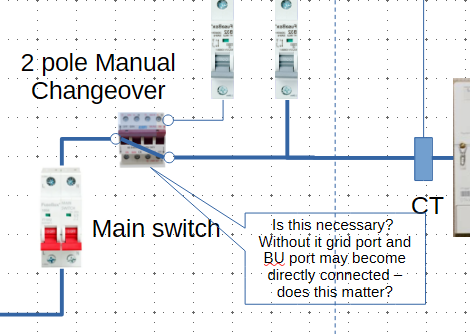
Yes, it certainly does matter if the Grid Port and the (Maintained) 'back-up' port could become connected!
That would be a serious breach of the regulations, and any electrician who agreed to undertake such a wiring configuration should lose their accreditation.
1: In the event of a a fault at the local substation, the DNO's engineers would isolate it by opening the contacts on its 11kV feed.
That should allow them to safely work on the transformer.
Your hybrid inverter would sense the absence of 50Hz at the grid port, and allow the Maintained Port to operate by using the inbuilt 50Hz frequency generator.
The 240v supply from the Maintained Port would energise the cable connecting your house to the local sub-station,
which would put the DNO engineers at risk of electrocution.
2: Even if the engineers survive, complete the repair and didn't notice that your Feeder cable had become live on one phase,
when they reconnect the 11kV supply to the transformer, your Maintained Port will be operating its 50Hz output unsychronised to the grid.
You will have pitted your inverter against the entire might of the British electricity grid.
It's a battle which should (rightly) cause all your fuses and trips to blow!
Even if you were to have a Changeover Switch in this position, I would anticipate the electrician wanting it in a sealed/tamper-resistant enclosure.
There would be 440v between the incoming grid and the output of your Maintained port.
They are effectively two independent phases at the moment when the grid becomes re-energised,
and will be so for around 60-seconds due to the time-delays required for G98 certification.
Save energy... recycle electrons!
25/01/2026 11:48 am
We requested a 16kW inverter with G100 enabled at whatever the level the DNO wanted. Their answer was to ignore all of the technology and simply limit the inverter to 10KW with 10KW export.
Tell us why you'd want to export anything.
It makes it more difficult for you to obtain approval, and it's bad for the grid because it increases losses at the local substation.
And I don't think you mean "G100 enabled".
G100 is a concept which covers situations when there are two or more sources of generation on the site.
Can we assume that you intend to refer to the level of permitted export to the grid?
Save energy... recycle electrons!
25/01/2026 12:47 pm
Thanks for all the help so far. Based on all the discussions here is my latest iteration for a system which I think would work with Solis inverter and likely also the Sunsynk, maybe others too. There are still a couple of unresolved questions around the changeover mechanism, the answer to one of which may well be inverter dependent.
Broadly I agree it can work with the Solis S6 hybrid. Other inverters with three ports, grid, backup/ups/islanding and gen are likely to work (but gen port needs to be able to work in AC coupling).
Hope you do not mind me numbered the points, for ease of additional comment.
The grid/off grid changeover characteristics are, I think
- manual grid/off grid changeover
- no need to preselect circuits which are available off grid
- manual load shedding needed required when going off grid if house load at time exceeds inverter capacity
1. this will connect the backup port to the consumer unit on the left. It provides convenience to allow the home to be served from the grid when the inverter is under maintenance (in this situation, it will connect grid to circuits. agree with @transparent : this cannot connect backup to grid, it would not even work with the Solis..).
2&3. yes, but you need to decide what inverter model and so power you will have available (this is why I choose 8kw).
At any point where the grid fails and the sources available fall a bit short, I believe I was told the Solis will hold it for a few seconds (this is part of the being able to hold it until a fossil fuel generator kicks in). When it does not have enough power, it will switch off the backup port. So I did not connect my EV charger to that (we still have a diesel car for any extremely unlikely prolonged emergency). We prefer for the electronics to continue to work, the gas boiler, the house alarm, etc. What I found is that, at 8kw, and with the 1.25 power factor Solis recommends, all cables and circuit breakers and protectors become a bit harder to find. And then the rule that electricians try to stick to (to have all the kit in a CU from the same manufacturer) will add restrictions. Even if I believe the regs guide them to mark amber and not red if you have a mix...
If by load shedding you mean that, after the inverter powers it all down, you switch off some circuits and then tell the inverter to have restart, yes, this will work.
I think it allows
- On grid with solar export or self consumption
- On Grid with battery charging from grid or solar excess
- On grid with no battery charging
- Off grid with solar self consumption
- Off grid with battery charging solar excess
- Off grid with power from battery/solar
As only the battery inverter is connected to the grid, I think it is the capacity of that only which ultimately matters for the connection, however this may depend on DNO interpretation.
I think this Solis allows it all. But with 2 and 5, since I only used the smart/gen port as an additional lower priority backup, I cannot confirm. Of course some people would connect all PV inputs directly to the Solis and not need to be concerned about the way the smart port handles it. But what you are looking to do could be relevant to many early PV systems. Contacting a distributor is probably the best way to get this confirmed by Solis. Assuming they do, you gain a commitment they will make it work, sometimes these are not limited by the hardware but by the firmware/menu options. 😉
And I can confirm that, in my case, UKPN was not interested in anything that was not directly connected to the grid (but clearly I only have a battery). They checked that the diagram matched what they expected and of course are welcome to visit at any point.
8kW Solis S6-EH1P8K-L-PLUS hybrid inverter; G99: 8kW export; 16kWh Seplos Fogstar battery; Ohme Home Pro EV charger; Vaillant Arotherm Pro 7kW; 100Amp head, HA lab on mini PC
25/01/2026 1:19 pm
Even if you were to have a Changeover Switch in this position, I would anticipate the electrician wanting it in a sealed/tamper-resistant enclosure.
There would be 440v between the incoming grid and the output of your Maintained port.
They are effectively two independent phases at the moment when the grid becomes re-energised,
and will be so for around 60-seconds due to the time-delays required for G98 certification.
Solis made it absolutely clear that this (connecting backup to grid) needs to be prevented - doing so would damage the inverter. In my case, they even asked to see the initial wiring of the circuits.
When my switch is providing grid power to the inverter, it simultaneously stops providing power to the circuits. The risk you highlight is reduced, as 2 independent things would need to go wrong here for it to be an issue... My primary goal is still safe and fully automated switching from grid to off grid. If I knew how reliably it works, I would have not bothered with my changeover switch. With 8k, I can max the ovens and the kettle would not trip it... And I think it supports an additional load for a few seconds anyway.
In James´ case, if I understand the goal of his changeover switch well, the risk is eliminated.
But for others reading it, it makes sense to highlight the risk in the scenario of such wrong wiring.
8kW Solis S6-EH1P8K-L-PLUS hybrid inverter; G99: 8kW export; 16kWh Seplos Fogstar battery; Ohme Home Pro EV charger; Vaillant Arotherm Pro 7kW; 100Amp head, HA lab on mini PC

25/01/2026 1:19 pm
We requested a 16kW inverter with G100 enabled at whatever the level the DNO wanted. Their answer was to ignore all of the technology and simply limit the inverter to 10KW with 10KW export.
Tell us why you'd want to export anything.
It makes it more difficult for you to obtain approval, and it's bad for the grid because it increases losses at the local substation.
And I don't think you mean "G100 enabled".
G100 is a concept which covers situations when there are two or more sources of generation on the site.Can we assume that you intend to refer to the level of permitted export to the grid?
Many thanks,
G100, or EREC G100, is a UK technical standard for Customer Export Limitation Schemes (CLS) that manages how much electricity renewable systems (like solar PV or battery storage) can export to the grid. It ensures that localized generation does not exceed grid capacity, allowing for higher, compliant installation limits.
Key aspects of G100 include:
-
- Purpose: It acts as a safety mechanism to prevent overloading the local distribution network (DNO).
- Application: Used when a site's potential generation exceeds the permitted export capacity, frequently required alongside G99 applications
.
- Mechanism: G100-compliant systems (often a combination of inverters and meters) monitor the power flow and, if necessary, instruct inverters to reduce output or increase on-site demand to stay within limits.
- Relevance: It is essential for avoiding network upgrades, allowing homeowners and businesses to install larger systems even when grid capacity is restricted.
We understand this. My point was we would have been very happy for the DNO to impose a G100 LImit on the export for the site. Instead, they simply limited the inverter size and matched that to the export limit on the G99 approval. They could have said the 16kW inverter is fine with a G100 limitation of 10kW, or 3kw or whatever number! Which would have unlocked our plans.
Cheers
This post was modified 9 months ago by antonical
6.5kWp of Solar G98 3.6kW inverter 32kWh battery. Samsung Gen 7 16kW Integrated Unit Newark Cylinders 'Heat Geek' Custom SuperTank and 50Ltr Volumiser Tank.

SPONSORS
Degrees of Separation

Latest Posts
-

RE: Heat pump branding. Clever, contemporary… or a bit too much?
I think Heat Geek have done an amazing job on their bra...
By Tomtheheatingengineer , 7 hours ago
-
RE: HeatGeek vs Octopus surveys: puzzling disparity - any ideas why?
I have just had 3 heat loss surveys, one by heat geek o...
By David , 7 hours ago
-
RE: Heat Geek Zero Disrupt: Are We Sleepwalking Into Another Race to the Bottom?
I think that's the key question. After all inverter uni...
By Prunus , 9 hours ago
-
RE: battery storage without solar
As of October 1st they need specific qualifications to ...
By EtchedPixels , 10 hours ago
-
RE: How should the Boiler Upgrade Scheme be reformed?
A unit which uses water to transfer the heat/chill from...
By Temperature_Gradient , 10 hours ago
-
RE: Renewables & Heat Pumps in the News
With regards to the BUS grant raid, I gave it more thou...
By ASHP-BOBBA , 10 hours ago
-
RE: Why are ASHP installs so expensive?
The whole system seems to work on the basis of...
By ian33a , 11 hours ago
-
RE: Missing flow temperature in Heat Geek proposal
Good plan. If you can get half hourly meter readings a...
By JamesPa , 16 hours ago
-
RE: Heat Pumps Without Grants: Would You Have Installed One & Will You Now?
@editor Most certainly. The heat pump was an ideal s...
By Abernyte , 16 hours ago
-
Although regulations may well vary from country to coun...
By Majordennisbloodnok , 17 hours ago
-
RE: Does anyone have experience of a smart water meter?
Yep I caught our slow leak from a £100 bill rise 8)
By EtchedPixels , 17 hours ago
-
RE: Do You Need a Buffer Tank or Low Loss Header for Underfloor Heating in a Large Property?
@jamespa in some cases, failing the Turing test might b...
By GrahamF , 20 hours ago
-
RE: Passiv Smart Thermostat - Help & Forum Support
@energystoragetech The heat capacity of some...
By JamesPa , 22 hours ago
-
RE: tepeo ZEB UK Support & Info Thread
Sorry you are correct, I was remembering figures from t...
By JamesPa , 1 day ago




SPONSORS

