

Notifications
Clear all
Joining the Renewable Heating Hub forums is completely free and only takes a minute. By registering you’ll be able to ask questions, join discussions, follow topics you’re interested in, bookmark useful threads and receive notifications when someone replies. Non-registered members also do not have access to our AI features. When choosing your username, please note that it cannot be changed later, so we recommend avoiding brand or product names. Before registering, please take a moment to read the Forum Rules & Terms of Use so we can keep the community helpful, respectful and informative for everyone. Thanks for joining!

20/01/2026 6:06 pm
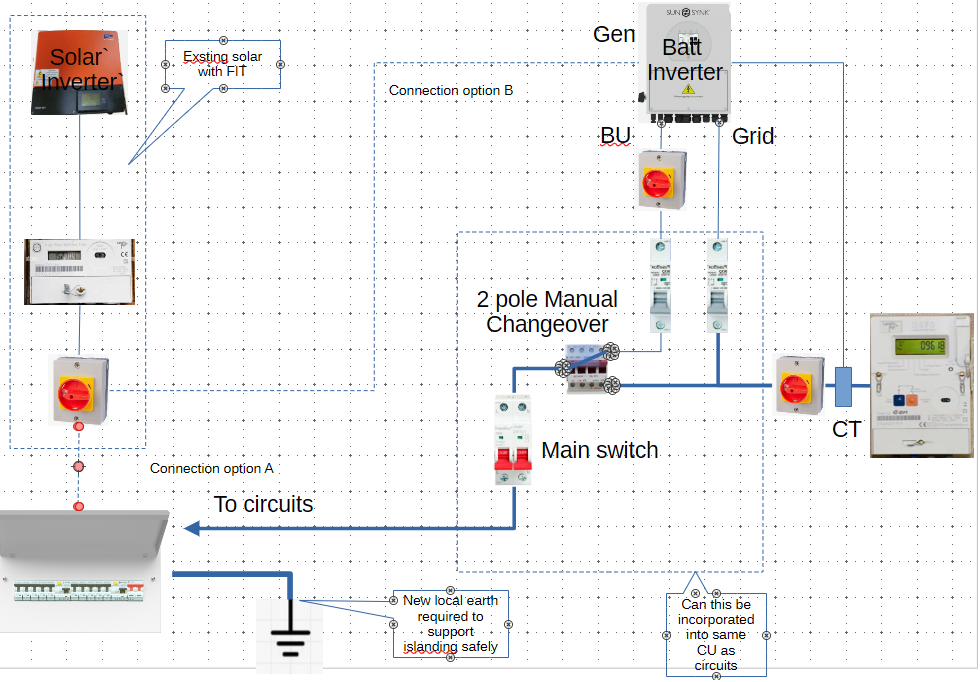
After a lot of discussion earlier on this thread, with much help from @batpred and @transparent, I have come to the diagram below as my 'strawman' arrangement for a solution that
- incorporates my existing solar (which benefits from a generous FIT so needs to be metered separately)
- allows islanding with manual changeover but does not require me to predetermine which circuits will be run in islanding mode.
- has a safe earth arrangement
There are some niggles/points:
- There are two possible connection points for my existing solar, which have different implications for the regulatory notifications/applications and inverter configurations. Which I choose if I go ahead will depend on what my DNO says. Opt B assumes that the inverter provides the necessary grid reference frequency when islanded, and accepts input from the generator/backup port when grid connected. This needs to be checked and may rule the option out.
- Although the way islanding is done does not require me decide up front which circuits to support in a power cut, it does mean that I will need manually to shed load if the consumption when islanded would otherwise exceed the capacity of the battery inverter.
- Im not sure whether the switch/breaker arrangement in the dotted box can be incorporated into the main CU or an electrician will insist on it being in a separate CU
- After much discussion the conclusion was reached above that, as my supply does not already have a LOCAL earth (because is it TN-S, same would also apply to TN-C-S) then a new local earth is required for islanding, to guard against cable disconnection also disconnecting the earth provided by the grid. The new local earth can be connected to grid earth and existing bonding arrangements remain intact
- The diagram assumes that the inverter itself separates the neutral when islanded from the grid neutral
- The CT clamp is the one that the inverter provides to limit export/ensure zero export. Implementations of this seem to differ so inverter specs need to be checked.
I welcome (but have no expectation of) comments on this arrangement and @mars perhaps it may help you short circuit (no pun intended but apologies anyway) some of your own discovery.
This post was modified 9 months ago 3 times by JamesPa
4kW peak of solar PV since 2011; EV and a 1930s house which has been partially renovated to improve its efficiency. 7kW Vaillant heat pump.
2


20/01/2026 6:10 pm
@jamespa, you've partially addressed a question in your diagram I forgot add to my previous post, and that's compatibility of my SolarEdge PV inverter and its ability to play nicely with the battery inverter. Is that even a consideration? I don't even know, which sums up my knowledge at this point. 😳
Will post more questions and replies to those above later tonight.
🔥 Britain’s Heat Pump Shitshow
How Installing a Heating System Became a National Nervous Breakdown
Free UK shipping.
📗 Heat Pumps Explained
A Jargon-Free Guide for Homeowners
Rewritten and updated for 2027
📘 From Zero to Heat Pump Hero
🛠️ Bodge Buster
New to heat pumps?
Take the Heat Pump Fundamentals course and use INTRO50 at checkout for 50% off.
20/01/2026 6:17 pm
My solar inverter is so old Im considering it to be dumb, hence the two connection point options. This is where regulatory considerations (G98, 99, 100) and the DNO/inverter manufacturer interpretation thereof start complicating matters in a way which is not quite determinate.
It looks like at least one combination will work from a regulatory standpoint, based on the discussion upthread, but the next stage for me (if I go ahead which remains TBD) is to approach my DNO, UKPN.
If you dont need a generation meter for the PV there are more straightforward options. As I have 10 years of FIT at >25p/kWh generated still to claim, ie about £10K in total, I do.
4kW peak of solar PV since 2011; EV and a 1930s house which has been partially renovated to improve its efficiency. 7kW Vaillant heat pump.
1
20/01/2026 6:31 pm
@majordennisbloodnok, my list of requirements is rather straightforward.
- 15-20kWh of storage
- Ability to island and recharge when the solar PV kicks in (in the event of a power outage). Enough power to keep the fridges, home sewage treatment plant pumps, etc. running. There'd be no heating in this scenario.
- Decent app control to allow discharging and recharging on demand, schedules, etc.
🔥 Britain’s Heat Pump Shitshow
How Installing a Heating System Became a National Nervous Breakdown
Free UK shipping.
📗 Heat Pumps Explained
A Jargon-Free Guide for Homeowners
Rewritten and updated for 2027
📘 From Zero to Heat Pump Hero
🛠️ Bodge Buster
New to heat pumps?
Take the Heat Pump Fundamentals course and use INTRO50 at checkout for 50% off.


20/01/2026 8:01 pm
Enough power to keep the fridges, home sewage treatment plant pumps, etc. running.
I think you need to add up the kW rating for each of these appliances (incl a switch-on surge if there is one).
That total then translates into how many kW the inverter(s) need to deliver.
The 15–20kWh of battery capacity you'd like only tells us half the answer.
I don't know my way around the Solar Edge models, although I'm well aware of the concept they use.
If the solar panels are equipped with Solar Edge optimisers, then they can only be connected into a Solar Edge inverter.
Could you tell us the model number of that inverter?
We could then assess the possibility of it being connected as an input to your new inverter(s) via an Auxiliary port.
Save energy... recycle electrons!
1

20/01/2026 8:35 pm
@majordennisbloodnok, my list of requirements is rather straightforward.
- 15-20kWh of storage
- Ability to island and recharge when the solar PV kicks in (in the event of a power outage). Enough power to keep the fridges, home sewage treatment plant pumps, etc. running. There'd be no heating in this scenario.
- Decent app control to allow discharging and recharging on demand, schedules, etc.
my 2 pennies.
Difficult to make assumptions on the power you require. My Solis inverter delivers 8kw on the backup/ups/islanding port, for as long as it has battery, PV or grid power, with 4ms transparent switch on grid failure. It stops providing power to the main grid port if it senses there's no grid ("anti-islanding").
Some low voltage lifepo4 batteries start at 16kwh capacity, so it could be very simple - but there are single 32kwh batteries. LV batteries are 48V (like Seplos Fogstar), as opposed to the HV 72V batteries with higher £/kwh.
I find the Soliscloud app very functional. Getting to the schedules requires quite a few clicks, but perhaps many users prefer the Solis AI or other EMS settings. I mostly use the app to have a look at the charts and that only requires starting it.
8kW Solis S6-EH1P8K-L-PLUS hybrid inverter; G99: 8kW export; 16kWh Seplos Fogstar battery; Ohme Home Pro EV charger; Vaillant Arotherm Pro 7kW; 100Amp head, HA lab on mini PC
1
20/01/2026 9:26 pm
Quite a few of the current models appear to support generator input too, which may be a consideration if you want an islanded solution for short to medium power cuts with the option of filling up the battery or running the home from generator if the power cut persists. None of these are features I've investigated yet with Growatt; I merely saw them mentioned, so please don't take it as anything more than a knot in a handkerchief for further thought.
Perhaps this Growatt is usable for basic cases? Or did they miss a 0? I see it handles LV batteries. I would check if true 4ms UPS or 10ms, but perhaps it does not matter so much.
8kW Solis S6-EH1P8K-L-PLUS hybrid inverter; G99: 8kW export; 16kWh Seplos Fogstar battery; Ohme Home Pro EV charger; Vaillant Arotherm Pro 7kW; 100Amp head, HA lab on mini PC

20/01/2026 11:03 pm
We are in an extremely well insulated (virtually passive) all electric house - we self built it in 2011.
We have a full fat 3.68kw full-fat FiT pV system plus another 5.2kw of dc coupled PV.
We have 14kwhrs of Pylontec LiFePo4 batteries tied to a Victron Multiplus - the multiplus provides full house back up in the event of a power cut which we get quite frequently living out in the sticks with overhead supplies.
We are essentially off grid for about 8 months of the year but during the winter we charge the batteries overnight on a cheap E7 tariff.
We have a Vaillant 5kw ASHP which runs in the winter overnight on cheap E7 electricity, if the weather is sub zero we might run the heat pump during the day but such days tend to be sunny so the power likely comes directly from the solar rather than from the batteries.
if we built again, we would pretty much repeat the system we have.
3.68kw FiT AC coupled pv
5 kw of DC coupled pv
14 kWhr of battery
3kw A2A ASHP
5 kw Vaillant ASHP heating UFH & Thermal store
3

21/01/2026 9:48 am
Quite a few of the current models appear to support generator input too, which may be a consideration if you want an islanded solution for short to medium power cuts with the option of filling up the battery or running the home from generator if the power cut persists. None of these are features I've investigated yet with Growatt; I merely saw them mentioned, so please don't take it as anything more than a knot in a handkerchief for further thought.
Perhaps this Growatt is usable for basic cases? Or did they miss a 0? I see it handles LV batteries. I would check if true 4ms UPS or 10ms, but perhaps it does not matter so much.
That Growatt, @batpred, is the one we have, so all my comments before are about that. It's fine with the 6kWh battery we have because at 3kW it can charge it fully in two hours, but with a much larger battery any recharging would simply take too long. You're right, though, that it does allow for islanding and it has served us pretty well for the last four years.
105 m2 bungalow in South East England
Mitsubishi Ecodan 8.5 kW air source heat pump
18 x 360W solar panels
1 x 6 kW GroWatt battery and SPH5000 inverter
1 x Myenergi Zappi
1 x VW ID3
Raised beds for home-grown veg and chickens for eggs
"Semper in excretia; sumus solum profundum variat"
21/01/2026 8:57 pm
LV batteries are 48V (like Seplos Fogstar), as opposed to the HV 72V batteries with higher £/kwh.
For regulatory purposes in UK, batteries which connect to inverter(s) at 75v DC and below may be installed by anyone.
Above 75v the installation requires a qualified electrician.
High Voltage batteries have the modules linked in series; adding another module therefore requires breaking into the existing current-carrying cables.
HV batteries are being used more because they are cheaper than LV units.
That's because the thickness of the wire conductor is dictated by the current (not the power in Watts).
Copper is getting much more expensive, so there's an incentive for manufacturers to switch to HV, which makes their battery units appear to be cheaper.
However, the requirement to use a professional installer would quickly override the price differential when compared with a self-install.
The risk of serious injury or death is much greater from a DC electric shock.
The reflex action which jerks away a hand which has made contact with a 240v AC mains supply, doesn't work with Direct Current.
Instead the hand gets 'stuck' to the conductor, and requires effort to pull it away.
No one should contemplate a DIY-install of HV storage batteries.
Save energy... recycle electrons!
22/01/2026 1:17 am
While I now find some standalone 48V (LV) batteries for £70+/kwh, I could no longer find 72V easily and what I did seemed to be 2 or 3 times (also ready-made standalone).
I realise that industrial units come with voltages above 200V, clearly targeted at professional installers!
8kW Solis S6-EH1P8K-L-PLUS hybrid inverter; G99: 8kW export; 16kWh Seplos Fogstar battery; Ohme Home Pro EV charger; Vaillant Arotherm Pro 7kW; 100Amp head, HA lab on mini PC
22/01/2026 12:24 pm
I haven't seen any HV storage product offered with 72v per module, although it's not an unreasonable figure.
That would use a BMS capable of supporting twenty-two LiFePO₄ cells.
I ought to have also pointed out that HV configurations have less resilience against failure.
Since the cells are in series, a fault with one cell or BMS will stop the entire array from working.
Save energy... recycle electrons!
1


SPONSORS

Degrees of Separation

Latest Posts
-

RE: Heat pump branding. Clever, contemporary… or a bit too much?
I think Heat Geek have done an amazing job on their bra...
By Tomtheheatingengineer , 5 hours ago
-
RE: HeatGeek vs Octopus surveys: puzzling disparity - any ideas why?
I have just had 3 heat loss surveys, one by heat geek o...
By David , 5 hours ago
-
RE: Heat Geek Zero Disrupt: Are We Sleepwalking Into Another Race to the Bottom?
I think that's the key question. After all inverter uni...
By Prunus , 7 hours ago
-
RE: battery storage without solar
As of October 1st they need specific qualifications to ...
By EtchedPixels , 7 hours ago
-
RE: How should the Boiler Upgrade Scheme be reformed?
A unit which uses water to transfer the heat/chill from...
By Temperature_Gradient , 8 hours ago
-
RE: Renewables & Heat Pumps in the News
With regards to the BUS grant raid, I gave it more thou...
By ASHP-BOBBA , 8 hours ago
-
RE: Why are ASHP installs so expensive?
The whole system seems to work on the basis of...
By ian33a , 8 hours ago
-
RE: Missing flow temperature in Heat Geek proposal
Good plan. If you can get half hourly meter readings a...
By JamesPa , 14 hours ago
-
RE: Heat Pumps Without Grants: Would You Have Installed One & Will You Now?
@editor Most certainly. The heat pump was an ideal s...
By Abernyte , 14 hours ago
-
Although regulations may well vary from country to coun...
By Majordennisbloodnok , 14 hours ago
-
RE: Does anyone have experience of a smart water meter?
Yep I caught our slow leak from a £100 bill rise 8)
By EtchedPixels , 14 hours ago
-
RE: Do You Need a Buffer Tank or Low Loss Header for Underfloor Heating in a Large Property?
@jamespa in some cases, failing the Turing test might b...
By GrahamF , 18 hours ago
-
RE: Passiv Smart Thermostat - Help & Forum Support
@energystoragetech The heat capacity of some...
By JamesPa , 19 hours ago
-
RE: tepeo ZEB UK Support & Info Thread
Sorry you are correct, I was remembering figures from t...
By JamesPa , 1 day ago


SPONSORS
