

Notifications
Clear all
Joining the Renewable Heating Hub forums is completely free and only takes a minute. By registering you’ll be able to ask questions, join discussions, follow topics you’re interested in, bookmark useful threads and receive notifications when someone replies. Non-registered members also do not have access to our AI features. When choosing your username, please note that it cannot be changed later, so we recommend avoiding brand or product names. Before registering, please take a moment to read the Forum Rules & Terms of Use so we can keep the community helpful, respectful and informative for everyone. Thanks for joining!

Topic starter
20/02/2025 5:19 pm
ROI is a complex topic with so many variables and impossible to have one size fits all. Installed infrastructure varies, grants change etc.
Listed Grade 2 building with large modern extension.
LG Therma V 16kw ASHP
Underfloor heating + Rads
8.7kw pv solar
3 x 8.2kw GivEnergy batteries
1 x GivEnergy Gen1 hybrid 5.0kw inverter
Manual changeover EPS
MG4 EV

21/02/2025 11:35 am
Thanks for posting those calculations @tim441
Your Topic Title first suggested to me that you were yet to install battery storage...
but your tag line states otherwise.
I am absolutely the worst contributor here to make comments about RoI
I actually never do those calculations for my own installations.
But I will make three observations for the benefit of others who will be reading this in future:
1: The financial viability of a renewable energy or heat-pump installation depends on the future (electricity) tariffs which will be used.
Regardless of political policy, the laws of physics are such that the present tariff strategies won't exist for much longer.
a: The National Energy System Operator (NESO) is aiming for total decarbonisation of the electricity grid by 2030.
At the moment, the majority of the overnight cheap-rate tariff periods are provided by Combined Cycle Gas Turbine (CCGT) generation.
Their decommissioning will coincide with greater uptake of EVs, which are typically recharged overnight.
b: An increasing proportion of our electricity bills will be paying for massive grid-infrastructure upgrades.
That grid reinforcement is required to connect ever more generation and storage sites to the grid, far beyond the requirements of this nation.
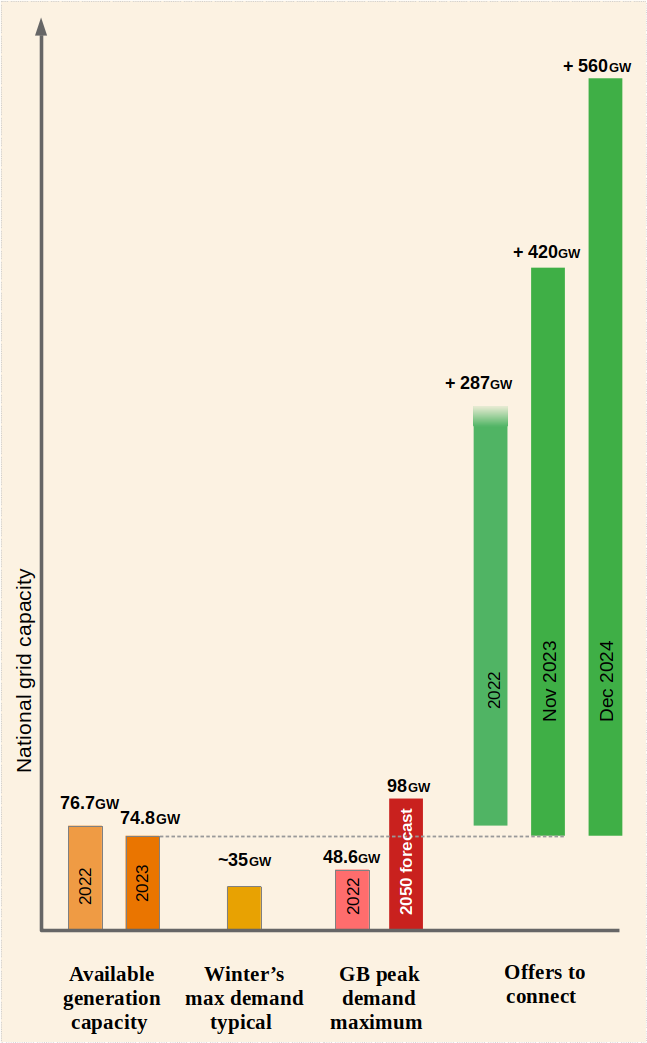
"With the transmission pipeline currently oversubscribed at more than 560GW – three times what is
needed to meet Britain’s net zero goals – there is huge uncertainty around what substations need
building and where."
National Grid Electricity Transmission, Dec’24
This is worded so as to appeal to households with low electricity consumption,
for whom the standing charges account for a high proportion of the bill.
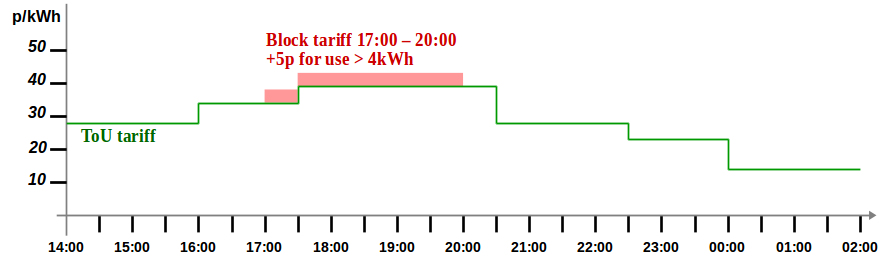
Simultaneously, Ofgem is considering that Block Tariffs should be introduced.
Block Tariffs are a standard feature within the firmware of all Smart Meters.
They allow a 'rule' to be set, whereby consumption is measured over several half-hour periods,
the price-per-kWh is then adjusted (up or down) beyond that defined by your base tariff.
For example, during the early-evening period of high electricity demand, a Block Tariff might be applied to increase the overall costs for high-usage.
A Block Tariff is independent of any Time-of-Use (ToU) tariff,
and can be superimposed onto it.
3: There are three main approaches to be considered when selecting in-home battery storage.
a) Chose a 'package deal' with an Inverter and Battery from the same manufacturer.
b) Choose a generic inverter and do a DIY build of your own battery
c) Do a mix of (a) & (b) whereby a generic inverter is connected to a pre-manufactured set of batteries
@tim441 indicates that he has chosen Option (a), using an inverter and three 8.2kW batteries from Givenergy.
That's the most expensive route.
GivEnergy are a UK-based company with an excellent reputation.
The issue to be faced is whether Option (a) offers adequate future resilience and flexibility.
- What happens if GivEnergy ceases to trade?
- Does the hardware have inbuilt obsolesence?
In this case, Tim might have a problem.
GivEnergy's announcements at the end of 2024 show that their future is to concentrate on their All-in-One products.
There is a new suite of (high-voltage) batteries...
... which are not backwards compatible with the existing stand-alone GivEnergy Inverters.
Those decisions make sound commercial sense for GivEnergy, based on ideas from their new(ish) product design strategist.
Their direction underlines a commitment to take a large share of the future UK storage market.
Existing satisfied customers might think otherwise.
Save energy... recycle electrons!
1
Topic starter
21/02/2025 11:51 am
@transparent thanks for adding interesting & useful food for thought.
On GivEnergy I'm definitely feeling the need to upgrade at some point anyway. The current 2.6kwh charge/discharge rate to/from batteries is a significant barrier to taking advantage
- of cheap slots
- Of dumping to grid if high value slots or SavingSessions
- Of utilising for whole home demand in power cut as EPS.
I'm hoping an obvious point will become apparent when it makes sense. Perhaps around 10 years. I suspect my kit will have a minimal 2nd hand value even now. My objective will be kit like Tesla Powerwall, GivEnergy All-in-one etc where I can meet all 3 above targets. With an ashp almost certainly still needing 20kwh or more storage.
Of course by then V2G, V2H technologies might become mainstream and be part of the decision making process.
Listed Grade 2 building with large modern extension.
LG Therma V 16kw ASHP
Underfloor heating + Rads
8.7kw pv solar
3 x 8.2kw GivEnergy batteries
1 x GivEnergy Gen1 hybrid 5.0kw inverter
Manual changeover EPS
MG4 EV
21/02/2025 5:35 pm
On GivEnergy I'm definitely feeling the need to upgrade at some point anyway.
[...]
I'm hoping an obvious point will become apparent when it makes sense. Perhaps around 10 years.
Erm... the 'obvious point' for such an upgrade is right now. 😮
Since GivEnergy are announcing a new range of Hybrid inverters which will only operate with their new high-voltage cells,
then it's highly unlikely that they will continue to manufacture the 'low-voltage' inverters such as your existing model.
GivEnergy were the only inverter manufacturer which had a lower power rating for discharge.
That's why you're only able to get 2.6kW of mains (240v AC) output from a 5kW inverter.
Adding a second 5kW GivEnergy low-voltage inverter might not even be possible.
They've struggled to get inverters operating in parallel.
You need to check this point with them.
Your other option is to continue with the existing 3x 8.2kW batteries, but choose an entirely different inverter.
I believe your batteries are built from sixteen LiFePO4 cells in series, offering a nominal 52v DC connection.
There are lots of inverters which could satisfactorily operate with them.
Save energy... recycle electrons!

Topic starter
22/02/2025 8:59 am
@transparent right now is definitely the ideal!
As at 2021 when installed the setup was probably OK vs cost and my limited knowledge. But landscape is much changed now.
It's also a question of whether it's worth upgrading inverter as standalone project if slightly longer term I'm more likely to move to a bigger upgrade. Including batteries and EPS setup. Not just a financial question or ROI... and not such a simple decision!
Listed Grade 2 building with large modern extension.
LG Therma V 16kw ASHP
Underfloor heating + Rads
8.7kw pv solar
3 x 8.2kw GivEnergy batteries
1 x GivEnergy Gen1 hybrid 5.0kw inverter
Manual changeover EPS
MG4 EV
22/02/2025 9:45 am
Let's assume that the three batteries are "good" and use LiFePO4 cells, each with a capacity of around 160Ah.
Their only significant limitation for the future is how much charge/discharge current can be supported by their integral Battery Management System (BMS) device.
A 8.2kWh model is not listed on their website, so I can't check the specification.
Do you still have the original datasheet?
The value of your Gen-1 Givenergy inverter depends almost entirely on whether it can be operated in parallel with another identical unit.
Does it have a "parallel operation" port to which cables can be connected?
If so, then it has some residual value to another owner.
And if not, then its low output of only 50% of its overall power-rating means that it's effectively worthless. 😣
160Ah LiFePO4 cells are readily available.
They are most often used in pre-built 12v batteries to be used in vehicles.
In any case, despite the imbalance of capacities, there are still arguments in favour of adding more battery storage with higher-capacity cells.
The most common type is the 280Ah, because it's the low-point on the curve of price v. capacity.
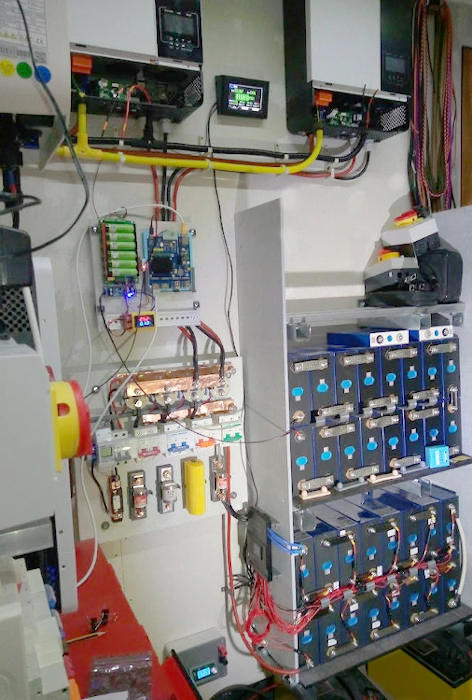
A 16-cell battery with 280Ah cells gives you a whopping 14kWh.
I have four of those.
Save energy... recycle electrons!
1
Topic starter
22/02/2025 10:01 am
@transparent wow! A fine looking setup...
I think this site has datasheets etc for my old kit
https://www.renugen.co.uk/givenergy-8-2kwh-lifepo4-battery/
Yes, I've got some decisions to make.... at some point
Listed Grade 2 building with large modern extension.
LG Therma V 16kw ASHP
Underfloor heating + Rads
8.7kw pv solar
3 x 8.2kw GivEnergy batteries
1 x GivEnergy Gen1 hybrid 5.0kw inverter
Manual changeover EPS
MG4 EV
22/02/2025 11:12 am
OK. So I think you need to grab all those datasheets and the scant Installation Note before Renugen remove them from their site.
That stuff is over 3 years old.
GivEnergy is very much a different company now... for the better! 🙂
Back then their specs contained obvious errors...
... which their distributors blindly copied.
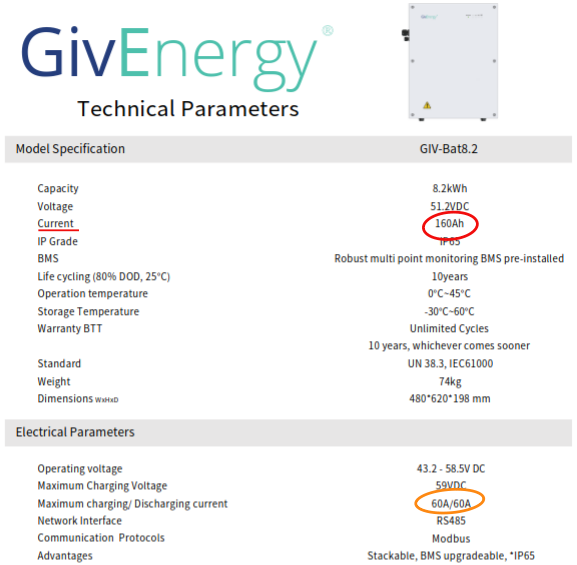
Current is measured in Amps... not Amp-hours !
That 160Ah figure refers to the cell capacity, which is what I 'calculated' earlier using guestimation.
The other salient figure to note is the 60A charge/discharge current, circled in orange.
That's the maximum rating permitted by the internal BMS.
You can't just swap-out for a different BMS because that maximum current is also dictated by the size of the internal cables.
Having said that, the maximum current which a LiFePO4 cell would be expected to deliver continuously is half of its Amp-hour rating.
Thus a battery with 160Ah cells would operate just fine with an 80A BMS,
provided the three internal cables were large enough.
Your GivEnergy batteries are under-specc'd to provide a margin of reassurance.
The product of the max.current and the nominal output voltage gives you the peak power-rating for each battery:
60A x 52v = 3120 watts, which is 3.12kW
You have three such batteries connected in parallel,
which can therefore provide 9.3kW
Apologies if I'm labouring over this maths.
There are others reading this topic who will also have 'older' GivEnergy products.
Compare those Battery ratings with those for my own configuration.
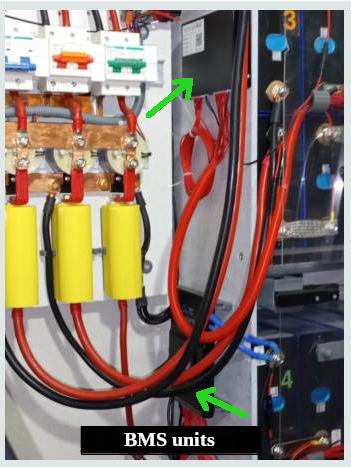
I have 280Ah cells, but 'protected' by 100A BMS units.
100A x 52v is roughly 5kW output power for each battery.
I too have underspecc'd my battery build.
It's common practice.
I've got some decisions to make.... at some point
Yes.
But before you get there, I would recommend that you join in and comment on any other Battery Storage topics which arrive here on the Forum.
Here is the right place to make all the mistakes...
... rather than when you actually buy something.
That will give you more confidence in making your own decision whenever the time comes.
Save energy... recycle electrons!
1

Topic starter
22/02/2025 11:45 am
@transparent many thanks- much valuable food for thought. Both for me and others.
Listed Grade 2 building with large modern extension.
LG Therma V 16kw ASHP
Underfloor heating + Rads
8.7kw pv solar
3 x 8.2kw GivEnergy batteries
1 x GivEnergy Gen1 hybrid 5.0kw inverter
Manual changeover EPS
MG4 EV

SPONSORS

Degrees of Separation
Latest Posts
-

RE: Indevolt Batteries UK Support & Info Thread
@dansus yeah, that definitely needs fixing. Good spot. ...
By Mars , 4 hours ago
-
RE: How will removing the standing charge on gas bills benefit heat pumps?
@toodles GIGO always stands! My Cosy 6, as you can...
By Watcher , 8 hours ago
-
RE: How much of your renewable and home setup would still work if the internet went down?
Interestingly we had an internet outage about a month a...
By Rob of York , 14 hours ago
-
RE: Double or Triple Glazed Windows?
Posted by: @singlespeed With 9 years repairing windo...
By Rob of York , 15 hours ago
-
@transparent we’re still running a secure version of PH...
By Mars , 18 hours ago
-
RE: How quickly would you want/expect heat recovery to take from setback?
Much longer than that here. The heating isn't even on. ...
By bobflux , 1 day ago
-
RE: Passiv Smart Thermostat - Help & Forum Support
Obviously the weather is changeable but there's a defin...
By Singlespeed , 1 day ago
-
RE: The Changing Jet Stream Could Challenge UK Air Source Heat Pumps
@rob-of-york I must admit that when we had a Daikin hea...
By Toodles , 1 day ago
-
RE: Forum updates, announcements & issues
Get the Renewable Heating Hub heads-up on WhatsApp. I...
By Mars , 2 days ago
-
RE: Safety study for plug in batteries out to tender - looks like Q3 2027 at best before legal
@editor I pointed out to the one of the Fuse execs that...
By dansus , 2 days ago
-
RE: 15kw pump for 225m2 1990's house - over kill?
@seaviews As well as loft insulation, there are othe...
By Rob of York , 2 days ago
-
RE: BT cuts you off, Plusnet blames Openreach... welcome to “seamless” broadband switching
Both of which (in most cases) use Openreach for the las...
By JamesPa , 2 days ago
-
RE: Renewables & Heat Pumps in the News
Yes, this is a swiss and german standard I believe, Vai...
By Batpred , 2 days ago
-
RE: Octopus Cosy 12 Heat Pump Regret: Incredibly Loud, Poor Heating & Constant Hum - Help!
@editor FWIW my problem was resolved, eventually, after...
By BigFish , 3 days ago





SPONSORS