

Notifications
Clear all
Joining the Renewable Heating Hub forums is completely free and only takes a minute. By registering you’ll be able to ask questions, join discussions, follow topics you’re interested in, bookmark useful threads and receive notifications when someone replies. Non-registered members also do not have access to our AI features. When choosing your username, please note that it cannot be changed later, so we recommend avoiding brand or product names. Before registering, please take a moment to read the Forum Rules & Terms of Use so we can keep the community helpful, respectful and informative for everyone. Thanks for joining!
03/03/2026 10:09 am
And I agree, the site below seems less credible than the manual, but it makes much more sense! Here is also a screenshot of the relevant extract.
I think it is just another Grundfos manual on one of those manuals.lib sites, the wording in the description is all but the same. It is a slightly different pump, the UPM3 Hybrid rather than the UPM3 Auto. I think one difference is the former has a PWM capabilities, the latter (mine) does not.
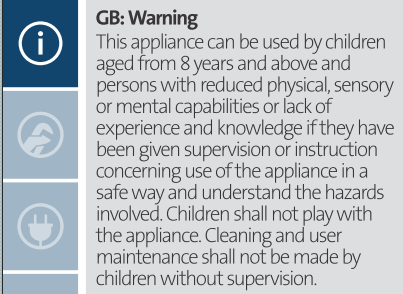
Frankly I find it impossible to take seriously the literature of a company that starts its UPM3 Auto 'Quick Guide' with an 'advisory' that 8 year olds, the blind, the deaf, the neuropathic, and not to mention the physically and mentally infirm, can all use the pump so long as they are 'given supervision or instruction':
As I said a while back, these manuals are written by AI bots running on chips a few capacitors short of a full circuit. Finding a 'performance curve' for a particular Grundfos pump makes finding a needle in a haystack look easy but at long last I think I have found one:
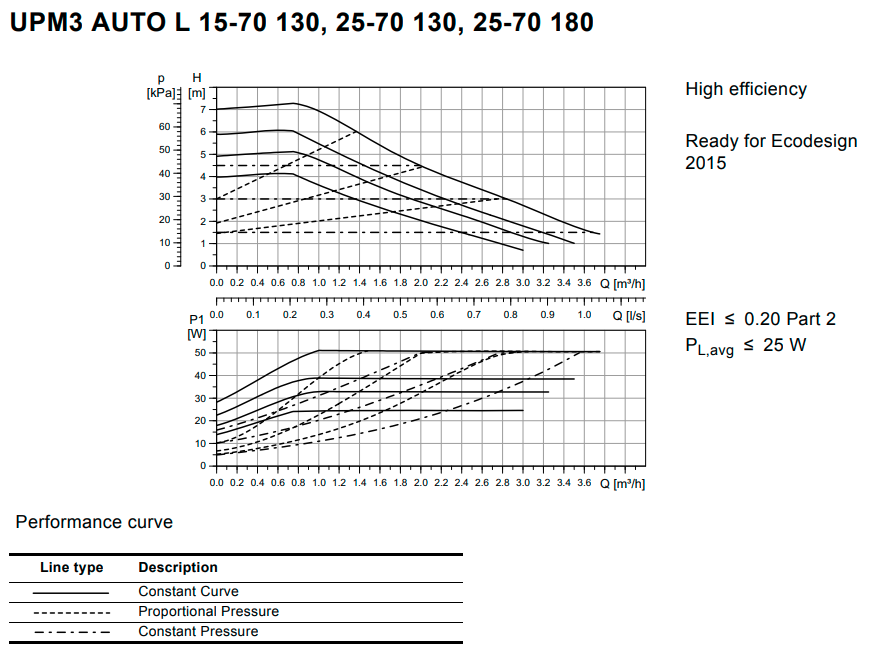
This too is as clear as mud. I am sure it is good to know that apropos of nothing, EEI ≤ 0.20 Part 2, and furthermore, that PL,avg ≤ 25 W. These are the kind of nuggets of information that help me get through my day. Elsewhere it says there are three 'CC' ('constant curve') settings, the chart has four CC lines, all showing varying speeds for a pump that runs at a constant speed. Without better labelling and explanation, that chart is nothing more than a waste of space.
However, all is not lost! I went back to a previous thread, the one that led to 'big bang' ie opening up all my lock shield valves, as a way to improve secondary flow, and was reminded of a post by the excellent @bobtskutter that it is in fact possible to calculate the secondary flow, given primary and secondary delta t and primary flow rate:
How did I calculate the secondary flow rate?
If you ignore energy accumulation within the metal work of the PEX and assume the same fluid on both sides with no phase change:
Energy reduction on hot side = Energy increase on cold side
Energy = M x Cp x DT
Energy_hot = Energy_cold
M_hot x Cp x DT_Hot = M_cold x Cp x DT_cold
Therefore:
M_cold = M_hot x DT_Hot / DT_cold
If I assume the fluid is water then density = 1, so:
flow_cold = flow_hot x DT_Hot / DT_ColdYour most recent data doesn't have a primary side flowrate, so I'll assume it's 1.5m3/hr, which seems a typical number in the data you've posted so far. The temperatures you've measured are repeatable - you've recorded roughly the same temperature 5 times. So I'll use the average value of the temperatures.
1.5 x 5 / 4 = 1.875m3/hr
The secondary flow is equal to the primary flow multiplied by the primary delta t divided by the secondary delta t. I already know the primary flow and delta t, all I need to do is manually measure the secondary delta t, and I can calculate the secondary flow.
The only problem is my heat pump's primary delta t is rarely constant. Nonetheless, the next time I get steady state running (OAT ~6-8°C), I can measure the secondary delta t and calculate the secondary flow rate. If the secondary delta t stays constant, then that must also means the secondary flow rate is constant.
What might happen to the secondary flow rate and secondary delta t when the unit is running in normal Midea cycling mode is at the moment beyond me, beyond a vague thought that if the secondary flow rate is constant, then the secondary delta t must do a merry dance to keep up with the changes in the primary delta t.
Since constant speed has basically no brains, if some TRVs close, the pump doesn't slow down, so the other still open TRVs get more flow.
Thanks. I am clear the pump has no brains, constant speed means constant speed. In a two rad system as shown, if one rad is shut down, the other gets twice the flow. But my system is totally open, all valves (TRVs and lock shields) all fully open all the time. Presumably this implies constant steady flow at the pump all the time, albeit with different flows in different branches of the circuit depending on the branches relative resistance? And this in turn means the secondary delta t must do a merry dance, as described above?
Midea 14kW (for now...) ASHP heating both building and DHW

03/03/2026 10:18 am
And this in turn means the secondary delta t must do a merry dance, as described above?
Yest exactly that. Many heat pumps (including, so far as I can, tell mine) run on constant pump speed (even if they have a water pump that is capable of modulating) and this means that the deltaT will vary depending on the load. As yet I haven't seen here a coherent argument that this is a problem.
As it happens this means that, for radiators at any rate, a straight-line WC curve is closer to the theoretical ideal having regard to the non linear relationship between radiator output and deltaT rad-room. So there is an argument that fixed flow is actually a good thing. Another argument is that fixed flow results in the need for slightly lower flow temperatures at low load. The counter argument is higher consumption by the water pump. For very low loss properties this could be significant, for properties with a more typical loss (say 6kW up) rather less so.
This post was modified 8 months ago by JamesPa
4kW peak of solar PV since 2011; EV and a 1930s house which has been partially renovated to improve its efficiency. 7kW Vaillant heat pump.
03/03/2026 10:35 am
And this in turn means the secondary delta t must do a merry dance, as described above?
Yest exactly that. Many heat pumps (including, so far as I can, tell mine) run on constant pump speed
Don't forget that here I am talking about the secondary pump. But I think the argument still applies, the secondary delta t has to do a merry dance to keep up with the primary delta t merry dance.
Midea 14kW (for now...) ASHP heating both building and DHW
03/03/2026 10:56 am
And this in turn means the secondary delta t must do a merry dance, as described above?
Yest exactly that. Many heat pumps (including, so far as I can, tell mine) run on constant pump speed
Don't forget that here I am talking about the secondary pump. But I think the argument still applies, the secondary delta t has to do a merry dance to keep up with the primary delta t merry dance.
I know and yes.
The secondary deltaT wont necessarily keep up with the primary deltaT because that will depend on what the pumps are doing, but it is determined by the exact same physics as the deltaT on a system without a buffer ie deltaT=heat lost from rad/(flow rate*specific heat capacity).
4kW peak of solar PV since 2011; EV and a 1930s house which has been partially renovated to improve its efficiency. 7kW Vaillant heat pump.


Topic starter
22/03/2026 3:00 pm
Hi all, just wanted to share an update on my ASHP journey and get some further views.
I mentioned that when I first moved in to the property the pressure gauge on (what I think is) the heating system expansion vessel was right at the bottom reading 0 bar. The system never threw up any error messages and continued to heat fine. I later understood from the installer that the previous owner had complained of pressure dropping over the course of the previous year since installation, but no leaks could be found and he never heard any more from her. I first discovered that the pressure was low in mid-January so I topped it up using the filling loop.
Coincidentally, a few days later I discovered a leak from inside the hot water cylinder, so the tank was drained and replaced under warranty (the cause if the leak - i.e. whether it was a manufacturing defect - is still being investigated by Strom, the makers).
The new tank was installed on 11th Feb 2026 and the pressure topped back up. The installer reckons the cause of the dropping pressure previously might have been the leaking hot water cylinder (which he thinks might be a leaking coil inside which may well have been faulty from new). However, would this gauge which is attached to the heating expansion vessel be affected by the DHW tank?
At the time of the replacement the weather was freezing outside and the pump was running a flow temp of over 40 degrees for heating and 55 degrees DHW with the pressure gauge showing 1.5 bar when the compressor was actively heating the DHW tank or space heating. It would then typically read between 1.2-1.5 bar with flow temps for heating around 29-36 degrees and DHW in the low 40s. Those readings were mostly while the compressor is running.
About 4 weeks ago I also discovered a leak in the pipe adjoining an ensuite towel rail so had that fixed in case it was also causing pressure loss. Since then the pressure gauge reads similar but as the weather is getting warmer and my pump is running flow temps at the bottom of my weather comp curve the pressure is reading lower when idling.
My weather comp curve is now set to 26 FT at 15 degrees outside temp and 46 FT at -4 degrees outside temp. This was lowered about 3 weeks ago from 28/48 as I was finding the house too warm.
Today and yesterday the temperature outside has got to 16 or 17 degrees so the pump has been running at the lowest 26 degrees flow temp for large parts of the day for heating. During cooler parts of the day, when the compressor is active and increasing the flow temp, I'm getting pressures of 1.3 bar (e.g. at 31 flow temp at 11 degrees outside). However, when the lowest possible flow temp of 26 degrees is reached and the compressor is not running I'm now getting pressures of 1 bar or just nudging beneath 1 bar.
What I'm trying to ascertain is whether the warmer weather (and therefore the lower flow temps) would cause the pressure to be reading lower? Or whether the system has been slowly losing pressure over the last 6 weeks despite there being no obvious signs of leaks and coinciding with the warmer weather.
In case it's significant, since the new tank was fitted I have had some initial 'spluttering' water from the kitchen mixer tap which is mains fed (but the hot water comes from the new DHW cylinder). This only happens when I turn on the tap quickly. If I'm slow with it I'm ok.
Thanks for reading!
This post was modified 7 months ago 2 times by Painter26
1

22/03/2026 3:30 pm
@painter26 Firstly, your last point, turning the tap on quickly releases the air mixed in with the water in that pipe, hence the sputtering. Your DHW system may be permitting some air to enter which suggest a pressure vessel is perhaps in need of some attention. It should vent the air out but not introduce more air.
Now as to the pressure in the heat pump primary pipework, much of this pipework is common to the DHW tank heat exchanging loop(s) and the central heating circuit. The water flows through either and would be controlled by a three way valve supplying heat for hot DHW or at all other times, the central heating. The pressure (usually ~1.5 bar, is common to both circuits so a leak in the system would cause a drop in pressure for both functions. Hence if there was a leak in the heating element of the DHW tank, then the pressure would drop for both services.
I haven’t made a study of the temperature versus expansion but if you are concerned, try taking a note of the pressure readings a week or two apart at times with the same temperature. If stable then perhaps you have said bye-bye to the leak! Regards, Toodles.
Toodles, heats his home with cold draughts and cooks food with magnets.
Topic starter
22/03/2026 3:38 pm
@painter26 Firstly, your last point, turning the tap on quickly releases the air mixed in with the water in that pipe, hence the sputtering. Your DHW system may be permitting some air to enter which suggest a pressure vessel is perhaps in need of some attention. It should vent the air out but not introduce more air.
Now as to the pressure in the heat pump primary pipework, much of this pipework is common to the DHW tank heat exchanging loop(s) and the central heating circuit. The water flows through either and would be controlled by a three way valve supplying heat for hot DHW or at all other times, the central heating. The pressure (usually ~1.5 bar, is common to both circuits so a leak in the system would cause a drop in pressure for both functions. Hence if there was a leak in the heating element of the DHW tank, then the pressure would drop for both services.
I haven’t made a study of the temperature versus expansion but if you are concerned, try taking a note of the pressure readings a week or two apart at times with the same temperature. If stable then perhaps you have said bye-bye to the leak! Regards, Toodles.
Thanks @toodles . When I explained the tap spluttering to my installer he did suggest perhaps the hot water expansion vessel might need recharging or looking at, which might explain it. I'm also getting examples where some mixer taps, if closed off suddenly, cause a slight shockwave to reverberate through to the pipes around expansion vessel. This was what caused the installer to wonder if the vessel needed recharging.
I will continue to monitor the pressure Vs outside temperature.
Ought the gauge always read a pressure of 1 bar or higher for optimum performance? If so, presumably filling the system using the filling loop when the system is cold and the outside temp is warm to moderate is the best time to do it?
22/03/2026 4:00 pm
@painter26 I don’t think the temperature difference is that critical; I endeavour to top our system up if it needs it every few months but if the pressure drops (as ours did a few days ago to ~1.1 bar) the sensor in the heat pump will trigger an error message or code.
My installer preferred ~1.3 bar but when I top ours up, I aim for ~1.45 bar (that’s all our mains water pressure will provide!). If the pressure then rises a little further because I had done the topping up when the heat pump was off, then it doesn’t rise very far at all and indicates ~1.5 bar. Don’t get hung up about the exact value, if you have somewhere in the region of ~1.3 - 1.5 bar, it should be fine. you might care to have the pressure vessel checked at your next service call though, Regards, Toodles.
Toodles, heats his home with cold draughts and cooks food with magnets.

Topic starter
22/03/2026 4:26 pm
@toodles thank you.
I may top the pressure back up to 1.3 bar while the flow rate is at its lowest just to see what it does when the outdoor temperature gets colder.
Once we get to late spring and summer with, hopefully, outdoor temperatures higher than the weather comp curve is set to, does one turn off the space heating side of the system, or just leave it running with the circulating pump idling but never (or rarely) calling for heat?
22/03/2026 5:19 pm
@painter26 I think this may be different for different systems; in my own case, a Daikin HP with a Homely smart controller, I can just let it ‘do its’ thing’ or when I am certain that rare thing called summer is here, I can turn heating off on the Homely app. Most systems will have a built-in sensor for the primary pump to start it running should the ambient temperature drop below a specified figure (usually set up by the installer when commissioning the heat pump). This will be a protection device and may start the pump up for a short time to ensure there is no risk of the expensive components such as the compressor from being damaged due to freezing. My Daikin pump has occasionally run on a frosty morning for this reason.
As we do not have our hot water heated by the heat pump, (we have a Sunamp Thermino which we chose as we didn’t have space for a 210+ litre DHW tank) the heat pump takes a long vacation in the warmer months.
Our pump is never actually turned off though, so Homely and the Daikin control board can keep the system ready for any need for some heat. Regards, Toodles.
Toodles, heats his home with cold draughts and cooks food with magnets.
Topic starter
22/03/2026 6:56 pm
@toodles thank you, I'll do a bit of digging to see what settings my system is set to.

23/03/2026 7:30 am
Once we get to late spring and summer with, hopefully, outdoor temperatures higher than the weather comp curve is set to, does one turn off the space heating side of the system, or just leave it running with the circulating pump idling but never (or rarely) calling for heat?
@painter123 I would just turn it off, and on again when you need it- for spring and autumn. This is a bit tricky with solely just the native controls at your disposal, as you will need to manually do this as you have no room influence. Even with the lowest curve settings I would imagine you will find that solar gains result in your house overshooting and your ashp will be actively heating your house for no benefit for periods of time during the day.
I believe T4autohmax setting is the OAT at which the ashp will stop heating so this would be worth looking into as well. Water flow temperature control zone 1 will still be on, and the circulator pump will still be on- it will just disable space heating. I have ours set at 17. I'm not sure how effective this would be on it's own, as if you set this lower (for example 15)- if you had a sunny day but 15 outside you might not need the heating on. 15 and overcast, you probably would.
In this transitional type of weather I use home assistant automations to turn my ashp off when IAT is over 22, and to turn back on again at 21. November through to February/mid March it will just be left on, so the same as you have been running yours.
Regarding your pressure drop- if you do have a leak, it sounds like a minor one. I have used leak sealer products a couple of times with success. In my situation I was losing about 0.1 bar every couple of days and couldn't find a visible leak anywhere- leak sealer solved this with no adverse effects on my ashp.

SPONSORS

Degrees of Separation

Latest Posts
-

RE: Heat pump branding. Clever, contemporary… or a bit too much?
I think Heat Geek have done an amazing job on their bra...
By Tomtheheatingengineer , 7 hours ago
-
RE: HeatGeek vs Octopus surveys: puzzling disparity - any ideas why?
I have just had 3 heat loss surveys, one by heat geek o...
By David , 7 hours ago
-
RE: Heat Geek Zero Disrupt: Are We Sleepwalking Into Another Race to the Bottom?
I think that's the key question. After all inverter uni...
By Prunus , 9 hours ago
-
RE: battery storage without solar
As of October 1st they need specific qualifications to ...
By EtchedPixels , 9 hours ago
-
RE: How should the Boiler Upgrade Scheme be reformed?
A unit which uses water to transfer the heat/chill from...
By Temperature_Gradient , 10 hours ago
-
RE: Renewables & Heat Pumps in the News
With regards to the BUS grant raid, I gave it more thou...
By ASHP-BOBBA , 10 hours ago
-
RE: Why are ASHP installs so expensive?
The whole system seems to work on the basis of...
By ian33a , 10 hours ago
-
RE: Missing flow temperature in Heat Geek proposal
Good plan. If you can get half hourly meter readings a...
By JamesPa , 16 hours ago
-
RE: Heat Pumps Without Grants: Would You Have Installed One & Will You Now?
@editor Most certainly. The heat pump was an ideal s...
By Abernyte , 16 hours ago
-
Although regulations may well vary from country to coun...
By Majordennisbloodnok , 16 hours ago
-
RE: Does anyone have experience of a smart water meter?
Yep I caught our slow leak from a £100 bill rise 8)
By EtchedPixels , 16 hours ago
-
RE: Do You Need a Buffer Tank or Low Loss Header for Underfloor Heating in a Large Property?
@jamespa in some cases, failing the Turing test might b...
By GrahamF , 20 hours ago
-
RE: Passiv Smart Thermostat - Help & Forum Support
@energystoragetech The heat capacity of some...
By JamesPa , 21 hours ago
-
RE: tepeo ZEB UK Support & Info Thread
Sorry you are correct, I was remembering figures from t...
By JamesPa , 1 day ago




SPONSORS

