

Notifications
Clear all
Joining the Renewable Heating Hub forums is completely free and only takes a minute. By registering you’ll be able to ask questions, join discussions, follow topics you’re interested in, bookmark useful threads and receive notifications when someone replies. Non-registered members also do not have access to our AI features. When choosing your username, please note that it cannot be changed later, so we recommend avoiding brand or product names. Before registering, please take a moment to read the Forum Rules & Terms of Use so we can keep the community helpful, respectful and informative for everyone. Thanks for joining!

04/03/2026 11:11 am
We suffered a water leak last year in two rooms and had the opportunity to inspect the underfloor heating pipe work. These are the observations that may help you:
- Engineering wood (~20mm thick) is both structurally strong and an excellent conductor of heat. The boards are fitted directly over the joists - no additional chipboard layer is needed. The room with engineered wood now outperforms the solid oak floored rooms.
- The underfloor pipes are carried by steel brackets that run along the joists, overlaid with thin aluminium sheet spreader plates. The wood flooring is in direct contact with these spreader plates.
From your description it sounds like your installer has used the pipe-in-screed construction method, where the pipes are clipped to insulation and then covered with screed up to the desired floor level, instead of a floating floor installation.
Step 1) Remove the chipboard - this is not needed. The engineered wood will be sufficient flooring.
Step 2) Either back fill the gap between the insulation and the top of the joists with screed Or refit the pipes in a suitable spreader plate solution (insulation with grooves or steel brackets) - whichever solution you use the screed or spreader plate must be touching the underside of the flooring.
Your original installer should make good or you can discuss this approach with a new installer.
Martin
1

04/03/2026 12:18 pm
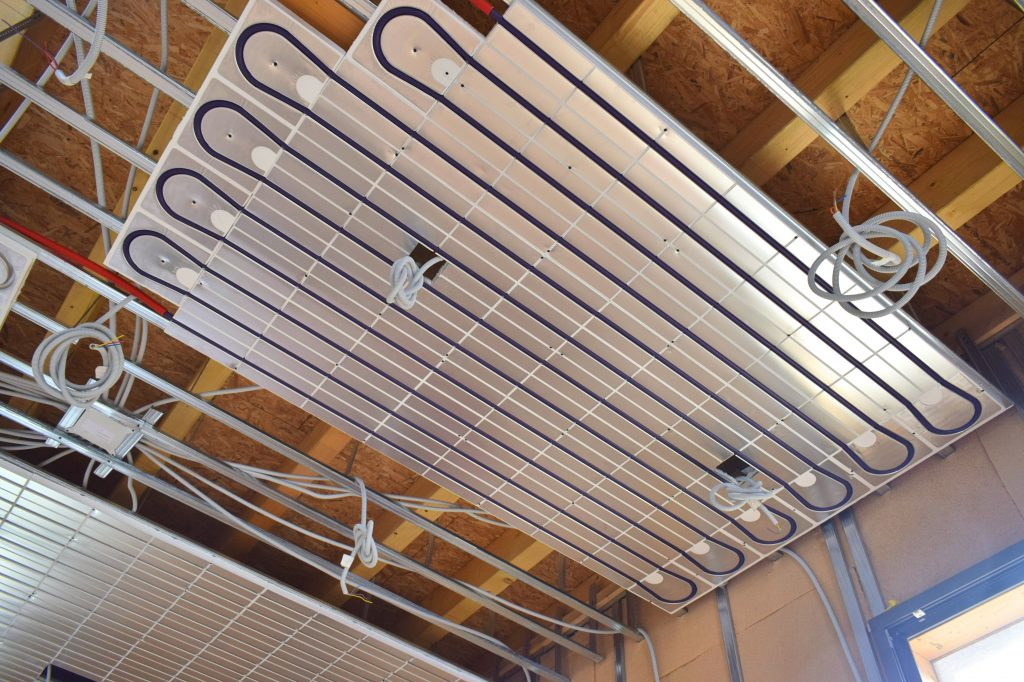
I'm going to install Thermacome ACOSI+ radiant ceiling. It's a French product, so perhaps not available in the UK, but still some important points:
- The heat spreader plate is 0.5mm aluminium sheet. Some other manufacturers use microns thick aluminium foil, which looks pretty but has no effect on heat transfer.
- Pipe spacing is 125mm and the plates can be easily cut with a box cutter or just snapped every 125mm. For radiant heating, closely spaced pipes provides better heat transfer at lower temperature.
- Total plate thickness 30mm with XPS foam insulation backing.
I'm having trouble visualizing the way your floor is constructed. Can you make a cutaway drawing with dimensions?
From what I understand you have insulation between joists, pipe simply dropped on top, surrounded by air, and chipboard resting on the joists. Final floor height is determined by the chipboard.
In all cases you need a heat spreading material (screed, aluminium plates...) and the floor boards must make good contact on top without air gap.
- Option 1: do it from below. Remove PIR insulation between joists without destroying it, install pipe in heat spreader plates screwed to the bottom side of the floor panels. This ensures the heat spreaders make good contact with the floor panels. Then reinstall PIR insulation from below. If the floor below allows this, this is the simplest solution, it also allows you to finish your floor and do the UFH this summer.
- Option 2: do it from above: Remove chipboard panels. Then you need the heat spreader to make good contact with the floor panels when you put them back, which means either a) it needs to be exactly the same height as what's available between the top of the PIR insulation and the top of the joists, there is no reason for this height to correspond to off the shelf UFH panels or even be the same everywhere, which means it'll have to be a screed or b) you can move the PIR insulation to adjust the height, but in this case it may be simpler to do it from below...
Also please check your PEX has anti oxygen barrier. If it does not it will let oxygen in and corrode your steel radiators. Normally it should have the barrier, but since this is not a normal installation... who knows.
This post was modified 8 months ago by bobflux

04/03/2026 6:34 pm
Thanks for sharing your observations, both of you. From what I’ve seen, the key is really ensuring the heat spreader makes good contact with the floor boards, air gaps kill efficiency. I like the breakdown of options from below or above; it’s useful to think in terms of “floor-to-spreader contact” rather than just the pipe position. Also, double-checking the PEX barrier is a good point, something easy to overlook until corrosion shows up.

Topic starter
05/03/2026 1:01 pm
The installer is making good. This weekend we're having the chipboard removed and a dry biscuit screed filled in between the joists to remove the air gap. On top we are having an 18mm cement board as advised by the company installing the engineered oak flooring, as our joists levels are very mixed!.
The cement board we have chosen has excellent thermal conductivity and is specific for UFH.
1

06/03/2026 11:54 pm
This looks like a practical solution 👍
Topic starter
28/03/2026 6:17 pm
To follow up and post for the benefit to anyone with a similar issue in the future; the solution has worked wonders. The engineered oak floor has now been laid and were nice and warm.
This post was modified 7 months ago by Maximumdo
2
Page 2 / 2
Prev
SPONSORS

Degrees of Separation

Latest Posts
-

RE: Heat pump branding. Clever, contemporary… or a bit too much?
I think Heat Geek have done an amazing job on their bra...
By Tomtheheatingengineer , 5 hours ago
-
RE: HeatGeek vs Octopus surveys: puzzling disparity - any ideas why?
I have just had 3 heat loss surveys, one by heat geek o...
By David , 5 hours ago
-
RE: Heat Geek Zero Disrupt: Are We Sleepwalking Into Another Race to the Bottom?
I think that's the key question. After all inverter uni...
By Prunus , 7 hours ago
-
RE: battery storage without solar
As of October 1st they need specific qualifications to ...
By EtchedPixels , 7 hours ago
-
RE: How should the Boiler Upgrade Scheme be reformed?
A unit which uses water to transfer the heat/chill from...
By Temperature_Gradient , 8 hours ago
-
RE: Renewables & Heat Pumps in the News
With regards to the BUS grant raid, I gave it more thou...
By ASHP-BOBBA , 8 hours ago
-
RE: Why are ASHP installs so expensive?
The whole system seems to work on the basis of...
By ian33a , 8 hours ago
-
RE: Missing flow temperature in Heat Geek proposal
Good plan. If you can get half hourly meter readings a...
By JamesPa , 14 hours ago
-
RE: Heat Pumps Without Grants: Would You Have Installed One & Will You Now?
@editor Most certainly. The heat pump was an ideal s...
By Abernyte , 14 hours ago
-
Although regulations may well vary from country to coun...
By Majordennisbloodnok , 14 hours ago
-
RE: Does anyone have experience of a smart water meter?
Yep I caught our slow leak from a £100 bill rise 8)
By EtchedPixels , 14 hours ago
-
RE: Do You Need a Buffer Tank or Low Loss Header for Underfloor Heating in a Large Property?
@jamespa in some cases, failing the Turing test might b...
By GrahamF , 18 hours ago
-
RE: Passiv Smart Thermostat - Help & Forum Support
@energystoragetech The heat capacity of some...
By JamesPa , 19 hours ago
-
RE: tepeo ZEB UK Support & Info Thread
Sorry you are correct, I was remembering figures from t...
By JamesPa , 1 day ago




SPONSORS