
Notifications
Clear all

Topic starter
14/01/2026 8:18 am
Hi everyone,
I wondered if I could ask for your thoughts on a reliable, easy to use home battery solution that will provide backup power in the event of grid failure and lower energy costs?
We have a Vaillant Aerotherm Plus 7kw ASHP and a 2.9kW solar array. In December the ASHP consumed 512kWh of electricity, although obviously that varies hugely and ranges up to 50kWh on really cold days. Last year we imported 4967 kWh of energy from the grid and generated just over 3000kWh, exporting about half of that.
We are currently on Ovo’s Heat Pump Plus tariff which sadly ends this month. This has prompted me to look at battery storage, along with concerns about future grid reliability. I recognise that I won’t achieve payback on the cost of battery storage.
The system needs to be as idiot proof and simple to operate as possible. Neither my partner nor I have the technical skills to be tweaking settings! I’d also like it to play nicely with smart tariffs like Ocotpus Agile to maximise potential savings and lower our carbon footprint.
I’ve had quote of £7124 from Octopus for a Powerwall 3, retaining my existing PV inverter. They have said that this is the only system they offer that can provide a true UPS. I don’t like Tesla as a brand and wondered if there are any other options that folks on here would suggest that would meet my criteria?
I also wondered if 13.5kWh is sufficient given our consumption or if I should be looking for a larger system?
Thanks very much for your thoughts.
This topic was modified 2 months ago by Mars


14/01/2026 8:45 am
Great topic… I was actually going to ask something similar myself. The Powerwall (our neighbour has one) is fairly idiot-proof, which definitely has its appeal (despite its cost), but I’m really interested to hear what other options people are running and how they’re getting on with them. I known there’s a lot of threads on the go along similar lines, but it’d be good to discuss pure ease of use, installation and costs here.
Beyond simple ROI, which is obviously easier to achieve with cheaper, semi- or unbranded kit that isn’t always the most user-friendly, two things really stand out for me: how much storage you actually need and whether the system can properly “island” during an outage.
Taking heating and the heat pump out of the equation entirely, our base load sits just under 1 kWh. To keep the maths simple, call it 1 kWh an hour to run fridges, electronics, lighting, our home sewage treatment plant, etc. We both work from home, so that load is fairly constant.
In a prolonged power cut like the one we’ve just had, that means we’re looking at around 24 kWh of usable storage just to get through a day. PV might top that up a little, and yes, you could conserve by cutting lighting and non-essentials, but it’s still a lot of battery capacity, which means space, complexity and cost.
That’s why I’m really keen to hear what others are doing, especially around resilience rather than just payback. Grid reliance, outages and energy security feel like they’re going to become much bigger conversations in the months and years ahead.
Get a copy of The Ultimate Guide to Heat Pumps
Subscribe and follow our YouTube channel!
14/01/2026 8:54 am
FWIW I started a thread here just a few days ago trying to understand the options for islanded (ie able to operate when grid disconnected) and non islanded systems. This was quite technical and currently totals 11 pages. It turned into a deep discussion of earthing arrangements (which are rather important). Suffice it to say its not trivial particularly if, like me, you also have solar with a FIT tariff which thus needs a separate generation meter.
I haven't yet reached a conclusion but the viability (for me) rests on combining the work to install the battery with a CU upgrade that is anyway well overdue and doing the whole thing as one job. This runs into the problem that the battery inverter people tend to be specialists and its as yet unclear to me where I can draw the line between a general electrician to do the bulk of the work, and a battery inverter specialist (or me) to do the remaining work.
The UK average house consumption (excluding EV and Heat pump) is less than 0.5kW (so 12kWh in 24 hrs) implying @editor, you must be running something high current for quite a long time!
4kW peak of solar PV since 2011; EV and a 1930s house which has been partially renovated to improve its efficiency. 7kW Vaillant heat pump.
1
14/01/2026 8:59 am
The UK average house consumption (excluding EV and Heat pump) is less than 0.5kW (so 12kWh in 24 hrs) implying @editor, you must be running something high current for quite a long time!
We are, quite literally, power users!
Get a copy of The Ultimate Guide to Heat Pumps
Subscribe and follow our YouTube channel!
1
14/01/2026 9:05 am
The other question I have is around safety. Are the cheaper, no-name or white-label systems genuinely safe and stable over the long term when it comes to cell chemistry, battery management systems and the risk of thermal runaway?
I’m especially curious about how well these systems handle fault conditions (over-charging, deep discharge, cell imbalance, inverter failure or high/low ambient temperatures) and whether their protection mechanisms and certification regimes are truly comparable to the bigger, more established brands.
Cost and capacity are one thing, but when you’re putting a large amount of stored energy inside or attached to your home, I’m keen to understand where the real risks sit, what standards actually matter and whether paying more is buying genuine safety and robustness or just a logo.
Get a copy of The Ultimate Guide to Heat Pumps
Subscribe and follow our YouTube channel!
1

14/01/2026 9:11 am
The other question I have is around safety. Are the cheaper, no-name or white-label systems genuinely safe and stable over the long term when it comes to cell chemistry, battery management systems and the risk of thermal runaway?
...
There is, of course, the question of whether the more expensive branded systems are indeed all those things too.
All, of course, within the context of kit - cheap or expensive - that passes the necessary certifications for domestic installation in the UK.
105 m2 bungalow in South East England
Mitsubishi Ecodan 8.5 kW air source heat pump
18 x 360W solar panels
1 x 6 kW GroWatt battery and SPH5000 inverter
1 x Myenergi Zappi
1 x VW ID3
Raised beds for home-grown veg and chickens for eggs
"Semper in excretia; sumus solum profundum variat"

14/01/2026 10:01 am
@editor We had our Samsung Gen 7. 12 Kwh ASHP installed just ahead of the 2024 winter. Previously our winter house load averaged 12 Kwh per day. The pump used 4417 Kwh from October 2024 to end of April 2025.
We had a Powerwall 3 installed in the summer of 2025, and as we are on Cosy tariff, it recharges 3 times a day. We use washing machine, spin dryer, dishwasher as well as heat pump, when we need to and do not always wait for the cheap tariff periods. In normal weather conditions, the battery keeps all our consumption within the off peak rates, but recently with the snow it struggled, and we went a little into standard rate times. I am awaiting the next bill to see by how much. We have been also working on zero battery reserve, which is not ideal.
We do not yet have an EV, but when the new V2G(H) chargers become more easily available and compatible with more cars, I am thinking of using that route as an extra battery source, instead of adding a Powerwall extension.
1

14/01/2026 11:56 am
The other question I have is around safety. Are the cheaper, no-name or white-label systems genuinely safe and stable over the long term when it comes to cell chemistry, battery management systems and the risk of thermal runaway?
I’m especially curious about how well these systems handle fault conditions (over-charging, deep discharge, cell imbalance, inverter failure or high/low ambient temperatures) and whether their protection mechanisms and certification regimes are truly comparable to the bigger, more established brands.
On safety and the misinformation implying all lithium batteries are the same, this is a useful thread that @cathoderay started. My conclusion is that lifepo4 batteries are safe when used with a BMS, etc.
My other conclusion from many threads here is that Tesla based power storage systems are:
- not any guarantee that the installer will optimise your system and so your investment
- always costing more for the same power rating than comparable systems. The components for something like ours with 8kw UPS/islanding and 16kwh storage can cost less than £2800k (excluding installation and certification costs)
- probably simpler for an installer to commission. But I did not see evidence this results in lower installation costs!
Most powerwall customers seem to be happy with the system, but there are plenty of other labels that provide seamless operation and also have a combined battery+inverter.
Ours was not off the shelf, it splits batteries from the inverter. But to be clear, you also cannot easily have a mix of battery BMS models in the storage "bank".
Below is a diagram showing how we use it. Cabling was a bit oversized, following from initial advice from Solis.

This post was modified 2 months ago by Batpred
8kW Solis S6-EH1P8K-L-PLUS hybrid inverter; G99: 8kw export; 16kWh Seplos Fogstar battery; Ohme Home Pro EV charger; 100Amp head, HA lab on mini PC
14/01/2026 12:34 pm
There is, of course, the question of whether the more expensive branded systems are indeed all those things too.
All, of course, within the context of kit - cheap or expensive - that passes the necessary certifications for domestic installation in the UK.
Clearly aware we are talking about safety here. But a similar example to Powerwall but for personal computing is the Apple vs Wintel debate.
My question has always been "can that solution I choose be accessible for most"..
And as I like to keep some choice, separating battery from inverter seemed sensible. By choosing the third largest inverter manufacturer, with a good footprint in the english speaking world, the risk of my solution not being supported in the next decades seems low.
The ENA accepts a very wide range of inverters and batteries, their website shows which ones. The Solis S6 cert docs can be found on the Ena website, via this link
connect-direct.energynetworks.org/device-databases/generation-device/SOLIS%2F12789%2FV1%2FA1
Getting an installation certified is a bigger topic that requires safety but goes beyond it..
8kW Solis S6-EH1P8K-L-PLUS hybrid inverter; G99: 8kw export; 16kWh Seplos Fogstar battery; Ohme Home Pro EV charger; 100Amp head, HA lab on mini PC
1
14/01/2026 3:46 pm
I’ve had quote of £7124 from Octopus for a Powerwall 3, retaining my existing PV inverter. They have said that this is the only system they offer that can provide a true UPS. I don’t like Tesla as a brand and wondered if there are any other options that folks on here would suggest that would meet my criteria?
I also wondered if 13.5kWh is sufficient given our consumption or if I should be looking for a larger system?
Happy to help. There are many systems able to provide true off-grid/islanding/UPS. When I searched, I saw Solis, Solax, and many others. In this forum, I heard about the GivEnergy 1PH Hybrid Inverter 8.0kW HV 3rd Generation that I compared with Solis S6-EH1P8K-L-PLUS on another thread..
In terms of capacity, utility bills generally provide useful info. For a home in SE england, in the coldest period, the consumption of an ASHP is typically around 30-40kwh per day
8kW Solis S6-EH1P8K-L-PLUS hybrid inverter; G99: 8kw export; 16kWh Seplos Fogstar battery; Ohme Home Pro EV charger; 100Amp head, HA lab on mini PC

14/01/2026 3:58 pm
@batpred We are also in the SE., I would say that 30 - 40 kWh consumption is about right at ~0deg. C. We have 2 x Tesla PW2’s but bought them a few years before all the stupidity started up in MAGA land. Using Cosy as our tariff, worst case days have meant our total home consumption of ~55 kWh (no gas here) leaves us with a battery level of ~45% at the time of the next cheapest Cosy period of 3 hours in which to recharge. (The 22:00 period is just 2 hours but that works out fine for us.) Regards, Toodles.
Toodles, heats his home with cold draughts and cooks food with magnets.
1

14/01/2026 7:04 pm
I wondered if I could ask for your thoughts on a reliable, easy to use home battery solution that will provide backup power in the event of grid failure and lower energy costs?
[...]
The system needs to be as idiot proof and simple to operate as possible. Neither my partner nor I have the technical skills to be tweaking settings! I’d also like it to play nicely with smart tariffs like Ocotpus Agile to maximise potential savings and lower our carbon footprint.
I’ve had quote of £7124 from Octopus for a Powerwall 3, retaining my existing PV inverter. They have said that this is the only system they offer that can provide a true UPS. I don’t like Tesla as a brand and wondered if there are any other options that folks on here would suggest that would meet my criteria?
I think I ought to raise another issue whilst you are still early on with the investigations into battery storage.
Some battery systems require you to be connected to an internet service which runs, monitors or controls the battery functions.
Others can be 'stand-alone'. They will continue to work indefinitely without a internet service, or contract with the manufacturer.
I spent 2 years as an OVO Trial Site for PowerVault battery storage.
The battery unit had no controls, display or function indicators.
Everything was implemented via an 'always on' internet connection to a server run by PowerVault themselves.

I wouldn't want to be in this situation again.
During dull days, the meagre amount of solar generation wasn't sufficient to supply the house whilst also keeping the battery system 'live'.
I was buying-in electricity to keep the battery operational.
There were also faults which would've gone undetected if not for additional monitoring which I had installed for my own interest.
Since the end of the PowerVault trial I've been using generic storage batteries, and three interconnected hybrid off-grid inverters from Growatt.
Running costs have been much lower and I gained resilience by having more than one battery and inverter.
The house is unaffected by me removing an inverter or battery from the set.
My 56kWh of battery storage provides sufficient energy to run the house off-grid during peak-rate tariff periods.
In summer they are replenished entirely by the rooftop solar panels, whilst in winter they can also get recharged from the grid under an Octopus ToU tariff.
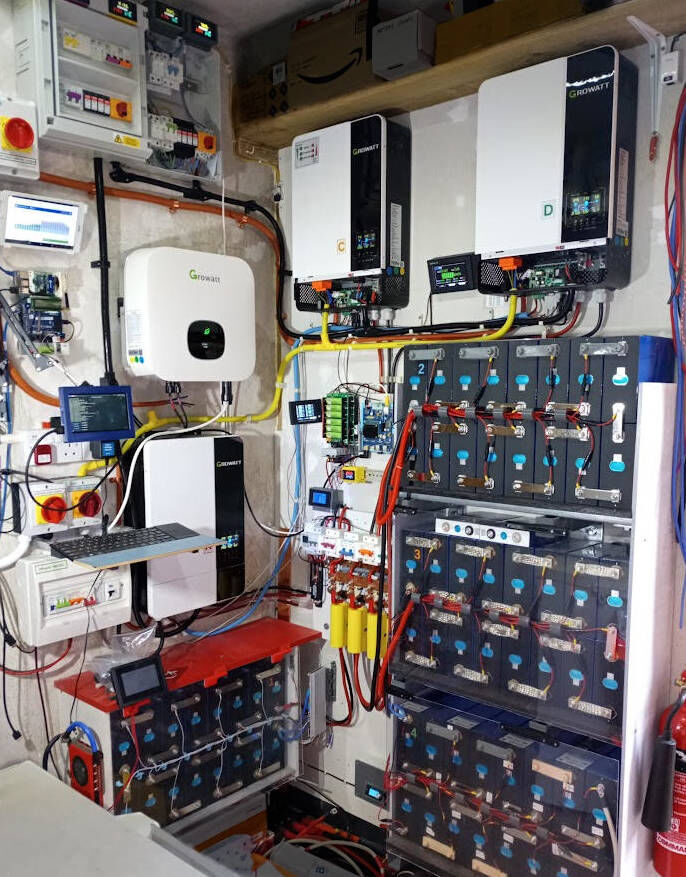
The Growatt approach was adequate, and could continue operating without any contracts or internet connection.
However, it suffered due to poor firmware in the Growatt inverters themselves.
Not all fault-codes get acted on, and I'm not confident that the system will 'fail safe' under all circumstances.
The parallel data connection between the inverters is also problematic.
Some commands are correctly acted upon by all inverters in the set, whilst others aren't.
Given the extent of my investment in the four batteries, they will remain,
but the inverters are (slowly) being replaced by Sunsynk Ecco units.
Sunsynk do expect that users will connect to their monitoring system, and hence take advantage of a wealth of useful statistics.
However, I've been running one of the new Sunsynk Ecco 5kWh inverters without any internet connection for just over three months, and it's fine with that.
So that's now my recommendation:
Choose a battery storage system which can offer advanced monitoring and technical support via an internet link,
but ensure that everything would continue to operate as required without internet dependence.
This post was modified 2 months ago 2 times by Transparent
Save energy... recycle electrons!
2
Page 1 / 4
Next

Latest Posts
-

RE: Daikin Altherma 3 LT compressor longevity question
This mess is intriguing: I wonder if this represent...
By bobflux , 19 minutes ago
-
RE: Say hello and introduce yourself
Hi. I'm Mike. Thank you for letting me join. My partn...
By Fretless6 , 2 hours ago
-
RE: Connecting Growatt SPH5000 over wired ethernet rather than wireless
The simplest wired option is usually the Growatt Ethern...
By Jonatan , 4 hours ago
-
RE: Peak Energy Products V therm 16kW unit heat pump not reaching flow temperature
ASHPs do have a minimum compressor speed. The minimum h...
By bobflux , 11 hours ago
-
RE: Electricity price predictions
@jamespa And it seems some of the nasty public cloud...
By Batpred , 12 hours ago
-
RE: Tell us about your Solar (PV) setup
Location: near Lyon, France 12kWp on the roof, 2x Sol...
By bobflux , 12 hours ago
-
RE: Jokes and fun posts about heat pumps and renewables
Technology is rapidly advancing. BBC News reported th...
By Transparent , 15 hours ago
-
What matters for flow and pressure drop is internal dia...
By bobflux , 16 hours ago
-
RE: Do Fridges and Freezers have COP ratings?
@editor Thank you all for your replies and submitted in...
By Toodles , 18 hours ago
-
I know and yes. The secondary deltaT wont necessaril...
By JamesPa , 22 hours ago
-
RE: Designing heating system with air to water heat pump in France, near Lyon
Just love the way you put it! 🤣
By Batpred , 2 days ago
-
RE: Safety update; RCBOs supplying inverters or storage batteries
Thank you for sharing. So it seems that your Schneid...
By Batpred , 2 days ago
-

RE: Forum updates, announcements & issues
@upnorthandpersonal thanks for the thoughtful, consider...
By Mars , 2 days ago
-
RE: Solar Power Output – Let’s Compare Generation Figures
@mk4 All 21 panels have their own Enphase IQ7a microinv...
By Toodles , 2 days ago
-
RE: Setback savings - fact or fiction?
Great, so you have proven that MELCloud is consistently...
By RobS , 3 days ago
-
RE: Mitsu PUHZ120Y 'Outdoor Temp 'error?
Thanks David & James It almos...
By DavidAlgarve , 3 days ago
-
RE: Surge protection devices SPDs
@trebor12345 - your original Topic about the right type...
By Transparent , 3 days ago
-
RE: Help needed with Samsung AE120RXYDEG
@tomf I’ve been sent this from a service engineer at Sa...
By Mars , 3 days ago
-
RE: Buying large amp bidirectional RCD and RCBO
Yes... I went through this particular headache and ende...
By bobflux , 4 days ago
-
O-oh! Let's take this as an opportunity to 'pass the ...
By Transparent , 4 days ago
-
RE: Homely setup on daikin heat pump
@craigh I refer to our somewhat elevated temperature of...
By Toodles , 4 days ago
-
RE: Air source heat pump roll call – what heat pump brand and model do you have?
My turn, this describes the future installation, only t...
By bobflux , 4 days ago