
Notifications
Clear all
Joining the Renewable Heating Hub forums is completely free and only takes a minute. By registering you’ll be able to ask questions, join discussions, follow topics you’re interested in, bookmark useful threads and receive notifications when someone replies. Non-registered members also do not have access to our AI features. When choosing your username, please note that it cannot be changed later, so we recommend avoiding brand or product names. Before registering, please take a moment to read the Forum Rules & Terms of Use so we can keep the community helpful, respectful and informative for everyone. Thanks for joining!
Air Source Heat Pumps (ASHPs)
65
Posts
12
Users
18
Reactions
3,404
Views

Topic starter
21/09/2026 12:37 pm
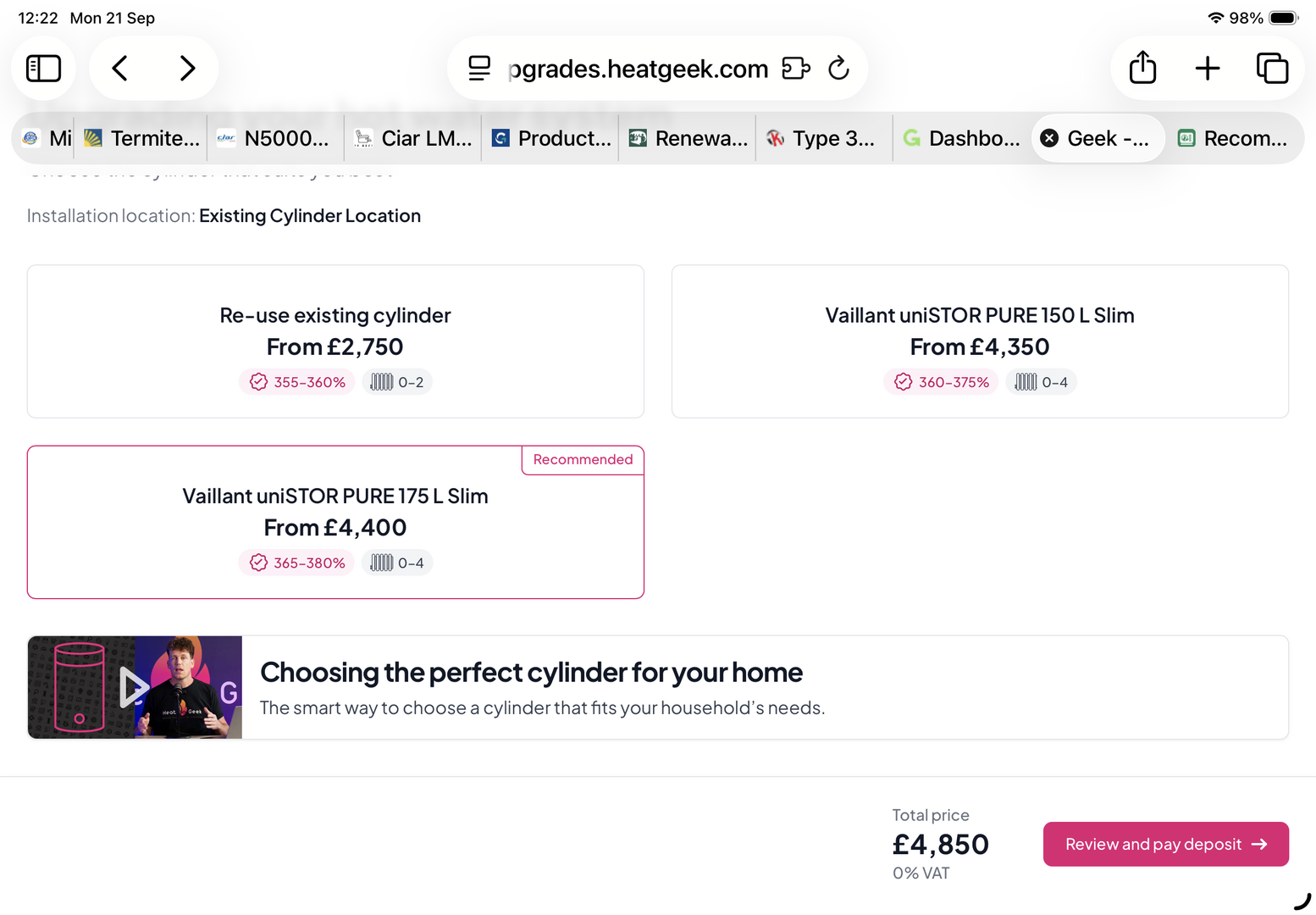
Looks like we will be going with Heat Geek, we will upgrade our 2 Type 11 radiators to Type 22 but will keep the 2 Type 21’s in our bedroom. The bigger item think is do we upgrade our 15 year old 180l slim water cylinder for the Vaillant uniSTOR PURE 175l Slim, 20% increase in efficiency but an extra £1650.00.
Any advice from people who did and didn’t change their hot water cylinder.
Cheers

21/09/2026 12:41 pm
Any advice from people who did and didn’t change their hot water cylinder.
I upgraded mine but only because it was vented.
Had it been unvented I would not have bothered, the payback time is too long for the very small amount of DHW we use, particularly as we heat at night on electricity costing 8p/kWh, so less than 4p/kWh delivered.
This post was modified 3 weeks ago by JamesPa
4kW peak of solar PV since 2011; EV and a 1930s house which has been partially renovated to improve its efficiency. 7kW Vaillant heat pump.

21/09/2026 4:18 pm
Posted by: @ian-s
The bigger item think is do we upgrade our 15 year old 180l slim water cylinder for the Vaillant uniSTOR PURE 175l Slim, 20% increase in efficiency but an extra £1650.00.
I would suggest working out a reasonable estimate of the savings that you might make based on your own hot water consumption, since that could differ significantly from what someone else may be using. This can be done simply from your gas usage in a summer month when there is no heating, but gas is used for hot water and potentially cooking, which is usually negligible so you can just ignore that.
Let's say you used 200 units of gas in July and you were there all month, no holidays. That would equate to about 100 kWh input electricity for a heat pump, since gas boilers are about 0.85 efficient on heating hot water and a heat pump is about 1.7 efficient. So over the year, that's roughly 1200 kWh. Now at standard electricity prices, say 25p as a quick estimate, that's £300 for hot water heating per year using a heat pump. A 20% saving is then £60 per year. In that case, an extra £1650 for a new hot water tank has a payback period of 27 1/2 years. However, that is assuming very pessimistic figures for electricity costs. Most likely you will move onto a time-of-use tariff, heat your hot water at night, and pay 10p per unit or less. Then the payback period is over 68 years...
If you have really high hot water usage, then the economics might work out for you, but for most people they simply don't.
Even if the numbers don't add up, you may still want to replace the hot water tank for other reasons, and that's fair enough. Either way, it's always good to understand the financial position.
This post was modified 3 weeks ago by Rob of York
Topic starter
21/09/2026 5:21 pm
@rob-of-york last year our gas usage between June and August was around 170kWh per month, this year around 210 as we tended to have 2 showers due to the weather and sunscreen. We are a 3 adult home and tend to have showers. We have solar and 10kWh of battery storage along with 2 EV’s so on have a cheaper overnight tariff. Could always use the money saved on water cylinder to get additional battery storage to cover most of the heat pump usage especially during the winter months.

21/09/2026 6:00 pm
Posted by: @ian-s
Could always use the money saved on water cylinder to get additional battery storage to cover most of the heat pump usage especially during the winter months
That sounds like a much more cost effective use of funds than a replacement hot water tank.
I have 6.56kW Solar PV, and 9.6kWh battery. Recently I have being doing some detailed modeling of how much of the electricity requirements of a heat pump I could meet with cheap rate overnight electricity and solar. At a SCOP of 3.8, I need about 2900kWh over winter to replace 11000kWh from gas. I've broken this down into daily gas usage and solar production for the period Oct 2024 to March 2025. The end result is that I could feed a heat pump with 600kWh directly at the overnight rate and 1200kWh from solar leaving 1100kWh at standard electricity rates. This assumes that my battery is used to provide all other day-to-day background electricity use.
If I added a further 9.6kWh battery, then the 1100kWh at standard electricity prices would reduce to just 200kWh saving roughly (0.26 - 0.09) x 900 = £150 per year.
That may work as a rough estimate or at least ballpark figure for the savings that you could make.
If you go down that route, I'd suggest waiting one winter to see how your electricity use works out with a heat pump and your existing battery. That way you will be able to collect figures for how much electricity you used at standard rates and hence get a much more accurate picture of what any savings would be if you added another battery.
3
Page 6 / 6
Prev

SPONSORS

Degrees of Separation

Latest Posts
-

RE: Does anyone have experience of a smart water meter?
@downfield I wonder if the flow of water powers a mini ...
By Toodles , 14 minutes ago
-
RE: Renewables & Heat Pumps in the News
@majordennisbloodnok the argument you cite from that TE...
By Transparent , 1 hour ago
-
RE: Why are ASHP installs so expensive?
I'd seen a reference to that on my google feed...
By ian33a , 2 hours ago
-
RE: Replacing Storage Heaters with a Heat Pump in a Stone Cottage
I found some interesting data about the price of heat p...
By Rob of York , 4 hours ago
-
RE: Air-to-Air Heat Pumps & Air Conditioning: UK Heating and Cooling Q&A
Thanks for that, quite interesting. I liked the bit a...
By springswood , 5 hours ago
-
RE: PV and battery long payback - sense check query
Thanks for all the comments. I finally got to the bott...
By DavidB , 6 hours ago
-
RE: Indevolt Batteries UK Support & Info Thread
People following this thread who are hoping that plug i...
By JamesPa , 16 hours ago
-
Safety study for plug in batteries out to tender - looks like Q3 2027 at best before legal
Whilst searching for other information I came across th...
By JamesPa , 16 hours ago
-
RE: Passiv Smart Thermostat - Help & Forum Support
By Singlespeed , 18 hours ago
-
RE: Help me keep the faith with my air source heat pump installation
just had Vaillant over to service the HP and asked abou...
By AdamK , 18 hours ago
-
RE: tepeo ZEB UK Support & Info Thread
OK so ZEB is basically a variant on a storage heater, b...
By JamesPa , 2 days ago
-
RE: Heat Geek installations: share your experiences
@editor I suspect that the Heat Geek online quote is a ...
By AndrewJ , 2 days ago
-
RE: Adding additional Solar Panels to a DC coupled battery system
Ah, yes. Thanks for clarifying.
By Transparent , 2 days ago
-
RE: Vaillant ecoTEC Plus - Flow Temp and Set Up
@trebor12345 I have been meaning to get home assista...
By Batpred , 3 days ago




SPONSORS