

Notifications
Clear all
Joining the Renewable Heating Hub forums is completely free and only takes a minute. By registering you’ll be able to ask questions, join discussions, follow topics you’re interested in, bookmark useful threads and receive notifications when someone replies. Non-registered members also do not have access to our AI features. When choosing your username, please note that it cannot be changed later, so we recommend avoiding brand or product names. Before registering, please take a moment to read the Forum Rules & Terms of Use so we can keep the community helpful, respectful and informative for everyone. Thanks for joining!

Topic starter
12/08/2026 7:46 am
Hi all,
I have some questions about flushing my system, cleaning it and adding inhibitor.
I had a small leak in the system pipework, so drained the system down to fix it (longer story which I will also post about).
Bit of background, the system is 2 years old - everything was new apart from one old retained towel radiator and one small section of 22mm copper piping on the radiator circuit (maybe 5m total). All other pipework and radiators were new.
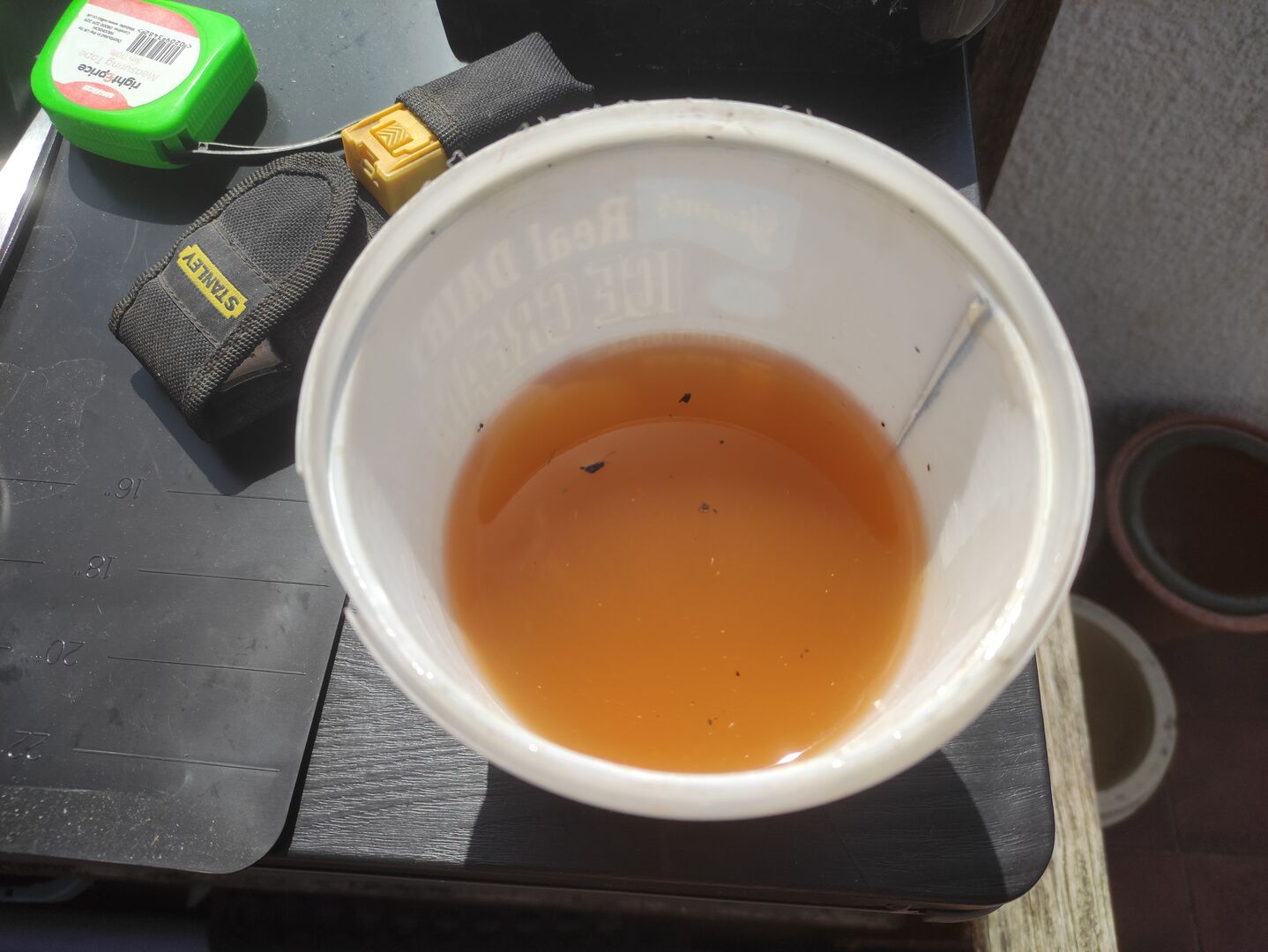
Whilst the system was fully drained, I took the opportunity to flush the system using the fill and flush loop. I closed all radiator valves and then opened one at a time flushing each radiator in turn until the water ran clear. The water coming out was orange brown in colour. I thought I was doing well, but once the system had settled for a while, if I flushed again more orange brown coloured water would flush out before running clear again. Is this normal, is this colouration from rust? Should I keep flushing? Picture of sample of water after much flushing below (ignore the black floaty bits which were in the container before).
I've bought some Sentinel X400 cleaner and X100 inhibitor. The instructions say the X400 cleaner should be circulated for a minimum of two hours at normal operating temperature and can be left in the system for 3-4 weeks before draining and refilling with the inhibitor. As the heating will not be back on until October, should I add the X400 cleaner now, and just circulate it around the system (radiators) for 10 mins per day as the heating is not on, or should I wait until October before adding it at which point it can work in a heated system? It will get circulated through the primaries and ASHP for 30mins per day during DHW cycles. The heating only ever runs at 32C LWT in October, so maybe not a huge difference to just pumping cool (25C) water round the system now for a few days to clean? I don't expect the system to be full of sludge so it's really a case of just wanting the system to be as clean as possible before refilling with inhibitor and being good to go for the next couple years.
If I don't add it until October, will my system be OK running for two months (DHW only) with just water and no inhibitor?
We are in a soft water area.
This topic was modified 2 months ago 2 times by Old_Scientist
Samsung 12kW gen6 ASHP with 50L volumiser and large radiators. 7.2kWp solar (south facing), Tesla PW3 (13.5kW). Net Zero

12/08/2026 9:39 pm
The colour suggests ferric oxide, ie rust. Or something of that colour that has been added to the system, but I think that unlikely.
My sludge is black for comparison.

12/08/2026 10:43 pm
If an old radiator was reused, perhaps it was full of sludge that then spread through the circuit.
Are there any points of oxygen ingress into the system? Non-barrier PEX, frequent refills, etc?
Topic starter
13/08/2026 9:19 am
Thanks both.
If an old radiator was reused, perhaps it was full of sludge that then spread through the circuit.
Are there any points of oxygen ingress into the system? Non-barrier PEX, frequent refills, etc?
That was my thought (hope) too, that the single old towel rail radiator was the culprit and that rust colouration naturally spreads though circulation.
No frequent refills. I have flushed repeatedly over a period of 2-3 days trying to flush it all out.
No previous issues with air in the system as far as I'm aware. We have two auto air vents, one by the DHW tank above the 3-way valve and another on top of the volumiser which is effective at venting air when the system is being refilled (also the system high point). I cannot hear any air in the system and the radiators have never released any air when I've checked them.
The filers all look clean when serviced.
Pipework is all copper, apart from one 5m run of plastic pipe in loft. I've no idea what grade - it was installed new 2 years ago as part of the ASHP installation.
This post was modified 2 months ago 2 times by Old_Scientist
Samsung 12kW gen6 ASHP with 50L volumiser and large radiators. 7.2kWp solar (south facing), Tesla PW3 (13.5kW). Net Zero

13/08/2026 10:18 am
This amount of brown in a 2 year old installation would be very worrying as it would indicate quite a lot of oxygen ingress rusting the inside of the steel rads... unless the brown was already inside the old radiator, in this case nothing to worry about.
It's a good idea to flush, get rid of it, see if it comes back... but flushing thoroughly is quite difficult. Pros use an expensive machine. I built the equivalent using a garden well pump and an air compressor, the idea is to send high flow water with bubbles, and the bubbles do wonders to shake off the crap and carry it out. Also when flushing an installation with radiators you have to whack the rads with a rubber mallet to shake off the crap.
Basically, it's less effort to take the old towel rail into the garden and flush it while turning it upright then upside down and shaking it lol
Plastic pipe can be several types. Normally it's written on it, but if you can't see it:
- MLC pipe: usually white, quite stiff due to aluminium layer, keeps its shape when bent, so if you see nice curved elbows it's MLC. Oxygen permeability: zero. Opaque. Basically the best replacement for copper.
- PEX pipe: stiff and noodly plastic, doesn't keep its shape. Not opaque, so if exposed to light, may allow algae to grow inside. Cheap.
- PEX pipe with oxygen barrier: looks shiny and usually has "Barrier" "BAO" or "OB" or some other initials written on it. Oxygen permeability: very low. The cheap replacement for copper, it works fine, no worries.
- PEX pipe without oxygen barrier: looks matte. Oxygen permeability: high. Will rust the inside of your rads, although with your length it's less of a problem than having 500m of it in underfloor loops.
1
13/08/2026 11:12 am
Don’t forget, it’s not the headspace gases that are the issue. It’s the dissolved oxygen in the heating fluid that’s key. Either there wasn’t any/insufficient inhibitor in your system or O2 is finding its way in.
Also remember the rads are just mild steel, so you don’t want to leave them wet and open to the air for too long as they will be constantly corroding in that condition. Do your clean, flush them and get sufficient inhibitor in ASAP.
1

13/08/2026 11:59 am
No previous issues with air in the system as far as I'm aware. We have two auto air vents, one by the DHW tank above the 3-way valve and another on top of the volumiser which is effective at venting air when the system is being refilled (also the system high point)
@old_scientist colour is different to our case when we had a debris issue…. Also occurred after 2 years operation. In our case we put it down to new radiators shelling off rust deposits with somewhat diluted inhibitor. Having said that we only had particle debris rather than sludge and it was dark in colour and not orange liquid.
Here are a few seemingly obscure checks that may help.
The comments from @papahuhu on the right volume of inhibitor flags up in my mind. Eg what volume is in your volumiser and has this volume been calculated into your total circuit volume, what material is your volumiser? Is there a risk of air being sucked in through a stuck air vent. And lastly is there a chance that one of your expansion vessels ruptured, adding more volume and more steel surface area with possibly no inhibitor - unmixed water contact?
Hopefully it will be none of the latter, more obscure reasons.
1
Topic starter
13/08/2026 1:32 pm
Thanks for the replies.
System volume is around 180L. I have no idea if inhibitor was originally added. They added glycol which may have contained inhibitor too, I don't know?
I've got 2x1L of Sentinel X100 inhibitor which is enough for 200L system volume at the recommended 1% dosing.
I'm assuming the rust has come from the old radiator which was at least 20 years old. Any inhibitor was never topped up (assuming any was even added to the original oil boiler system). All the other steel radiators were replaced with new Stelrad K2's.
The old towel rail radiator is on a drop loop (ground floor, fed from above) so I would imagine it's going to be impossible to completely flush it at 1-1.5bar mains water pressure on a simple fill and flush, as any debris would have to flush back up over two floors up into the loft to get back to the fill and flush loop.
I'll flush each radiator one more time in situ (I'm not taking them off to flush), add the cleaner, give it a few days to circulate and then flush and fill with inhibitor.
Samsung 12kW gen6 ASHP with 50L volumiser and large radiators. 7.2kWp solar (south facing), Tesla PW3 (13.5kW). Net Zero
13/08/2026 1:50 pm
To exclude it being a biofilm of sulphate reducing bacteria, if you sniff the brownish water, does it smell sulphurous or eggy?
Topic starter
13/08/2026 2:07 pm
To exclude it being a biofilm of sulphate reducing bacteria, if you sniff the brownish water, does it smell sulphurous or eggy?
@papahuhu No smell, just the dirty brownish orange colouration.
That was a particularly dirty sample I collected for the purposes of the photo, after a few mins it runs clear. But flush it again the next day and it's the same, so whatever it is is presumably settling.
Samsung 12kW gen6 ASHP with 50L volumiser and large radiators. 7.2kWp solar (south facing), Tesla PW3 (13.5kW). Net Zero
13/08/2026 2:26 pm
Thats good, it would have explained the colour at least.
With the glycol, possible organic acids complicate the potential causes of the staining. I suppose as long as there aren’t chunks of rust getting past the mesh strainer and blocking orifices, it doesn’t matter what the colour is.
Topic starter
13/08/2026 2:55 pm
Thats good, it would have explained the colour at least.
With the glycol, possible organic acids complicate the potential causes of the staining. I suppose as long as there aren’t chunks of rust getting past the mesh strainer and blocking orifices, it doesn’t matter what the colour is.
The Y strainer has been cleaned a few times, and minimal amounts of small black debris was present each time. Definitely no concerns there.
The magfilter was also flushed at annual services and that looked pretty clean too.
I replaced some of the outdoor copper pipework this week, and there was an 'orange' covering on the inside of the pipes which wiped off (again, no noticeable sulphide smell), consistent with the colour of that water sample.
I'm thinking everything points to fine rust particular matter (silt) in the water, originating from that old radiator?
Best case, I could buy one of those plumbers flexible radiator buckets, disconnect the pipes into the bottom of that old towel radiator and allow the system to drain out through the radiator thus allowing gravity to flush it through? But that sounds like it has the potential to get messy and I end up with dirty brown water all over the bathroom floor, at which point Mrs OS is not going to be happy!
EDIT: It's interesting that in 22 years living at this property, not once has the service engineer ever asked about, tested or offered to top up the inhibitor (or glycol). They come, 'service' the boiler (now ASHP) and leave.
This post was modified 2 months ago 2 times by Old_Scientist
Samsung 12kW gen6 ASHP with 50L volumiser and large radiators. 7.2kWp solar (south facing), Tesla PW3 (13.5kW). Net Zero

Page 1 / 2
Next
SPONSORS

Degrees of Separation

Latest Posts
-

RE: Heat pump branding. Clever, contemporary… or a bit too much?
I think Heat Geek have done an amazing job on their bra...
By Tomtheheatingengineer , 4 hours ago
-
RE: HeatGeek vs Octopus surveys: puzzling disparity - any ideas why?
I have just had 3 heat loss surveys, one by heat geek o...
By David , 4 hours ago
-
RE: Heat Geek Zero Disrupt: Are We Sleepwalking Into Another Race to the Bottom?
I think that's the key question. After all inverter uni...
By Prunus , 6 hours ago
-
RE: battery storage without solar
As of October 1st they need specific qualifications to ...
By EtchedPixels , 6 hours ago
-
RE: How should the Boiler Upgrade Scheme be reformed?
A unit which uses water to transfer the heat/chill from...
By Temperature_Gradient , 7 hours ago
-
RE: Renewables & Heat Pumps in the News
With regards to the BUS grant raid, I gave it more thou...
By ASHP-BOBBA , 7 hours ago
-
RE: Why are ASHP installs so expensive?
The whole system seems to work on the basis of...
By ian33a , 8 hours ago
-
RE: Missing flow temperature in Heat Geek proposal
Good plan. If you can get half hourly meter readings a...
By JamesPa , 13 hours ago
-
RE: Heat Pumps Without Grants: Would You Have Installed One & Will You Now?
@editor Most certainly. The heat pump was an ideal s...
By Abernyte , 13 hours ago
-
Although regulations may well vary from country to coun...
By Majordennisbloodnok , 13 hours ago
-
RE: Does anyone have experience of a smart water meter?
Yep I caught our slow leak from a £100 bill rise 8)
By EtchedPixels , 13 hours ago
-
RE: Do You Need a Buffer Tank or Low Loss Header for Underfloor Heating in a Large Property?
@jamespa in some cases, failing the Turing test might b...
By GrahamF , 17 hours ago
-
RE: Passiv Smart Thermostat - Help & Forum Support
@energystoragetech The heat capacity of some...
By JamesPa , 18 hours ago
-
RE: tepeo ZEB UK Support & Info Thread
Sorry you are correct, I was remembering figures from t...
By JamesPa , 1 day ago




SPONSORS
