

Notifications
Clear all
Joining the Renewable Heating Hub forums is completely free and only takes a minute. By registering you’ll be able to ask questions, join discussions, follow topics you’re interested in, bookmark useful threads and receive notifications when someone replies. Non-registered members also do not have access to our AI features. When choosing your username, please note that it cannot be changed later, so we recommend avoiding brand or product names. Before registering, please take a moment to read the Forum Rules & Terms of Use so we can keep the community helpful, respectful and informative for everyone. Thanks for joining!
Air Source Heat Pumps (ASHPs)
65
Posts
12
Users
18
Reactions
4,603
Views

Topic starter
14/09/2026 7:58 am
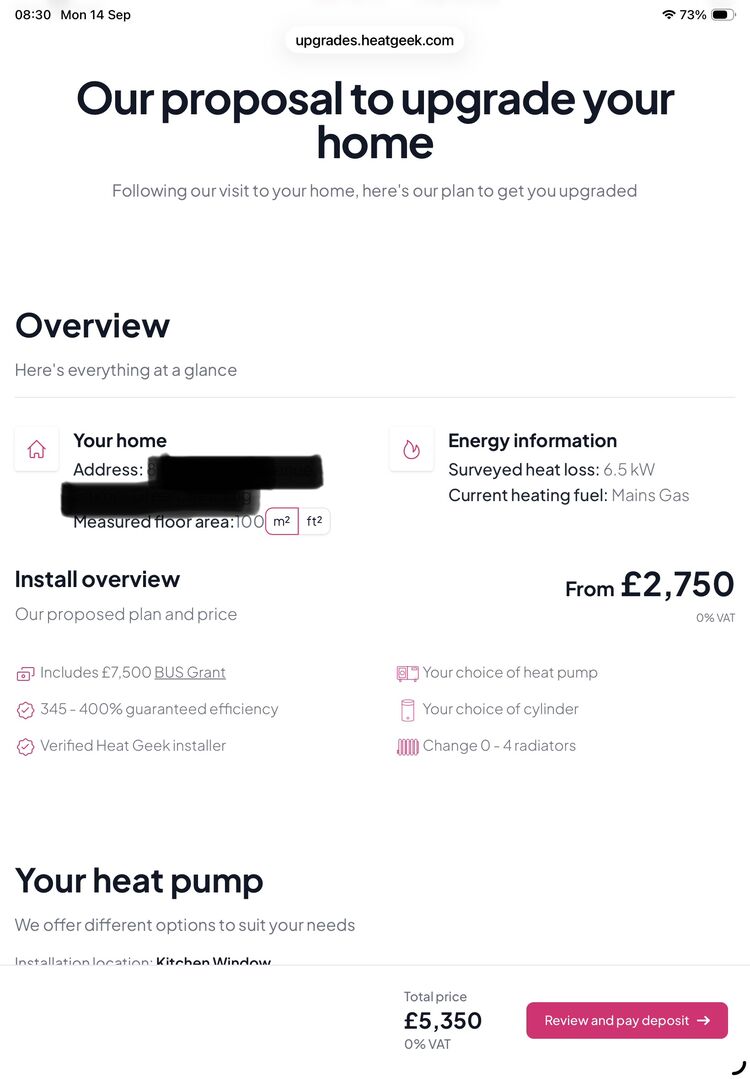
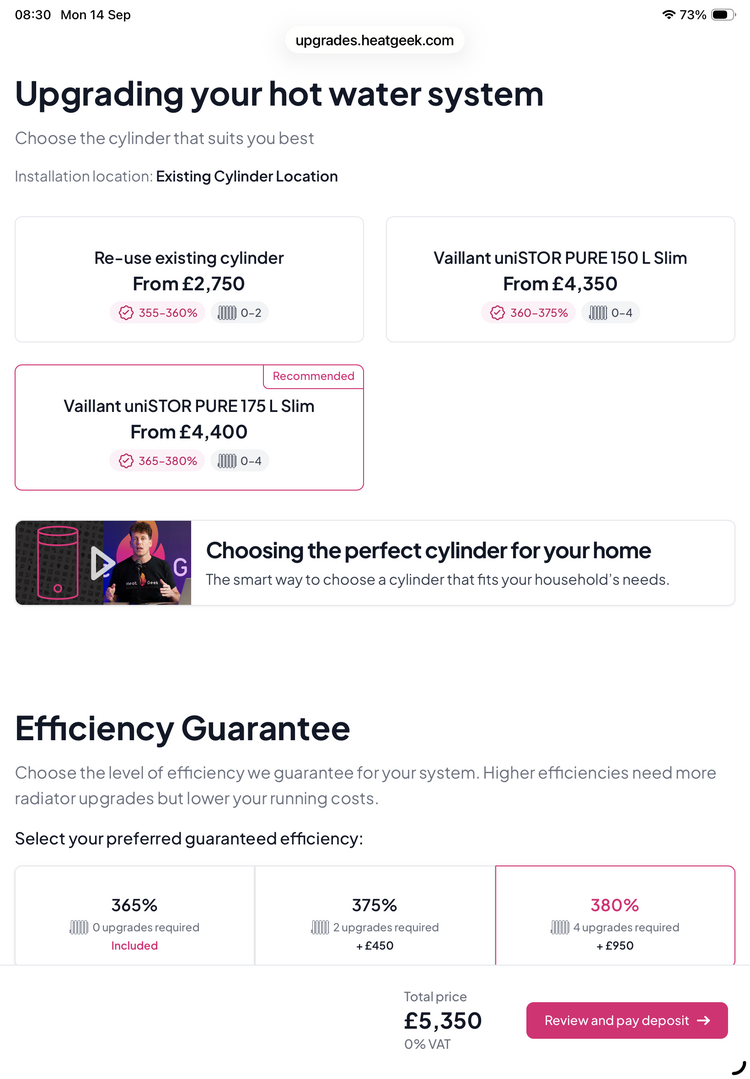
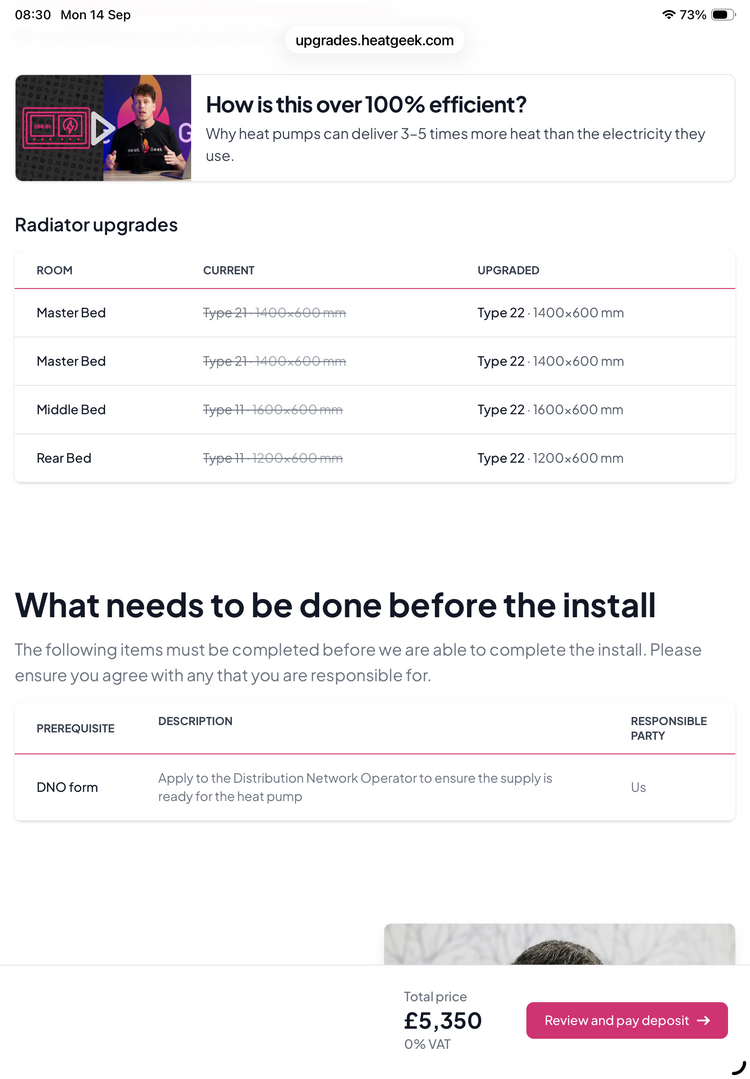
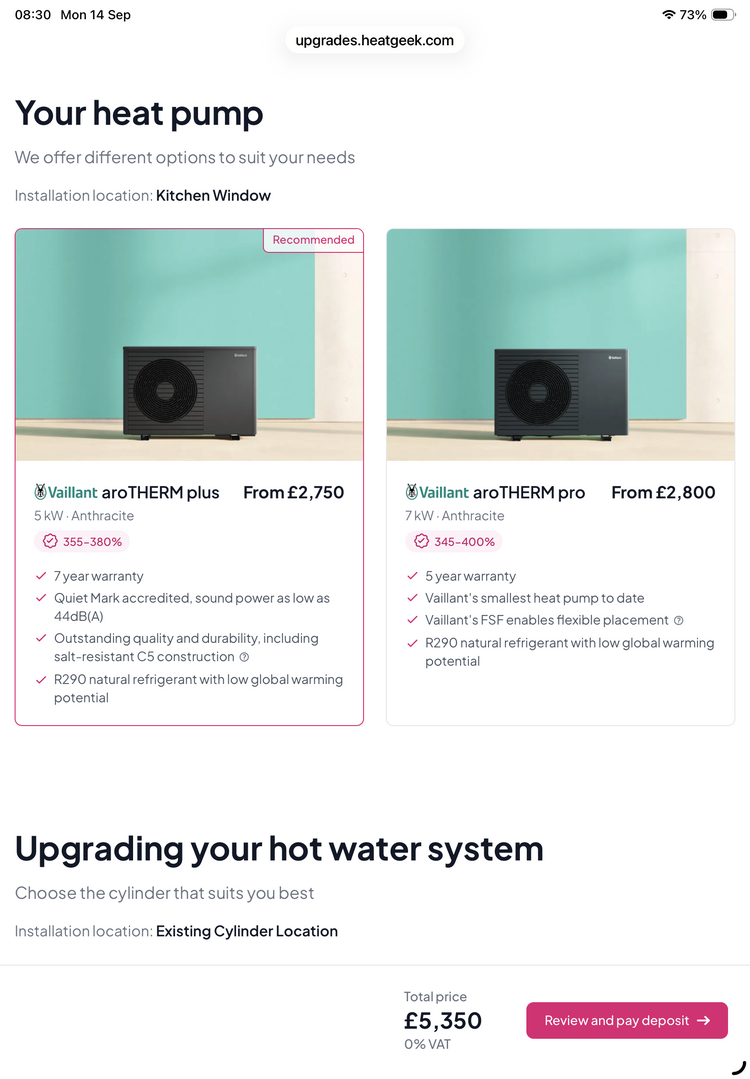
We now have a couple of proposals, 1 Heat Geek and 1 Dwellow so was wondering if anyone could give their thoughts on them. Heat Geek will leave the electric rads in our hall and utility where Dwellow want to fit brand new radiators which will be a challenge to get pipe work to them. Heat Geek have ignored our garden room/conservatory where Dwellow want to upgrade the radiator.


14/09/2026 9:35 am
My first reaction is that these are prima facie much of a muchness at high level (which is sort of good) apart from the price difference (£7193 Dwellow vs £5350 Heat Geek). The differences in rad upgrades are worth examining though. Dwellow's is obviously a much 'fuller' proposal but heat geek has a good reputation and has the SCOP guarantee. There are definitely some questions worth asking:
Radiators
Heat Geek will leave the electric rads in our hall and utility where Dwellow want to fit brand new radiators which will be a challenge to get pipe work to them. Heat Geek have ignored our garden room/conservatory where Dwellow want to upgrade the radiator.
Do you prefer to have the upgrades or not, notwithstanding the disruption? Is it likely these areas will anyway be heated sufficiently from adjacent rooms, does the conservatory/garden room matter in the heating season. Dwellow is proposing to replace a tall designer rad in the conservatory with a bog standard rad, because of a deficit of only 71W. If the designer rad is in good condition, I had paid a lot for it, and I like it, I may not want this and may prefer to take the risk.
Also Dwellow's schedule of upgrades doesnt make sense as 'current' and 'proposed' are mostly the same (perhaps this means no change), needs clarifying!
This may be the decider or a reason to go back and press Heat Geek!
Alkso there are significant differences between the two proposals in terms of which rads they intend to upgrade. It would be worth drawing up a table with columns as follows and doing a stare and compare
Room, existing rad, HG loss estimate, HG proposed rad, Dwellow loss estimate, Dwellow proposed rad
FT and SCOP
I dont think HG specify the design FT, but they do, unlike Dellow, guarantee SCOP, which is powerful. Dellow just quote MCS SCOP which is somewhat lower than the HG guarantee.
Buffer tank
I presume that neither are fitting a butter tank, worth checking
Choice of model
This is interesting on several levels!
HG are suggesting the 5kW Arotherm plus, Dellow the 7kW Arotherm pro.
The former is possibly taking a (calculated and probably sound) risk on the actual heat loss being a bit smaller than the survey says, but they would presumably swap it out if it turned out not to be the case (see the guarantee), but why the 5kW plus not the 5kW pro which is (was?) cheaper and, at least in my mind, better looking? The answer to this maybe to do with some evolution of naming that seems to have emerged on the Vaillant site, the 'pro' has mysteriously disappeared, replaced by the second generation 'plus' that looks remarkably like the pro. Perhaps wother clarifying with both HG and Dellow!
Dellow have gone for the 7kW pro, the safe option, which may turn out to be a tad oversized.
Whats your annual gas consumption?
Pipework routing and location
Dwellow mention the location but not the pipework routing. Are you happy with any visual impact of the proposed routing. HG dont mention location, has it been discussed and are you happy.
The Installer
Did you get to talk to anyone, who were you more comfortable with?
Hope that helps, happy to comment further.
This post was modified 1 month ago 3 times by JamesPa
4kW peak of solar PV since 2011; EV and a 1930s house which has been partially renovated to improve its efficiency. 7kW Vaillant heat pump.

14/09/2026 5:31 pm
One interesting difference between your two quotes is the room temperatures assumed. HG assumes 21C throughout and DW have used a variety of temperatures from 18C for bedrooms to 22C for bathrooms. These represent the temperatures used for 2007 and newer houses (21C throughout except bathrooms) and older ones. This may well explain the differences in radiator upgrades. HG suggest radiator upgrades in the bedrooms, perhaps needed to get them to 21C, whereas DW don't and assume 18C for those rooms. This difference in room temperatures would also go quite someway to explain the differences in overall heat loss between the two quotes.
As your house was built in 1962, I think the different temperatures for different rooms that DW applied is the one that is expected. See the table at the bottom of this webpage: https://heatloadcalculator.mcscertified.com/docs/reference-sources/design-conditions You could perhaps ask HG why they have used 21C throughout and what their recommendations would be using the room temperatures appropriate for houses in age bands A-J such as yours. In particular are those 4 bedroom radiator upgrades still needed for the 380% guarantee if only 18C is required for the bedrooms. Also worth asking if the guarantee would be 400% if you went for the 7kW unit.
The upgrade to a new hot water tank is £1650 over using your existing one on the HG quote. I would suggest giving careful thought to whether that is worthwhile. The savings in electricity costs may be marginal. If it gives you a guaranteed SCOP of 3.8 instead of 3.6, then on say 10000kWh of gas at 90% efficiency, that's 9000kWh output needed, which is 2500kWh at 3.6 and 2368kWh at 3.8, so you save 132kWh per year or about £34 at standard rate electricity prices and the payback period is over 48 years. I think you could probably find a better way to spend £1650 that would save far more, possibly starting with extra insulation around your existing hot water tank. I did that and it saved £40 a year for £40 outlay! If you have suspended timber floors on the ground floor, then you might consider underfloor insulation. 150mm of rockwool netted between the joists makes a big difference to the heat loss.
Finally, the HG quote shows ventilation losses of 2810W out of the 6500W total. That seems very high given the new guidance.
There are updated CIBSE guidelines that should hopefully mean installers no longer use large defaults for ACH (Air Changes per Hour) for older properties:
The guide will now align with BS 12831-1:2017, which sets simple defaults:
- 0.5 ACH for habitable rooms
- 0.0 ACH for non-habitable rooms
These apply to all homes, regardless of age or construction.
I would suggest asking both installers what ACH values they used and if it is not 0.5 ACH ask them why and point to the new guidance. This will represent a big change to the ventilation losses if they were using the old values.
Back of an envelope sanity check: guessing your room heights at 2.5m the total volume is 126 sqm x 2.5 = 315 cubic metres. The ventilation losses are then 0.33 x 0.5 x volume x temp difference = 0.33 x 0.5 x 315 x 24 = approx. 1250W. This is a long way from the 2810W that HG have assumed. It would take the overall heat loss below 5kW. It is possible that they know this are are having to use the old ACH values for some reason. Certainly that would explain why they are happy to fit a 5kW heat pump.
1
Topic starter
15/09/2026 8:18 am
It looks like our heat pump journey is coming to an end. After speaking with Dwellow it looks like we have an issue with our new hall and utility, these were created by filling in the space between the house and the garage. When we did this we fitted 2 electric rads as getting central heating pipe work to the rooms was pretty much impossible due to no pipe work near that side of the house. Dwellow said we have to have rads that run from the heat pump heating circuit to qualify for the BUS grant and could surface mount pipe work to get to the rooms and in the rooms, that is a total no from us.
Intresting that Heat Geek didn’t mention this and appear to accept that there are electric rads in the areas and do not appear to need to be replaced.
Bit confused if we went with Heat Geek and there was a subsequent inspection and it failed we could have had to pay the BUS grant back which really makes transitioning at this time a financial no no.
Still appears there is differing advice out there, are companies ignoring some of the rules and regulations or interpretating them differently?
Oh well onwards and upwards, anyway many thanks for all of your comments and advice, I know a lot more now and who know when the BUS grants goes the price may fall enough to look again unless the same rule on a couple of electric rads remains.
This post was modified 1 month ago by Ian S
15/09/2026 8:56 am
It looks like our heat pump journey is coming to an end. After speaking with Dwellow it looks like we have an issue with our new hall and utility, these were created by filling in the space between the house and the garage. When we did this we fitted 2 electric rads as getting central heating pipe work to the rooms was pretty much impossible due to no pipe work near that side of the house. Dwellow said we have to have rads that run from the heat pump heating circuit to qualify for the BUS grant and could surface mount pipe work to get to the rooms and in the rooms, that is a total no from us.
Others would have a different interpretation of the BUS rules to this. There are examples on this forum of alternative interpretations, also read on.
Bit confused if we went with Heat Geek and there was a subsequent inspection and it failed we could have had to pay the BUS grant back which really makes transitioning at this time a financial no no.
Still appears there is differing advice out there, are companies ignoring some of the rules and regulations or interpretating them differently?
Definitely the latter. The actual relevant requirements, directly quoted from the legislation, are
[a heat pump meets the requirements if:]
(b)it is capable of meeting the full space heating and hot water heating demands of that property, and
(c)it replaces the heat generating components of the original heating system installed in that property (where applicable), other than any—
(i)supplementary electric heater, including any immersion heater,
(ii)circulation pump, or
(iii)solar thermal collector.
In your case the heating requirement for the hall and utility could, I would imagine, reasonably be met by transfer of heat from adjacent rooms. Neither is a habitable room so if its a bit chillier who cares? Thus as long as the rads in the adjacent rooms are oversized a bit and the total capacity is OK the BUS requirements are met by any reasonable interpretation. Thats how Heat Geek are looking at it.
My bathroom and downstairs toilet are heated by the same means (downstairs toilet no heating but hall is adjacent and rad oversized, bathroom wholly inadequate landing but hall is adjacent and rad oversized). This is quite common.
There have been similar arguments in relation to low loss houses where its pretty obvious that just heating the downstairs, or mostly only the downstairs, is going to work. The legislation does not specify a radiator in every room, it specifies that it must be capable of meeting the full space heating requirements without prescribing how. It is also, at least arguably, a requirement placed on the Heat pump not the system (the section is specifically headed 'requirements for heat pumps' and clearly differentiates the heat pump from delivery of the heat).
Finally is it really likely that the intention was to rule out properties with one or two non habitable impossible to get to rooms if they could be heated to a reasonable extent by spill over from adjacent rooms?
I was half way to suggesting 'just go with Heat Geek' based on the quotes you posted. I think, with a bit of interrogation of Heat Geek (who have a very good reputation), the Dwellow response tilts further towards that.
Of course the above is not a guarantee, but I would suggest that the risk you have to refund the BUS grant provided that at least some heat transfers from adjacent rooms and the capacity overall is sufficient is negligible (and its probably negligible even if those conditions aren't met).
This post was modified 1 month ago 18 times by JamesPa
4kW peak of solar PV since 2011; EV and a 1930s house which has been partially renovated to improve its efficiency. 7kW Vaillant heat pump.

15/09/2026 10:44 am
I would encourage you to have a conversation with HG at this stage rather than stop at this point. You might still call a halt later, but you would have a more complete picture. Getting extra information before coming to a final decision is nearly always a good thing.
I completely agree with @jamespa re the legislation, which I have also read carefully, as I have two A2A units that can serve a similar purpose to your electric radiators. The key point is that the heat pump has to meet the overall heat demand of the property. With that in mind, given your quotes, I'd be looking at the 7kW option. For the Aerotherm plus, the 7kW unit has a better SCOP above 40C flow temperatures than the 5kW, which makes a good case for it given the negligible extra cost. (Not sure if this applies to the pro, you'd need to dig a bit deeper).
There are often some nuances, for example the point I made about ACH values. It can take time for the software that different installers use to be updated inline with changed guidance. If like us you treat the whole house as open plan, doors open to all rooms, then modeling 21C everywhere is sensible. It is also a conservative assumption, as is using the larger ACH values even if it is unnecessary with a well sealed house. If it doesn't change the selection of heat pump, then such overestimates don't really matter, and will simply mean that the achieved efficiency is slightly higher than expected, which no one will have a problem with.
I suggest that you raise your concerns with HG. If you felt it necessary, you could ask them to put in writing why they do not require radiators in the hall and utility.
It's important to understand the basic legal position. The BUS grant is not paid to you as the home owner, it is paid to the MCS certified installer and comes back from them if there is a compliance issue.
The Ofgem guidance is useful in this respect, see
5.11 Where we identify non-compliance with the BUS regulations, Ofgem may take
compliance actions against the installer, including withholding or recouping payments, or
revoking vouchers, and we will inform both you and the installer of this.
1
Topic starter
19/09/2026 2:35 pm
Hi
Thanks for all of your comments, I have been asking HG some additional questions especially around the heat pump size and the flow temperature they have advised. There response is below, it would appear they are confident 5kW would meet our house needs also get the impression they don’t like being questioned about their advice. They also do not appear to design systems that will achieve a 45° flow temperature so if we went with them it would be 49° to 50°. We tend to run our house around 19° upping to 20° on colder days only going higher very occasionally when elderly parents stay.
Heat Geek Response:
RE: the missing 3D room renderings - it's a glitch that our software engineers are working on to fix
RE: flow temperature - unfortunately we don't have a design configuration where we could get the flow temperature down to 45 C, even with 5+ radiator upgrades
In regards to offering a 5kW plus as an option, we stand by our Heat Geek comfort and efficiency guarantee and if the heat pump is found to be the reason the system is not performing up to the agreed upon standard we will replace it and cover the labour costs at no cost to you.
Cheers
Ian
This post was modified 1 month ago by Ian S
19/09/2026 3:08 pm
In a sense a performance guarantee rather than a guarantee of particular parameters is what a customer needs.
If I were otherwise happy with the proposal I would personally accept this as sufficient. We don't ask what the temperature of the engine in a (fossil) car gets to, we ask how many mpg, what's the acceleration and what's the top speed. The focus on performance is a sign of a maturing industry and thus to be welcomed.
This post was modified 1 month ago 4 times by JamesPa
4kW peak of solar PV since 2011; EV and a 1930s house which has been partially renovated to improve its efficiency. 7kW Vaillant heat pump.
1
19/09/2026 3:35 pm
I wouldn't be too concerned about the design flow temperature. As that's only the flow temperature when it's very cold outside, for example -3C. The rest of the time, weather compensation lowers the flow temperature and hence radiator power output with the aim of matching the heat loss that occurs with a higher outdoor temperature to the amount of heat going into the house.
In short, you'll see the design flow temperature about 1% of the time, the other 99% it'll be lower and the heat pump more efficient.
Knocking 5C off the design flow temperature will likely cost you a lot of radiator upgrades (possibly all of them) to save less than £50 a year. So needs a careful look at whether it's cost effective and what the payback period is. (I'd be surprised if it makes economic sense).
This post was modified 1 month ago by Rob of York
2

SPONSORS
Degrees of Separation
Latest Posts
-

RE: New Build 3 Phase or 1Phase
Not so. 1: It's now the case that the Service Fuse wi...
By Transparent , 12 hours ago
-
RE: How will removing the standing charge on gas bills benefit heat pumps?
I think it has an enormous impact on air/air users. The...
By EtchedPixels , 19 hours ago
-
@editor Ouch, sorry to re start the tick. I had assume...
By DavidB , 2 days ago
-
RE: Say hello and introduce yourself
@e-a-west as the good Major said, welcome to the forums...
By Mars , 2 days ago
-
RE: How much of your renewable and home setup would still work if the internet went down?
Yes I actually have a copy of a tool that whenever a ce...
By EtchedPixels , 2 days ago
-
RE: Indevolt Batteries UK Support & Info Thread
@editor Hi, To resolve this, please tap on the A...
By Indevolt Tech , 2 days ago
-
RE: Double or Triple Glazed Windows?
Posted by: @singlespeed With 9 years repairing windo...
By Rob of York , 3 days ago
-
@transparent we’re still running a secure version of PH...
By Mars , 3 days ago
-
RE: How quickly would you want/expect heat recovery to take from setback?
Much longer than that here. The heating isn't even on. ...
By bobflux , 4 days ago
-
RE: Passiv Smart Thermostat - Help & Forum Support
Obviously the weather is changeable but there's a defin...
By Singlespeed , 4 days ago
-
RE: The Changing Jet Stream Could Challenge UK Air Source Heat Pumps
@rob-of-york I must admit that when we had a Daikin hea...
By Toodles , 4 days ago
-
RE: Forum updates, announcements & issues
Get the Renewable Heating Hub heads-up on WhatsApp. I...
By Mars , 4 days ago
-
RE: Safety study for plug in batteries out to tender - looks like Q3 2027 at best before legal
@editor I pointed out to the one of the Fuse execs that...
By dansus , 4 days ago
-
RE: 15kw pump for 225m2 1990's house - over kill?
@seaviews As well as loft insulation, there are othe...
By Rob of York , 4 days ago





SPONSORS