

Notifications
Clear all
Joining the Renewable Heating Hub forums is completely free and only takes a minute. By registering you’ll be able to ask questions, join discussions, follow topics you’re interested in, bookmark useful threads and receive notifications when someone replies. Non-registered members also do not have access to our AI features. When choosing your username, please note that it cannot be changed later, so we recommend avoiding brand or product names. Before registering, please take a moment to read the Forum Rules & Terms of Use so we can keep the community helpful, respectful and informative for everyone. Thanks for joining!

Topic starter
03/11/2026 12:27 pm
I was going to add this to the Boiler Upgrade Scheme funding reduced by circa £750 million in 2026 budget thread, which is showing some signs of morphing into a why don't people choose heat pumps thread, but decided the topic is better off in a thread of its own.
The scale of the problem
One of the first things I learnt about assessing medical research is always to check the sources for statements made. Academic literature makes heavy use of references to back up statements made in a paper, and yet it is surprising how often the reference fails to back up the statement made. This problem applies even more to 'market research' and 'industry insight' papers where statements of apparent fact float around like Wordsworth's lonely clouds, bereft of any grounding in solid fact. One such lonely cloud is the current annual number of fossil fuel boilers installed in the UK. A number around 1.7 million crops up all over the place, but none of the references or sources that I have found substantiate this number. Google's 'AI' efforts on this question are spectacularly pathetic, even by its own poor standards:
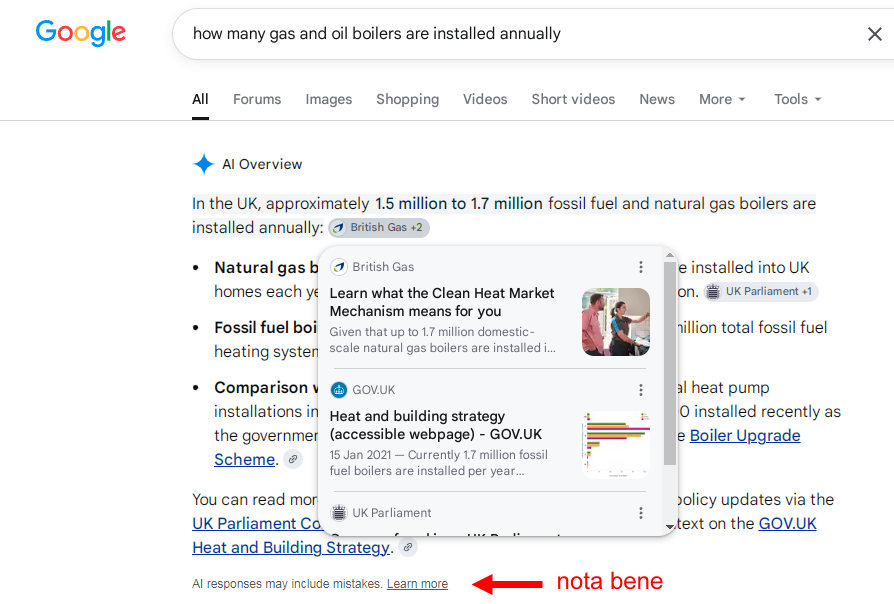
The first 'source' is an undated (maybe around 2023/24) British Gas marketing plug that incidentally drops in a statement that 'up to 1.7 million domestic-scale natural gas boilers are installed in the UK every year' without anything to back up that 'up to' number. Unsubstantiated tosh, binned.
The second 'source' is a Johnson government October 2021 policy paper on its Heat and Building Strategy. Note the date, because of pandemic effects. Two thirds of the way down a long page the policy paper asserts that 'Currently 1.7 million fossil fuel boilers are installed per year (natural gas, oil and coal). [footnote 396]' Unfortunately, footnote 396 no longer exists, if indeed it ever existed. The wayback machine (see note at bottom of page for link) does have archived pages for the relevant period, mid 2021, but they do not appear to contain any actual market research, let alone substantiated numbers. Instead there is a graphic:

which sort of sums it up. Unsubstantiated tosh, binned. Nonetheless, it is possible, but not proven, that this was the 'source' for the British Gas number.
The third 'source' is 'Written evidence [to a select committee?]submitted by Energy & Utilities Alliance (EUA) (WFP0062)' The EUA, we are told, 'provides a leading industry voice helping shape the future policy direction within the sector. Using its wealth of expertise and over 100 years of experience, it acts to further the best interests of its members and the wider community in working towards a sustainable, energy secure and efficient future'. Really? It goes on to assert that 'In 2024, just under 1.5 million natural gas boilers were installed into homes with around 90,000 heat pumps installed in comparison'. Note the heat pump number, we shall come back to that. However, for now, no source is given for either number. Unsubstantiated tosh, binned.
All that we have established so far is that google AI doesn't have a leg to stand on when it comes to evidence. It just churns out tosh. However, buried within [footnote 396] there is a glimmer of hope shining though the clouds: a named organisation, and a general indication that it does market analysis: 'BSRIA (2020), Domestic Boiler Market Analysis – United Kingdom'. And indeed they do, but at £1,410 for the latest report for a single country, I won't be getting that report anytime soon:
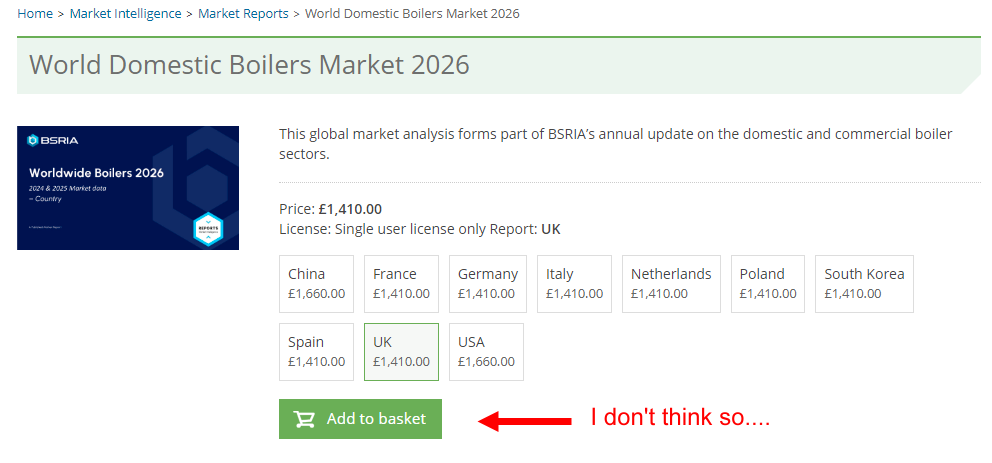
BSRIA (Building Services Research and Intelligence Association) does have a News Page and Archive, but none of the available press releases contains anything about the number of boilers installed in the UK in recent years.
In the interests of thoroughness, I did a more forensic analysis on the wayback machine, and still drew a blank: the earliest BSRIA heating market reports available are from 2025, long after the Johnson government's paper was published:
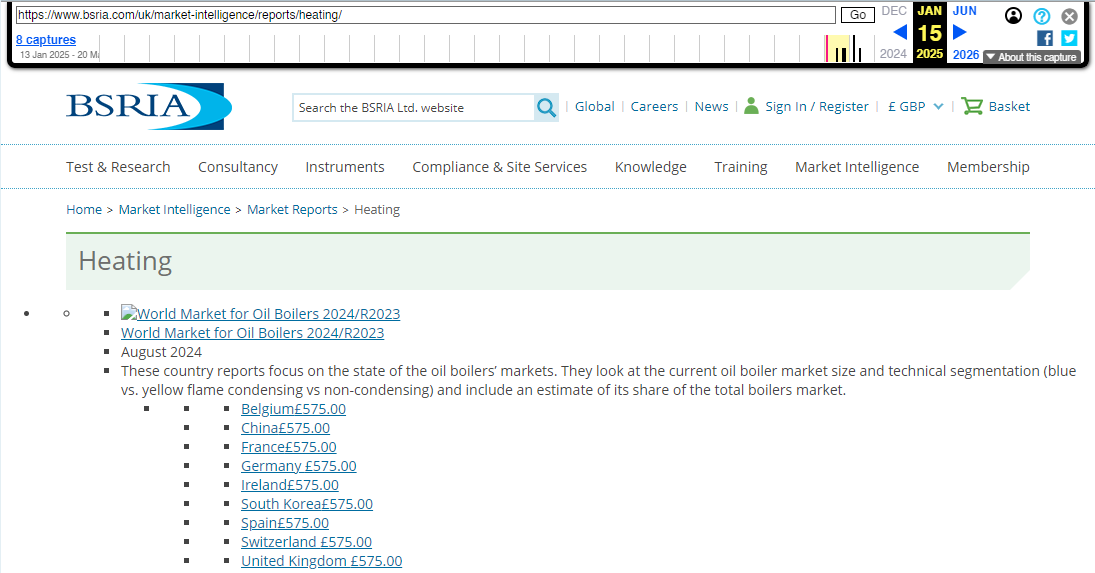
The bottom line appears to be there is nothing in the public domain to substantiate the often quoted 1.7 million annual (domestic?) boilers installed in the UK number. The best that we can hope for is that the goons who wrote Johnson government's policy paper (a) splashed out and got the then current, now at least several years out of date, BSRIA report (b) bothered to read and just as importantly critically appraise the report and (c) had reasonable grounds for believing the 1.7 million number they quoted (d) it wasn't a number distorted by pandemic effects and (e) it still applies today. Quite a lot to wish for...but at the same time, maybe it is the best we have? Who knows?
In passing: possible evidence that google AI just makes things up: I did a search for an organisation called the Heating and Hotwater Industry Council (HHIC) which may or may not publish domestic boiler installation stats. Google AI thinks it does:
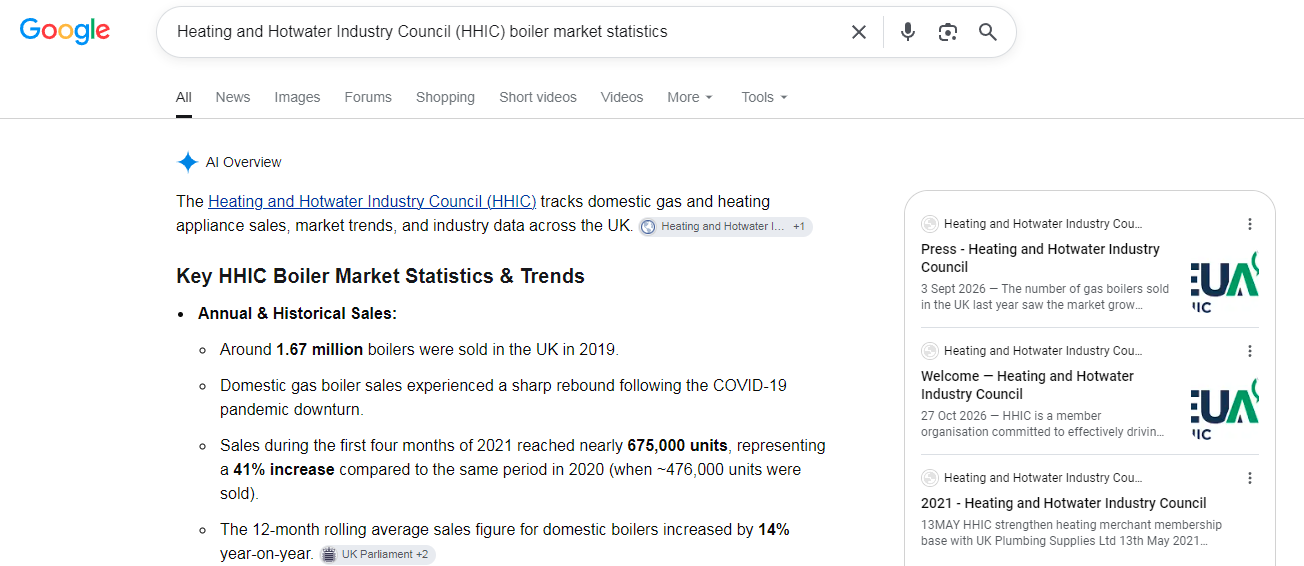
See the first entry in the box on the right: a press release date 3 Sept 2026 on the number of gas boilers sold in the UK last year which 'saw the market grow...' but tantalisingly failed to show the numbers. However that press release does not exist. It is not on the HHIC press release page, instead, it looks very like google AI made it up. When you click on the three dots by the link you get this:
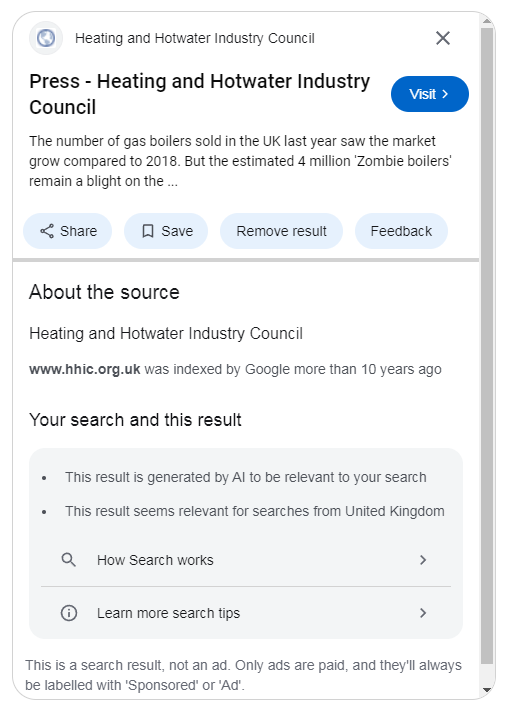
The reference has disappeared, and another, which does exist, and is intriguingly about 'zombie boilers', appears in it's place. But the giveaway is a bit further down, where it says 'This result is generated by AI to be relevant to your search'. If that doesn't mean made up, I don't know what does.
If the fossil fuel boiler numbers are but clouds in the sky, then we are at least on somewhat firmer ground with the heat pump numbers, thanks to the government grants. These numbers by definition exclude non-grant aided installations — anybody care to guess how many there are of them? — but the grant numbers are at least reasonably solid. There is still an element of smoke and mirrors in play, with folks wont to quite the number of applications (which is in fact a measure of heat pump aspirations) rather than the number of grants paid, which better reflects the numbers installed. The latest (published on 29 October 2026, link will go out of date when the next lot are published, but should get you near enough) available statistics (England and Wales only, not all UK) show in Table M1.1, that in the year to September 2026, 32,096 air to water heat pump redemptions were paid (and 32,780 redemptions applications were received). This is rather less than the 90,000 suggested by the EUA (mentioned above) which most likely mistook aspirations for installations. It also got confused over geography, making it unclear whether its aspirations number is for the whole UK, or just England and Wales.
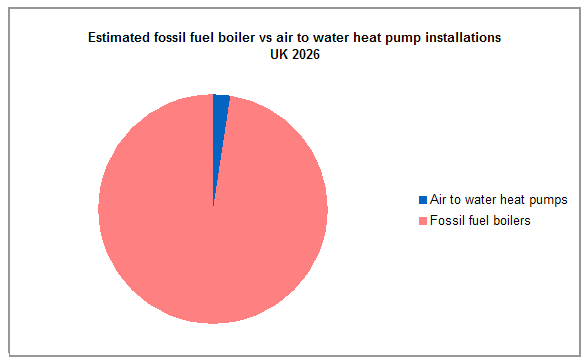
The numbers for the UK as a whole ie including Scotland and Northern Ireland for air to water heat pumps, based on MCS certified retrofits (excludes new builds and non-MCS certified, which most likely means non-grant aided installations), are equally depressing. Last year, in 2025, 52,940 air to water heat pumps were installed in the UK, but numbers in 2026 appear to have fallen. In the first two quarters, 20,705 air to water heat pumps were installed, giving an annual number of 41,410 heat pumps installed, if installations continue at the same rate during the last two quarters of 2026.
The scale of the problem? For the UK, something like 1.7 million (or whatever) boilers vs something like 42 thousand heat pumps. It looks like this:
Now some of those 1.7 million boilers with be so called so-called distress purchases. Personally I don't like the phrase 'distress purchase', it conjures up images of a 'boiler victim', or in modern parlance, a 'person living with boiler failure'. But the key point is that the 'official stats', such as they are, for distress purchases include both those truly living with boiler failure, as well as those who are aware that at some point in the future they too are likely to find themselves living with boiler failure. The distinction is important, because the first group, those already living with boiler failure, are likely to find themselves rushed into a panic purchase (the term I prefer) because of the urgency of the situation, while those in the second group, soon to be living with boiler failure, do at least have some time, be it maybe days or much more likely weeks or months, to consider their options — and one of those options is to replace their fossil fuel boiler with a heat pump.
At a rough estimate, around 30% (see the other post for details on how this number is arrived at) of all heating system replacements are true panic purchases (living with boiler failure purchases). That leaves 70% that are not panic purchases, where the occupier does in most if not all cases have time to consider their options. We can redraw the pie chart to show that proportion and the numbers:
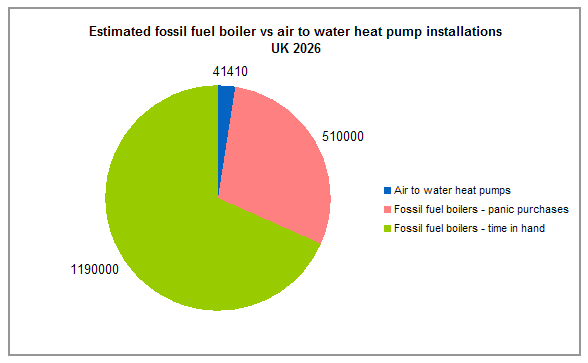
That is around 120,000 occupiers per year who have at least some, and possibly quite a lot, of time to consider the option of installing a heat pump, but who in the event decide to stay with a fossil fuel boiler. Putting it another way, only around one in thirty of those in a position to consider a heat pump actually go on to install one. That is the true scale of the problem.
The next obvious question is why do people overwhelmingly choose to stay with a fossil fuel boiler? I rather suspect the answer may lie as much as if not more in psychology as it does in economics.
Edited repeatedly to fix the broken BSRIA wayback machine link, but failed, again and again. The url is
https//web.archive.org/web/20210629095802/https//www.bsria.com/uk/
You need to manually add the two missing colons between https and //
This topic was modified 3 weeks ago 5 times by cathodeRay
Midea 14kW (for now...) ASHP heating both building and DHW

1

03/11/2026 1:46 pm
The next obvious question is why do people overwhelmingly choose to stay with a fossil fuel boiler? I rather suspect the answer may lie as much as if not more in psychology as it does in economics.
Surprised that you have to ask that question.
Money, potential disruption, unfamiliarity and lots of FUD in the media.
Even with the grants you are likely to have to pay out more for a heat pump than a replacement gas boiler.
Once you've done it, at the current spark gap, the running costs are likely to be greater than a gas boiler. (Yes, you can mitigate that, but few people want to learn how to game the system.)
If the current system uses a combi boiler a cylinder needs to be fitted; that's likely to be disruptive even before you start changing radiators.
Sometimes it just isn't reasonable.
3 years ago I designed and installed a heat pump heating system in our house. It replaced a perfectly functional gas system. I did it because I wanted to and I don't like gas. It cost a fortune and involved an unreasonable amount of disruption - basically I replaced everything. No grants or MCS registration were involved so it won't appear in any statistics.
We also own a small flat on the south coast. That has a gas combi boiler which is nearing the end of life, but there is no rational path for replacing the boiler with a heat pump. No location for the outdoor unit, difficult to get permission from the freeholder, no running cost saving. When it needs replacing it will be with another combi boiler
1

03/11/2026 4:16 pm
There are a lot of statistics about boilers presented in an easy to digest form here:
https://www.greenmatch.co.uk/boilers/statistics
That said, there are no references to the origin of the data. It may be from "Global Market Insights" however, I couldn't find the data there without the need to pay for it, as is often the case with fundamental market research done by companies rather than instituitions.
The Govt. figures in "Boiler Upgrade Scheme 2026 – 2030 Summary Business Case"
put the number of gas boiler installs at 1.5 to 1.7 million.
What is very clear though is that it greatly exceeds the number of heat pump installs.
To try and answer the question of the thread: "Why don't people choose heat pumps?"
- Capital cost - Boiler replacement like for like is typically around £3000. Average spend on a heat pump is £5400 AFTER the BUS grant (according to Octopus https://octopus.energy/blog/heat-pump-cost-explanation/).
- Running costs - Seem much more uncertain for a heat pump and may be higher than gas. Until recently, the spark gap has meant that this was almost certainly true until the householder got into the nuances of time of use tariffs.
- Complexity - the installation of a heat pump is much more complex and hence there is a fear of the unknown, compounded by horror stories in the press.
- Space - moving from a combi boiler to a heat pump, significant space may be needed or at least perceived to be needed for a hot water tank. Significant outdoor space is needed for the heat pump itself. Some people may not want one in a relatively small garden or on the balcony of a flat.
- Consideration of the next replacement. Once committed to a heat pump and having used the £7500 BUS grant once, if the heat pump breaks down or reaches the end of its life, is the next replacement going to cost £12000 rather than £3000 for a gas boiler? Will the Govt. mandate no heat pump to gas boiler swaps in the future?
The combination of higher initial cost, the potential for higher running costs, a much more involved and disruptive installation, higher perceived risk of a poor outcome, and a potentially very high cost of the next replacement makes for a pretty compelling argument against.
(Note, I'm being somewhat devil's advocate here. The above points aren't necessarily the case for all or even the majority of heat pump installs, however, they may be perceived to be so by many people briefly considering a heat pump in the short time available before replacing a failed or faulty gas boiler).
This post was modified 3 weeks ago by Rob of York
1

03/11/2026 4:28 pm
f the heat pump breaks down or reaches the end of its life, is the next replacement going to cost £12000
It really shouldn't, but until the designed-to-fail system is fixed, it just might!
I have been extremely pleased with my heat pump which has delivered a far superior level of comfort in my 1930s house for same or less running costs than gas without playing games with optimising for tarrifs, using batteries etc. I wouldn't want to revert to gas.
However I took a lot of care in picking an installer informed by the good people of this forum and recognise that the vast majority will go for the simple option until the system has been redesigned to incentivise them to do otherwise. The government is taking some steps in the right direction, but much more will need to be done by government and the industry across multiple aspects of the 'system' if heat pumps are to be anything other than a minority heating source.
This post was modified 3 weeks ago 3 times by JamesPa
4kW peak of solar PV since 2011; EV and a 1930s house which has been partially renovated to improve its efficiency. 7kW Vaillant heat pump.
1
Topic starter
03/11/2026 4:50 pm
@hml1827 — thanks for your reply. The question you quote rather than the title of the thread is partly rhetorical, insofar as some of us here are trying to get more heat pumps installed, and that means looking at the scale of the problem (is it really a problem, answer yes, given the numbers in my post), and what the barriers are. You have succinctly summarised many of them, again thank you!
I'm not a heat pump head case, just an ordinary punter who in 2021 had to decide what to do about an old oil boiler and more to the point, old oil tank that had started to go 'porous', no actual florid leaks, but a vague sense of CH oil getting out, most likely from internal corrosion, and things were only going to get worse. Mains gas wasn't an option, and I didn't fancy LPG. I persuaded myself on the basis of some calculations that a heat pump should work in my old leaky building, even if it was going to be expensive, but so too is any form of heating, because of a high heat loss even after adding acceptable insulation measures (being listed is another constraint). The heat pump was finally installed in early 2022, and now over four years on, and despite some initial problems, I can say I am very satisfied with the system. It does cost a bit more to run than would be the case had I stayed with oil, even after the recent increases in heating oil prices, but the house is more comfortable.
You are right to mention your heat pump installation not appearing in any official statistics. There is de facto no way of knowing how many of these happen. My hunch is the number is small, compared to to ~40,000 known about heat pump installation per year, let alone the x million fossil fuel boilers. But the real point of the post was to demonstrate that even with the uncertainties over the numbers, there is still annually a huge number of people who could consider a heat pump, but in the end don't fit one. In my immediate neighbourhood, where we all have broadly similar properties, I am the only one with a heat pump. One neighbour (a tenant and that means another raft of complications) is still on solid fuel (coal!) (Rayburn) and mains electric heaters, another has a very ancient oil boiler that they struggle to keep going, and so on.
For me, the grant was the deciding factor. I am not poor, but I am not well off either, and finding the capital to pay for the installation on my own wasn't really an option. I could however manage a small increase in running costs, which are spread out over time, though of course for many that isn't really an option either.
But my hunch is that for many who don't get a heat pump, the barriers are as much psychological as practical, they are so to speak not minded to get a heat pump. I am thinking of things like loss aversion, and the status quo bias. If that is the case, then logical arguments are unlikely to get very far, even if I still think the ultimate persuasive sledge hammer is an 100% grant, but that too comes with a whole raft of other problems.
My suggestion (it is no more than that at this stage) is that the primary decision to avoid a heat pump is psychological (emotional) and then the logical decisions (too expensive, too disruptive, too little available space etc) follow. Countering those logical arguments with logical counter-arguments fails because the mind has already emotionally decided.
Buried in those 120,00 per year decisions not to install a heat pump will be a number of people who can afford a heat pump, removing at a stroke a major barrier, but still choose not to do so. I wonder why more of them don't install a heat pump?
Midea 14kW (for now...) ASHP heating both building and DHW
03/11/2026 5:12 pm
gBuried in those 120,00 per year decisions not to install a heat pump will be a number of people who can afford a heat pump, removing at a stroke a major barrier, but still choose not to do so. I wonder why more of them don't install a heat pump?
To answer that I think you have also to ask why would people install a heat pump?
I can think of three reasons
(1) Greater comfort - but this is not sold by the industry so doesn't count
(2) Green minded
(3) Want to show off and know people for whom having a heat pump would be a 'show off'
The last two will draw in some including me (number 2) but won't draw the majority in. Unless there is a positive reason then all the reasons not to will dominate, if the option is even considered. To do something different to the herd requires a positive reason.
This post was modified 3 weeks ago 2 times by JamesPa
4kW peak of solar PV since 2011; EV and a 1930s house which has been partially renovated to improve its efficiency. 7kW Vaillant heat pump.

03/11/2026 5:34 pm
My feeling (which could, of course, be way off) is a bit like repeating much of the above but from a different angle.
Replacing a (non combi) gas boiler with an air to water heat pump as a straight swap should only differ in cost according to the relative prices of the boiler or heat pump - around £3,000 from what I can see (about £1,500 for a new boiler vs about £4,500 for an 8ish kW heat pump). An extra £3,000 installation cost shouldn't be a big show-stopper, but the problem is, of course, whether the rest of the system is ready to take a heat pump. If not, you're wasting energy but it's going to be cheaper to replace the boiler with a boiler and keep being wasteful than fix the rest of the system as well and you still have the option of fixing the system piecemeal before revisiting the boiler/heat pump question a few years down the line.
And thereby hangs the problem. I believe most homes with boilers in have central heating that's just not efficiently designed and there's little incentive for people to get that fixed irrespective of what's providing the heat into it.
105 m2 bungalow in South East England
Mitsubishi Ecodan 8.5 kW air source heat pump
18 x 360W solar panels
1 x 6 kW GroWatt battery and SPH5000 inverter
1 x Myenergi Zappi
1 x VW ID3
Home Assistant to make it all play nicely together
Raised beds for home-grown veg and chickens for eggs
"Semper in excretia; sumus solum profundum variat"
Topic starter
03/11/2026 5:51 pm
There are a lot of statistics about boilers presented in an easy to digest form here
I saw that Greenmatch page, but as you noted it mostly (not all, there are some links, but they are often dated and/or dubious) lacks sources. Its the old problem of everyone quoting everyone else without ever checking the facts.
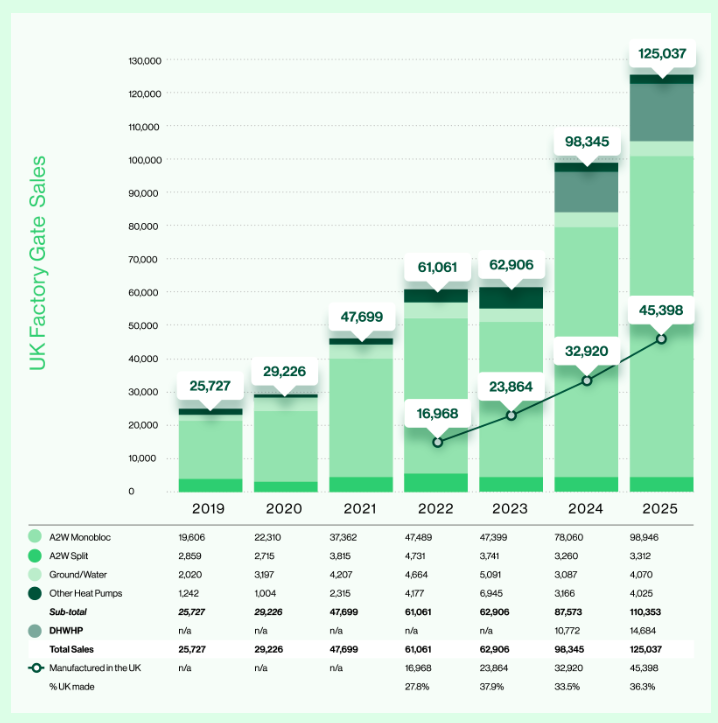
I didn't find the Boiler Upgrade Scheme 2026 – 2030 Summary Business Case (meta data suggests it was produced in mid 2026) but it just again asserts the 1.5 to 1.7 million boiler number without giving a source. It also goes frankly off piste with its tractor production is up sorry heat pump sales are up claim: 'growth continued into 2025, with heat pump sales reaching a record high of over 125,000'. This does have a source, but it is the Heat Pump Association UK, and the number is based on factory gates sales, which in turn relied on 'a combination of utilising data provided by HPA UK manufacturing members and using market estimation techniques to extrapolate the data to represent the full UK Heat Pump market'. In other words, the tractor producers used modelling to model their own production, and rather unsurprisingly tractor production is up:
At this point my confidence in the authors of the Boiler Upgrade Scheme 2026 – 2030 Summary Business Case went sub-zero. Using dodgy stats from a trade association to imply something that simply is not the case (most people will read 'heat pump sales' as retail sales to consumers) is simply not on. It is also a good example of the need to check references, in case a claimed statement is in fact not backed up by the reference, as happened here, though at least in fairness the authors did provide a reference.
The combination of higher initial cost, the potential for higher running costs, a much more involved and disruptive installation, higher perceived risk of a poor outcome, and a potentially very high cost of the next replacement makes for a pretty compelling argument against.
Again a concise summary of the usual logical arguments, but my contention is that they succeed because they fall on fertile ground, ie a mind that is already emotionally decided.
Consider loss aversion, in this case the perceived threat of losing a heating system that simply just works to some new fangled system that by all accounts needs a PhD in thermodynamics to get it working. Loss aversion comes about because the perceived emotional pain from a loss is roughly twice the emotional benefit from an equivalent gain. The emotional pain we get from losing £100 is emotional gain we get from a gift of £100, or, to put it another way, to remove the loss aversion behaviour, the potential gain has to be double the potential loss. We are, this suggests, losing the arguments because we are not demonstrating that the potential gains are indeed 'worth' double the potential pains.
On the question of why those who can afford a heat pump chose not to do so, it turns out Which? has already done some research on this. In fact, they have it seems already done the research I was contemplating, but had little hope of completing! A couple of quotes from Beyond Affordability: Why heat pumps feel like a gamble:
"However households who could afford to make the switch are also choosing not to, suggesting other factors are also influencing decision making. While
previous assumptions heavily weighted the upfront financial cost as the primary roadblock, this new research shows that the problem runs deeper. It is not simply a question of affordability, but of willingness to pay."
"Much of the existing evidence base has been survey-focused, which effectively identified affordability as a major issue but failed to capture why consumers with the right homes and adequate budgets were still getting stuck in the decision-making funnel. By utilising qualitative methods, specifically in-depth interviews and focus groups, this research uncovered the deeper psychology nuances governing homeowners behaviour. This approach revealed that the decision to not get a heat pump is heavily influenced by behavioural biases such as present bias and loss aversion. Most homeowners are currently living with a heating system that is ‘tried and tested’ and whilst they may be worried by recent energy price rises and the impact that oil and gas has on the environment, taking a step into the unknown feels like a high risk. The qualitative findings make it clear that simply
introducing new financial loans or models that spread out the cost will not be enough; the psychological barriers of perceived risk and lack of control must be addressed first and foremost."
On this occasion I will forgive the authors the 'decision-making funnel' jargon on the grounds that the general thrust is very much in line with my own thinking, with the added advantage that they actually did some research, on the processes involved. Where I suspect they are on shakier ground is on the question of how to tackle these psychological and emotional barriers so that folks can as it were squeeze through the decision-making funnel.
Edited to add HPA UK link
This post was modified 3 weeks ago by cathodeRay
Midea 14kW (for now...) ASHP heating both building and DHW

03/11/2026 5:52 pm
@cathoderay One of the ways that people overcome psychological (emotional) barriers is to experience something for themselves often via friends or people that they trust. I don't think the number of heat pump installs is necessarily sufficient to get a real snowball effect going based on that, and perhaps there just isn't the USP to do so for the majority of people.
I see a contrast here with air-to-air. Since I got an air-to-air system last year and we had five unpleasant heat waves this summer, all of the friends that have visited or stayed with us have asked about it, wanted to see it running, listened to how quiet the outdoor unit is, and gone away thinking about getting such a system themselves. So far two have committed deposits and another is in the process of getting quotes. The killer argument has been sleep quality in hot weather, i.e. the cooling side. That combined with a realization that the install costs are modest, the disruption minimal, and the system can recoup a substantial fraction of the outlay over a 10 year period via highly efficient heating. This makes for a compelling argument; lower CO2 emissions and a redundant heating system are added benefits.
I doubt if I had been demoing an air-to-water heat pump the impact would have been anything like as great. I could have shown that the outdoor unit was quiet, and that the comfort level of low temperature heating was really nice. However, I'm already there with radiator temperatures in the 30s and low 40s most of the time with the weather compensation on my gas boiler, so there wouldn't be that much new to see. Then the conversation would doubtless move on to the initial cost, running costs, and how long the installation took, at which point there might be head scratching and "not for me" comments. It's a much harder sell.
I think most people want a simple reliable system that heats their house in a comfortably way and don't actually care what the heat source is provided that it doesn't cost a fortune to run. I think you are right that risk aversion plays a role here. One that could likely be overcome if the economics / running costs were firmly in favour of heat pumps. In short, the spark gap is too high. Lower that significantly and suddenly people would WANT heat pumps, and find lots of things wrong with the gas central heating that they have lived with for years!
Topic starter
03/11/2026 6:05 pm
I see a contrast here with air-to-air. Since I got an air-to-air system last year and we had five unpleasant heat waves this summer, all of the friends that have visited or stayed with us have asked about it, wanted to see it running, listened to how quiet the outdoor unit is, and gone away thinking about getting such a system themselves. So far two have committed deposits and another is in the process of getting quotes. The killer argument has been sleep quality in hot weather, i.e. the cooling side. That combined with a realization that the install costs are modest, the disruption minimal, and the system can recoup a substantial fraction of the outlay over a 10 year period via highly efficient heating. This makes for a compelling argument; lower CO2 emissions and a redundant heating system are added benefits.
Spot on. What we see here is you demonstrating the very considerable gains (comfort and others) set against modest pains (costs), thus achieving the magic double the gain vs the pain approach that neutralises the inhibitory effect of loss aversion.
I was going to add that your friends went through the decision-making funnel like high speed train through a tunnel but managed to stop when I realised I was getting into what Clive James once called a Mr Fish Situation.
Midea 14kW (for now...) ASHP heating both building and DHW
03/11/2026 6:27 pm
Although the vast majority will be starting with a boiler that runs at a fixed high FT, so they will see benefits from a system upgrade (boiler or heat pump) involving WC, you are absolutely right. It comes down to people needing a positive motivation to depart from the norm.
One question for your friends, are they using the system to heat as well as cool, or just to cool for a few days in the summer?
Put another way, can A2A serve as a 'Trojan horse' (to convert heating to heat pumps) for those who can afford the luxury, or will it turn out to be just another way to increase our energy consumption?
This post was modified 3 weeks ago 7 times by JamesPa
4kW peak of solar PV since 2011; EV and a 1930s house which has been partially renovated to improve its efficiency. 7kW Vaillant heat pump.
Topic starter
03/11/2026 8:02 pm
I think most people want a simple reliable system that heats their house in a comfortably way and don't actually care what the heat source is provided that it doesn't cost a fortune to run. I think you are right that risk aversion plays a role here. One that could likely be overcome if the economics / running costs were firmly in favour of heat pumps. In short, the spark gap is too high. Lower that significantly and suddenly people would WANT heat pumps, and find lots of things wrong with the gas central heating that they have lived with for years!
Again, spot on. The problem is that we in the UK have dug ourselves into a deep hole, and there is no easy way out. The historical combination of cheap North Sea gas and a bonkers policy of loading green levies onto electricity bills set up a situation where anyone who has access to mains gas is hugely incentivised to use gas for central heating (and their gas boiler system has in a way become a so called sunk cost). The problem is how to reverse the situation ie set the spark gap at a level, which is probably around 2 to 2.5, that means heat pump based heating, because of its high effieciency, is demonstrably and reliably cheaper to run than gas central heating, such that the loss to be averted becomes high gas heating bills! But we have as yet to find ways to do that without causing civic unrest...
Midea 14kW (for now...) ASHP heating both building and DHW
Page 1 / 8
Next
