

Notifications
Clear all
Joining the Renewable Heating Hub forums is completely free and only takes a minute. By registering you’ll be able to ask questions, join discussions, follow topics you’re interested in, bookmark useful threads and receive notifications when someone replies. Non-registered members also do not have access to our AI features. When choosing your username, please note that it cannot be changed later, so we recommend avoiding brand or product names. Before registering, please take a moment to read the Forum Rules & Terms of Use so we can keep the community helpful, respectful and informative for everyone. Thanks for joining!
Air Source Heat Pumps (ASHPs)
98
Posts
17
Users
53
Reactions
10 K
Views

31/10/2026 6:25 pm
@watcher If you have sash windows, or a plastic door you can "re-engineer" a bit then the Midea is an excellent piece of kit. Shove it out of the sash window, close the sash close to pipe level and then cut a pair of pieces of celotex or similar to go round the pipe and done. Possibly also add some sashlocks for the right height.
With a plastic door you take the bottom panel out, shove the external unit through it and then cut a U in one side of the panel for the pipe and add some insulation/duct take around it, then reassemble the door.
Otherwise the fact you can't split the two units is a major pain in the arse.
This post was modified 3 weeks ago by Majordennisbloodnok

31/10/2026 6:39 pm
@etchedpixels
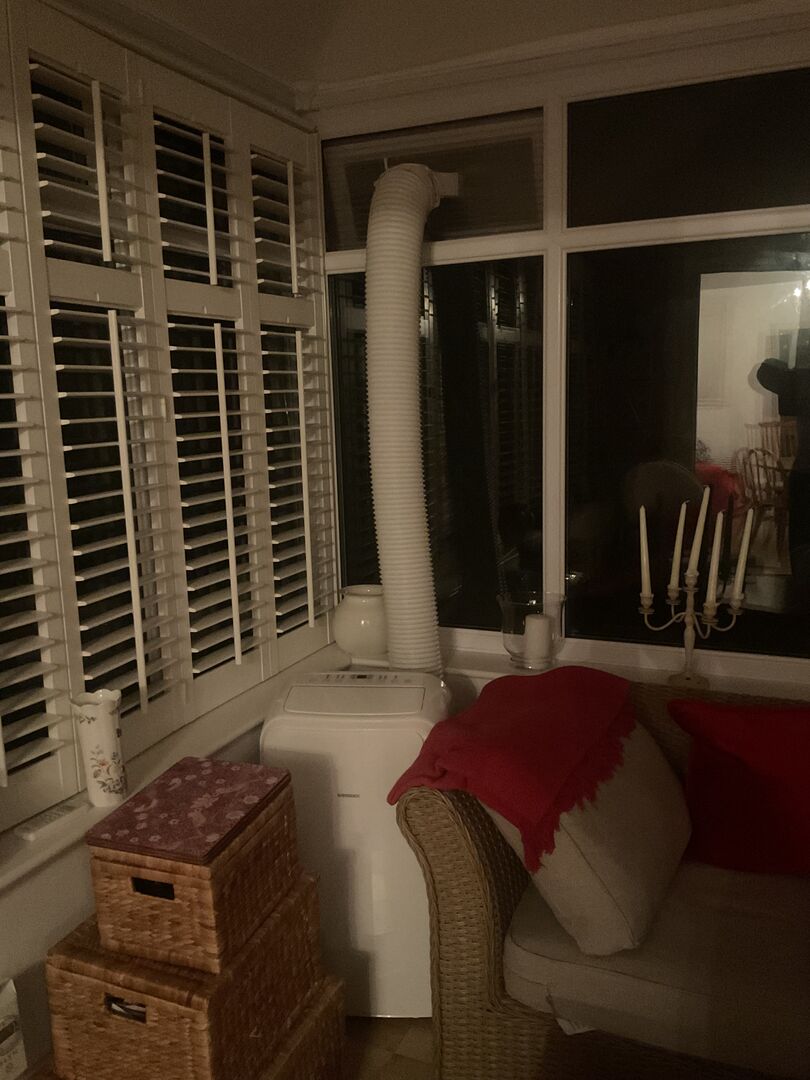
Agreed, just a thought for others. I am A2W plus A2A in the lounge with a conservatory abortion!
Why?? Because I use it to warm the glass house if I have a sunny day! Extends its use through the year and stops damp accumulation.
This post was modified 3 weeks ago by Majordennisbloodnok

1

04/11/2026 6:07 pm
@rob-of-york Hi Rob,Interesting points you have raise here! Thank you! I definitely need to tread carefully here as it could turn out to be an expensive mistake - both immediately and long term!
And yes I agree re the effective 30p/kWh to run a heat pump vs exporting that excess power from the batteries, which is what is keeping it cost neutral at moment even in winter.
We have only generated 1.08 kWh of solar generation today (4th Nov.) 🙄, so that export is what makes a big difference... I'm charging the batteries from 20%ish SoC at 2AM to 95-100% by 5AM (circa 18 kWh @ 16p/kWh = £2.88) and then discharging the surplus back down to 35% SoC during the evening peak period (4-7PM). Even on a near-zero solar production day like today, that's still about 40% available for export. Around 10 kWh (about £3 of electricity at 30p/kWh). So I get my electricity for free even in winter...
Any ASHP option would need to factor that export loss into it's costings...
I'll have a look at the Cosy Cooler options but I'm not a big fan of buying from Octopus even if I like their tariff plans... I'm doubtful that they offer best value for money.
Apologies for the delayed reply - I've been setting up my Switchbot thermometers so that I can measure my house energy loss... Happy to report that this is now up and recording with monitors outside in my garden and in my Lounge and kitchen. I'm able to export the data to Excel but I haven't figured out how to access the mini-hub and sensors from my PC yet? 🤨 That would be nice if I could do that! I have the Sigen app on my desktop browser making monitoring easy and having the thermometer sensors available too would be a bonus (rather than using my tablet or phone to access the data).
This post was modified 2 weeks ago by Majordennisbloodnok
Installed solar [7.44 kWp] and batteries [Sigenstor 3 x 8kWh] and 12 kW inverter in July 2025.
04/11/2026 6:39 pm
Hi James,
Thanks for your input here!
With a house that has lots of separate rooms and an existing distribution network it is difficult to see how it is going to work - this is where A2W majors. For a relatively open plan house, particularly if its modest in size, it seems like A2A is a great fit delivering both heating and cooling is a single package at a higher efficiency than A2W. With a decent ToU tarrif and/or solar panels, the simplest DHW solution in this case is probably an immersion heater in a tank. Retaining a boiler, particularly if the standing charge is scrapped, is clearly also an option. By the time you take into account maintenance costs for a boiler dedicated to DHW an immersion probably work out cheaper though!
But....
In the aforesaid open plan house the solution where A2A heating is practical the solution is perhaps obvious - just use A2A. I feel that this could be a major selling point once the industry is ready to deliver A2A in volume in domestic situations, which currently it is not.
And I am coming to agree with you here @jamespa... I'm coming at this from a desire to want to remove the gas boiler (which is only 2 years old!) BUT I'm starting to realise that given the installation costs of a 220L hot water tank plus plumbing costs and the heating costs using electricity for that hot water tank (vs exporting that electricity, even at only 11p/kWh day rate), is not being very cost effective verses an 8p/kWh for gas... Even if this goes up to 10p/kWh! That is with the proviso that daily standing charges DO disappear of course!
Sure, servicing the boiler is going to cost £80 to £100 per year. Gas costs for my DHW currently run at around £15 per month with half of that being the DSC. So, assume around £7.50/month for DWH, my DHW annual bill is around £200 per year. At that cost per year any ROI is going to be quite lengthy for a hot water immersion tank installation run from my electricity... Even assuming that I could run it from off-peak (day rate) excess solar for three quarters of the year, that is still costing me 11p/kWh if not exported. Again, with the proviso that these export values remain - which they very likely will NOT.
The Heating/Cooling via A2A is probably going to be a win, if only because the cooling is going to be VERY welcome come next summer... But even then I'm struggling to see a route to ROI any time this side of my 83rd birthday... (sic). I've asked for a quote to 'ballpark' an A2A install and hopefully Danny will come back to me in the next week or so with something that I can have a feel for the £££ numbers... But, despite gas DSC going away, (and the unit cost going up to circa 10-11p/kWh), I'm struggling to see how to make this all work atm.
This whole energy market is in serious flux atm and trying to jump one way or another is proving tricky... Indeed, having installed solar and batteries has now landed me in a kind of 'no-mans-land'! I'm currently energy neutral as my summer electricity export is paying for my winter gas consumption (and some). Messing with that formula is a headache!
This post was modified 3 weeks ago 5 times by SusannaSaunders
Installed solar [7.44 kWp] and batteries [Sigenstor 3 x 8kWh] and 12 kW inverter in July 2025.

04/11/2026 7:09 pm
Hi James,
More good points here:
The regulation hampers progress in fixing these! In fairness our understanding of the practical use of the technology, and some aspects of the technology itself, have evolved immensely and thus the technological context has changed, but the underlying fundamentals remain namely a grant/tariff/regulation system that does not encourage the behaviour it is supposed(?) to support.
Part and parcel of the problem is the 'for profit' energy market designed and run in the post-Thatcherism era... As has been said above, much of the regulation and policy costs are around ensuring that profitability for the privatized energy market... The energy regulator is evidently not on the consumers side - whatever they may claim! [as an aside - the same problem basically as the water industry].
I'd add that the grant scheme, as designed, is definitely designed for the rich to make use of it (who might have £15k to drop on such a project) and leave the poor to pick up the real tab because they can't take advantage of these grants... Sure, the Warm Homes Scheme might lower loan costs a bit assuming you can find £200 a month from your monthly budget for a loan but basically, it's a benefit for the rich, not the poor!
If the government was truly serious about Net Zero and Green policies in general, this is not the way it should be done...
Whether this 'design to fail' was deliberate political choice, lack of attention to detail or just incompetence is a matter of speculation, but until its fixed things wont change materially.
Agreed... The Tory and Labour Duopoly isn't really interested in fixing this problem from where I'm standing.
Personally I would like to see this go a lot further. We are currently upgrading many parts of the gas distribution network because they are dangerously old. This is ultimately wasted capital investment and, if its possible to construct a suitable scheme, the money could instead be given to households to subsidise them to move off gas.
We have had a LOT of disruption in northern Somerset over recent months as new gas pipe infrastructure has been installed around here. Presumably to support a number of large new housing estates that are going up (one of which I now live on). And yes, giving that money to people via their council tax to get off gas would have been a better use of the money imo too!
Part of the problem is also the property developers.. {I curse every one of them!} Who will only move away from sticking in a gas boiler when literally strong armed into doing so! It pains me to see new builds still going up here with gas boilers in them! 😩
Currently we are consuming what we want and foisting the costs onto future generations, a position that morally is difficult to justify!
I totally agree with you! Even though I'm in my 60s, retired and have no kids! Morally, this is a no-brainer and burning fossil fuels needs to stop!
This post was modified 2 weeks ago by Majordennisbloodnok
Installed solar [7.44 kWp] and batteries [Sigenstor 3 x 8kWh] and 12 kW inverter in July 2025.
04/11/2026 7:14 pm
The unfortunately thing here is that heat pumps were not mandated for new builds in 2024 as they are now, otherwise there would be one in place, with a hot water tank and radiators of the appropriate size.
At least they are mandated now! A bit late in the day in my opinion - as the wide-scale gas refit and new gas infrastructure is going ahead in our area anyway! 😡
This post was modified 2 weeks ago by Majordennisbloodnok
Installed solar [7.44 kWp] and batteries [Sigenstor 3 x 8kWh] and 12 kW inverter in July 2025.
04/11/2026 7:23 pm
Given its a new build and the building regs changed a few years ago to mandate design for max 55C flow temp, it's quite possible rads don't need replacing. However I believe builders can game the regs by some sort of pre registration nonsense which locks ttem in to older regs, so it may not be thus way..
I strongly suspect this is the case, especially with large sites that have had their plans drawn up years ago and are still projected to take another 3+ years to complete! That is the case here. This site of some 250 homes is barely half way completed (currently Phase 2 - Liddymore Park in Watchet by Summerfield Homes if you want to check it out). The remainder of the site will take another 3 years at least and I would borrow good money that none of those new builds still to be put up (at least a hundred houses) will be 'adjusted' in their design spec for a heat pump etc. The plans are already signed off and done! 😤
The long and short of it is that despite new builds now getting heat pumps - that is only new building sites starting from the drawing board! It's not retrospective.
This post was modified 2 weeks ago by Majordennisbloodnok
Installed solar [7.44 kWp] and batteries [Sigenstor 3 x 8kWh] and 12 kW inverter in July 2025.
04/11/2026 7:31 pm
@etchedpixels There is a lot to be said for living in a ‘Mature Build’ home, one can move in, assume that much work needs to be done in the way of insulation, re-wiring, re-plastering and decoration etc., but at least one is for-warned that this work may be required to bring the dwelling up to an acceptable standard. The new build should have all this work already carried out but one can never be sure…
From my experience of buying a new build... The worse decision of my life! Assume that everything is borked/broken/sabotaged or incompetently installed. The latter is on a good day! The first year and a half was spent just fighting with Summerfield Homes! 😡 [profanity would be fitting here].
All caught up now! 😎 🤗
This post was modified 3 weeks ago by SusannaSaunders
Installed solar [7.44 kWp] and batteries [Sigenstor 3 x 8kWh] and 12 kW inverter in July 2025.


04/11/2026 8:15 pm
Given that you have an almost new boiler then, if you are looking for ROI on installing a heat pump forget it. If you are looking for more or less break even on running costs (by which i mean it could be a bit less or could be a bit more depending on the direction of yte wind, but neither life changing), 25% of the carbon footprint and quite likely increased comfort, then just go for it.
What sort of prices you are being quoted? You mention £15k which is way over after grant. I received quotes in the range 5-20K after grant, it's absolutely vital to shop around as some prices appear to be based on what the assumption that you are extremely gullible or just very rich, or perhaps just a bet that if you quote an unreasonably high price for jobs you dont really want then some will say yes. In fairness this is how the construction industry works, nothing special about heat pumps!
This post was modified 3 weeks ago 7 times by JamesPa
4kW peak of solar PV since 2011; EV and a 1930s house which has been partially renovated to improve its efficiency. 7kW Vaillant heat pump.
04/11/2026 9:47 pm
What sort of prices you are being quoted? You mention £15k which is way over after grant.
The £15K quote was for an A2W system with rads upgraded and was not including the BUS grant (so about £7,500 I think it was still to pay post BUS grant).
No quotes yet re an A2A system and I'm guessing these quotes will very a lot depending upon format picked, number of cartridges or ceiling ducts etc. My initial thoughts are for a single wall mounted unit on the landing for the upstairs. Probably another 2 units in the lounge and kitchen downstairs. Upstairs is usually more than warm enough without the radiators on so I'm reasonably confident that could work... As long as we don't sell the house when that could become an issue due to a lack of room by room control.
As for motivations, sure, I'd love to get my carbon footprint down! Although, I'm not prepared to pay significantly over the odds for my energy bill to do so. 🙄 I'm not prepared to martyr myself for that cause just yet. I'm living on a pension of £13k per year. I don't have money to burn!
This post was modified 2 weeks ago by Majordennisbloodnok
Installed solar [7.44 kWp] and batteries [Sigenstor 3 x 8kWh] and 12 kW inverter in July 2025.
04/11/2026 10:38 pm
Assuming your newbuild insulation was assembled vaguely correctly for most of the year you'd probably find that a single portasplit or similar DIYable setup downstairs will do the job (4kW heat output).
The saying on newbuild sites is "do your best, foam the rest"
This post was modified 2 weeks ago by Majordennisbloodnok

04/11/2026 11:02 pm
I'm living on a pension of £13k per year. I don't have money to burn!
£7.5k is a great deal of your own money to be spending on switching from gas to an A2W heat pump when your income is a pension of £13k a year. Particularly as it is unlikely that you'd see a reduction in running costs.
I guess it depends just how highly you value getting completely off of gas / removing those CO2 emissions.
Removing 6400kWh of gas demand per year equates to less than 18 tonnes of CO2 over the 15 year lifetime of the heat pump. At a cost of £15k that's over £800 per tonne of CO2, which is more than 10 times the current EU and UK carbon trading prices. In other words, it is a very long way from being value for money as an environmental measure to remove that amount of carbon emissions from the atmosphere.
Costs for a good quality 3-way multi-split A2A system installed are likely to be around £6k, and then you would still need a solution for hot water. So a complete replacement system using A2A would also be very expensive, since the grant is only £2500 and there are a lot of hoops to jump through, such as heating every room.
The partial solution of a single-split 3.5kW A2A heat pump (indoor unit in the upstairs landing) for £2200 for a Daikin Perfera system could halve your CO2 emissions by using it for heating in conjunction with your gas boiler as well as providing adequate cooling. That is around £122 per tonne of CO2 removed, which is a lot better environmental return for your money and the taxpayers money (none in this case) than A2W. You'd still have a gas boiler, but use a lot less gas. Heating using A2A (SCOP 5+) on 30p per unit electricity works out around 6p per kWh, which is cheaper than gas, so there is a modest saving to be made in running cost - enough to offset the maintenance costs.
Compared to getting an A2W heat pump, you could make a bigger difference by getting a single-split A2A system for yourself and also treating your two best friends to a gift of the same! That would cost less, save more CO2 emissions, and set you and your friends up with air-conditioning for the summer heat waves to come. You'd also leave a £7500 BUS grant on the table for someone who may be able to use it to remove 11500kWh or more gas usage per year - the OFGEM average. (The BUS grant is going to run out now the Govt. has reduced the overall funding pot available, so the number of people who will be able to get it is limited).
Note annual maintenance for A2W is around £180 compared to around £90 for gas and around £80 for A2A.
This post was modified 2 weeks ago by Majordennisbloodnok
1
