We had an Ecodan installation done as part of wider building work and this was completed last July. Reading some of the posts in here (especially the recent “Advice for a novice” thread by @Green_Fox recently) have been very helpful – I suspect that (1) we may have more hardware than necessary, and that (2) our current setup is not optimal, but the main issue to address is (3) the frequent L9 errors we have been having as the weather has got colder. But I do appreciate that the way we address (3) may be contingent on also addressing (1) and (2)…
Location: 4 bedroom Victorian terraced house with loft and kitchen extensions in London.
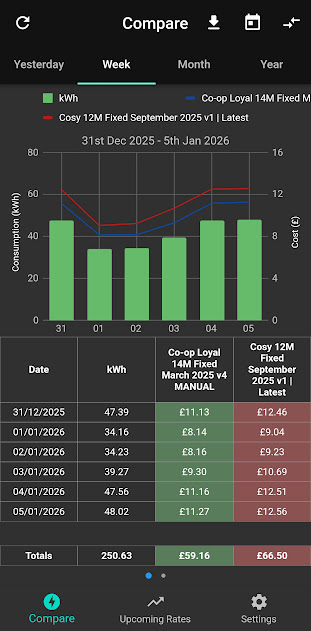
Electricity tariff: We are currently still on the Octopus “Co-op Loyal 14M Fixed March 2025 v4” tariff, and using the Octopus Compare app, we can see this is a bit cheaper than the current Octopus Cozy tariff, so we have stuck with that for now.
Hardware:
Back garden: Mitsubishi Ecodan 11.2kW ASHP
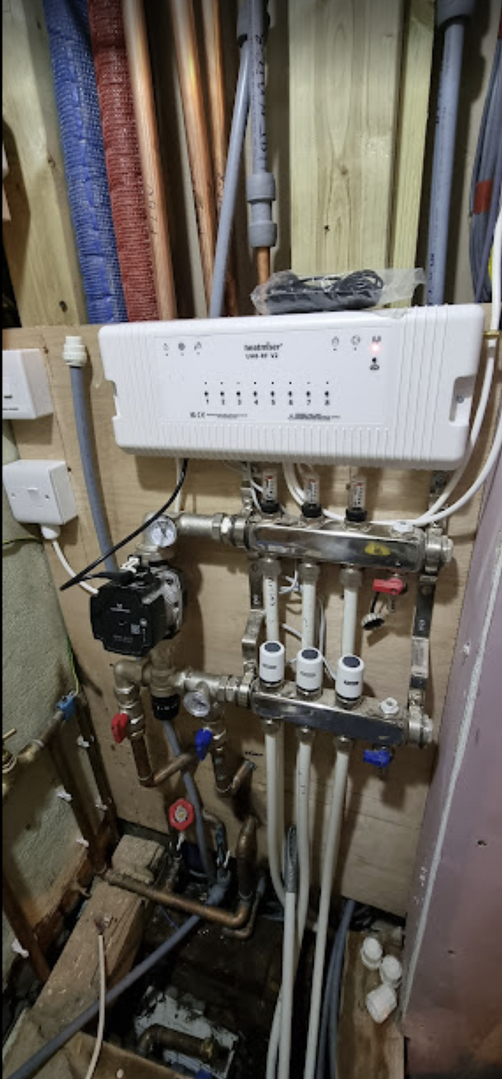
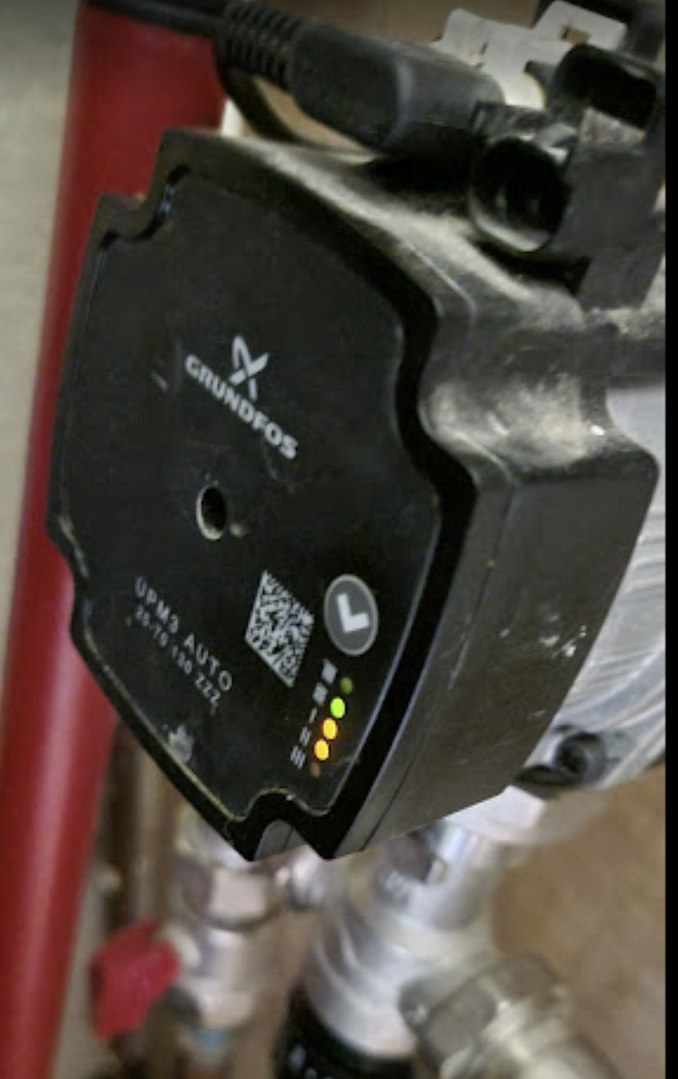
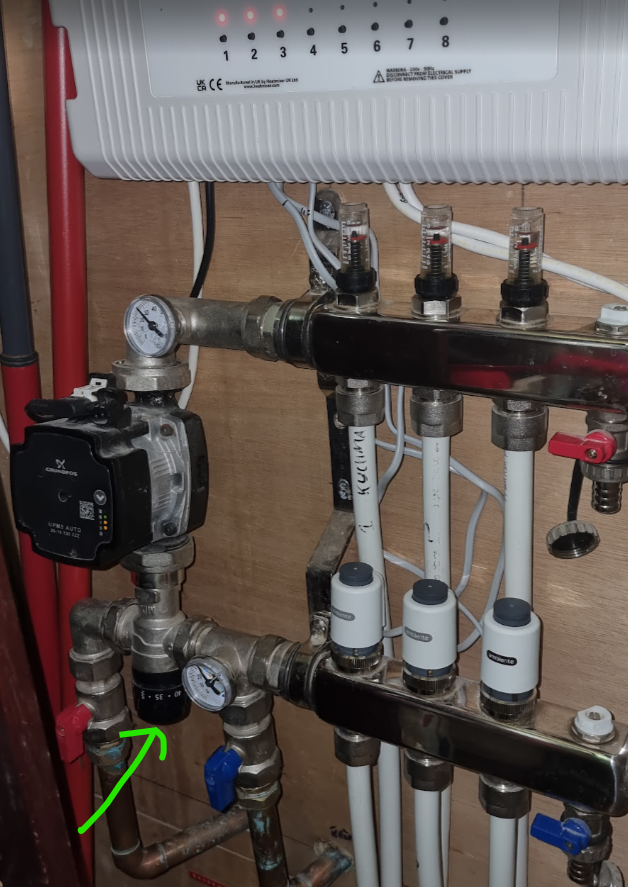
Under-stair cupboard: Grundfos UPM3 pump set to “Constant Pressure 2”, Heatmiser UH8-RF v2 attached to manifold with three outputs: (i) UFH in kitchen (tiled floor), (ii) UFH in lounge (engineered wood floor), (iii) radiators in hallway and upstairs, and Heatmiser Neohub.
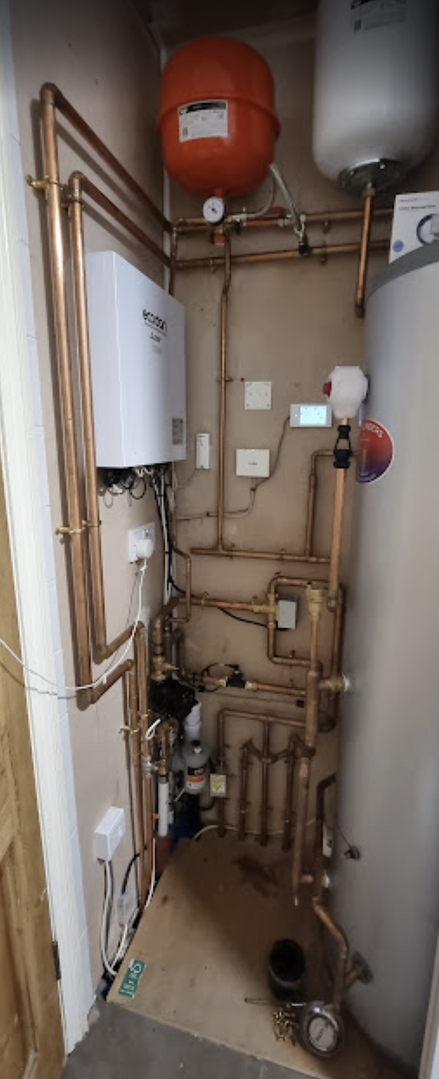
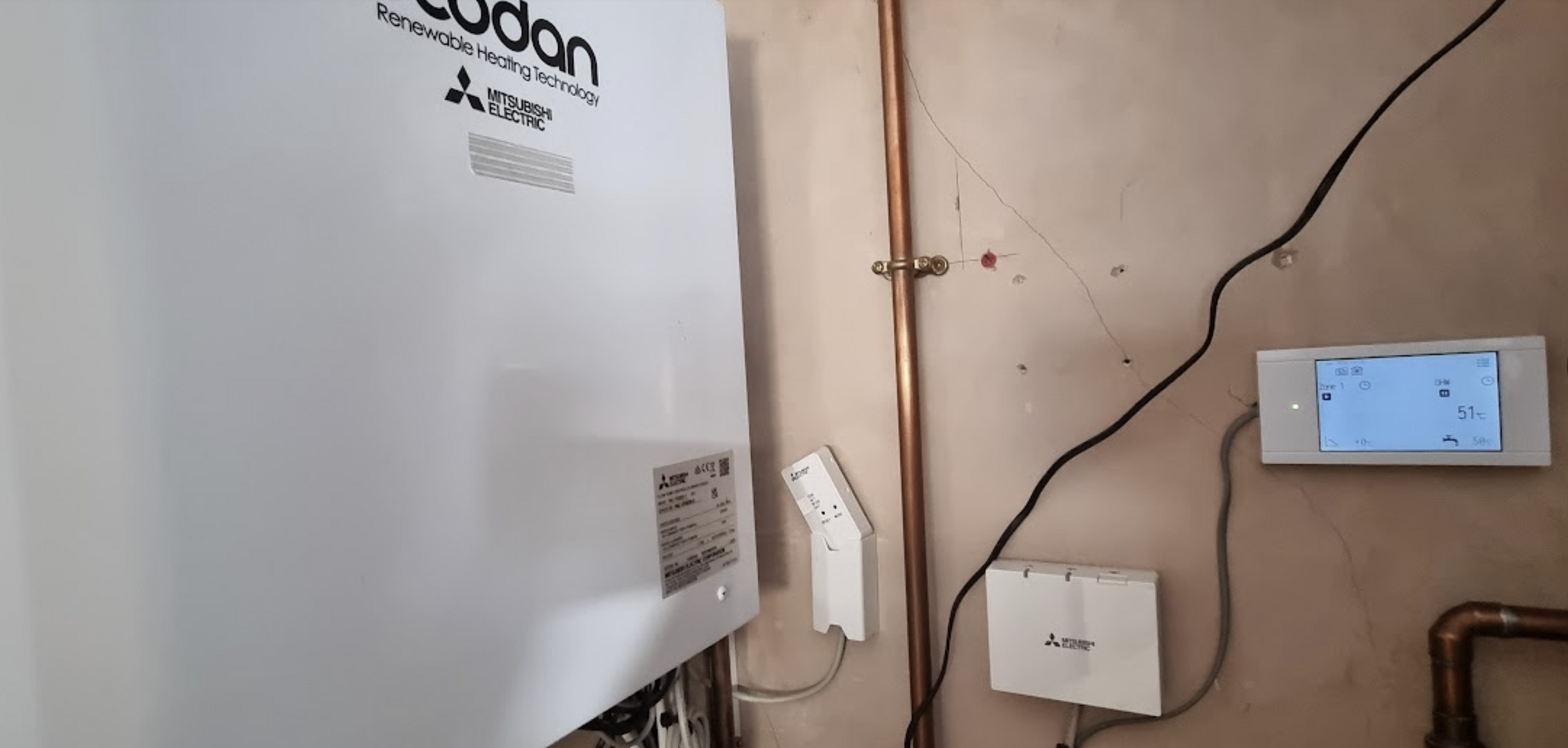
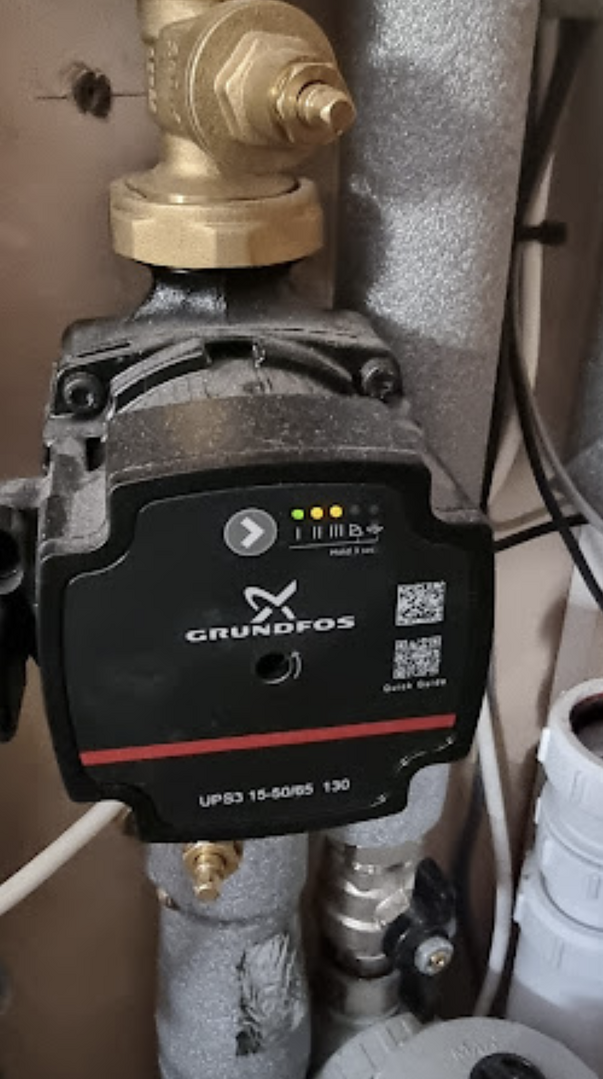
Bathroom cupboard upstairs: Grundfos UPS3 pump set to “Constant Curve 3”, Mitsubishi Ecodan FTC7 controller and UK Cylinders 250L hot water cylinder.
Setup:
Thermostats: We have three Heatmiser neoAir v3 wireless thermostats, one in the kitchen, one in the lounge and one upstairs.
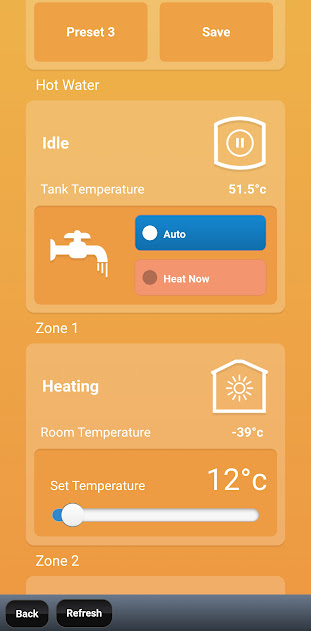
Call for heat: If I have understood correctly, the Heatmiser takes charge of calling the Ecodan for heat and so the Ecodan’s “Zone 1” is essentially a dummy zone that doesn’t seem to do anything. (It seems to think the room temperature is always minus -39C). So I think all room temperatures are monitored by the Heatmiser thermostats. (And I am not sure whether the Ecodan Wi-fi interface box does anything or not.)
Both 2xUFH and radiators are fed from the same manifold, so I presume they all have the same flow temperature. (I am not sure if there is any custom mixing at the manifold to tweak them to different temperatures.)
Ideally and in retrospect, I would have two zones on the Ecodan, with one weather curve for the UFH and another, steeper, weather curve for the radiators but since the Heatmiser controls all the heating, we cannot do that so the weather curve is set to the best compromise.
Radiators and insulation generally: The radiators are our previously-installed standard ones but we are open to upgrading them to ones more suitable for heat pumps. We definitely need to get a new, more insulated, front door and that is top of our list to do this year. The rest of the house isn’t too bad as Victorian houses go (and the new kitchen is all triple glazed and solar glass with a nice U-value).
Weather curve: This was set to quite a gentle curve in the autumn (-5C > 35C and 15C > 30C, so about 0.8 or 1.0) but as the weather got colder this seemed not to be enough to get the radiators to do anything much (I know they do not need to be hot!) and so we currently have it set a bit higher (-2C > 45C and 15C > 30C, so about 1.2) which seems to be working well, but we’re hoping to be able to tweak that down a bit.
Hot water: The DHW is currently set to 50C but we could probably tweak it down a bit. (There are only 2 of us and we don’t fill baths much.) It was in auto top-up mode, but we recently switched it to only top up between 3am-6am and 1pm-3pm.
Preferred temperatures: In autumn and spring, 19C feels fine. In the winter, we tend to go for about 20C to feel OK. We’ve therefore had the Heatmiser thermostats set to 20.5C in the daytime and we’ve been trying to tweak the weather curve so that it doesn't quite reach 20.5C. We’ve been setting it back to about 19.5C overnight, so that the house doesn’t lose too much heat in the night.
The L9 issue
In the summer/early autumn when we never called for heat, we had no errors. Later in the autumn with occasional modest heating needed, we began getting occasional L9 errors during the night, meaning we had to reset it in the morning, but since the weather wasn't too cold, it wasn't a huge deal.
As the weather got colder and we had more heating, these happened more and more frequently (and now means we wake up to a very cold house) and is now happening often enough that it is pretty clear that what is happening is that once the temperature drops enough for the heating to come back on, the Ecodan can’t detect enough flow to do so and we have to clear the error on the control panel. (It is annoying that you cannot clear this error via the MelCloud app and you have to be physically present to do so.)
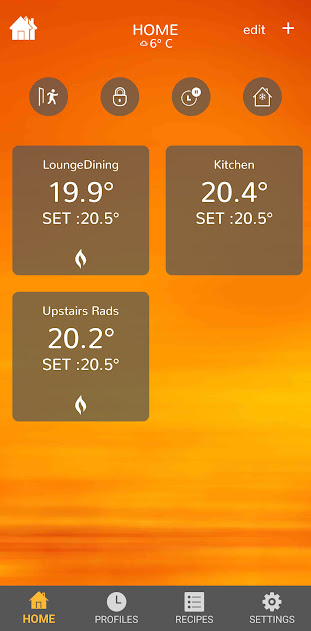
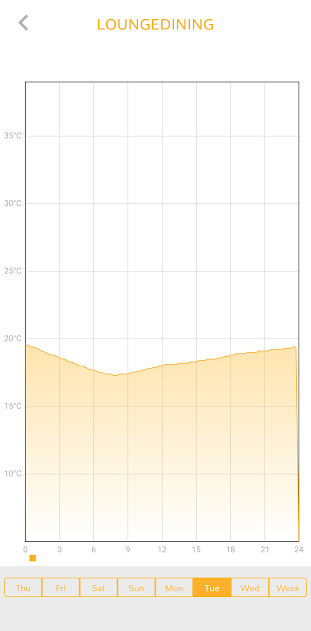
When this happens, the house gets colder much faster than it heats up and so it takes almost the whole of the next day to regain the heat we lost overnight. Obviously this is really inefficient and costly. This screenshot shows the temps from the L9 error at midnight and when we cleared the error at 8am.
Over the last few days, we have been temporarily getting round this by keeping one thermostat set higher than we would like so that at least one zone stays on all night - this makes things hotter than we would like, but it does avoid the error, the shutdown and the cold house and is hopefully cheaper than re-heating from scratch.
Next steps
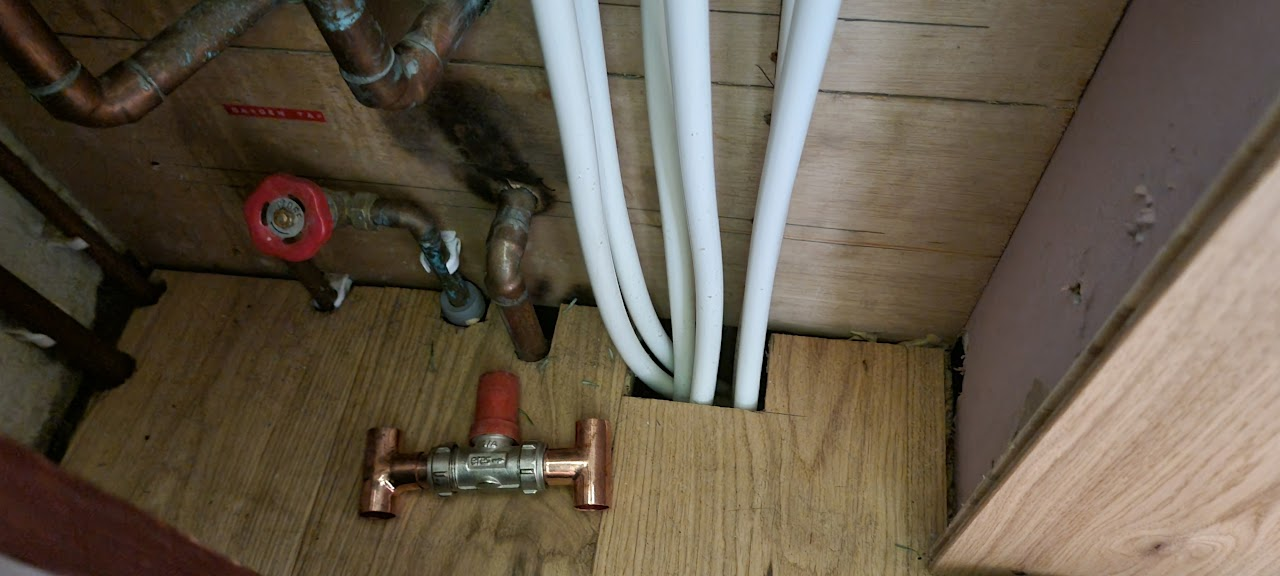
Our builder and installer suggest that it may be that the Heatmiser actuators are too slow to open for the Ecodan to be happy and so the L9 error believes there to be a low flow issue. He has suggested that we need to have a bypass valve installed and that this may address the issue, but I thought I would check what people here thought before getting any plumbing altered. I think it is fair to say that they are not super experts in heat pump installations which is why I thought I would ask around before making any major changes. Here is the bypass ready to go in:
I appreciate there may be a lot of suggestions about changes we should make to the setup (one of which may be to remove all the Heatmiser hardware!) but if we are able to address the L9 errors first, that would be ideal.
Sorry for the length and detail! Any advice appreciated. Happy to post back if you need any more detail, though I am not an expert in any of this by any means either, but am learning fast...
This topic was modified 2 months ago by anotherdaveuk
Our builder and installer suggest that it may be that the Heatmiser actuators are too slow to open for the Ecodan to be happy and so the L9 error believes there to be a low flow issue. He has suggested that we need to have a bypass valve installed and that this may address the issue, but I thought I would check what people here thought before getting any plumbing altered. I think it is fair to say that they are not super experts in heat pump installations which is why I thought I would ask around before making any major changes. Here is the bypass ready to go in:
I appreciate there may be a lot of suggestions about changes we should make to the setup (one of which may be to remove all the Heatmiser hardware!) but if we are able to address the L9 errors first, that would be ideal.
Your installer is probably right. The L9 error means low flow, and if the zones aren't open this will be the reason. You cant fix the error without fixing the cause!
There is, as you have surmised, a bigger picture here namely that having zones going on and off on thermostats is a bad way to run a heat pump. Aside from the significant inefficiencies involved in having competing control systems (which is like having multiple bosses) there is, in extremis, the possibility that it will attempt a defrost at a time when there is insufficient water accessible to it to complete the defrost and as a result will stop working altogether until manually restarted.
The real solution is to run this open loop with all the thermostats effectively disabled by turning them up to maximum (so they are always calling for heat), the weather compensation curve adjusted to suit your house and if necessary the zones balanced by adjusting the flow regulating valves on the manifold/LSVs. You cant have two zones operating at different temperatures simultaneously unless you do mixing down which is inefficient (this is true whether you have boiler or heat pump) so the fact you have radiators may be sized for a different flow temperature presents a problem, albeit not an insuperable one. Alternatively as you are open to upgrading them, doing so in order that they are designed to run at the seme temperature is the thing to do.
As a short term fix you could fit the bypass, but TBH I probably wouldn't because of the risk of insufficient system volume. I would instead at least try permanently opening a couple of the zones (by turning the thermostats to max), trimming the temps down on the flow valves. Then I would work out my long term strategy and decide whether to replace the radiators or not, with the ultimate aim of running the whole thing at the same flow temperature on weather compensation wilt minimal or no active controls external to the heat pump. This will almost certainly require configuration, not new plumbing.
I hope that gets you thinking, there is a very similar thread running here which has almost exactly the same problem and which I encourage you to read.
This post was modified 2 months ago 2 times by JamesPa
4kW peak of solar PV since 2011; EV and a 1930s house which has been partially renovated to improve its efficiency. 7kW Vaillant heat pump.
@jamespa Thanks very much for this, and for mentioning the "Ecodan novice" thread which I had been reading with interest already.
Regarding the radiators, when we had our original installer survey the property (this ended up, for various reasons, not being the same installer who eventually did the install itself), he did say that our current radiators were likely not up to spec, but that it may be worth taking a suck-it-and-see approach and changing them over later if deemed necessary, so we have no issue doing so for at least some of them a bit further down the line and have always anticipated that we might have to. (It is helpful that the weather is about as cold as it ever gets right now!)
Regarding current performance of the three zones (based on current settings),
the kitchen UFH reaches temperature quickest of all, I think mainly as the back of the house is well insulated and the kitchen is new, as well as the porcelain tiles conducting the heat well
the lounge UFH is much slower and has only just managed to creep to 20C today for the first time this week, I think partly due to the front of the house being colder (old bay windows and a front door we need to replace), but also the wooden floor won't conduct heat as well
the radiators (hallway, plus both upstairs floors) are more of a mixed bag - on the first floor, the one at the front of the house near a bay window just about manages to get the room comfortable if not quite cosy, while the ones at the back seem fine. Up in the loft conversion, the front room radiator is tiny and definitely insufficient, while the others are fine
Our CoP is currently about 2.75 and was around 3.0 in November, so I guess that is not too bad.
Our daily energy consumption during this cold snap was between 20-30kW when we were setting it back to a lower temp at night, but since we've had it continual to avoid the L9 errors, it's been more like 30-40kW. Back in November, it was a lot more variable (between 5-30kW) but the weather was variable and we were fiddling with it a lot.
(I'm currently on the free trial of the Mel Pump app - if only Mel Cloud provided some of this stuff!)
Regarding your specific advice of things to try now, can I ask a bit more about the specifics of this please? (My knowledge of this stuff is very limited!)
The real solution is to run this open loop with all the thermostats effectively disabled by turning them up to maximum (so they are always calling for heat), the weather compensation curve adjusted to suit your house and if necessary the zones balanced by adjusting the flow regulating valves on the manifold/LSVs.
By this bit in bold, do you mean the flow rate? i.e. the action described in this video?
Would I be increasing the rate for the zones slower to heat and/or decreasing it for the ones which are faster? Hope I have understood that correctly.
I would instead at least try permanently opening a couple of the zones (by turning the thermostats to max), trimming the temps down on the flow valves
And for this bit in bold, do you mean this (single) temperature regulator here marked with the green arrow below or something else entirely? What sort level of reduction would be good to try? And how does this work with/against the flow temperature set in the Ecodan's weather curve?
Many thanks again for any advice you can give!
This post was modified 2 months ago 3 times by anotherdaveuk
Before I answer your specific questions just one more thing to highlight. The upstairs rads may well be big enough, but because your heatmiser is (probably) turning the heat pump on and off according to the 'call for heat', it may be that they are periodically being deprived of hot water and thus reducing their total output. That's another problem with 'multiple bosses'. This is why, in the other thread to which you refer, the advice, which will also apply to you at some point, is to check whether the heatmiser does switch the heat pump on and off and, if it does organise things so that the heatmiser is permanently 'calling for heat' - ie it never switches the heat pump off.
Bear that in mind also as you progress. As I say, too many bosses!
By this bit in bold, do you mean the flow rate? i.e. the action described in this video?
Exactly that, by reducing the flow rate to a zone you will reduce the output of that zone and thus can tune it down if its too hot. If this is done systematically across all zones (an activity called 'balancing'), whilst making sure that you don't unnecessarily restrict flow overall by ensuring at least one zone is fullly open, you can get to the point where thermostats are unnecessary (other than as limiters set a couple of degrees above target to deal principally with solar gain). All you need to do in this case is run the system 24x7 with an appropriate weather compensation curve and the whole house will be permanently at your desired temperature or thereabouts. That's exactly what many people with heat pumps (including me), and doubtless some with boilers that are running WC, do whether they have radiators or UFH. Its actually a bit of a revelation in comfort and also generally the most cost effective (for once nature works in our favour!). The problem is that it risks putting the aftermarket controls industry out of business and it elapsed takes time to set up (because you need to let things settle), which installers don't have. So many installers just set a rough weather curve, put in lots of controls, and hope that the controls will sort things out. Unfortunately the controls conflict with each other - too many bosses - which leads to the sort of problems you are seeing. Bear this in mind!
At this stage I haven't suggested a 'whole house balancing' because you asked for a quick fix for the L9 errors as a priority. So I suggested a quick fix which is to ensure a couple of zones are always open by whacking the thermostats up to max, (it may take more than a couple) and, because these will probably overheat, to adjust down the flow valves to restrict the water throughput to these zones. This is only a quick fix though to get you out of a hole whilst you think about the idea of whole house balancing and, if necessary, upgrading your rads.
And for this bit in bold, do you mean this (single) temperature regulator here marked with the green arrow below or something else entirely? What sort level of reduction would be good to try?
I dont mean the single temperature regulator valve, I mean the individual valves for each zone. The flow indicators for these valves are the clear tubes sticking up between the manifold and the heatmiser, I dont know exactly how you adjust the flow but for sure you can. A good level of reduction is one that gets the zone to the right temperature with the thermostat for that zone set to max.
And how does this work with/against the flow temperature set in the Ecodan's weather curve?
You appear to have a mixing valve for the UFH (the 'single temperature regulator valve'), which mixes flow and return water so that the flow to the UFH is at a lower temperature than the flow to the radiators. This is common. Given this, and assuming that its set to a value lower than the FT from the heat pump as determined by the WC curve, the water temperature in the UFH will be constant and at the temperature determined by that mixing valve. Thus (depending on the weather curve and the setting on that regulator valve) only the flow to the rads will vary with outdoor air temp (OAT)
4kW peak of solar PV since 2011; EV and a 1930s house which has been partially renovated to improve its efficiency. 7kW Vaillant heat pump.
check whether the heatmiser does switch the heat pump on and off and, if it does organise things so that the heatmiser is permanently 'calling for heat' - ie it never switches the heat pump off
Yes, I think it probably is doing exactly that (as you'd expect if not tweaked to do otherwise, I guess). I think this screenshot from Mel Pump may show the on-and-off-ness...
(The midnight "off" is when all thermostats much have reached their temperatures, since we have not yet managed to tweak things so that we can effectively stop using them yet, while the 4am "off" is the L9 error.)
Thus (depending on the weather curve and the setting on that regulator valve) only the flow to the rads will vary with outdoor air temp (OAT)
Just to clarify, I am not sure this is correct - remember that our radiators are also controlled by the manifold, so they are not independent. The manifold has three valves: UFH1, UFH3 and RAD.
Just to clarify, I am not sure this is correct - remember that our radiators are also controlled by the manifold, so they are not independent. The manifold has three valves: UFH1, UFH3 and RAD.
So does that mean the rads are operating at the same fixed temp as the ufh, determined by the temp regulator on the manifold. If so what's the point of weather compensation and the mixing valve. What temp is the mixing valve set to, perhaps it's set high ie above the ft from the heat pump so it has no effect?
Given all the emitters are on the manifold then the l9 errors will inevitably occur if, as your installer says, the call for heat precedes the opening of the valves. They should clear though unless only one zone open isnt enough. Do they?
If so what's the point of weather compensation and the mixing valve.
I understand your question, but what I can say without any doubt at all is that adjusting the weather curve on the FTC7 absolutely does make a difference to the UFH/RAD temps, as that is the only thing I have really been tweaking from November until this week. (Once the cold weather kicked in, it became clear that the original shallow curve programmed in wasn't enough, and so after we steepened it, the house temps have been fine.)
What temp is the mixing valve set to, perhaps it's set high ie above the ft from the heat pump so it has no effect?
Aha! You may have that right! It's difficult to be exact, as the arrow on the mixing valve is round the back (hence this shonky second photo) but it looks like about 55C (while the FTC7's curve goes up to "-2C = 45C")
Given all the emitters are on the manifold then the l9 errors will inevitably occur if, as your installer says, the call for heat precedes the opening of the valves. They should clear though unless only one zone open isnt enough. Do they?
Well, they manually clear when I press "reset error" on the FTC7, sure - they clear just fine. If you mean "are there additional errors which clear themselves?" then I am not sure - they are not reported in the Ecodan error report if so.
This post was modified 2 months ago by anotherdaveuk
Aha! You may have that right! It's difficult to be exact, as the arrow on the mixing valve is round the back (hence this shonky second photo) but it looks like about 55C (while the FTC7's curve goes up to "-2C = 45C")
OK thats great, so basically the mixing valve is disabled and the whole system is running at the same, weather compensated, temperature. From this and his diagnosis of the L9 errors it sounds like your installer is actually a good one!
Note that if the WC curve only goes down to -2 it will flatline beyond that point, so you wont get enough heat in extremes such as we have been having recently (unless its adjusted too high at lower temps). Recently I have been suggesting to people that they extend WC curves downwards if this is the case, basically doing a linear extrapolation of the current curve to (say) -5 if you are in the south or -10 if you are in Scotland (or just -10 anyway). Even that isn't enough for Marham (in Norfolk) a couple of days ago! (-12.5 I think)
So a quick fix for your L9 error, as I say, is (hopefully) to have one zone open permanently, by turning up the thermostat on that zone to max. Maybe this should be the radiator zone given thats where you get some underheating. Heat pump will then be on 24x7 and you can adjust down the zone a bit if you need to on the flow valve.
Regard this as temporary however prior to doing a full balance & WC optimisation. Are you ready for an outline of how to do that?
OK thats great, so basically the mixing valve is disabled and the whole system is running at the same, weather compensated, temperature. From this and his diagnosis of the L9 errors it sounds like your installer is actually a good one!
Note that if the WC curve only goes down to -2 it will flatline beyond that point,
I just figured this out a day or two ago - I had assumed that the two ends of the curve would just extrapolate and only used -2C because that is what Google gave me as a good example 🤣 I do keep meaning to change that to -5C but hadn't got round to doing the maths... [edit: I think that 15C>30C and -2C>45C extrapolates to -5C > 48C so will do that now]
So a quick fix for your L9 error, as I say, is (hopefully) to have one zone open permanently, by turning up the thermostat on that zone to max. Maybe this should be the radiator zone given thats where you get some underheating. Heat pump will then be on 24x7 and you can adjust down the zone a bit if you need to on the flow valve.
It may not happen right away but please do - it would be good to get a rough idea of what needs to come next... Thanks yet again!
OK. I think your system, which seems well designed, is actually pretty simple. In outline:
Firstly adjust the rad circuit
Run UFH on thermostats initially, at your desired temp
Run rads open loop ie with thermostats/trvs set to max and flow control valve for the rad circuit set to max or at least high (I suspect it is already)
Run heat pump 24x7
Adjust weather compensation curve (down hopefully) to give right temperatures in the rooms with rads, balancing the radiators if rooms settle at different temperatures (guide here , in essence use the LSVs to get the rooms at the same temperature - or the required difference in temperatures -whilst ensuring that at least one LSV, normally the one on the radiator furthest from the heat pump, is fully open)
Note that you use balancing to adjust the difference in temperatures between rooms. You use the weather compensation to adjust the absolute temperature
Tweak until you are happy
Rad rooms now set up
Now turn the UFH thermostats to max
Adjust the flow control valves for the UFH circuits to get the right downstairs temperature
You may need to tweak the WC down a tad if (9) results in a lot of turning down of the downstairs flow rate thus pushing more upstairs. However this will be max a degree or two.
Before you do anything make sure you understand why you are doing each step and what its objective is. If what you are doing seems wrong ask. Happy to explain as required.
4kW peak of solar PV since 2011; EV and a 1930s house which has been partially renovated to improve its efficiency. 7kW Vaillant heat pump.