

Notifications
Clear all
Joining the Renewable Heating Hub forums is completely free and only takes a minute. By registering you’ll be able to ask questions, join discussions, follow topics you’re interested in, bookmark useful threads and receive notifications when someone replies. Non-registered members also do not have access to our AI features. When choosing your username, please note that it cannot be changed later, so we recommend avoiding brand or product names. Before registering, please take a moment to read the Forum Rules & Terms of Use so we can keep the community helpful, respectful and informative for everyone. Thanks for joining!

09/02/2024 1:19 pm
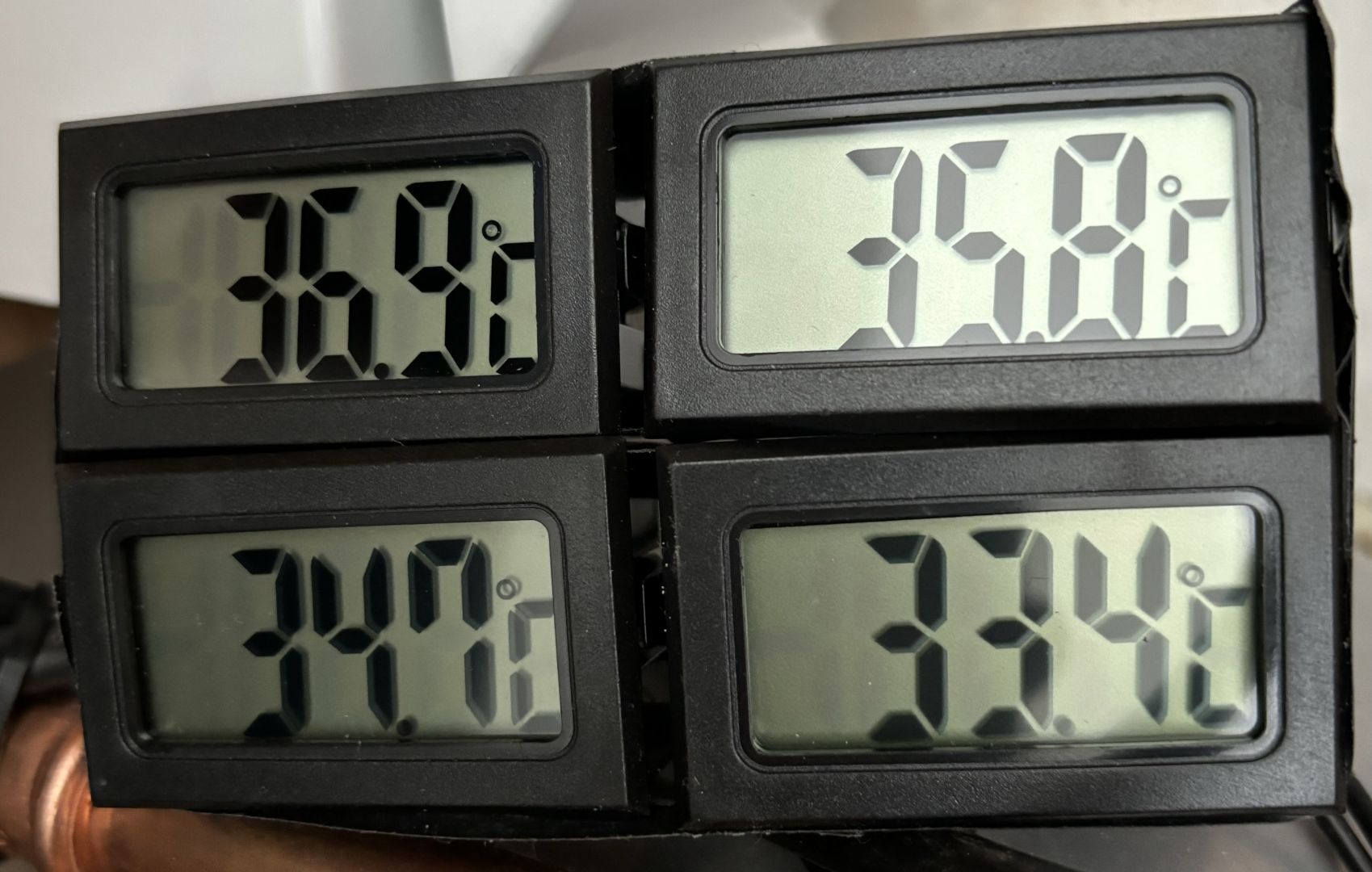
I purchased some LR44 button Cells and powered up the 4 sensors; I laid the four probes close together and placed a Govee thermometer on either side of this bundle of sensors. The Govees both indicated the same temperature and I left the whole caboodle for 5 days occasionally comparing the readings on all four sensors to the Govees. I found that two of the sensors were consistently 0.1 degree C low and 0.1 degree C high and the others were 0.9 and 1.1 degrees C lower than the Govees. The four displays were then taped into a little ‘block’ and the probes taped onto the LLH pipes and covered with insulation. I left the probes to settle for an hour and then read (as per the photo) the results. Top left and bottom left are the heat pump flow and return; the top right and bottom right are the flow from LLH to emitters and return respectively. The left hand displays are both within 0.1 degree of Govee reference and the right hand pair are 0.9 and 1.1 degrees of reference. Outside temperature (according to Daikin Onecta app) was 13 degrees C and heat pump and secondary pump are noth working. Any comments welcomed but I’ll see what results show when OAT becomes more winter-like. (One other thing, supplier has not supplied replacement button cells so have reported them to Amazon) Regards,, Toodles.
Toodles, heats his home with cold draughts and cooks food with magnets.
1

09/02/2024 1:35 pm
So applying the correction factors which you have established, the LWT is 37C and the RWT is 34.8C, giving a DT of 2.2C in the primary circuit. On the secondary side of the LLH the flow temperature is 36.7C and the return temperature is 34.5C, again indicating a DT of 2.2C.
The temperature drop across the LLH is only 0.3C, so I would assess that your system is operating in quite an efficient manner.
09/02/2024 2:13 pm
@derek-m 😊 Toodles.
Toodles, heats his home with cold draughts and cooks food with magnets.
06/03/2024 6:00 pm
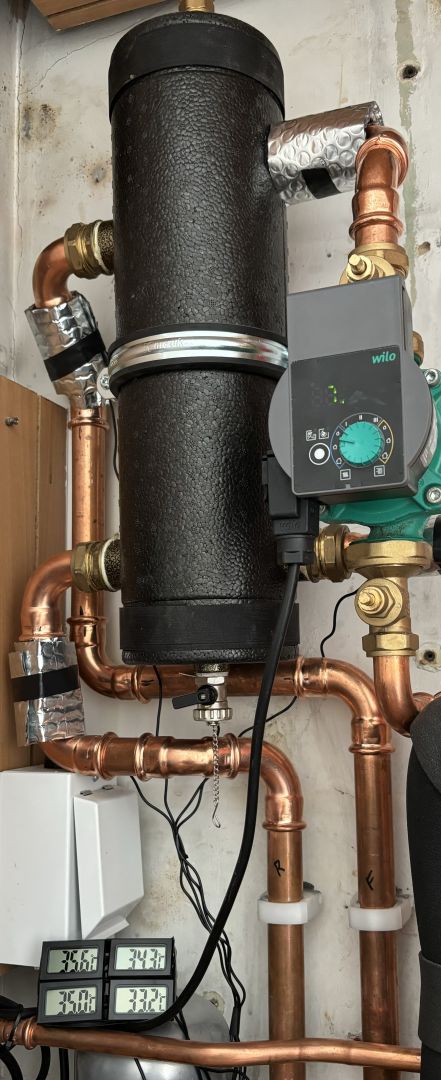
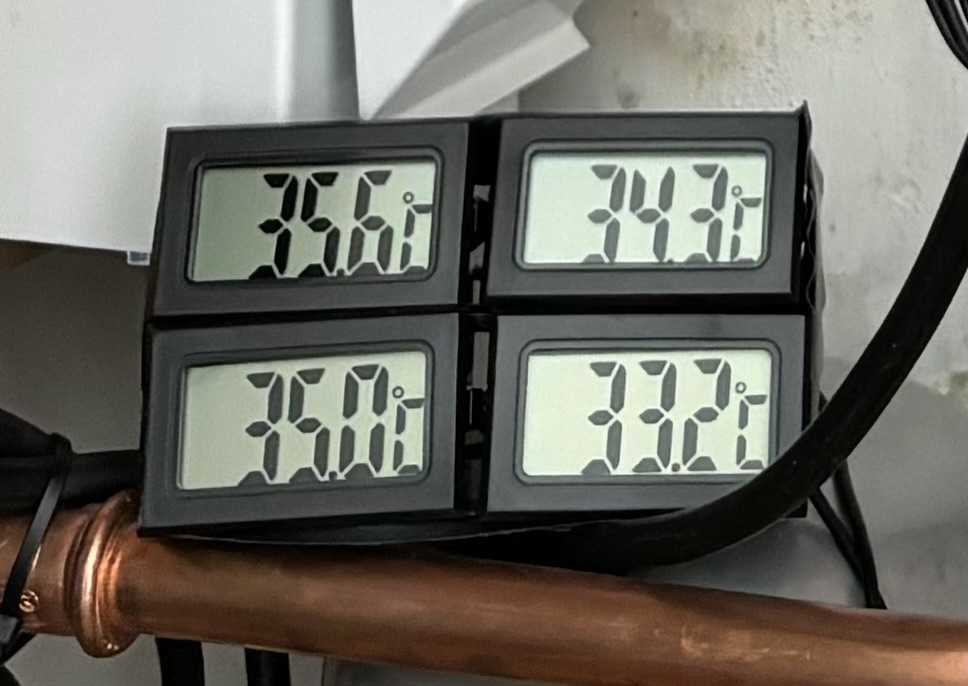
@derek-m Hello Derek, I have left the system running with the thermometers in place for a few weeks now; glancing at the readings from time to time indicates that the varying OAT’s for a constant IAT show that the differential is fairly consistent. The displays are: Top Left = Flow to LLH. Top right = LLH flow out to rads, Bottom right = Return from Rads and Bottom Left = Return from LLH to ASHP. With the correction factors of the two right hand displays being 1 degree C. lower when all sensors were bunched together for several days, I am applying a +1 degree to these two thermometer readings; though I know these are not super-accurate devices, I think they probably provide a reasonable indication of the trends of changing temperature at the 4 points. I seem to have an average drop of 0.2 - 0.3 degrees across the input from the flow to the output of the LLH and 0.3 - 0.6 degrees C. across the return to the LLH and the return to the ASHP.
From time to time, I notice a dynamic ‘blip’ from time to time where one display or the other might indicate perhaps a 1 degree difference but this is short lived usually. I even noticed a difference of 4 degrees momentarily where the flow into the LLH exceeded the reading on the flow out to the rads; this lasted about 30 seconds or so and I have no idea why this should happen.
I don’t know the make of LLH as no label is visible but it is approx. 46 cm. Tall and 17 cm. wide.
Observations welcomed please!. Regards, Toodles.
Toodles, heats his home with cold draughts and cooks food with magnets.

06/03/2024 6:37 pm
I suspect that the image was subjected to some filesize reduction so here is a close up of the displays. Toodles.
Toodles, heats his home with cold draughts and cooks food with magnets.
06/03/2024 8:42 pm
I believe that the temperature readings indicate that your system is quite well balanced, in that the flowrate into the LLH is slightly greater than the flowrate out to the radiators.
This is probably the optimum achievable situation, since the slight mixing that is taking place within the LLH is at the return flow end. Slight mixing of the return flow should not have a detrimental effect on heat pump operation and overall efficiency.
07/03/2024 10:27 am
Thank you Derek, at least it is only a little ‘Devil’ then! Regards, Toodles.
Toodles, heats his home with cold draughts and cooks food with magnets.


Topic starter
20/03/2024 9:49 am
Many of you may be aware of my growing skepticism towards certain elements of the heat pump, and one aspect I find particularly perplexing is the position held by both manufacturers and installers of heat pumps. This confusion was further compounded following my participation in an online discussion involving a group of installers and a representative from one of the leading heat pump manufacturers. The debate quickly escalated, especially around the topic of buffer tanks, reaching a point of intense contention. Interestingly, the manufacturer chose to remain notably silent as the installers, who were divided in their opinions, engaged in a heated exchange.
The crux of the debate revolved around whether buffer tanks could be installed efficiently and effectively by installers in general. The conversation revealed that integrating a buffer tank with a low temperature heat pump system, along with managing all related components, is a complex process. It became evident that a significant number of installers in the UK lack the necessary skills and training to execute such an installation successfully. Prompted by this realisation, I questioned why the industry doesn't move away from using buffer tanks altogether to avoid the complications associated with their installation.
This query led to an unexpected direct message from a high-ranking official within the manufacturing company, asserting their unequivocal support for the use of buffer tanks and their desire for these components to be incorporated into installations, regardless of the efficiency of the installation process. Needless to say, this was a private exchange, and a position they didn’t want to express publicly.
This admission was startling and left me perplexed about the overarching objectives of the heat pump industry. It begs the question: why are we installing advanced heat pump systems only to undermine their performance with suboptimal installations? Surely, the ultimate aim should be to ensure that we are installing the most efficient systems possible, rather than settling for setups that significantly impede their functionality.
🔥 Britain’s Heat Pump Shitshow
How Installing a Heating System Became a National Nervous Breakdown
Free UK shipping.
📗 Heat Pumps Explained
A Jargon-Free Guide for Homeowners
Rewritten and updated for 2027
📘 From Zero to Heat Pump Hero
🛠️ Bodge Buster
New to heat pumps?
Take the Heat Pump Fundamentals course and use INTRO50 at checkout for 50% off.
1

20/03/2024 10:51 am
@editor Mars, as you might know, we have an LLH (which fortunately seems to be running with relatively low losses to the efficiency 😉). I am not about to rip out the LLH to extract a little more efficiency though! The majority of installers seem to opt for an LLH or a Buffer Tank by default as a ‘rear covering’ exercise don’t they? I had a long conversation with the director of the installers and he seemed to view the situation as a positive addition as it removed the necessity to achieve such a delicate setting of the Delta T performance from the secondary circuit that fed the emitters. I think our system is running well, but there is always the nagging feeling …’Might my Air Source Heat Pump run more efficiently if I had the LLH removed?’ Regards, Toodles.
Toodles, heats his home with cold draughts and cooks food with magnets.
1

20/03/2024 11:51 am
The cynic in me says this is about reducing call-outs & guaranteeing adequate volume for defrost. From a customer POV, as well as having the potential to be poorly installed, a buffer increases cost and takes up space which many may not have.
It would be worth, IMHO, pressing them on the question of whether they mean 'buffer tank' or 'volumiser'. The latter at least has less potential for poor installation.
4kW peak of solar PV since 2011; EV and a 1930s house which has been partially renovated to improve its efficiency. 7kW Vaillant heat pump.
2

20/03/2024 2:11 pm
Is there also a danger in the terminology that is being used ie low loss header, buffer and volumiser. Not all LLH's act as buffers, correctly specified and installed they operate perfectly correctly as a hydraulic separator. It very much depends on where on the LLH the ports are positioned.
Are we in danger of vilifying an entire class of products?
20/03/2024 2:22 pm
Is there also a danger in the terminology that is being used ie low loss header, buffer and volumiser. Not all LLH's act as buffers, correctly specified and installed they operate perfectly correctly as a hydraulic separator. It very much depends on where on the LLH the ports are positioned.
Are we in danger of vilifying an entire class of products?
As far as I am aware there would be no problem with a LLH or buffer tank, if the primary and secondary flowrates can be balanced to ensure that no mixing of the flow and return takes place. Obviously balancing the flowrates becomes problematic if the heat pump controller is able to vary the primary flowrate, without the necessary adjustment also being performed on the secondary, thereby unbalancing the system.
Having an additional water pump that may not be necessary is also a possible waste of electrical energy.
SPONSORS

Degrees of Separation

Latest Posts
-

RE: Renewables & Heat Pumps in the News
It's also hardly unusual. The Midea portasplit won a ra...
By EtchedPixels , 1 hour ago
-
RE: How quickly would you want/expect heat recovery to take from setback?
That's the issue, those graphs show your heat-pump (in ...
By Temperature_Gradient , 2 hours ago
-
RE: How should the Boiler Upgrade Scheme be reformed?
Not quite, regular A2W heat-pumps need a load of extra ...
By Temperature_Gradient , 2 days ago
-
RE: Heat Geek installations: share your experiences
one thing i learnt from reading people’s comments and e...
By Batpred , 2 days ago
-
RE: Cooling/heating with one unit
"The way we use A2A on a cheap overnight EV tariff is t...
By mrkfm , 2 days ago
-
RE: Do I add Air Con or MVHR to existing A2W ASHP?
We have ‘signed on the dotted line’ today for a Panason...
By Toodles , 2 days ago
-
RE: Heat pump branding. Clever, contemporary… or a bit too much?
...or it was there and was lost thanks to laziness and ...
By Majordennisbloodnok , 2 days ago
-
@bobflux Thank you for your response. I am trying to ...
By RonV. , 2 days ago
-
This post is about how I successfully configured a buff...
By Tony.Stolz , 2 days ago
-
The installer visited yesterday and suggested the noise...
By JamesChatz , 2 days ago
-
RE: HeatGeek vs Octopus surveys: puzzling disparity - any ideas why?
Your house sounds a lot like mine. 2 surveyors each sp...
By JamesPa , 2 days ago
-
RE: Heat Geek Zero Disrupt: Are We Sleepwalking Into Another Race to the Bottom?
Thats true only if you do the wrong experiment. Done c...
By JamesPa , 2 days ago
-
RE: battery storage without solar
As of October 1st they need specific qualifications to ...
By EtchedPixels , 3 days ago
-
RE: Why are ASHP installs so expensive?
The whole system seems to work on the basis of...
By ian33a , 3 days ago





SPONSORS

