

Notifications
Clear all
Joining the Renewable Heating Hub forums is completely free and only takes a minute. By registering you’ll be able to ask questions, join discussions, follow topics you’re interested in, bookmark useful threads and receive notifications when someone replies. Non-registered members also do not have access to our AI features. When choosing your username, please note that it cannot be changed later, so we recommend avoiding brand or product names. Before registering, please take a moment to read the Forum Rules & Terms of Use so we can keep the community helpful, respectful and informative for everyone. Thanks for joining!

20/03/2024 2:22 pm
Is there also a danger in the terminology that is being used ie low loss header, buffer and volumiser
Agreed
Not all LLH's act as buffers, correctly specified and installed they operate perfectly correctly as a hydraulic separator. It very much depends on where on the LLH the ports are positioned.
Surely an LLH suffers from mixing of flow and return to the same extent, probably more because its smaller, than a buffer does, and like a buffer needs to be set up properly to function without degrading efficiency (which seems to be where many installations go wrong).
Can you explain why 'hydraulic separation' is needed in a typical domestic central heating system. I totally understand why extra volume may be needed, but not hydraulic separation. if you are doing something complex with a back up boiler or a rather large system then maybe, but in a typical house what value does it add?
4kW peak of solar PV since 2011; EV and a 1930s house which has been partially renovated to improve its efficiency. 7kW Vaillant heat pump.
1
20/03/2024 2:38 pm
Is there also a danger in the terminology that is being used ie low loss header, buffer and volumiser. Not all LLH's act as buffers, correctly specified and installed they operate perfectly correctly as a hydraulic separator. It very much depends on where on the LLH the ports are positioned.
Are we in danger of vilifying an entire class of products?
As far as I am aware there would be no problem with a LLH or buffer tank, if the primary and secondary flowrates can be balanced to ensure that no mixing of the flow and return takes place. Obviously balancing the flowrates becomes problematic if the heat pump controller is able to vary the primary flowrate, without the necessary adjustment also being performed on the secondary, thereby unbalancing the system.
Having an additional water pump that may not be necessary is also a possible waste of electrical energy.
True, but it appears they are frequently not balanced.
My questions to @abernyte (or anyone else) is:
In a domestic installation of a 'normal' scale (say up to 6 bedrooms/300 sq m) with either radiators or UFH but not both
- what value does a LLH add?
- what value does a buffer add that a volumiser doesn't add?
The application of Occams razor is generally a good principle so until we identify the value add then there is no argument for their presence.
4kW peak of solar PV since 2011; EV and a 1930s house which has been partially renovated to improve its efficiency. 7kW Vaillant heat pump.
1

20/03/2024 2:43 pm
The default setup on a Mitisubishi Ecodan solar thermal ported pre plumbed cylinder has a LLH. My installer, who was one of the highly experienced "better" class of installer when queried regarding this said that the LLH in question has the flow injection plume above the return fitting outlet (not opposite as some seem to have) and as such would operate as a thermal separator to allow the primary and secondary pumps to operate efficiently at different variable speeds.
Since installation the system operates with a flow temp rarely above 35C and has been a resounding success as a heating system. Not a scientific recommendation I admit but I see no reason to doubt his explanation ...so far!
20/03/2024 2:52 pm
The default setup on a Mitisubishi Ecodan solar thermal ported pre plumbed cylinder has a LLH. My installer, who was one of the highly experienced "better" class of installer when queried regarding this said that the LLH in question has the flow injection plume above the return fitting outlet (not opposite as some seem to have) and as such would operate as a thermal separator to allow the primary and secondary pumps to operate efficiently at different variable speeds.
Since installation the system operates with a flow temp rarely above 35C and has been a resounding success as a heating system. Not a scientific recommendation I admit but I see no reason to doubt his explanation ...so far!
Which simply begs the question - why do I want primary and secondary pumps in the first place (which incidentally must be balanced for the LLH to work without impeding system efficiency). For the avoidance of doubt I'm talking about a typical fairly simple domestic setup where a heat pump replaces a gas boiler (ie 95% plus of real world scenarios). Why would I have a second pump, a low loss header/buffer etc. None of this appears in your typical CH system. What value do they add.
You may not know I accept, but until someone tells us then the best assumption is no value at all and, since they clearly add trouble and cost, thats a good argument to leave them out.
4kW peak of solar PV since 2011; EV and a 1930s house which has been partially renovated to improve its efficiency. 7kW Vaillant heat pump.


20/03/2024 2:58 pm
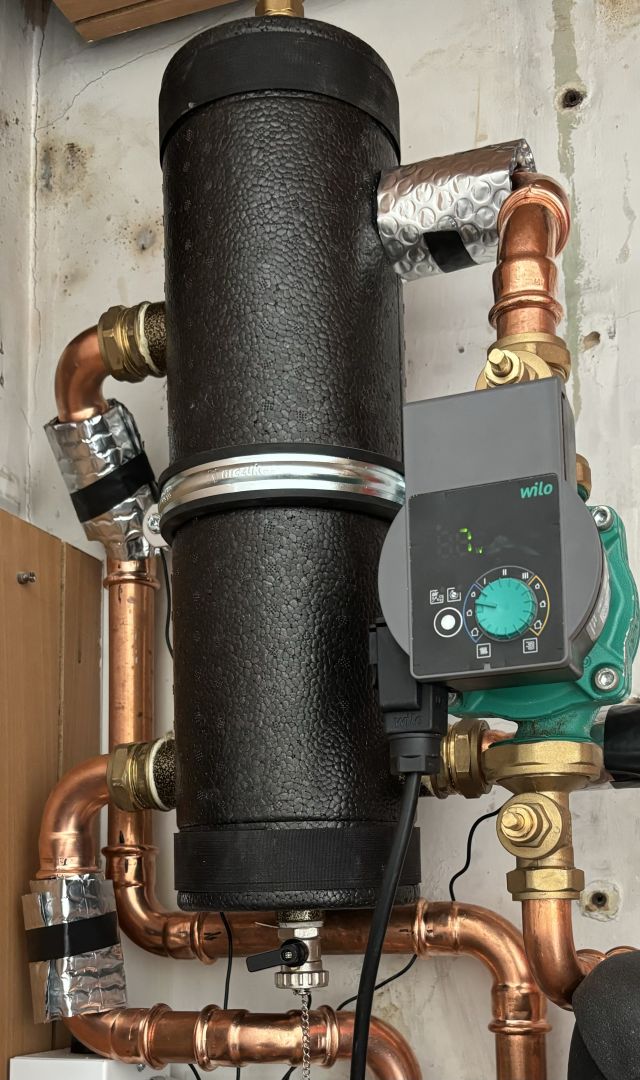
@abernyte I suspect that arrangement might be similar to the one in our airing cupboard. The flow is the top left pipe and the return is the lower left. The top right is the flow to the secondary pump thence to radiators and the lower right is return from the radiators? Regards, Toodles.
Toodles, heats his home with cold draughts and cooks food with magnets.
20/03/2024 3:03 pm
Yes other than Mitsubishi use a 35mm LLH
20/03/2024 3:11 pm
Yes other than Mitsubishi use a 35mm LLH
But why (bother with a secondary pump and llh) in a typical domestic install?
Does anyone actually know a reason that stands up to scrutiny? I am not trying to be difficult, I genuinely want to know? @abernyte, @editor, @derek-m any ideas or is this another appendix from heat pump history that needs to be surgically removed?
4kW peak of solar PV since 2011; EV and a 1930s house which has been partially renovated to improve its efficiency. 7kW Vaillant heat pump.

20/03/2024 3:25 pm
Yes other than Mitsubishi use a 35mm LLH
But why (bother with a secondary pump and llh) in a typical domestic install?
Does anyone actually know a reason that stands up to scrutiny? I am not trying to be difficult, I genuinely want to know? @abernyte, @editor, @derek-m any ideas or is this another appendix from heat pump history that needs to be surgically removed?
The only reason of which I can think, is that it would be to allow system designers to accommodate 'smart' thermostats and TRV's into their designs, without suffering 'low flow' problems.

20/03/2024 3:35 pm
Yes other than Mitsubishi use a 35mm LLH
But why (bother with a secondary pump and llh) in a typical domestic install?
Does anyone actually know a reason that stands up to scrutiny? I am not trying to be difficult, I genuinely want to know? @abernyte, @editor, @derek-m any ideas or is this another appendix from heat pump history that needs to be surgically removed?
The only reason of which I can think, is that it would be to allow system designers to accommodate 'smart' thermostats and TRV's into their designs, without suffering 'low flow' problems.
Wow that's inventive but I'm sure you agree that it can be discarded as a legitimate reason.
Perhaps we ought to ask why should they be included rather than trying to argue that they should be omitted. No system designer worth their salt includes components without a reason.
4kW peak of solar PV since 2011; EV and a 1930s house which has been partially renovated to improve its efficiency. 7kW Vaillant heat pump.
20/03/2024 4:03 pm
Yes other than Mitsubishi use a 35mm LLH
But why (bother with a secondary pump and llh) in a typical domestic install?
Does anyone actually know a reason that stands up to scrutiny? I am not trying to be difficult, I genuinely want to know? @abernyte, @editor, @derek-m any ideas or is this another appendix from heat pump history that needs to be surgically removed?
The only reason of which I can think, is that it would be to allow system designers to accommodate 'smart' thermostats and TRV's into their designs, without suffering 'low flow' problems.
Wow that's inventive but I'm sure you agree that it can be discarded as a legitimate reason.
Perhaps we ought to ask why should they be included rather than trying to argue that they should be omitted. No system designer worth their salt includes components without a reason.
Which is why I have spent the past three years trying to convince forum members that they should have their poorly designed systems corrected to make them operate more efficiently.

20/03/2024 6:07 pm
The only reason of which I can think, is that it would be to allow system designers to accommodate 'smart' thermostats and TRV's into their designs, without suffering 'low flow' problems
I think you are both correct, its because systems aren't designed, they are plumbed in by people who don't understand system design but attend a manufacturer's installation course. So the additions of these components are their to mitigate any system design and it will function in any given scenario, not optimally but it will function.
20/03/2024 6:12 pm
The only reason of which I can think, is that it would be to allow system designers to accommodate 'smart' thermostats and TRV's into their designs, without suffering 'low flow' problems
I think you are both correct, its because systems aren't designed, they are plumbed in by people who don't understand system design but attend a manufacturer's installation course. So the additions of these components are their to mitigate any system design and it will function in any given scenario, not optimally but it will function.
I fear you are right. However the reason suggested (which is very plausible) is the equivalent of dressing a dirty wound instead of first cleaning it up because the patient complains about the sting of the antiseptic, except that if you did the latter you would likely get struck off.
4kW peak of solar PV since 2011; EV and a 1930s house which has been partially renovated to improve its efficiency. 7kW Vaillant heat pump.
SPONSORS
Degrees of Separation

Latest Posts
-

RE: Passiv Smart Thermostat - Help & Forum Support
Obviously the weather is changeable but there's a defin...
By Singlespeed , 16 minutes ago
-
RE: Double or Triple Glazed Windows?
It is very comforting to see the condensation on the ou...
By Toodles , 20 minutes ago
-
RE: The Changing Jet Stream Could Challenge UK Air Source Heat Pumps
@rob-of-york I must admit that when we had a Daikin hea...
By Toodles , 45 minutes ago
-
RE: Forum updates, announcements & issues
Get the Renewable Heating Hub heads-up on WhatsApp. I...
By Mars , 2 hours ago
-
RE: Safety study for plug in batteries out to tender - looks like Q3 2027 at best before legal
@editor I pointed out to the one of the Fuse execs that...
By dansus , 2 hours ago
-
RE: 15kw pump for 225m2 1990's house - over kill?
@seaviews As well as loft insulation, there are othe...
By Rob of York , 4 hours ago
-
RE: How much of your renewable and home setup would still work if the internet went down?
On the money, @editor. Until manufacturers stop actin...
By Majordennisbloodnok , 5 hours ago
-
RE: Indevolt Batteries UK Support & Info Thread
Google Cloud outage: Let's not jump to the conclus...
By Transparent , 5 hours ago
-
RE: BT cuts you off, Plusnet blames Openreach... welcome to “seamless” broadband switching
Both of which (in most cases) use Openreach for the las...
By JamesPa , 5 hours ago
-
RE: How quickly would you want/expect heat recovery to take from setback?
@technogeek agreed. I’ve stopped the setback since tha...
By AndrewJ , 6 hours ago
-
RE: Renewables & Heat Pumps in the News
Yes, this is a swiss and german standard I believe, Vai...
By Batpred , 20 hours ago
-
RE: Octopus Cosy 12 Heat Pump Regret: Incredibly Loud, Poor Heating & Constant Hum - Help!
@editor FWIW my problem was resolved, eventually, after...
By BigFish , 1 day ago
-
My heating has been off and DHW on throughout the summe...
By DavidAlgarve , 1 day ago
-
RE: Anyone concerned about GivEnergy?
The GivE forum seemed to have survived the collapse of ...
By downfield , 1 day ago
-
RE: Cooling/heating with one unit
@mrkfm The Solo has a small capacity and only suitable ...
By dgclimatecontrol , 1 day ago






SPONSORS

