

Notifications
Clear all
Joining the Renewable Heating Hub forums is completely free and only takes a minute. By registering you’ll be able to ask questions, join discussions, follow topics you’re interested in, bookmark useful threads and receive notifications when someone replies. Non-registered members also do not have access to our AI features. When choosing your username, please note that it cannot be changed later, so we recommend avoiding brand or product names. Before registering, please take a moment to read the Forum Rules & Terms of Use so we can keep the community helpful, respectful and informative for everyone. Thanks for joining!

Topic starter
20/04/2026 10:51 pm
Hi all, just joined as in the thinking about heat pump installation but a but terrified by what I have seen. i don't want a half baked compromise system and everything in my bungalow off the main run of pipes in the roof space of my bungalow is 8mm copper microbore. I need to convince my wife that we can have a highly efficient Heat Pump system (at a manageable cost, but I am concerned I might have to replace all the microbore at a cost of at least 5k plus a full redecorate). Or settle for a system of low efficiency. We live in a reasonably well insulated late 60's bungalow with hot water central heating and a combi boiler. so i am dreading spending money getting quotes and then finding I am facing a 20k estimate. (repiping at 5k, redecorating at 2k, install after grant at 4k, water tank at 2.5k, and probably 2 additional 10kw batteries at 5k.
Am i being paranoid? What are your thoughts?
This topic was modified 6 months ago by Mars

21/04/2026 10:09 am
Am i being paranoid? What are your thoughts?
It's possible you don't need to replace the microbore but without more details, specifically heat loss per room, it's difficult to tell. To get a feel do you know your current annual fuel consumption? What's the floor area and construction of the house. Is 8mm the od or id of the pipe? It won't have a material effect on efficiency, to first order you either need to replace it to get enough heat transfer, or you don't.
If you can answer the questions above we can start developing a view.
4kW peak of solar PV since 2011; EV and a 1930s house which has been partially renovated to improve its efficiency. 7kW Vaillant heat pump.
Topic starter
23/04/2026 2:45 pm
@jamespa Hi James, thanks for responding. We use around 12000kw of gas a year. i am estimating our hear loss at around 5-6kw. Its standard 8mm copper pipe with i believe an internal dimension of 6mm, but i would need to slice it to be sure. it is definitely 8mm external. Heat Geeks quick quote system has it at around 5kw heat loss. My bungalow design has a long main run installed along the centre line of the property with I believe 28mm pipe, then the radiators all drop of to the external walls with an average of probably 6-7 meters across and down to each radiator. We have 3 bedrooms each with a radiator 2 with 1600 x 600, 1 small bedroom with 500mx600mm, 1 hallway with a radiator 1200x600, a small porch with a radiator 500x600mm, a living dining kitchen with 2 x 1600mm x 600 mm radiator and a smaller 500 mm x 600mm radiator. We do have a wood burner in addition but is going to be decommisioned as it causes us both major breathing problems as we both use CPAP machines
23/04/2026 3:10 pm
@jamespa Hi James, thanks for responding. We use around 12000kw of gas a year. i am estimating our hear loss at around 5-6kw. Its standard 8mm copper pipe with i believe an internal dimension of 6mm, but i would need to slice it to be sure. it is definitely 8mm external. Heat Geeks quick quote system has it at around 5kw heat loss. My bungalow design has a long main run installed along the centre line of the property with I believe 28mm pipe, then the radiators all drop of to the external walls with an average of probably 6-7 meters across and down to each radiator. We have 3 bedrooms each with a radiator 2 with 1600 x 600, 1 small bedroom with 500mx600mm, 1 hallway with a radiator 1200x600, a small porch with a radiator 500x600mm, a living dining kitchen with 2 x 1600mm x 600 mm radiator and a smaller 500 mm x 600mm radiator. We do have a wood burner in addition but is going to be decommisioned as it causes us both major breathing problems as we both use CPAP machines
12000kWh is consistent with 4-6kW depending on your current heating pattern etc. Given that its definitely not clear to me whether you can get away with the microbore without doing the individual room calculations. There is a cheat sheet here (scroll down), bottom line is 8mm pipe should be good for 800W at the normal design deltaT of 5C, or 1kW at 7C. Thats at a pipe water speed of 0.9m/s, some will say you can go up to 1.5m/s. If the cost of replacement is particularly high you could operate at DT of 10, but this will degrade efficiency by about 10%.
I would say you need a good designer. They will be able to find a way to do it if its possible, or if its not possible perhaps propose to replace only the pipework to the most demanding rooms. A mediocre or poor designer wont. There are installers on here who say that they hardly ever (or even never) replace microbore, but at the same time people here report that their installer insists even though its obviously unnecessary.
Really this is a case where a good installer and likely a full survey is needed.
Sorry thats probably not as helpful as you might have hoped. @ashp-bobba may be able to add something as he reports doing houses with microbore from time to time.
4kW peak of solar PV since 2011; EV and a 1930s house which has been partially renovated to improve its efficiency. 7kW Vaillant heat pump.

Topic starter
23/04/2026 5:06 pm
@jamespa Appreciate thoughts. At least it points me in the direction that it may be possible. Going to start with a major installer who does free assessment. that way my wife may not eviscerate me for wasting money. I may treat myself to a full assessment by a top class installer for my birthday! I would love to do this from a curiosity and environmental prospect, however it really has to make sense financially if i am to have any hope of convincing the Generalissimo who was involved with some early installs for a major housing association and had some really bad experiences! Went solar and EV in the summer, and would love to move forward in supporting a more sustainable system.
23/04/2026 6:11 pm
Going to start with a major installer who does free assessment
If they will do room by room you will have the necessary data to take the next step in assessing the microbore issue. Some will do this free of charge I think. Unfortunately you should brace yourselves for some silly quotes. Mine (no microbore replacement required) varied from 5K to 20K(!) after BUS, and oddly enough the best by some margin were the two cheapest. It took a while to get there though, and a lot of learning from this site.
I have absolutely no regrets about my heat pump neither does my wife (who was initially anti). Its so much more comfortable than anything I achieved with a boiler and about the same/slightly lower running cost; well worthwhile even if I ignore the environmental benefits (which was the initial reason to consider it).
Please keep posting your questions.
This post was modified 6 months ago by JamesPa
4kW peak of solar PV since 2011; EV and a 1930s house which has been partially renovated to improve its efficiency. 7kW Vaillant heat pump.

24/04/2026 12:29 pm
Nicely large radiators -- single layer or double? With zig-zag sheet metal dissipators on their back?
When you live in an area with hard water, limescale may have limited cross sections during the decades of refilling. Hoover bumps in the pipes along skirtings shouldn't be too deep.
I'm underpricing JamesPa by saying that when you kept the house at 20°C more or less permanently (night time and holiday setback allowed), at a consumption of 12 000 kWh per year you can cope with 3 kW heating power at -3°C. This means you will want 4 kW, the installer 5 kW but adding a 'margin' to 6 kW *rolleyes*.
To calculate heat loss per room is good only when you know what's inside the walls and how efficiently the windows are insulated. Otherwise it will become more of an estimation or even a guess. An engineer will have a clue what is to expect but, without a pair of X-ray-glasses, can't look into the components, so he will 'keep to the safe side' and get to exaggerated results.
When you want to know if the microbore system will do, my proposal as always is to try running a heat pump mock-up with your existing combi-boiler, as follows:
Before turning any knob, make notes of the current state first, then start by opening any thermostatic radiator valve (TRV) and putting the hall thermostat on full blast. Now you control indoor temperature manually-only by turning the boiler's flow temperatur knob as necessary or, if you have a weather compensation as part of the controller and know how to manage this, even better, use this to govern the boiler flow temperature. Meanwhile, the circulation pump will run 24/7, guzzling leccy like hell, but never mind, this being temporarily only and anyway cheaper than a dang-so-called-expert.
When you find some rooms getting warm but some not, start fiddling with the lockshield valves. Open the ones where the rooms don't get warm, when this is done to no effect start closing the other ones. Keep then in mind, that the very most action between closed and open will be in the first quarter-turn of the valve. Listening to the (typically low) flow noise helps to get your bearings.
During test run, don't do temperature setbacks (while being out or during night) and make notes of the flow temperatures which keep the house perfectly warm and in comparison track outdoor temperatures. When you get along with 45°C at 0°C outdoor, this would be fine, 50°C being a C minus mark, 55°C an D, but even better still than ransacking your home..
When you cannot get outdoor temperatures around freezing point to test for, you may want to provide a diagram with outdoor temperature on the one axis and flow temp on the other. After some temperature tracking, there will be a field of operating points which can be approximated by a straight line which may tell you what you can expect at low outdoor temps.
Unfortunately, at the moment you come half a year too late or too early -- during summer, temperature differences will be too low to come to other than indistinct results supposedly.
24/04/2026 12:56 pm
Nicely large radiators -- single layer or double? With zig-zag sheet metal dissipators on their back?
Yes for sure, but large radiators dont change the mass flow calculations and thus the viability or not of the microbore.
4kW peak of solar PV since 2011; EV and a 1930s house which has been partially renovated to improve its efficiency. 7kW Vaillant heat pump.

Topic starter
24/04/2026 1:49 pm
@lejamaiscontent Thank you kindly. I am not in a rush, so waiting until next winter is not a major set back to work out what we need. We already have some huge in house temperature differentials, between the front Northern ground floor bedroom and the rear kitchen living room. Already got plans to enlarge and replace some radiators to remediate the existing combi boiler system which should help set us up for next winters tests.
Topic starter
24/04/2026 1:52 pm
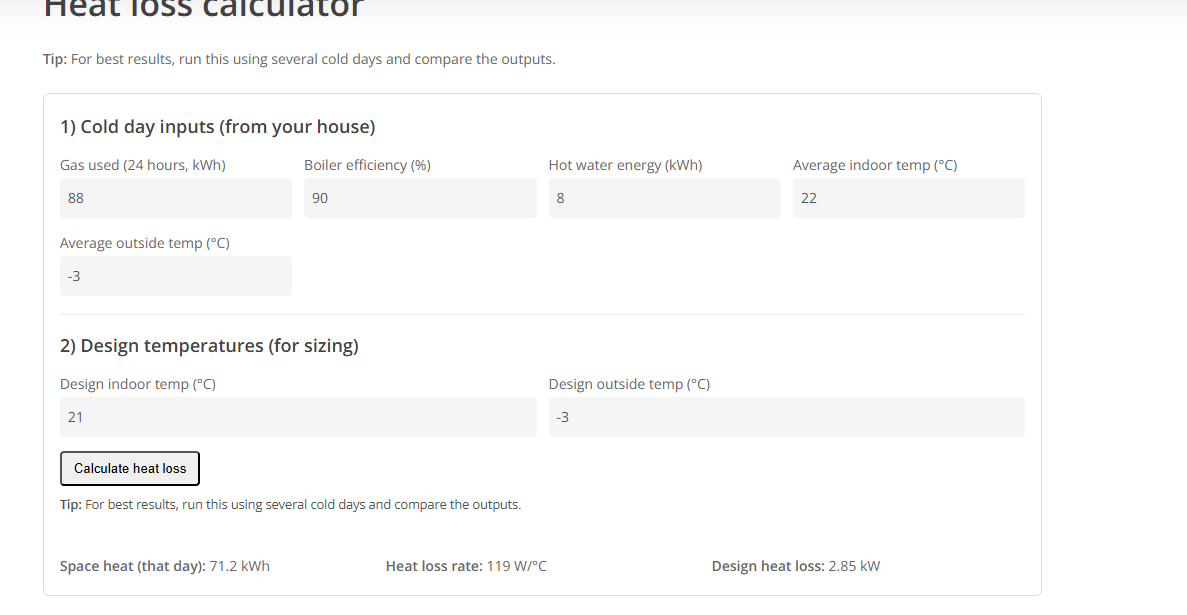
@lejamaiscontent i did use one of the online calculators and at -3 degrees, with our current consumption which is shy of the 12k i said at nearer 10000 but i am not sure what impact the multifuel stove had and when we stopped using it. That gave an outcome of around 2kw. I am sceptical and your experimental route offers an interesting set of tests to annoy the other half with.
Topic starter
24/04/2026 1:56 pm
I used this heat loss calculator based on my worse day which was 85kw of gas, on a -3 day at 22 degrees. Temerature on the day in question was -3 until 11am and rose to 5 degrees. So not that accurate. Website is Free Heat Loss Survey Tool - What Size Heat Pump?
This post was modified 6 months ago 2 times by kilgorexv
24/04/2026 4:22 pm
Uh-oh, 85 kWh in 24 hours sum up to 3.5 kW in average .... perhaps the stove was meddling into the yearly result .... good you mention that.
Anyway it will be difficult to find a heat pump with less than 4 kW nominal .... at what temperature ever the nominal may be .... take care that you will need the 3.5 kW @ -3°C. Plus that, at temperatures around 5°C, some pumps spend a lot of time with de-icing, such decreasing the usable heat supply (you can see this in the tables given by the producer about power, temperature and COP).
The mock-up run will clarify if the pipework is fit for a heat pump, but not which nominal power output you will need. If you put gas consumption figures to the flow and outdoor temperatures tracking, you will get nice statistics helping you to design the system. This is something no professional can obtain without producing a quite crazy bill.
Page 1 / 2
Next
SPONSORS

Degrees of Separation
Latest Posts
-

RE: How will removing the standing charge on gas bills benefit heat pumps?
I'm not sure it makes much of a difference to heat-pump...
By Temperature_Gradient , 2 hours ago
-
@editor Ouch, sorry to re start the tick. I had assume...
By DavidB , 3 hours ago
-
RE: Say hello and introduce yourself
@e-a-west as the good Major said, welcome to the forums...
By Mars , 4 hours ago
-
RE: New Build 3 Phase or 1Phase
We are on three phase power because it's an enormous li...
By EtchedPixels , 5 hours ago
-
RE: How much of your renewable and home setup would still work if the internet went down?
Yes I actually have a copy of a tool that whenever a ce...
By EtchedPixels , 13 hours ago
-
RE: Indevolt Batteries UK Support & Info Thread
@editor Hi, To resolve this, please tap on the A...
By Indevolt Tech , 21 hours ago
-
RE: Double or Triple Glazed Windows?
Posted by: @singlespeed With 9 years repairing windo...
By Rob of York , 2 days ago
-
@transparent we’re still running a secure version of PH...
By Mars , 2 days ago
-
RE: How quickly would you want/expect heat recovery to take from setback?
Much longer than that here. The heating isn't even on. ...
By bobflux , 2 days ago
-
RE: Passiv Smart Thermostat - Help & Forum Support
Obviously the weather is changeable but there's a defin...
By Singlespeed , 2 days ago
-
RE: The Changing Jet Stream Could Challenge UK Air Source Heat Pumps
@rob-of-york I must admit that when we had a Daikin hea...
By Toodles , 2 days ago
-
RE: Forum updates, announcements & issues
Get the Renewable Heating Hub heads-up on WhatsApp. I...
By Mars , 2 days ago
-
RE: Safety study for plug in batteries out to tender - looks like Q3 2027 at best before legal
@editor I pointed out to the one of the Fuse execs that...
By dansus , 2 days ago
-
RE: 15kw pump for 225m2 1990's house - over kill?
@seaviews As well as loft insulation, there are othe...
By Rob of York , 2 days ago




SPONSORS