

Notifications
Clear all
Joining the Renewable Heating Hub forums is completely free and only takes a minute. By registering you’ll be able to ask questions, join discussions, follow topics you’re interested in, bookmark useful threads and receive notifications when someone replies. Non-registered members also do not have access to our AI features. When choosing your username, please note that it cannot be changed later, so we recommend avoiding brand or product names. Before registering, please take a moment to read the Forum Rules & Terms of Use so we can keep the community helpful, respectful and informative for everyone. Thanks for joining!

Topic starter
19/04/2026 4:23 pm
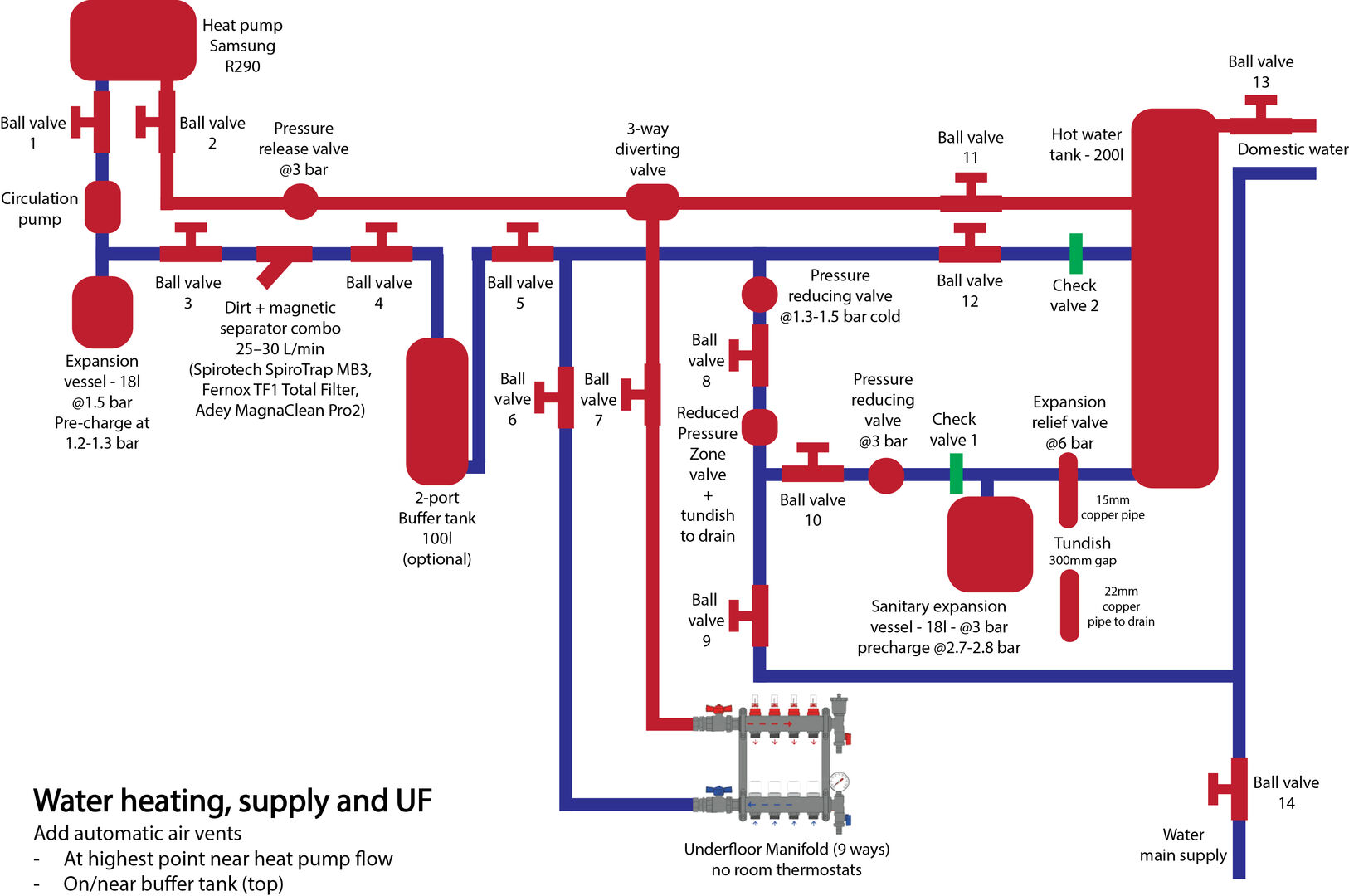
Hi everyone, I'm planning to install a new heating system (heat pump + underfloor) in my house, possibly later this year. For context, the total area is about 75 square metres (one floor only). This is a new build, with 10 cm XPS under the UF pipes (16mm), 20cm EPS exterior insulation, vapour membrane and 20cm mineral wool in the ceiling, triple glazed windows and doors. I've no prior experience with this stuff, but I've watched and heard loads of "horror" stories about failed heat pump installations and UF heating going wrong. So, I thought that I would do a bit of research on this topic before contacting an installer, just so I would be able to judge if everything at least sounds OK before I commit to anything. With the help of ChatGPT I was able to learn a few things about this topic, and I did even manage to put together a "schematic" of the system. ChatGPT suggested a Samsung EHS AE050CXYDEK/EU heat pump (5kW), and other (should I call them?) accessories. In principle I understand the role each part plays within the system, but I would highly appreciate if anyone with experience could offer any "real world" advice / feedback / insights, as we all know that ChatGPT tends to hallucinate sometimes (in fact, ChatGPT asked me to update it quite a few times, as it changed its "mind" :-)). I would not be very happy if I later found that I went in a completely wrong direction with this. Thank you, much appreciated.
Hamilton

19/04/2026 6:19 pm
I will comment at greater length later when I have the time but as a matter of interest and importance what accessories did chat gpt suggest? Did it provide a drawing?
One thing worth saying now is that loads of roomstats are pointless.
This post was modified 6 months ago 2 times by JamesPa
4kW peak of solar PV since 2011; EV and a 1930s house which has been partially renovated to improve its efficiency. 7kW Vaillant heat pump.
1
Topic starter
19/04/2026 6:39 pm
@jamespa Hi James, thanks for your quick reply. I did select an image when I originally posted my question, but I now notice that it does not actually show up. Trying again here...
1
19/04/2026 8:01 pm
Can I suggest you read this introduction to heat pumps as it will help understand things better
Thanks for posting the image. The heating side of it isnt perfect but is a reasonable general guide (not to be followed in detail). However the connections to the mains water supply are wrong so ignore these! To the heating you may want to add 2 anti-freeze valves, near the heat pump itself at the lowest point. Also what it calls a buffer tank is in fact a volumiser, and the difference matters a lot!
Now the health warning, I am not a heating engineer, I am an ordinary householder with a degree in physics and a career in engineering followed by a second career in local government. What I say is informed by my physics background (it helps understand heating!) and three years studying the topic here and elsewhere, initially to inform my own (very successful) install, but not as a bit of a hobby to help others. So feel free to sense check/challenge what I say.
Now to your question. There are good heat pump installers and poor ones, just like there are good builders and poor ones (its all the construction industry!). According to a large independent survey by NESTA in 2023, satisfaction levels with heat pump installs are very similar to those with boiler installs albeit a bit more polarised. The problem is that in both cases there are a fair proportion of not particularly satisfied people, and of course those who have had a heat pump installed blame it on the technology rather than the spread of quality in the industry.
The good news is that, judging by what we see here, poor heat pump installs are almost invariably due to one of four factors which are pretty easily spotted by the homeowner if they know what to look for. These are:
1. Unnecessary buffer tank (a tank that has connections to both flow and return, normally 4 in total but can be 2 or 3), plate heat exchanger (PHE) or Low Loss Header (LLH) between heat pump and emitters. A 2 port volumiser with connections to either the flow or return but not both is OK (this is what is shown in your diagram).
2. Oversized heat pump, sometimes by more than a factor of 2. Oversizing can be nearly as bad as undersizing. There are some strategies to mitigate oversizing but its generally best avoided. The oversizing arises because of overestimated heat loss, due to various factors
3. The use of third party controls and/or controls not properly set up. Generally heat pumps should be run on the manufacturers controls alone. Third party thermostats, particularly 'smart' thermostats should be avoided. TRVs/multiple zones etc are also usually to be avoided. There are exceptions but this is the starting point.
4. Poor workmanship, most notably missing/wrong insulation.
Your house is definitely going to have a loss of <5kW, possible 2-3kW. So a 5-6kW is strictly oversized, but there isn't anything much smaller available and anyway you probably want 5-6kW for your DHW for reasonable reheat time. Fortunately with UFH in a slab you can take advantage of this to use ToU tarrifs.
In summary you should avoid any installer that proposes
- a buffer tank (or LLH/PHE)
- third party controls (exceptions - Homely, Adia, Havenwise which are specifically designed for heat pumps)
- estimates your heat loss/proposes a heat pump >5-6kW.
I would also interrogate anyone proposing a pre-plumbed cylinder. This is not necessarily bad but sometimes they come with a built in LLH which should be avoided.
I would also avoid any installer that insists on multiple zones, with the size of house you have its essentially pointless and anyway ineffective because heat will leak from room to room. Certainly it is necessary that there are multiple UFH loops that can be 'balanced' by adjusting the flow, but separate controls other than manual flow control valves are almost certainly superfluous. If they are already fitted dont worry, they can be disabled!
If you use the above as your primary filter that should weed out the real dross and get it down to some serious contenders.
In terms of control. Its going to be primarily, possibly exclusively, weather compensation. You may layer on some mild room influence but WC will be your primary tool.
Your big challenge, whether you have a boiler or heat pump, is that your slab is a big storage heater but, unlike a storage heater, you dont have fins that you can control to change the output. This makes for great stability but is very slow to respond, almost certainly too slow for a thermostat to be useful. The only real control you have is how much heat you put in over the several hours before (just like a storage heater).
Fortunately heat pumps help with this because (a) they operate at a very low temperature which tends to make the heating almost self regulating and (b) they use weather compensation which means that the flow temperature (and thus the amount of energy stored in the slab) is adjusted according to the outside temperature (which determines the heat loss) and that adjustment is done in good time thus dealing with the slow response. I wont go into further detail here (there is some in the guide referred to above) but can if you want.
@bobflux is more knowledgeable specifically about UFH than I am and may wish to comment or correct.
One final thing I would think about is solar gain. If you have rooms that benefit from this there is a probability of overheating if you cant control it (again no matter what the heat source). If you do think you might have this problem perhaps post some more details for some suggestions.
Hope that helps get you started, please read the introduction I referred to and ask more questions now and as your journey progresses
4kW peak of solar PV since 2011; EV and a 1930s house which has been partially renovated to improve its efficiency. 7kW Vaillant heat pump.
2

Topic starter
19/04/2026 8:34 pm
@jamespa Oh wow, that's more than I was expecting. There's a lot of details that don't make much sense to me (but that's my lack of knowledge, not you...), so this tells me that I need to do some more digging. Thanks for the link provided, I'll definitely check it out, and hopefuly that will shed some light for me on this. As I said, I just want to make sure that I won't contract some cowboy with minimal knowledge on heat pumps / UF, and end up paying for stuff that won't work. Thanks again, your time is much appreciated.
19/04/2026 9:27 pm
@hamilton no problem, feel free to ask for clarification.
@editor may be able to recommend an installer in your area, otherwise feel free to post details of quotes here and someone, not necessarily me, will doubtless provide some helpful comment. Sadly there are cowboys out there, as is generally true in the construction industry so far as I can make out! However if you exclude based on what I have said above you should avoid the problems that account for almost all the 'bad' installs we hear about here.
4kW peak of solar PV since 2011; EV and a 1930s house which has been partially renovated to improve its efficiency. 7kW Vaillant heat pump.
2


20/04/2026 8:05 am
@hamilton which county are you based in?
🔥 Britain’s Heat Pump Shitshow
How Installing a Heating System Became a National Nervous Breakdown
Free UK shipping.
📗 Heat Pumps Explained
A Jargon-Free Guide for Homeowners
Rewritten and updated for 2027
📘 From Zero to Heat Pump Hero
🛠️ Bodge Buster
New to heat pumps?
Take the Heat Pump Fundamentals course and use INTRO50 at checkout for 50% off.

20/04/2026 4:47 pm
Agree with everything James said.
With a heat pump + UFH + good insulation, if the installation is not botched you're pretty much in the ideal case for maximum efficiency, lowest running cost, and excellent comfort.
About the underfloor heating:
- Is it a slab? Or some of the other variants like pipes in aluminium diffuser plates?
- If it's a slab, thickness and material? (concrete, anhydrite, etc) to get an idea of the thermal mass ; also what kind of floor covering? tile?
- Triple check the pipes in the UFH are either PEX with anti oxygen barrier or Multilayer Composite. Best way is to check the markings on the side of the pipes, if you have some left. Or just post pics.
- Number and length of circuits, to calculate pressure drop & flow (requires knowing type of pipe as 16mm PEX has 13mm internal diameter but MLC is 12mm).
- More details to help understand your situation: what part of the installation is already built? is the UFH built? manifolds installed? pipes laid out to bring water to your UFH manifolds? if yes, type, diameter and length of these pipes? Do you visualize how the pipe layout will be, where to put the hot water tank, path for the pipes to the heat pump, etc, any foreseeable snags? Is it as simple as "well there's already a conduit so just push the pipe through" or a bit more "core drill through the whole house" kind of situation?
I hear Samsung air to water heat pumps are a bit noisy, but never heard one myself.

Topic starter
20/04/2026 5:31 pm
@editor Hi, I'm in co. Dublin, Ireland, countryside. I know this forum is aimed at the UK market, but could not find anything simillar and valuable in Ireland.
1
20/04/2026 5:35 pm
@hamilton we welcome everyone from around the world! I'll ask my professionals network if they can recommend someone in your neck of the woods.
🔥 Britain’s Heat Pump Shitshow
How Installing a Heating System Became a National Nervous Breakdown
Free UK shipping.
📗 Heat Pumps Explained
A Jargon-Free Guide for Homeowners
Rewritten and updated for 2027
📘 From Zero to Heat Pump Hero
🛠️ Bodge Buster
New to heat pumps?
Take the Heat Pump Fundamentals course and use INTRO50 at checkout for 50% off.
1
Topic starter
20/04/2026 5:42 pm
- Is it a slab? Or some of the other variants like pipes in aluminium diffuser plates? - slab
- If it's a slab, thickness and material? (concrete, anhydrite, etc) to get an idea of the thermal mass ; also what kind of floor covering? tile? - cement and sand mix, 7cm (5 for pipes + 2 on top), tiles all over
- Triple check the pipes in the UFH are either PEX with anti oxygen barrier or Multilayer Composite. Best way is to check the markings on the side of the pipes, if you have some left. Or just post pics. - PE-RT Type 1
- Number and length of circuits, to calculate pressure drop & flow (requires knowing type of pipe as 16mm PEX has 13mm internal diameter but MLC is 12mm). - 9 circuits, at 10cm centre to centre, planned layout image attached to this message. Again, I created that myself, aiming to keep each circuit pipe length under 120m as per recommendations. (PS: ignore the red square in Z3 area)
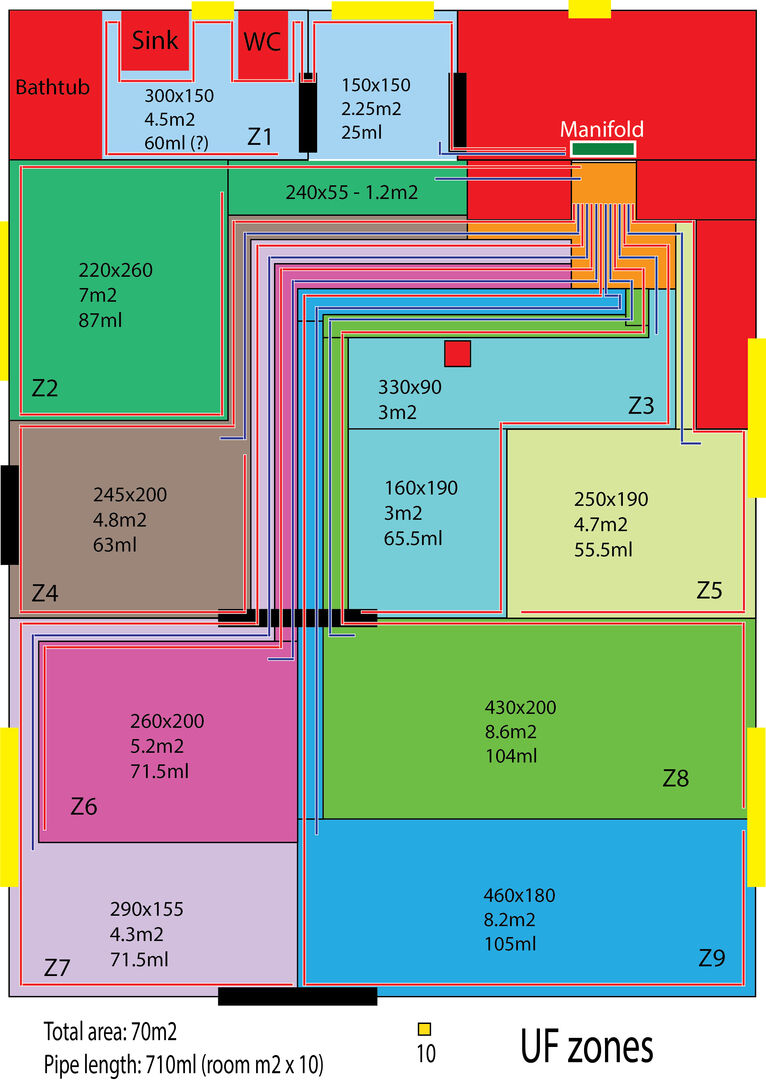
- More details to help understand your situation: what part of the installation is already built? is the UFH built? manifolds installed? pipes laid out to bring water to your UFH manifolds? if yes, type, diameter and length of these pipes? Do you visualize how the pipe layout will be, where to put the hot water tank, path for the pipes to the heat pump, etc, any foreseeable snags? Is it as simple as "well there's already a conduit so just push the pipe through" or a bit more "core drill through the whole house" kind of situation? - nope, nothing built right now, at the moment I only have the "main" slab to be covered with 10cm graphite XPS and pipe to be laid on top
I hear Samsung air to water heat pumps are a bit noisy, but never heard one myself. - that would not be a problem, as it's countryside
Thanks a lot for your time.
20/04/2026 8:31 pm
I hear Samsung air to water heat pumps are a bit noisy, but never heard one myself. - that would not be a problem, as it's countryside
All heat pumps have noise specs which you can find. Look for noise power not noise pressure, they are different but both measured in dBm.
So far as I can make out from this forum Samsung heat pumps are perfectly ok. Their main downside is limited control capability. If you just want to operate on pure weather compensation, which I suspect is appropriate for your situation, you are fine. Forget night time setbacks or anything other than on/off adjustments to suit tou tarrifs however. To do either of these other than by using an on/off temperature sensor, which is unlikely to be satisfactory in your setup, you will need homely as well as the Samsung controller unless you want to play around yourself with the modbus and home assistant or some do it yourself control electrics.
This post was modified 6 months ago by JamesPa
4kW peak of solar PV since 2011; EV and a 1930s house which has been partially renovated to improve its efficiency. 7kW Vaillant heat pump.
1
Page 1 / 2
Next

SPONSORS

Degrees of Separation
Latest Posts
-

RE: How will removing the standing charge on gas bills benefit heat pumps?
I'm not sure it makes much of a difference to heat-pump...
By Temperature_Gradient , 5 hours ago
-
@editor Ouch, sorry to re start the tick. I had assume...
By DavidB , 5 hours ago
-
RE: Say hello and introduce yourself
@e-a-west as the good Major said, welcome to the forums...
By Mars , 7 hours ago
-
RE: New Build 3 Phase or 1Phase
We are on three phase power because it's an enormous li...
By EtchedPixels , 7 hours ago
-
RE: How much of your renewable and home setup would still work if the internet went down?
Yes I actually have a copy of a tool that whenever a ce...
By EtchedPixels , 16 hours ago
-
RE: Indevolt Batteries UK Support & Info Thread
@editor Hi, To resolve this, please tap on the A...
By Indevolt Tech , 23 hours ago
-
RE: Double or Triple Glazed Windows?
Posted by: @singlespeed With 9 years repairing windo...
By Rob of York , 2 days ago
-
@transparent we’re still running a secure version of PH...
By Mars , 2 days ago
-
RE: How quickly would you want/expect heat recovery to take from setback?
Much longer than that here. The heating isn't even on. ...
By bobflux , 2 days ago
-
RE: Passiv Smart Thermostat - Help & Forum Support
Obviously the weather is changeable but there's a defin...
By Singlespeed , 2 days ago
-
RE: The Changing Jet Stream Could Challenge UK Air Source Heat Pumps
@rob-of-york I must admit that when we had a Daikin hea...
By Toodles , 2 days ago
-
RE: Forum updates, announcements & issues
Get the Renewable Heating Hub heads-up on WhatsApp. I...
By Mars , 3 days ago
-
RE: Safety study for plug in batteries out to tender - looks like Q3 2027 at best before legal
@editor I pointed out to the one of the Fuse execs that...
By dansus , 3 days ago
-
RE: 15kw pump for 225m2 1990's house - over kill?
@seaviews As well as loft insulation, there are othe...
By Rob of York , 3 days ago




SPONSORS