

Notifications
Clear all
Joining the Renewable Heating Hub forums is completely free and only takes a minute. By registering you’ll be able to ask questions, join discussions, follow topics you’re interested in, bookmark useful threads and receive notifications when someone replies. Non-registered members also do not have access to our AI features. When choosing your username, please note that it cannot be changed later, so we recommend avoiding brand or product names. Before registering, please take a moment to read the Forum Rules & Terms of Use so we can keep the community helpful, respectful and informative for everyone. Thanks for joining!

Topic starter
18/04/2026 12:25 pm
I have a 6 year old Samsung Gen5 system. I have a problem with the mixer valve switching between DHW and CH. The valve moves perfectly from CH to DHW, (to the left, anti-clockwise) but when switching DHW to CH (to right, clockwise) there is a terrible graunching noise and the ESBE moves very jerkily, fully over to the right, from DHW to CH. It continues to 'graunch' for several seconds before going silent. My heating engineer has now fitted 4 new ESBE valves, with the same result. ESBE technician arrived and tested the valve: Result was that the power source during the DHW to CH stage was 'faulty'.... By setting up the valve on the bench with a 'clean' power supply, he was able to show the valve worked perfectly and without any noise or 'complaint' at all. The heating engineer reports that the Gen5 MIM is faulty and requires replacement.
My questions are what is a MIM unit, what version might I require, and is it possible to DIY change one? What do folk think might be an alternative solution, if there is one? It appears very strange to me that the actual voltage during the DHW to Ch phase is not a steady 240v, or how an intermittent voltage could be produced? I have spoken to a very helpful Samsung tech and he suggests that the NO or NC wire contacts on the valve itself have not been connected to the correct terminal contacts B16, & B17 on the control unit board?
Any ideas would be most gratefully received, as the replacement MIM prices I've looked at are 'pricey'!!!

18/04/2026 3:28 pm
My first thought is to watch the changeover voltage on an oscilloscope, but that requires access to an oscilloscope.
If it is what it seems, which it may not be, it's a very odd fault, presumably in the driver circuit that converts the logic of the mim to 240V. Is that on the mim board itself or somewhere else I wonder. Is the valve connected directly to the mim or via some intermediary circuitry?
4kW peak of solar PV since 2011; EV and a 1930s house which has been partially renovated to improve its efficiency. 7kW Vaillant heat pump.
1

18/04/2026 4:59 pm
Hi @ian-l
What version MIM does the Gen5 use? Are you able to remove the cover and take a decent photo of the circuit board will all connections, and post it here?
I'm not sure about the Gen5 as I don't have a manual, but my Gen6 is probably similar (MIM-E03CN / MIM-E03EN)
The MIM is just the box with circuit board that controls the power supply and control electronics for valves and pumps etc
There are a number of screw terminals, labelled B1 - B26 (the labelling on mine is rubbish so it's always best to count the physical terminals starting at B1 on the left)
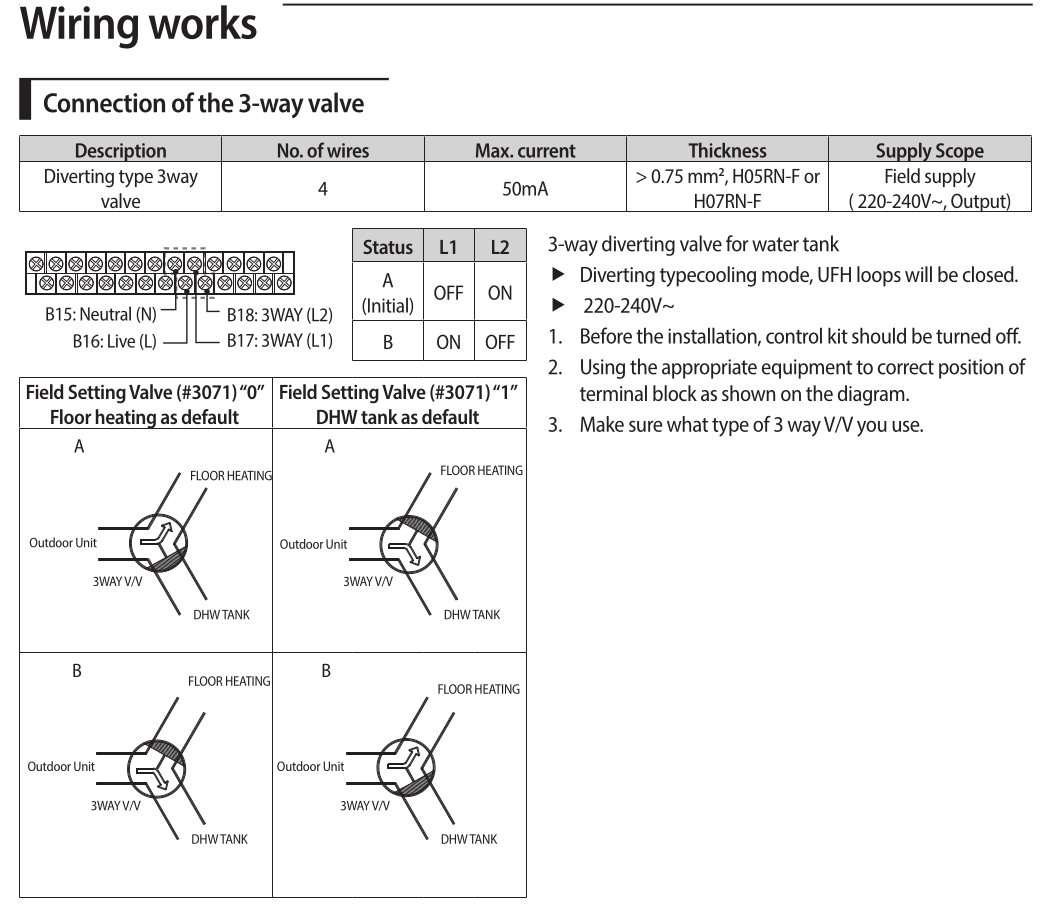
The diverter valve (3-way valve) commonly has 4 wires, connected to B15-B18 on my Gen6 unit.
B15 and B16 are Neutral (N) and live (L) power connections respectively for the 3-way valve. The other two wires are the control wires that determine the position of the valve, and are controlled by FSV #3071
The default (for FSV #3071 = 0) is for the valve to be in the position of heating (CH), and is set by B17 being powered 'OFF' (NC - normally closed) and B18 being powered 'ON' (NO - normally open)
To switch valve position, to DHW, B17 changes OFF -> ON and B18 ON -> OFF
These connections (B17/B18) should be ~220-240v and 50mA max current when live, according to the Samsung manual.
If the issue is switching from DHW to CH, that corresponds with B18 going from OFF to ON, so I would check the connection to B18, and check there is the correct voltage at B18 when the CH is active (an AC volt meter connected between terminals B15 and B18 should read ~220-240v).
Check the MIM installation manual for a Gen5 to make sure the terminal numbers are the same as above for my Gen6 - do you have a copy of your MIM installation manual?
I'm assuming it's not just a loose connection if an engineer has tried replacing the valve multiple times, and gone so far as checking voltages. It's more likely a fault on the circuit board switching to provide live voltage to that terminal (I would check the voltages on all the live B terminals out of interest if you have a multimeter and are competent to work on live systems)
If there's a local fault and the terminals are not supplying the correct voltage, then I guess you will either need a new board or will need to rig up an alternative 240v power supply and switching to manually switch the valve. You could take any permanently live 240v feed from any B terminal and switch it between the control wires on the valve to move manually the valve (I've actually done similar on my own system to prevent the valve moving to the DHW position during antifreeze cycles and draining the DHW cylinder overnight if the heating is off). The downside of this is you lose the automatic control but at least you don't have to fork out for a new MIM board.
Here is a screenshot of the Gen6 MIM installation manual for MIM-E03CN / MIM-E03EN:
This post was modified 6 months ago 14 times by Old_Scientist
Samsung 12kW gen6 ASHP with 50L volumiser and large radiators. 7.2kWp solar (south facing), Tesla PW3 (13.5kW). Net Zero
18/04/2026 5:37 pm
The default (for FSV #3071 = 0) is for the valve to be in the position of heating (CH), and is set by B17 being powered 'OFF' (NC - normally closed) and B18 being powered 'ON' (NO - normally open)
To switch valve position, to DHW, B17 changes OFF -> ON and B18 ON -> OFF
I assume FSV #3071 is set to the default value of Floor heating (#3071 = 0)
As an interesting aside, if you change FSV #3071 to 1 (DHW now as default), does this effectively flip the issue, so the graunching noise now occurs when the valve is moving from CH to DHW, the opposite to before? If it does, this would appear to confirm a control/voltage issue on B17/B18.
Samsung 12kW gen6 ASHP with 50L volumiser and large radiators. 7.2kWp solar (south facing), Tesla PW3 (13.5kW). Net Zero

Topic starter
19/04/2026 12:57 pm
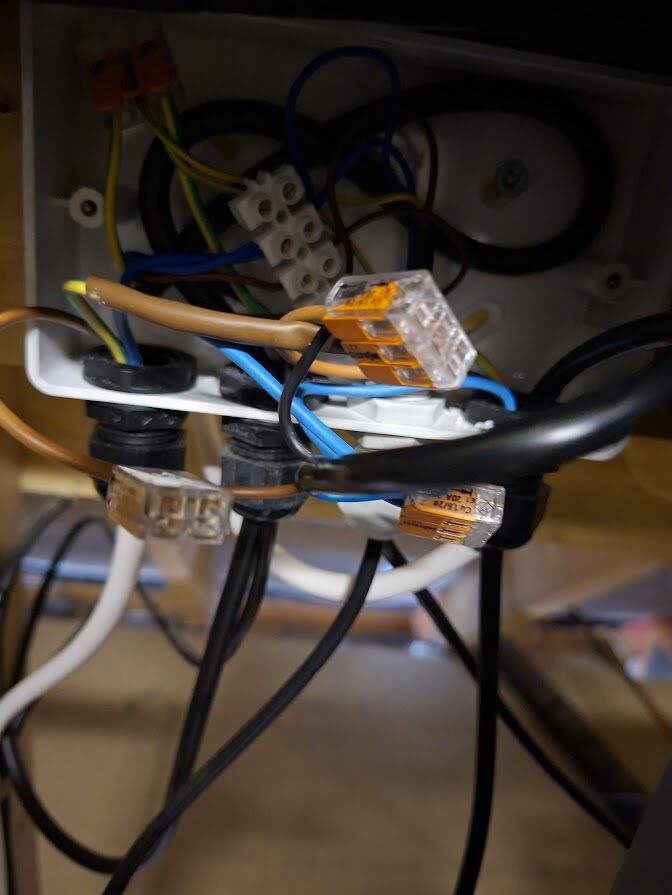
Thanks so much for your detailed reply. I will see if I can take a photo om panel and attach it with a later reply. I am attaching a photo of the valve wires into a small junction box adjacent to the valve itself. The problem is that there are several other units (pump and secondary flow valves) also wired into the same small junction box, and for me, it is impossible to verify if the Esbe valve wires, are correctly connected to the B17 and/or B18 connectors at the main control unit. The blue wire (N) is connected, I must assume, correctly, to a waga N unit; the Brown (P) power is correctly connected to a waga B unit, and the Black wire, which I understand should be connected to the B17 control panel connector, is un-verified as connected to the B17 or B18 control unit connector?
I was wondering if I can locate the B17 connector on the main control panel, and connect a single wire from downstairs, up to the actual valve Black wire, and see if that 'works' OK? I am assuming this black wire should be connected to the B17 main panel connector, rather than the B18 connection? Is there supposed to be a wire connected to the B18 connector??
Sorry about my very basic knowledge level! I can follow wiring diagram and happy to make any connections, but in general 'how electricity works' is rather beyond my ken! 🤔

SPONSORS

Degrees of Separation
Latest Posts
-

RE: How will removing the standing charge on gas bills benefit heat pumps?
I'm not sure it makes much of a difference to heat-pump...
By Temperature_Gradient , 6 hours ago
-
@editor Ouch, sorry to re start the tick. I had assume...
By DavidB , 6 hours ago
-
RE: Say hello and introduce yourself
@e-a-west as the good Major said, welcome to the forums...
By Mars , 8 hours ago
-
RE: New Build 3 Phase or 1Phase
We are on three phase power because it's an enormous li...
By EtchedPixels , 8 hours ago
-
RE: How much of your renewable and home setup would still work if the internet went down?
Yes I actually have a copy of a tool that whenever a ce...
By EtchedPixels , 17 hours ago
-
RE: Indevolt Batteries UK Support & Info Thread
@editor Hi, To resolve this, please tap on the A...
By Indevolt Tech , 1 day ago
-
RE: Double or Triple Glazed Windows?
Posted by: @singlespeed With 9 years repairing windo...
By Rob of York , 2 days ago
-
@transparent we’re still running a secure version of PH...
By Mars , 2 days ago
-
RE: How quickly would you want/expect heat recovery to take from setback?
Much longer than that here. The heating isn't even on. ...
By bobflux , 2 days ago
-
RE: Passiv Smart Thermostat - Help & Forum Support
Obviously the weather is changeable but there's a defin...
By Singlespeed , 2 days ago
-
RE: The Changing Jet Stream Could Challenge UK Air Source Heat Pumps
@rob-of-york I must admit that when we had a Daikin hea...
By Toodles , 2 days ago
-
RE: Forum updates, announcements & issues
Get the Renewable Heating Hub heads-up on WhatsApp. I...
By Mars , 3 days ago
-
RE: Safety study for plug in batteries out to tender - looks like Q3 2027 at best before legal
@editor I pointed out to the one of the Fuse execs that...
By dansus , 3 days ago
-
RE: 15kw pump for 225m2 1990's house - over kill?
@seaviews As well as loft insulation, there are othe...
By Rob of York , 3 days ago




SPONSORS
