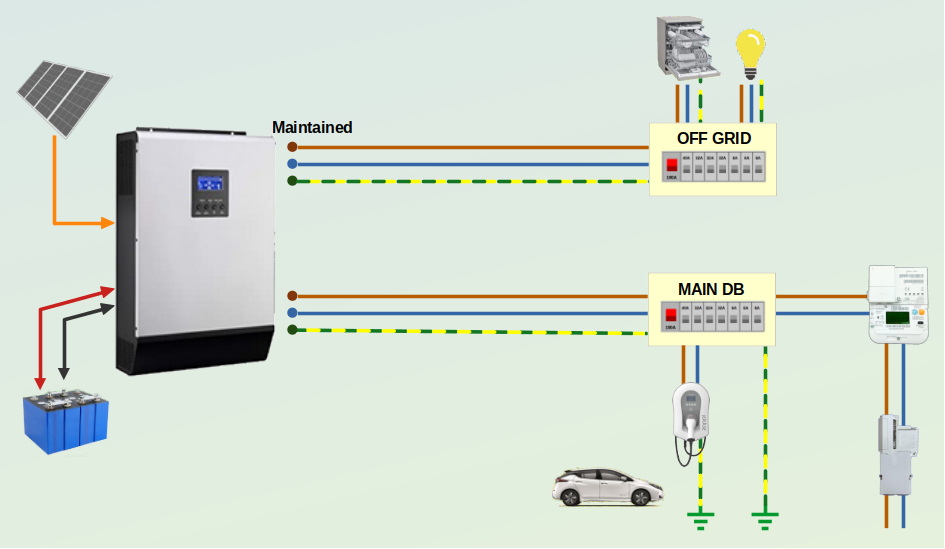
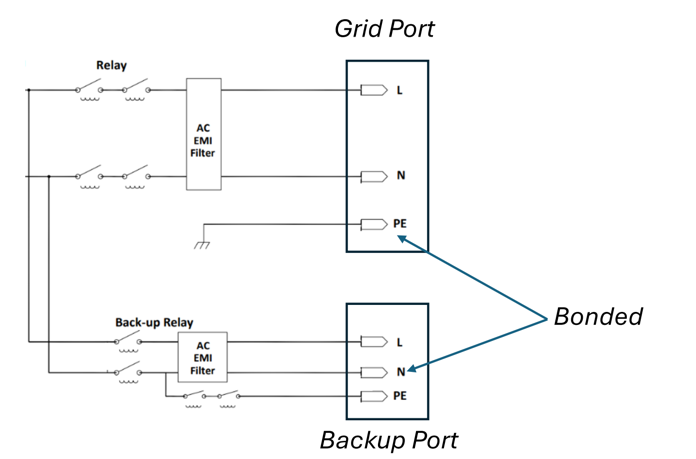
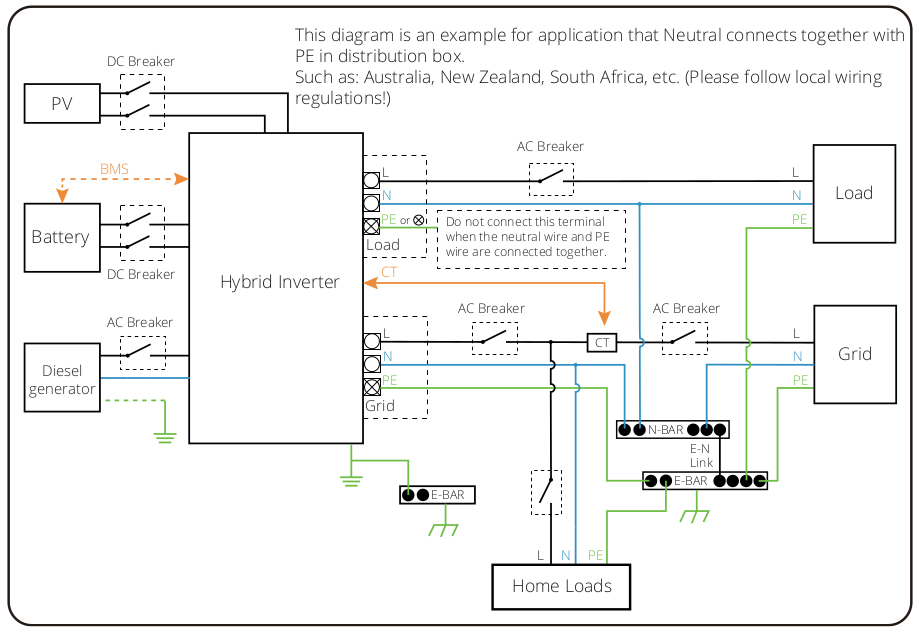
I too think that the Solis earthing diagram is confusing.
As I see it the situation is this...
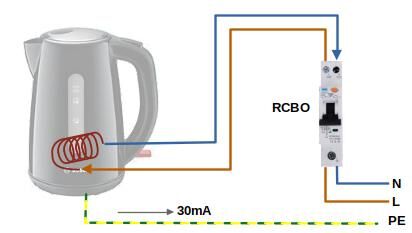
We commonly have circuits which are protected by an Earth-Leakage Trip, such as an RCD or RCBO. They 'measure' the current passing through live and neutral. If there's a difference (of 30mA or more) between the current on live and neutral, then it implies there is a fault - some current is passing to earth. The imbalance in the current must cause the Trip contacts to open.
Appliances have a Protective Earth (PE) connection to ensure that a fault allows current to find its way to earth. If that were not so then the metalwork of the appliance would 'float' to a high voltage under fault conditions. That means there's a risk of electric shock if a person then touches the appliance.
If I install an inverter in a house which has its own earth rod (as my own TT supply does), then a power-cut doesn't remove my earth.
So it's OK to use the earth rod for both grid-tied appliances, and those which continue to be powered from the 'off-grid' output.
However, if the earth is provided by the DNO, then I can't trust that it's intact (the cable might be cut) nor do I now have a Neutral.
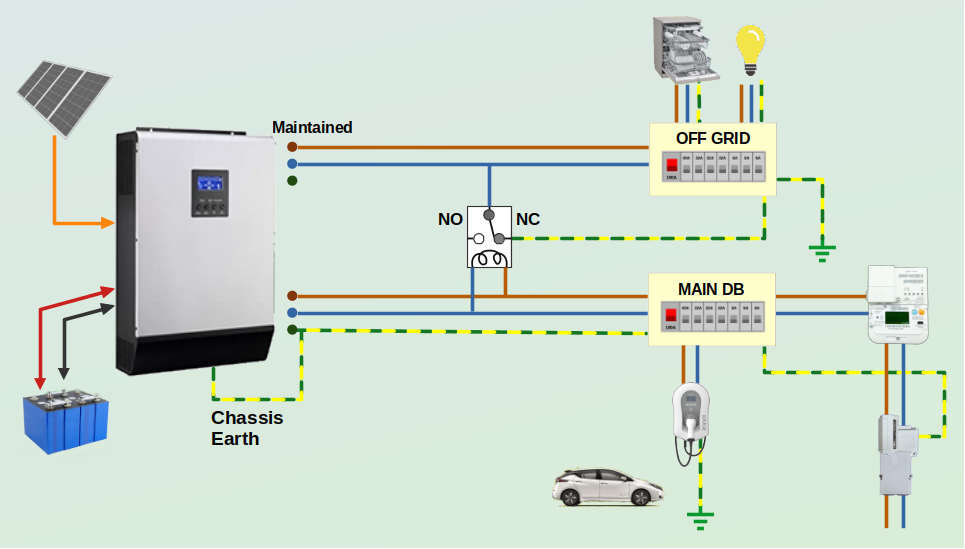
For an Off-grid (Maintained) output from the inverter to continue operating during an outage, it must have its own earth rod, and the Neutral must be tied to it.
That relay may or may not already be included inside the inverter. The installation instructions must therefore be followed.
Once the mains power is restored, the relay becomes re-energised and the connection between Earth and Neutral is removed for the appliances which have been operating off-grid.
The Neutral-Earth bond at the Service Fuse (TN-C-S) or the substation (TN-S) again provide the required earth reference.
If that relay weren't present, then the RCD supplying the inverter from the Main Distribution Board would trip out. It would sense the connection between Neutral and Earth and act as if there were a fault.
The actual instructions may still vary between inverter manufacturers. Some inverters will have the Neutral terminals connected together permanently, and others won't during a power-out.
This post was modified 2 months ago 3 times by Transparent
However, if the earth is provided by the DNO, then I can't trust that it's intact (the cable might be cut)
I cant see how that is the case if the earth is provided by means of a bond to the metal outer sheath of the incomer; no cut (other than one in your driveway of which you would surely be aware) can remove it. This is 'usual' for TN-S according to the IET diagram and text here
I can see how this is the case if the earth is provided by your DNO 'remotely'. This is 'usual' for TN-C-S according to the diagram in the same location
Which makes me wonder about how TN-C-S is safe, because isn't it the case that 'earth' potential can vary from location to location so its normal (required?) to earth near an installation
Or did I misunderstand?
This post was modified 2 months ago 5 times by JamesPa
4kW peak of solar PV since 2011; EV and a 1930s house which has been partially renovated to improve its efficiency. 7kW Vaillant heat pump.
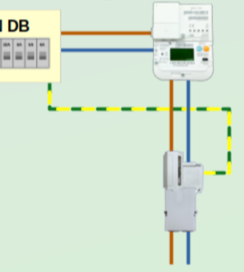
This is what the Solis Engineers sent me about earthing, it does not mandate a rod in all situations, but it may apply:
When no voltage is present at the inverter’s grid port, the neutral on the backup port is bonded to the protective earth (PE) terminal on the same port. In typical installations, this is the point where an earth rod is connected. The Solis design offers flexibility by allowing either a dedicated earth rod or the grid’s PE connection to be used at this port. Important: Always consult and comply with local electrical regulations and standards when configuring neutral-to-earth bonding and earthing methods.
This was what led me to believe the requirement for the rod is related to the inverter backup/UPS/off-grid, but this does not stop it covering all earthing requirements in the site.
My recommendation is still to have the distributor review the overall plan and diagram. I approached Solis for this, but I do not think that should be necessary, and the disadvantage is they are not always that familiar with all local regulations. I could have oversized a few circuits as a result.
Now in terms of earthing, in most sites, if the DNO provides an earth connection, is it not reliable?
I wonder what happens with purpose built flats, is earthing via bonding to metallic pipes or is there a rod for the block?
I too think that the Solis earthing diagram is confusing.
Hopefully I helped explain it, my recommendation is to get the distributor to do some work for their margin. They may suggest an installer, but that could mean thousands extra for an MCS certified one. And they would probably not be able to recommend one that works in your area..
So with the diagram, I managed to get electricians to do the work. But it should be said that far too many NICEIC professionals are too busy fitting new sockets and lights to want to get into higher powered circuits.. Even fitting an EV charger is not common knowledge.
Also, most electricians that had "heard" about inverters immediately pointed out that the idea of treating an inverter as a socket that you can supply via a 30ma RCBO was a non-starter. And that was even before there was any discussion of the type of inverter.
It is not an absolute requirement, the electrician is the best one to confirm what is needed.
For my Off-grid (Maintained) output from the inverter to continue operating during an outage,
it must have its own earth rod, and the Neutral must be tied to it.
That relay may or may not already be included inside the inverter. The installation instructions must therefore be followed.
Once the mains power is restored, the relay becomes re-energised and the connection between Earth and Neutral is removed for the appliances which have been operating off-grid.
The Neutral-Earth bond at the Service Fuse (TN-C-S) or the substation (TN-S) again provide the required earth reference.
If that relay weren't present, then the RCD supplying the inverter from the Main Distribution Board would trip out. It would sense the connection between Neutral and Earth and act as if there were a fault.
The actual instructions may still vary between inverter manufacturers. Some inverters will have the Neutral terminals connected together permanently, and others won't during a power-out.
The Solis S6 is a "key in hand" kind of islanding/UPS capable inverter. So the operation can be seamless. But it should be said this may the same with others, like the givEnergy inverter I subsequently looked into. The Solis delivers a bit more for similar cost, has that extra smart port that can work as lower priority UPS or to take an AC coupled PV inverter but this could be trumped by other factors.
Perhaps when the initial off-grid inverters became available, they required manual or ATS switches?
I cant see how that is the case if the earth is provided by means of a bond to the metal outer sheath of the incomer; no cut (other than one in your driveway of which you would surely be aware) can remove it.
The usual type of underground cable with a metal 'outer' is Steel Wire Armoured. This has an external Polyethylene (or XPLE) layer outside of the steel.
Based on your description (and no photos), I need to assume that is what you've got. If, OTOH, you're telling us that the portion of that cable you can see has no outer insulating layer, then it might indeed be contacting the soil (earth) for the entirity of its length to the local substation.
That's not only unusual, but is a hypothesis based on several assumptions. The risk could only be reduced by your electrician performing a full earth-loop test to a ground reference point.
The diagrams I've produced above are a simplified version of lots that I read yesterday in inverter manuals, when I should've been making marmalade. 😀
The 'cut' I've mentioned could be the loss of your entire local substation, whilst the DNO replace the transformer with a new one!
The whole point of an earthing regime is that it must remain safe during all possible circumstances.
@batpred - please don't re-quote a diagram unless your next bit of text is referring to something in it. This topic bears all the hallmarks of being extremely long, and we don't want other readers having to pore over reasonings/corrections which aren't actually present!
in terms of earthing, in most sites, if the DNO provides an earth connection, is it not reliable?
The mains earth design is reliable, but not dependable in the situation where you're installing your own in-home 'generator' (inverter) to operate when the grid supply is down. That's the main point being discussed here!
I wonder what happens with purpose built flats, is earthing via bonding to metallic pipes or is there a rod for the block?
Earthing the mains circuits in the home, and bonding to metal pipework, are two entirely different issues.
Metal pipes (gas and water) must be bonded to the central earth point in the home. But that bonding NEVER provides a method of earthing mains circuits for power and lighting.
Multiple occupancy buildings always have an earth connection to the consumer units in exactly the same way as a single home does.
The Solis S6 is a "key in hand" kind of islanding/UPS capable inverter. So the operation can be seamless.
The information and diagram you have posted from Solis aren't sufficient to make that generalisation.
Your text and the diagram refer to bonding, which isn't the same concept as providing an earth.
When you mention the Backup Port here: the neutral on the backup port is bonded to the protective earth (PE) terminal on the same port. In typical installations, this is the point where an earth rod is connected.
I can see no circumstances in which an earth rod would be connected to the Backup Port. Nor is there one shown on the Solis-supplied diagram.
This post was modified 2 months ago 4 times by Transparent
The diagrams I've produced above are a simplified version of lots that I read yesterday in inverter manuals, when I should've been making marmalade.
Please dont feel obliged to respond quickly or at all, we all do this in our time on an as and when basis. I am very grateful for any input which has been extremely helpful, but have no reason to expect it! Also Im not asking for personalised advice on my particular installation, only on the principles!
The usual type of underground cable with a metal 'outer' is Steel Wire Armoured. This has an external Polyethylene (or XPLE) layer outside of the steel.
Based on your description (and no photos), I need to assume that is what you've got. If, OTOH, you're telling us that the portion of that cable you can see has no outer insulating layer, then it might indeed be contacting the soil (earth) for the entirity of its length to the local substation.
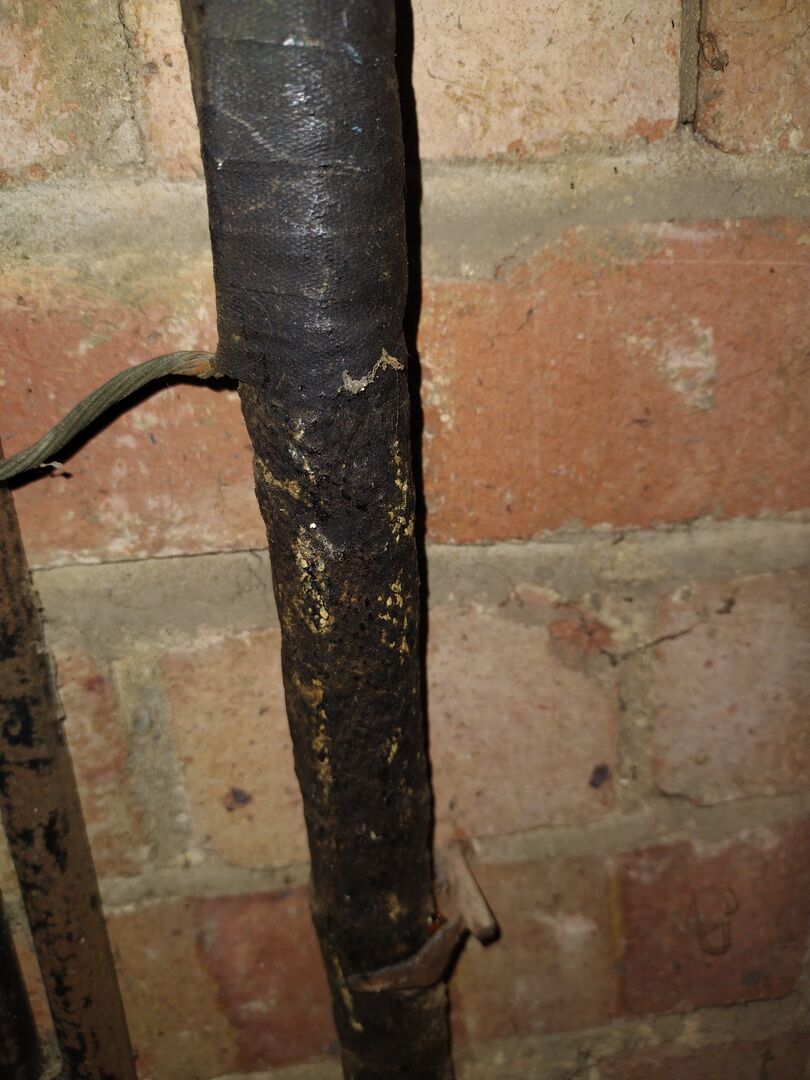
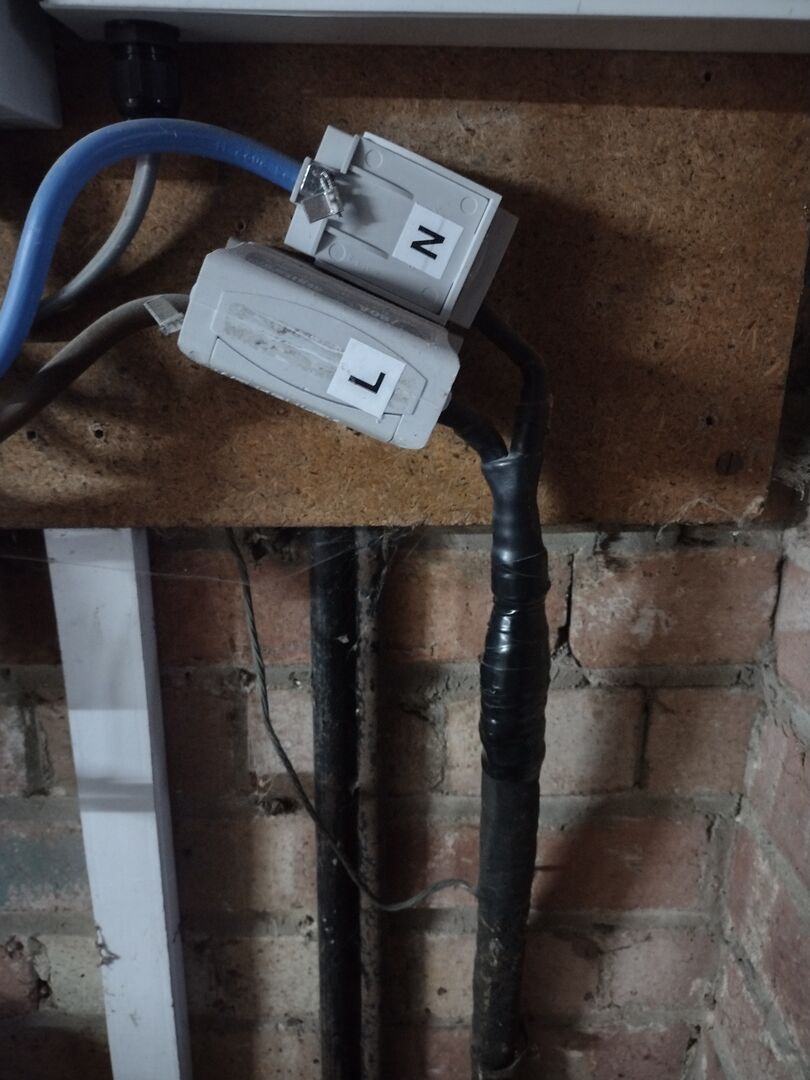
However since you ask are a couple of photos of the premises earth wire connected to the metallic sheath of the incomer. Obviously I dont know how far 'back' into the system/soil this metal outer goes.
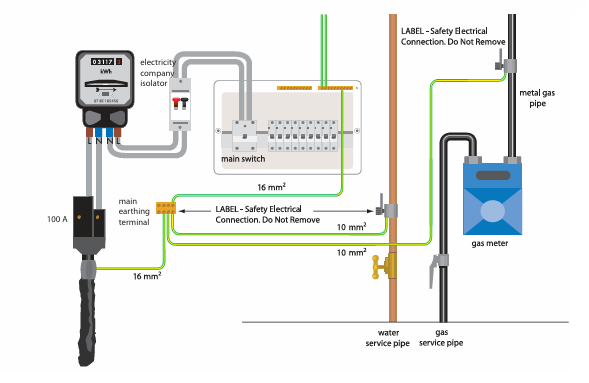
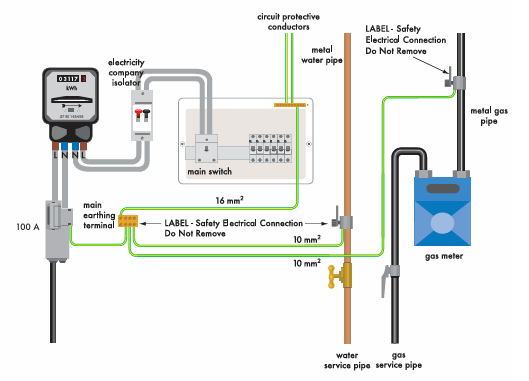
Apart from the terminal blocks at a jaunty angle (thanks to UKPN) this looks precisely like this diagram from the IET for a TN-S system. The accompanying text says 'the consumer’s earthing terminal is typically connected to the metallic sheath or armour of the distributor’s service cable into the premises'
Here is the diagram for TN-C-S from the same source.
I am struggling not to conclude that my current earthing arrangements are equally (and precisely equally) safe, or indeed unsafe, whether the grid is connected or not!
This post was modified 2 months ago 3 times by JamesPa
4kW peak of solar PV since 2011; EV and a 1930s house which has been partially renovated to improve its efficiency. 7kW Vaillant heat pump.
in terms of earthing, in most sites, if the DNO provides an earth connection, is it not reliable?
The mains earth design is reliable, but not dependable in the situation where you're installing your own in-home 'generator' (inverter) to operate when the grid supply is down. That's the main point being discussed here!
Ok. I am concerned that the earthing arrangement being as below, it should have a rod added to it.
I am curious since one EICR reported it as TN-S, about 6 months ago. The most recent recorded it as TN-C-S.
The Solis S6 is a "key in hand" kind of islanding/UPS capable inverter. So the operation can be seamless.
By "key in hand", I am referring to the fact that on the Solis S6, the backup/UPS/islanding port is automatically fed from grid, battery and PV. The inverter based on the simple rule that is configured, so there is no switch that would need to be manually pressed for as long as there is a power source.
Whereas some of the earlier inverters (that operate the grid port in islanding mode) will need an external isolator or switch that is typically manually activated.
Your text and the diagram refer to bonding, which isn't the same concept as providing an earth.
When you mention the Backup Port here: the neutral on the backup port is bonded to the protective earth (PE) terminal on the same port. In typical installations, this is the point where an earth rod is connected.
I can see no circumstances in which an earth rod would be connected to the Backup Port. Nor is there one shown on the Solis-supplied diagram.
The text you are quoting in magenta is directly from Solis.
In any case i did not see any incompatibility between their advice and connecting all earth points, from all consumer units and also all inverter port earth connections to the single home earthing arrangement.
My EV charger did not mandate its own earthing either and so the earth wire is connected to the consumer unit and then to the busbar that is next to the utility meter.
I understand that a single rod can be connected to this busbar, to make sure that, even in case the DNO cuts the neutral, earthing will work.
8kW Solis S6-EH1P8K-L-PLUS hybrid inverter; G99: 8kw export; 16kWh Seplos Fogstar battery; Ohme Home Pro EV charger; 100Amp head, HA lab on mini PC
I am struggling not to conclude that my current earthing arrangements are equally (and precisely equally) safe, or indeed unsafe, whether the grid is connected or not!
When the grid is off, there it could be that the neutral cable is interrupted. In this case, there´s no earthing! Chances are that if that happens, it is because they are digging your cable in the driveway, so you would know to switch off your inverter.
But since my goal is that it will be all automatic in case of a powercut, I decided I will get a rod put in when I next have a qualified sparky in.
8kW Solis S6-EH1P8K-L-PLUS hybrid inverter; G99: 8kw export; 16kWh Seplos Fogstar battery; Ohme Home Pro EV charger; 100Amp head, HA lab on mini PC
When the grid is off, there it could be that the neutral cable is interrupted. In this case, there´s no earthing! Chances are that if that happens, it is because they are digging your cable in the driveway, so you would know to switch off your inverter.
So far as i can see no because its NOT connected to the neutral, its connected to the metallic sheath of the distributor’s service cable into the premises as it says in the IET guide. Unless they are digging in my driveway and unearth the service cable, but as you say in that case I'd know about it.
Also note that all I said was 'I am struggling not to conclude that my current earthing arrangements are equally (and precisely equally) safe, or indeed unsafe, whether the grid is connected or not!' The key point being that islanding is not, in this case, the issue (but safety of the arrangement when the grid is connected may be).
Yours on the other hand (and according to the diagram you reproduced) is connected to the neutral and is thus a different arrangement where, so far as I can understand, islanding may well make a difference.
Refer to the two different diagrams reproduced above and the accompanying text which are from the IET, and thus should be definitive.
Thank you for your kind invitation. I must say that this concerns me; the consumer unit in my 1930s house was replaced about 15 years ago by a qualified electrician, who signed off the whole installation and inspected the earthing arrangements, the general design of which I note is expressly recognised by the IET. This being the case there must surely be hundreds of thousands, perhaps millions, of houses with the same arrangement, the occupants of which are equally at risk. If one cannot rely on the mains earth design, a qualified electrician and the IET collectively to design safe and reliable earthing arrangements, on whom can one rely? If indeed this is unsafe, then what is being done to address the problem?
May I respectfully suggest that, rather than focussing on my house in particular, you address what seems likely to be a systemic problem in the earth arrangements of the UK housing stock. I am of course happy to provide one example, but the wider context also needs to be explored in your programme. Finally I note that you have previously suggested on your programme that mains earth design is reliable (my italics). Are you now changing your position and asserting that this is not the case?
Tongue in cheek of course but my point remains that I cant see any reason why I should not conclude that my current earthing arrangements are equally safe, or indeed unsafe, whether the grid is connected or not!'. The issue of whether they should anyway be upgraded is separate, the concerning thing (if indeed they do need to be upgraded) is that this wouldn't have arisen had I not been considering islanding, and seriously there must be hundreds of thousands+ of houses with this arrangement.
This post was modified 2 months ago 8 times by JamesPa
4kW peak of solar PV since 2011; EV and a 1930s house which has been partially renovated to improve its efficiency. 7kW Vaillant heat pump.
When the grid is off, there it could be that the neutral cable is interrupted. In this case, there´s no earthing! Chances are that if that happens, it is because they are digging your cable in the driveway, so you would know to switch off your inverter.
So far as i can see no because its NOT connected to the neutral, its connected to the metallic sheath of the distributor’s service cable into the premises as it says in the IET guide. Unless they are digging in my driveway and unearth the service cable, but as you say in that case I'd know about it.
Also note that all I said was 'I am struggling not to conclude that my current earthing arrangements are equally (and precisely equally) safe, or indeed unsafe, whether the grid is connected or not!' The key point being that islanding is not, in this case, the issue (but safety of the arrangement when the grid is connected may be).
Indeed!
And my apologies, I should have expected you had assessed it. 😊
Yours on the other hand (and according to the diagram you reproduced) is connected to the neutral and is thus a different arrangement where, so far as I can understand, islanding may well make a difference.
And I also found the reason for the multiple categorisations for our earthing arrangement. It is TN-S, but the head was upgraded as in TN-C-S, causing the confusion. The foundation of the house is of concrete, so I am not sure whether the conductor is exposed outside, where the soil would have lower resistance. As none of the EICRs shows any measurements, it is still something to be confirmed. Given how keen electricians are to carry these EICRs, it could be the path of least resistance (pun intended) that the IET could take to at least raise awareness of the problem.
And in any case, even my untrained eye can tell the DNOs oxidised earth cable is likely a bottleneck should any of the many of the earth cables crowding the busbar need earthing...
8kW Solis S6-EH1P8K-L-PLUS hybrid inverter; G99: 8kw export; 16kWh Seplos Fogstar battery; Ohme Home Pro EV charger; 100Amp head, HA lab on mini PC
Whether the outer metallic braid of the mains incomer is covered by an insulated layer (Polyethylene or Bitumen), it remains the case that the actual location of the earth-tie is at the substation transformer. That's dictated by the supply designation of TN-S.
@jamespa the two possible points of weakness in your earthing arrangement are
the method by which the (7-strand?) earth wire is connected to the outer braid of the incomer, which should remain visible
the cross-sectional diameter of that stranded earth wire, which should be 10mm² minimum
Even if that earth is deemed fully satisfactory, it's still the case that 'off-grid' inverters would need an independent earthing arrangement for when the grid is down, if the supply is TN-S or TN-C-S.
That may or may not be included within the design of the inverter.
In other words, if the inverter installation manual says "connect an earth rod to this point unless you already have a TT supply" then that's the reason for the instruction.
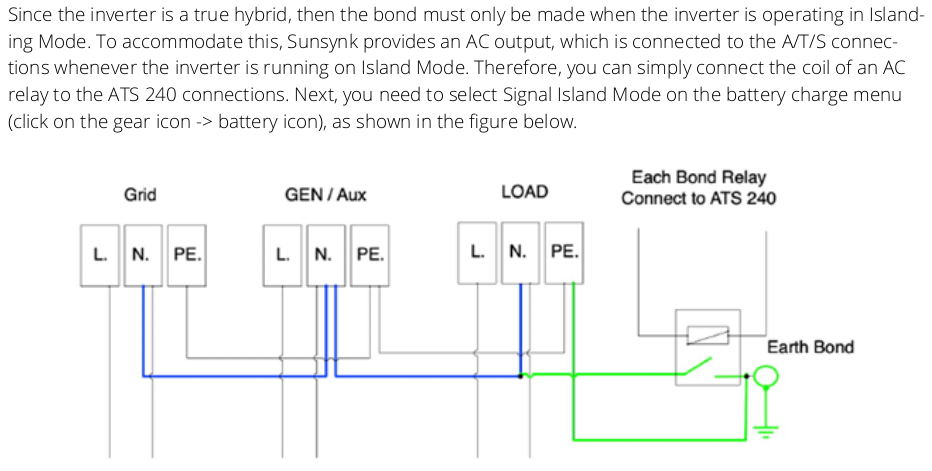
Here's a section of the manual for the SunSynk Ecco inverter range where they make particular reference to the issue:
In the above diagram, you will note that there is an earth rod attached to the Earthing Strip in the Consumer Unit...
... whereas another section of the same manual covers the instance where an earth rod and relay must be fitted:
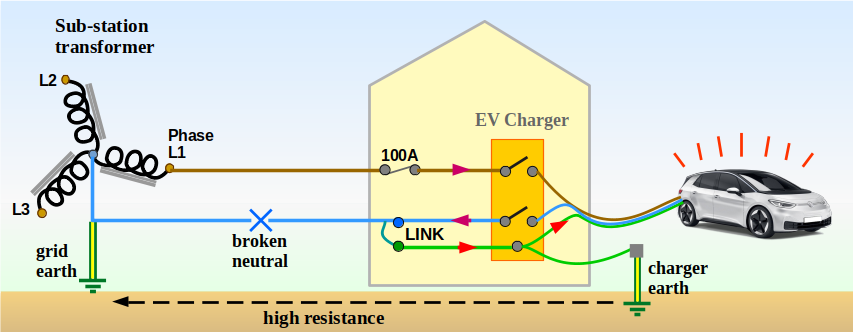
@batpred - There certainly are instances when a broken Neutral needs to be considered. It's the reason why many EV chargers are given their own earth-rod or earth-grid when the supply is TN-S or TN-C-S.
But that's not the same reasoning which applies to an inverter operating off-grid during an outage.
My EV charger did not mandate its own earthing either and so the earth wire is connected to the consumer unit and then to the busbar that is next to the utility meter.
That's more likely to be due to your EV Charger having an inbuilt earth-detection system, as many now do. It will switch off if there's a break on the Neutral between you and the substation.
I also found the reason for the multiple categorisations for our earthing arrangement. It is TN-S, but the head was upgraded as in TN-C-S, causing the confusion.
Please define what you're referring to as "the head".
When you used it previously I thought you were referring to the test point on the top protruding section of an earth rod. But now I think you mean the Service Fuse - which is often called the Cut Out by DNO Engineers.
This post was modified 2 months ago 2 times by Transparent