

Notifications
Clear all
Joining the Renewable Heating Hub forums is completely free and only takes a minute. By registering you’ll be able to ask questions, join discussions, follow topics you’re interested in, bookmark useful threads and receive notifications when someone replies. Non-registered members also do not have access to our AI features. When choosing your username, please note that it cannot be changed later, so we recommend avoiding brand or product names. Before registering, please take a moment to read the Forum Rules & Terms of Use so we can keep the community helpful, respectful and informative for everyone. Thanks for joining!
Energy Storage
337
Posts
23
Users
119
Reactions
47.4 K
Views

30/07/2026 1:27 pm
For a unit that's wired in and has battery sockets that remain live do you also need the grounding rod and changeover. I know you do if you feed power back into the house but I can't make head or tails of the situation if it's wired in and only providing power on sockets in the unit itself.
My UPS (used for my computer and networking equipment) (which is a battery which is charged from the mains and provides output through an inverter only to sockets mounted on the unit) doesnt need that and has no provision for that, neither have other UPS units I have seen.
When the grid is connected to my UPS live is about 230V relative to mains earth and neutral just a few volts, both as expected.
When the grid is disconnected from my UPS both live and neutral register about 115V relative to mains earth. I would probably have expected it to float, so that neither registers any voltage, but it may be that my multimeter has an impedance that is too high for the latter to occur. I suppose I should measure again with a shunt resistor once I have worked out how to do it safely. If it does in fact float (as a bathroom shaver socket with a built in transformer should) then you would need to touch both wires to get a shock; most common faults will not result in shock risk.
This post was modified 3 months ago 2 times by JamesPa
4kW peak of solar PV since 2011; EV and a 1930s house which has been partially renovated to improve its efficiency. 7kW Vaillant heat pump.

30/07/2026 7:03 pm
Yep. That's how most units seem to work - but the question I asked was "if wired in". The moment it stops being a camping accessory and is permanently wired into the property the rules change.

30/07/2026 8:09 pm
When the grid is disconnected from my UPS both live and neutral register about 115V relative to mains earth.
But where is the safety earth for the equipment you have plugged in to the maintained outlet?
There needs to be an earth path which ensures a fuse blows (or a trip's contacts open) in the event of the load going faulty.
The strategy shouldn't be based on what happens when the appliances are working correctly.
For the (majority of) houses which have a TN-C(S) connection, the householder should provide their own earth connection using a ground stake for appliances which are connect to the maintained outlet.
That's because you can't rely on the presence of a functional earth path via the DNO's cables and local substation. The reason for the outage could be a broken Neutral/Earth wire between the house and the substation. In that scenario there wouldn't be an earth for your appliances operating from the battery in 'off-grid' mode.
Broken neutrals will occur with increased regularity in the next few years. As we install more EV chargers randomly across the three phases, the earlier installations result in greater phase imbalance. Consequently significant current will be flowing through the neutral, which historically has been a thinner conductor.
Since the Neutral is not fused in the substation, that neutral current causes thermal stress and breakdown in the insulation. The conductor fails.
It might seem odd that I'm raising this technical issue about the electricity grid in a topic on the Indevolt Battery.
But the two issues are linked.
If storage batteries are going to be deployed by homeowners without involvement from an electrician or qualified installer, then 'we' are going to have to take care of safety issues ourselves.
Save energy... recycle electrons!
1
30/07/2026 8:36 pm
But where is the safety earth for the equipment you have plugged in to the maintained outlet?
I have absolutely no idea what the safety analysis (when the grid is not present) looks like for UPS devices (which is what I made my measurements on). What I do know is that they have been around for decades and so its a reasonable bet that it has been sorted out.
My guess, and it is a guess, has always been that they include some sort of cut out internally, float, and thus do not depend on either a grid or local earth being present to offer a similar level of safety to mains connections. However that is a guess only.
Thats as far as my analysis goes, and as far as I intend to take it, given that these devices have been around for so long and 'death by UPS' has not made the headlines, despite their widespread deployment both in commercial and domestic environments. If anyone is interested in how UPS devices remain acceptably safe (and have done so for decades) then they may wish to seek out the product standards for this class of device and enlighten us all.
If a 'storage battery' is charged from the mains and then used off grid to supply one or more sockets mounted on the unit (ie not connected to the house circuitry) then it is precisely identical to a UPS and I imagine (but dont know) that it uses the same protection mechanisms.
The difference (relative to a UPS) only occurs when current flows from the battery to the house circuitry, and thus it is in this case that different considerations arise, whether the connection is by means of a plug or 'wired in'.
This post was modified 3 months ago 7 times by JamesPa
4kW peak of solar PV since 2011; EV and a 1930s house which has been partially renovated to improve its efficiency. 7kW Vaillant heat pump.
1



Topic starter
30/07/2026 11:08 pm
Reading through the most recent comments and replies, I think my original point still broadly stands, but I may have oversimplified what is actually a more complicated product and regulatory picture.
At the level of the household circuit, 800W is still 800W, whether it has come directly from solar or from a battery. That part seems fairly intuitive. Where I feel the distinction becomes important is in how the unit is being used and what the current rules allow and there are effectively three different scenarios.
One is using the unit as a portable power station, where it charges from the wall and powers appliances through its own sockets. Another is having it fixed-wired as part of the home installation, with the usual electrical and network requirements. The third is discharging stored energy back through an ordinary wall socket, which appears to be the area the present plug-in rules do not yet cover.
That makes me think the main issue is not necessarily whether the product is technically capable, but whether the different operating modes are being explained clearly enough to UK homeowners. The phrases “plug-in”, “grid feed-in” and “backup power” can easily give the impression that all of those functions are available through the same simple connection, when the reality seems more conditional.
🔥 Britain’s Heat Pump Shitshow
How Installing a Heating System Became a National Nervous Breakdown
Free UK shipping.
📗 Heat Pumps Explained
A Jargon-Free Guide for Homeowners
Rewritten and updated for 2027
📘 From Zero to Heat Pump Hero
🛠️ Bodge Buster
New to heat pumps?
Take the Heat Pump Fundamentals course and use INTRO50 at checkout for 50% off.

31/07/2026 4:32 am
@editor Your summary is spot on, and you’ve captured the nuance of the current UK landscape better than most marketing copy does. The technology is versatile, but the regulatory pathways are distinct. When a single device can act as an off-grid EPS, a hardwired G98 home battery, and a plug-in solar receiver, wrapping all of that into simple marketing terms like "plug-in energy storage" naturally creates confusion.
Based on feedback from this thread, we are actively updating our UK landing pages, documentation, and app onboarding flows so that terms like "grid feed-in," "EPS backup," and "plug-in solar" are explicitly linked to their corresponding installation requirements.
⚡ Indevolt UK Technical Team
Official Support | Smart Energy Storage & Home Automation Solutions
🛠️ Discord: https://discord.gg/aZTvvTK9pt
📧 Support: support.uk@indevolt.com
1

31/07/2026 7:50 am
@jamespa Well you tell me?
I'll give you an example:
DJI Power 2000 - a portable power bank that can charge from the grid (or solar) but provide UPS like functionality. (Allowed to be sold)
Indevolt PowerFlex 3000 - a portable power bank that can charge from the grid (or solar) but provide UPS like functionality (Not allowed to be sold?)
I'm pushing you towards an answer if being truthful. How is one allowed but the other isnt? - Thats why Indevolt are about to start selling the product pre regs. The issue of how to use it is the customers alone.
31/07/2026 8:17 am
@jamespa Well you tell me?
I'll give you an example:
DJI Power 2000 - a portable power bank that can charge from the grid (or solar) but provide UPS like functionality. (Allowed to be sold)
Indevolt PowerFlex 3000 - a portable power bank that can charge from the grid (or solar) but provide UPS like functionality (Not allowed to be sold?)
I'm pushing you towards an answer if being truthful. How is one allowed but the other isnt? - Thats why Indevolt are about to start selling the product pre regs. The issue of how to use it is the customers alone.
The distinction between the product categories is fairly simple.
- If it has a battery but cannot feed back to your house electrics via a plug on the device (so the only means to discharge are via sockets on the device, to other devices that are not connected to your house electrics) then it is fully legal. This is an established product category most commonly called a ups (uninterruptible power supply), or a variant of that same product category with some additional controls but the same essential electrical functionality. These have been around in one form or another for decades.
- If it has a battery and can feed back to your house wiring via the plug on the device then it is an second type of device. The legal position is evolving but it is not currently fully legal (the exact legal position has some complexities which I cannot fully describe).
- If it has only solar panels and no batteries and can feed back to your house wiring via the plug on the device it is a third type of device. These (provided they meet the interim spec published by the Government) will become legal on 27th August. Until then this product cateegory has the same legal status as category (2)
Categories 2 and 3 are both part of the current debate over 'plug in', the point being that they can feed into your house electrics via a plug on the device and a socket on the wall and thus without professional intervention. The electrical considerations for both are similar (arguably exactly the same) but the Government has fast tracked category 3 to establish the principle and attenuate the unsubstantiated objections by the self-serving installation industry, which wants to block both because they fear that it poses an major threat to the industry, despite the fact they have been legal in Germany and several other EU countries for some while.
I don't know for certain which capabilities the DJI has and therefore into which category it falls. However it is described as a 'portable power station' suggesting that it may not be able to feed back to your house electrics through its plug, discharge is only through the sockets, and thus it is category 1. The power flex definitely can feed back through the plug on the device into your house wiring, and is in category 2
This post was modified 3 months ago 10 times by JamesPa
4kW peak of solar PV since 2011; EV and a 1930s house which has been partially renovated to improve its efficiency. 7kW Vaillant heat pump.

31/07/2026 9:07 am
That makes me think the main issue is not necessarily whether the product is technically capable, but whether the different operating modes are being explained clearly enough to UK homeowners. The phrases “plug-in”, “grid feed-in” and “backup power” can easily give the impression that all of those functions are available through the same simple connection, when the reality seems more conditional.
Completely agree and the same confusion exists for wired-in batteries, some of which claim to provide backup but in fact do so only in a very limited way.
Plug-in is never going to provide back up power to your house electrics whilst the requirement to disconnect on grid failure exists. Since the purpose of the requirement to disconnect is to protect grid engineers working on the line, this is unlikely to change. Plug-in can provide back up power to one or more sockets on the unit itself, into which appliances can be plugged. These sockets can be powered whether or not the grid is operational, so the appliances can be plugged into them 'permanently'. The fact that the socket is on the unit places physical constraints on the location of any device(s) plugged in. In this respect the functionality is identical to that of a UPS.
Wired-in can provide backup to your house electrics, but requires a mechanism to separate your electrics from the grid when the grid fails (to meet the disconnection requirement). Furthermore the backup capacity (power) is limited by the inverter capacity (power). The manufacturers go about this in various ways, many of which require you effectively to divide your electrics into two and decide which should be powered when the grid fails. Others, particularly the high-end products, have a more convenient mechanism. This is very poorly explained in the marketing blurb of many that I have looked at. I suspect that this ambiguity suits the product manufacturers, as the provision of backup to the house electrics is a differentiator between wired in and plug in which will become more valuable as plug in becomes both legal and more commonplace.
This post was modified 3 months ago 3 times by JamesPa
4kW peak of solar PV since 2011; EV and a 1930s house which has been partially renovated to improve its efficiency. 7kW Vaillant heat pump.
31/07/2026 10:44 am
The distinction between the product categories is fairly simple.
Do we think the Secretary of State for ESNZ is properly aware of these distinctions?
Is DESNZ using the terminology in a clear and consistent fashion?
If not, then now would be the right time to contact them. There's likely to be a civil servant wrestling with the very same points that we're discussing here.
Save energy... recycle electrons!
31/07/2026 12:17 pm
@jamespa DJI kit I've played with can grid tie but the grid tie is currently not enabled on the UK shipping product. It's an interesting question whether it's compliant given how easy that option is to change, ditto though I continue to be surprised that the Ecoflow kit has a 1200W option in 800W countries and nobody cares that loads of people predictably set it to 1200W !
1
31/07/2026 1:27 pm
@transparent Its a firmware update and then you toggle it on. So its easy to do.
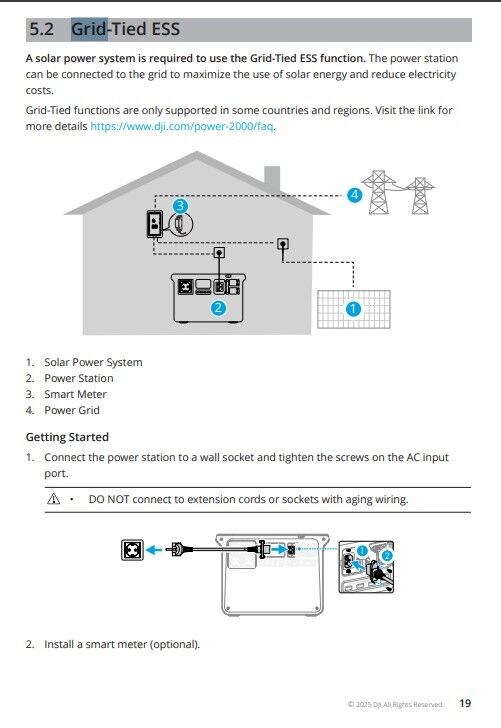
The DJI itself is a category 2, but sold as a category 1.
DJI never advertise this functionality, ever but its right there in the manual.
So the Powerflex and the DJI would be equivalent. My point I'm making is that DJI do it, and its OK. Indevolt should be able to as well as long as they get the optics right for the current regulatory position. Which is "no backfeed" ...for now

This post was modified 3 months ago 6 times by sonosppp
SPONSORS

Degrees of Separation
Latest Posts
-

@editor Ouch, sorry to re start the tick. I had assume...
By DavidB , 38 minutes ago
-
RE: Say hello and introduce yourself
@e-a-west as the good Major said, welcome to the forums...
By Mars , 2 hours ago
-
RE: New Build 3 Phase or 1Phase
We are on three phase power because it's an enormous li...
By EtchedPixels , 2 hours ago
-
RE: How much of your renewable and home setup would still work if the internet went down?
Yes I actually have a copy of a tool that whenever a ce...
By EtchedPixels , 11 hours ago
-
RE: How will removing the standing charge on gas bills benefit heat pumps?
The shoulder months are very difficult to judge COP on ...
By scrchngwsl , 12 hours ago
-
RE: Indevolt Batteries UK Support & Info Thread
@editor Hi, To resolve this, please tap on the A...
By Indevolt Tech , 19 hours ago
-
RE: Double or Triple Glazed Windows?
Posted by: @singlespeed With 9 years repairing windo...
By Rob of York , 1 day ago
-
@transparent we’re still running a secure version of PH...
By Mars , 2 days ago
-
RE: How quickly would you want/expect heat recovery to take from setback?
Much longer than that here. The heating isn't even on. ...
By bobflux , 2 days ago
-
RE: Passiv Smart Thermostat - Help & Forum Support
Obviously the weather is changeable but there's a defin...
By Singlespeed , 2 days ago
-
RE: The Changing Jet Stream Could Challenge UK Air Source Heat Pumps
@rob-of-york I must admit that when we had a Daikin hea...
By Toodles , 2 days ago
-
RE: Forum updates, announcements & issues
Get the Renewable Heating Hub heads-up on WhatsApp. I...
By Mars , 2 days ago
-
RE: Safety study for plug in batteries out to tender - looks like Q3 2027 at best before legal
@editor I pointed out to the one of the Fuse execs that...
By dansus , 2 days ago
-
RE: 15kw pump for 225m2 1990's house - over kill?
@seaviews As well as loft insulation, there are othe...
By Rob of York , 2 days ago




SPONSORS

