

Notifications
Clear all
Joining the Renewable Heating Hub forums is completely free and only takes a minute. By registering you’ll be able to ask questions, join discussions, follow topics you’re interested in, bookmark useful threads and receive notifications when someone replies. Non-registered members also do not have access to our AI features. When choosing your username, please note that it cannot be changed later, so we recommend avoiding brand or product names. Before registering, please take a moment to read the Forum Rules & Terms of Use so we can keep the community helpful, respectful and informative for everyone. Thanks for joining!

13/07/2026 11:08 am
@mk4 - perhaps I should clear up some of those 'unknowns':
1: There is a mechanism called Active Network Management (ANM) which is used to curtail/reduce the amount of generation which may be exported to the grid by commercial sites. Prior to the site being constructed, the Applicants can be provided with a forecast, showing the expect level of constraint for hours of the day and days of the year.
The ANM forecast can vary substantially, depending on what existing generation sites are already connected to the grid in the vicinity.
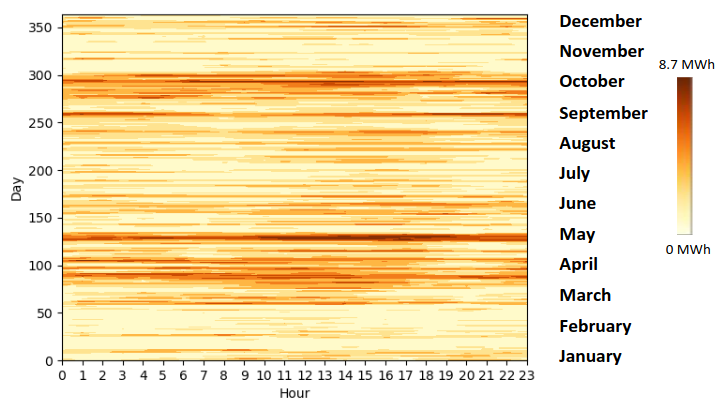
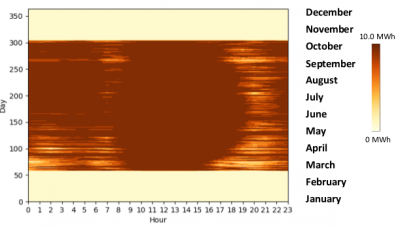
The Shutdown Order given to Derril Solar and other regional generators is not the same as ANM.
The Order is for a complete cessation of export to the grid, rather than a quantity of curtailment which will vary by the hour.
2: There is a priority mechanism in place for connections to the Distribution Grid.
Each generation site is allocated a number corresponding to the date when they obtained a grid connection.
Earlier sites are therefore less likely to be adversely affected by curtailment.
The table below shows 22 sites which have "Offer to Connect" status for a particular location on the grid.
The Position column is their number in the priority list.
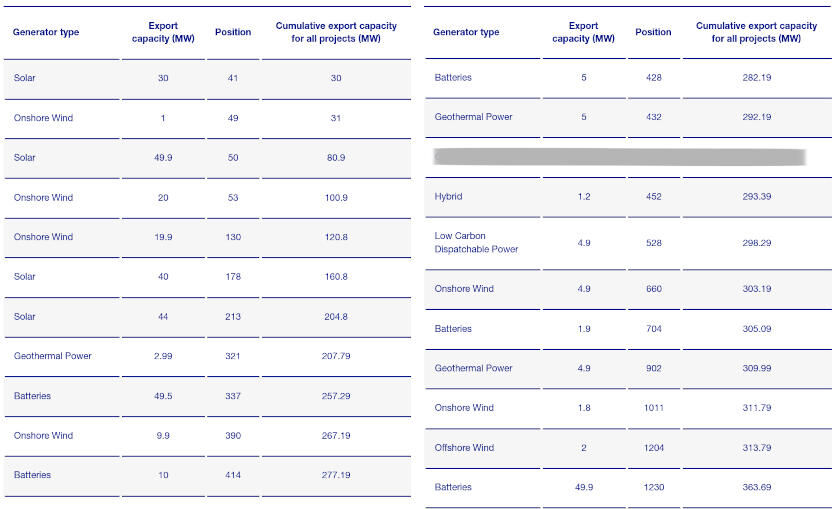
Most of these will physically be connected at lower-voltages on the grid, rather than directly at this location.
However, the cumulative total shows the potential maximum power which this location might be presented with.
Some details are deliberately omitted for security and confidentiality reasons.
3: The Guardian article states that National Grid (NGET) have been told by NESO to take a supergrid transformer out of use during summer 2026.
That isn't an action instigated as a response to over-supply. Exporting more to overseas wouldn't alleviate the situation.
The problem in the West Country is lack of Reactive Power support.
Almost all the generation sites in Cornwall and Devon are connected to the grid using inverters. At the time they were ordered and installed there was no requirement for these to be "grid forming". Therefore they do not provide the necessary Reactive Power handling.
Reactive Power forms part of the mechanism by which NESO controls supply and demand on the grid. When there is insufficient Reactive Power capability, the grid becomes unstable in that region. It can suffer rapid Rate of Change of Frequency (RoCoF), which is a parameter measured by the grid operations room.
Reactive Power is usually provided to the grid by rotating turbines and flywheels.
There is such a concept of 'having too much solar' in a region. The West Country is now experiencing that.
DESNZ have continued to encourage more solar farms to be constructed, regardless of the potential for having too little Reactive Power support. NESO may not reject further applications for solar farm connections in the region.
On Thursday (16th July) Cornwall Council Planning Committee will discuss application PA24/05312 from EDF Energy for another 49.9MVA solar farm at Trelion. It would be competing with Derril Water for access to Route-K of the grid.
Save energy... recycle electrons!
1
13/07/2026 11:14 am
Are planners able to mandate co-location of BESS for new solar sites, and would that help solve the GRID issues by effectively turning them into a steady 24h predictable supply.
No.
Neither a Council Planning Committee, nor the grid operator may instruct an Applicant what power mechanism they wish to install.
In any case, BESS also uses inverters to connect to the grid.
That doesn't provide a solution to the lack of Reactive Power support.
Save energy... recycle electrons!
1

13/07/2026 12:19 pm
@jamespa You may or may not be aware but: Ripple Energy were the architects of the individual co-ops for the four energy projects; two wind farms were set up and are still running. The third co-op is Derril Water Solar Farm and the fourth (another wind farm) project collapsed and Ripple Energy went into receivership. As an aside, I recouped my investment in the fourth project via Section 75. DWSP was in take-off mode at the time but was delayed on the runway. As a co-op, it is independent of the parent company; however, at that stage there was very little if any management and it fell to co-op members to volunteer as managers. Other than to say that various mishaps occurred after this stage had been reached, I will say no more at present. Regards, Toodles.
My experience of green energy investing isn't great. I invested in Secured Energy Bonds, another solar scheme, one of the many mini bond failures generally.
After years of complaints via the FOS and FSCS we got all our money back with interest (due to issues with the original promotional material approved by a FCA regulated company)
I now stay clear of green generation investments..
This post was modified 3 months ago by Jeff

13/07/2026 12:35 pm
In France we had such scheme with wind turbines.
Investors own a share of the wind turbine, and cash in a share of the profits, but an overlooked detail was that investors are left holding the bag when it comes to dismantling the installation at the end of its useful life and restoring the site. These costs are ruinous, and the deal amounts to nothing more than the builder taking their profit and passing the hot potato to clueless victims.


13/07/2026 1:22 pm
Institutional investors have not faired much better. Of the 3 solar funds listed on the FTSE stock exchange, Bluefield Solar Fund (BSIF) launched in 2014 at £1.00 and is currently under offer to be bought by Drax for 92.5p at a capital loss of 7.5% in 12 years. Foresight Solar Fund (FSFL) also launched in 2014 at £1.00 and currently trades at 72.5p (27.5% loss over 12 years), and NextEnergy Solar Fund (NESF) which also launched in 2014 at £1.00 trades at 47p giving a staggering 53% capital loss in 12 years. Even after dividends reinvested, a 20 year risk-free gilt would return more than some of these funds. Why would anyone currently invest money in renewables in the UK?
Most of these losses have been precipitated in the last 4 years due to rising interest rates and changes to government policy such as increases in corporation tax, the introduction of windfall taxes (Energy Generator Levy) and changes to CPI inflation measures from RPI. This uncertain investment environment just means investors will want even higher (potential) returns for the risks they are being asked to take, which further drives up electricity prices for all of us. Despite Ed being pro-renewables, government fiscal policy is not helping investment in renewables, as is very clearly reflected in investor sentiment towards the aforementioned renewables funds. Markets price risk and reward, and it's not a great picture presently with little sign of inflation and interest rates falling to the BoE target, and is set to get a whole lot worse if Reform are elected and renege on AR7/8 contracts as per their manifesto.
This post was modified 3 months ago 4 times by Old_Scientist
Samsung 12kW gen6 ASHP with 50L volumiser and large radiators. 7.2kWp solar (south facing), Tesla PW3 (13.5kW). Net Zero

13/07/2026 1:34 pm
Hopefully if the Reform lot don't get defeated by a man with a bin on his head then the energy suppliers will have the guts to simply turn off and stop bidding on UK power provision if they renege on AR7/8.
There is lots of money to be made on renewables but the old adage "In a gold rush sell shovels" is still true.
13/07/2026 1:41 pm
Hopefully if the Reform lot don't get defeated by a man with a bin on his head then the energy suppliers will have the guts to simply turn off and stop bidding on UK power provision if they renege on AR7/8.
There is lots of money to be made on renewables but the old adage "In a gold rush sell shovels" is still true.
If Reform were to win, I suspect that many of the AR7/8 projects simply won't ever get built. The treat alone is probably enough to delay construction. Which the climate change skeptics and FF lobby may see as a victory.
This post was modified 3 months ago by Old_Scientist
Samsung 12kW gen6 ASHP with 50L volumiser and large radiators. 7.2kWp solar (south facing), Tesla PW3 (13.5kW). Net Zero
17/07/2026 1:24 pm
Yesterday, Thurs 16th July, the Planning Committee for Cornwall Council (unitary authority) voted against the advice of their officers, and rejected an application from EDF Energy to build another solar farm in the county.
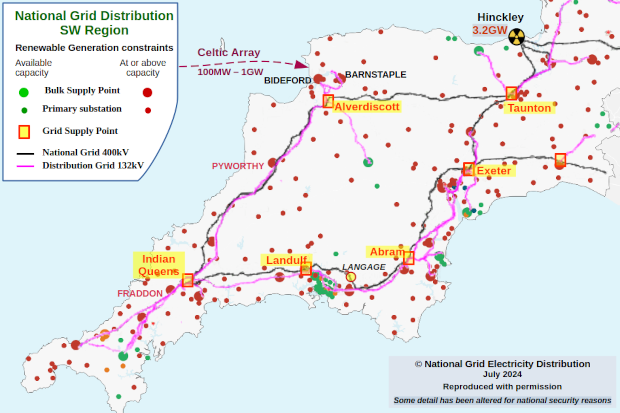
EDF's proposals for Trelion Solar with a 47.5MW connection to the grid at Indian Queens would've added yet more solar to the grid on the same Route-K where Derril Park and other generation sites have been instructed by NESO that they must not export anything.
The Shadow Secretary of State for ESNZ, Claire Coutinho MP, is separately pursing instability in the electricity network, in particular on Tues 23rd June 2026.
See the (interim) Hansard transcription of the debate on NESO and the risk of blackout from Weds 15th July.
As I write, the full Hansard record for the day is not yet available from its usual location in the online Parliamentary library.
As you would expect, the depth of understanding by MPs on what denotes the grid being 'unstable' isn't great.
I will suggest that concentrating on the frequency falling to 49.8Hz isn't a good measure of the severity of the problem!
That's well within the Statutory Limits.
The Grid Operations Control room would normally respond to the Rate of Change of Frequency (RoCoF) rather than the absolute value in Hz.
The issues to take note of are these:
- did NESO need to take emergency actions on grid instability on Tues 23rd June, caused in whole or in part by a lack of Reactive Power support?
- did <someone at NESO> request that those emergency actions were 'covered up' (not made part of the record) in order to protect their reputation?
The Government replies are given by Michael Shanks MP, Minister of State at DESNZ, whose stance can be summed up with this quotation (column 941-942):
[...] electricity supplies were maintained throughout the June heatwave. No customer demand was subject to disconnection. Statutory frequency limits were maintained throughout the event, and the largest credible loss that could have occurred was also covered. Let me explain exactly what we mean by the margin in this instance. The margin represents the cushion of spare generation above the peak demand that is maintained by NESO, and at no point did we come close to breaching that. It did not indicate any kind of emergency situation. Demand was met, and those are the facts.
You will note that those Facts do not address whether the grid was stable, nor what was the root cause for which NESO implemented emergency measures.
The importance of Derril Solar Park being instructed to remain idle this summer is that it has little to do with grid capacity or Supply & Demand.
National Grid could upgrade the entire South West Transmission Grid with expensive larger copper conductors, but the generation sites along Route-K (Indian Queens to Alverdiscott) would still not be exporting in summer'26.
The key piece of information here is the NESO request for more Reactive Power services on 5th June. This is directly linked to the instruction that Derril Park and others may not export to the grid. I've had that confirmed by a senior National Grid engineer.
Inverters which supply the grid from solar farms, wind turbines and BESS (battery storage) don't provide Reactive Power handling because they're not rotating turbines. That's the principle reason why Derril Park is offline.
Without sufficient Reactive Power, NESO can't operate the grid. Reactive Power forms part of the mechanism by which NESO controls voltage and current-flow on the grid. When there is insufficient Reactive Power capability, the grid becomes unstable in that region.
Put in simplistic terms, the electricity generation which is being scattered across the West Country hilltops is the 'wrong' type.
You can indeed have too many solar farms and BESS in a region...
... and that's the situation we've now reached in Cornwall and Devon.
Save energy... recycle electrons!
2


17/07/2026 1:38 pm
Yesterday, Thurs 16th July, the Planning Committee for Cornwall Council (unitary authority) voted against the advice of their officers, and rejected an application from EDF Energy to build another solar farm in the county.
Was this on grounds of grid capacity(your post hints that this may be the case) and if so is grid capacity a material consideration in planning law (I don't know for certain but it seems unlikely that it would be).
No need to answer that but if the answers are yes and no respectively then the developers are likely to appeal and win the appeal.
Presumably it's neso that has the responsibility for technical planning of these matters, do they have powers to prevent connection, do they have powers not to buy the energy. Basically how is this aspect of grid planning actually supposed to work, or has it been designed as a free market (or worse as an opportunity for industry to exploit the taxpayer/customer).
This post was modified 3 months ago 4 times by JamesPa
4kW peak of solar PV since 2011; EV and a 1930s house which has been partially renovated to improve its efficiency. 7kW Vaillant heat pump.

Topic starter
17/07/2026 1:59 pm
- @transparent Thank you very much for that explanation - there is a great deal to be resolved obviously (charged against our standing charges I suppose.) Regards, Toodles.
Toodles, heats his home with cold draughts and cooks food with magnets.
1
17/07/2026 2:44 pm
Was this on grounds of grid capacity(your post hints that this may be the case) and if so is grid capacity a material consideration in planning law (I don't know for certain but it seems unlikely that it would be).
No. Even if Members of a Planning Committee believed that there was substantial excess generation in the area, they are very unlikely to state that as a reason for rejecting an Application. The Council's legal officer would indicate to the Chair that such an observation is not regarded as 'material' under the rules.
I have deliberately not been in direct communication with Councillors who sit on the Planning Committee in order to avoid placing them in a position which would influence a Decision or a future Appeal.
Although I don't live in Cornwall, I have spoken with others who would be affected by the Application, including Councillors.
There is a feeling that Planning Regulations do not provide the appropriate tools for a proper assessment of applications for energy sites.
If Councillors did understand the underlying science, and believed that approving an Application would
- provide no benefit to residents in the area
- increase the risk of outages
then they are likely to vote against the Application, but might indicate that they did so for other reasons, such as the use of agricultural land in categories 1-3.
NESO and DESNZ need to get a grip on this problem. At the moment they don't provide any submission which would help Councillors during the planning process.
An Applicant might claim that they already have an Offer to Connect to the grid from the DNO, and NESO won't confirm or deny whether that Offer has passed through Gate-2 of their Connections Reform process. Councillors are left completely in the dark.
As we can see demonstrated by the the fact that many generation sites have had their export ceiling reduced to zero, NESO is content to sit on the fence.
It will allow grid connections to proceed whilst simultaneously knowing that they will need to dramatically curtail electricity output when wearing its other hat of Grid Operator. No one knows what agreements and compensations might apply because those are contained within confidential contracts.
I'm unhappy at this present position. It lacks transparency and allows NESO to act without oversight.
If accepting another generation or storage site connection is likely to decrease Reactive Power support in the area, then NESO should state this openly at the Planning Application stage. The LPA could then insert a Planning Condition requiring the Applicant to install Power Factor Correction (PFC) equipment as part of their installation, commensurate with an engineering recommendation from the DNO or the Transmission Grid Operator.
Note: PFC is basically a capacitor or a flywheel. The latter has the added benefit of also increasing system inertia.
If NESO stated this as a requirement, then they could also make it a condition that the PFC remained connected to the grid and operational, even if the generation from that site were curtailed to Zero. Ie the PFC would become an asset which NESO could call on to ensure stability.
This post was modified 3 months ago by Transparent
Save energy... recycle electrons!
2
17/07/2026 3:08 pm
This 'story' is indeed fast moving.
NESO has just released two News Updates which are relevant:
Management of Frequency during extreme weather, week commencing 22nd June
Statement on Electricity Systems Operations, general release via LinkedIn
The former is issued by Craig Dyke, Director of Operations at NESO.
He wasn't in the Grid Operations Room on Tuesday 23rd June - the date highlighted by Claire Coutinho MP (see above)
I can be certain of that because we were both at the same NESO Workshop in Somerset! 😎
When previously working for National Grid ESO, Craig authored the technical report on the East of England Outage of 9th August 2019.
This post was modified 3 months ago by Transparent
Save energy... recycle electrons!

SPONSORS

Degrees of Separation
Latest Posts
-

RE: How will removing the standing charge on gas bills benefit heat pumps?
I'm not sure it makes much of a difference to heat-pump...
By Temperature_Gradient , 1 hour ago
-
@editor Ouch, sorry to re start the tick. I had assume...
By DavidB , 2 hours ago
-
RE: Say hello and introduce yourself
@e-a-west as the good Major said, welcome to the forums...
By Mars , 4 hours ago
-
RE: New Build 3 Phase or 1Phase
We are on three phase power because it's an enormous li...
By EtchedPixels , 4 hours ago
-
RE: How much of your renewable and home setup would still work if the internet went down?
Yes I actually have a copy of a tool that whenever a ce...
By EtchedPixels , 13 hours ago
-
RE: Indevolt Batteries UK Support & Info Thread
@editor Hi, To resolve this, please tap on the A...
By Indevolt Tech , 20 hours ago
-
RE: Double or Triple Glazed Windows?
Posted by: @singlespeed With 9 years repairing windo...
By Rob of York , 1 day ago
-
@transparent we’re still running a secure version of PH...
By Mars , 2 days ago
-
RE: How quickly would you want/expect heat recovery to take from setback?
Much longer than that here. The heating isn't even on. ...
By bobflux , 2 days ago
-
RE: Passiv Smart Thermostat - Help & Forum Support
Obviously the weather is changeable but there's a defin...
By Singlespeed , 2 days ago
-
RE: The Changing Jet Stream Could Challenge UK Air Source Heat Pumps
@rob-of-york I must admit that when we had a Daikin hea...
By Toodles , 2 days ago
-
RE: Forum updates, announcements & issues
Get the Renewable Heating Hub heads-up on WhatsApp. I...
By Mars , 2 days ago
-
RE: Safety study for plug in batteries out to tender - looks like Q3 2027 at best before legal
@editor I pointed out to the one of the Fuse execs that...
By dansus , 2 days ago
-
RE: 15kw pump for 225m2 1990's house - over kill?
@seaviews As well as loft insulation, there are othe...
By Rob of York , 2 days ago


SPONSORS