

Notifications
Clear all
Joining the Renewable Heating Hub forums is completely free and only takes a minute. By registering you’ll be able to ask questions, join discussions, follow topics you’re interested in, bookmark useful threads and receive notifications when someone replies. Non-registered members also do not have access to our AI features. When choosing your username, please note that it cannot be changed later, so we recommend avoiding brand or product names. Before registering, please take a moment to read the Forum Rules & Terms of Use so we can keep the community helpful, respectful and informative for everyone. Thanks for joining!
Solar Photovoltaic (PV)
53
Posts
11
Users
25
Reactions
6,852
Views

17/07/2026 3:20 pm
There is a feeling that Planning Regulations do not provide the appropriate tools for a proper assessment of applications for energy sites.
I can understand this but am not sure that the purely technical issues should sit with development management at all. Councillors and council officers are not equipped to deal with such matters and they anyway have an impact beyond the local area. To my mind the purely electrotechnical issues should lie with National Grid/Neso, possibly as.a statutory consultee to the planning process or as a separate product cess.
If accepting another generation or storage site connection is likely to decrease Reactive Power support in the area, then NESO should state this openly at the Planning Application stage. The LPA could then insert a Planning Condition requiring the Applicant to install Power Factor Correction (PFC) equipment as part of their installation, commensurate with an engineering recommendation from the DNO or the Transmission Grid Operator.
That makes sense, but the planning authority wouldn't be able to do this if grid capacity is not a material planning consideration.
On balance it seems to me that the electrotechnical issues might be best sitting outside (and thus in parallel with) planning law, dealt with by an organisation (presumably neso) with the specific remit and skills.
As we can see demonstrated by the the fact that many generation sites have had their export ceiling reduced to zero, NESO is content to sit on the fence.
Does that matter. Or put another way does anyone lose other than the investors who have knowingly taken a risk which may or may not pay off, as is common with investments of all types. Provided of course neso were transparent at the time they were asked with the best info to hand. This isn't a precise or entirely predictable problem so there are bound to be some problem cases.
This post was modified 3 months ago 4 times by JamesPa
4kW peak of solar PV since 2011; EV and a 1930s house which has been partially renovated to improve its efficiency. 7kW Vaillant heat pump.

Topic starter
17/07/2026 3:39 pm
@jamespa (Admission: I have invested in Derril Water Solar Farm and am not in any way impartial in this discussion). I feel that with all the talk, research, expert’s discussions, schemes to promote NetZero etc. it is sheer madness to allow generation equipment to be built but not used. There is something rotten in the system if permission can be granted for schemes costing £Millions that are intended to provide clean energy but before they commence to provide this clean energy, it is suddenly realised that the existing infrastructure will not allow for the generation. (Gets down from soapbox and stows it away under the chair.) Regards, Toodles.
Toodles, heats his home with cold draughts and cooks food with magnets.
1
17/07/2026 3:48 pm
@jamespa (Admission: I have invested in Derril Water Solar Farm and am not in any way impartial in this discussion). I feel that with all the talk, research, expert’s discussions, schemes to promote NetZero etc. it is sheer madness to allow generation equipment to be built but not used. There is something rotten in the system if permission can be granted for schemes costing £Millions that are intended to provide clean energy but before they commence to provide this clean energy, it is suddenly realised that the existing infrastructure will not allow for the generation. (Gets down from soapbox and stows it away under the chair.) Regards, Toodles.
I understand what you are saying but if we don't build facilities that are, as a minimum, not fully used, the inevitable consequence is that there will be insufficient supply, because we can't get the sums precisely right several years in advance. The public won't tolerate that easily and so there is some sort of trade off to be done which almost inevitably involves underused capacity.
I am sorry this investment hasn't so far worked out for you personally. The risk must have been known to the promotors, at least qualitatively. Whether they chose to declare it to investors is of course a whole other question! Is it possible that the proposition was mis-sold or is it alternatively the case that this still has a good chance of making good in time?
This post was modified 3 months ago 4 times by JamesPa
4kW peak of solar PV since 2011; EV and a 1930s house which has been partially renovated to improve its efficiency. 7kW Vaillant heat pump.
Topic starter
17/07/2026 4:19 pm
@jamespa I can understand that predictions of future demand are resting in the properties of a crystal ball but, what must have been apparent at that time was that the energy that would be generated would have nowhere to go! Regards, Toodles.
Toodles, heats his home with cold draughts and cooks food with magnets.


17/07/2026 4:24 pm
What you state @jamespa would be entirely sensible.
The intention was to divide GB into Regions, each of which would have a body called the Regional Energy Strategic Planners. That is clearly stated in the Ofgem document on Local Energy Institutions and Governance released simultaneously with Parliament passing the Energy Act (Nov'22).
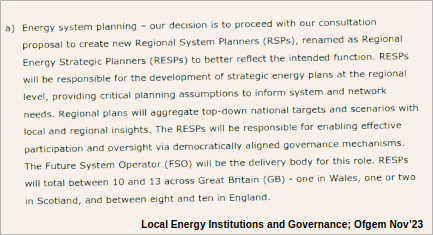
That RESP body would include representatives from Local Government, together with the DNOs for the Region and NESO staff who would have knowledge of the upper level (nationwide) energy strategies. It's the presence of elected Councillors which provides the democratic mandate for their decisions.
Note that NESO didn't exist in name yet, and is referred to as the Future System Operator.
However, by the time Ofgem released it's next Consultation on the RESPs, there are two significant changes:
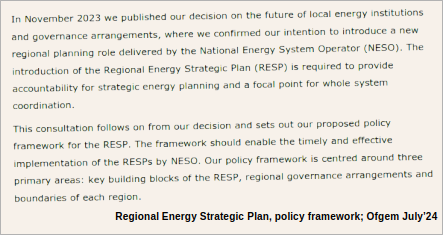
- A RESP is now a document rather than a body of people. The Regional Energy Strategic Plan is to be created using input from Local Actors, including Councils.
- Ofgem has 'instructed' NESO to form the RESPs and implement the process
That leaves NESO without scrutiny by elected Members. The RESP document effectively has similar status to the National Planning Policy Framework (NPPF). Instead of Councillors having responsibilities for energy planning, they are now subordinate to another set of regulations which they must abide by in their Decisions.
There are no RESP documents yet. They can't be written until NESO has completed creating the underlying data-sets, including the Strategic Spatial Energy Plan (SSEP). That won't happen until the end of 2027.
The NESO regional staff are about to describe what support they will deliver for Local Actors. Some will be invited to form a Strategic Board for each region, with NESO chairing it. Others may be accepted into regional Working Groups to 'advise' the Strategic Board.
NESO is clearly in the driving seat.
Lots of issues remain unclear.
Those include who is responsible for taking the decisions which should be underpinned by good science.
If the Secretary for State says that Government Policy is to encourage and facilitate as many solar and wind generation sites as possible, who is going to say "You can't place it in that area because there isn't sufficient reactive power support".
Save energy... recycle electrons!
17/07/2026 4:27 pm
@jamespa I can understand that predictions of future demand are resting in the properties of a crystal ball but, what must have been apparent at that time was that the energy that would be generated would have nowhere to go! Regards, Toodles.
It sounds like a mis-sell then if that was not declared in the prospectus.
4kW peak of solar PV since 2011; EV and a 1930s house which has been partially renovated to improve its efficiency. 7kW Vaillant heat pump.
17/07/2026 4:36 pm
what must have been apparent at that time was that the energy that would be generated would have nowhere to go!
That isn't the dominant factor in the case of Derril Water and its neighbours on the 132kV Route-K.
It isn't a matter of supply & demand, whatever the Minister of State says.
The issue which caused those sites to cease generation is an instruction from NESO. It's based on a technical requirement to have enough Reactive Power support in a geographical area.
Note that the MPs (in Hansard) have only been talking about the national picture.
The same is the case for the News Release from NESO earlier today.
It's the geographical information which we need to notice in the Request for Reactive Power support from NESO, dated 5th June.
They needed Reactive Power in the South West.
That's the same region where solar export has been shut down.
That's not a coincidence.
This post was modified 3 months ago 2 times by Transparent
Save energy... recycle electrons!
1
Topic starter
17/07/2026 4:49 pm
@transparent But, But should they not have known about the need for stability provided by Reactive Power support at that time? Surely the laws of physics haven’t changed in that time? Sorry to harp on about this but aren’t there experts who would have been consulted on projects like this? Regards, Toodles.
Toodles, heats his home with cold draughts and cooks food with magnets.
1


17/07/2026 5:47 pm
As we can see demonstrated by the the fact that many generation sites have had their export ceiling reduced to zero, NESO is content to sit on the fence.
Does that matter. Or put another way does anyone lose other than the investors who have knowingly taken a risk which may or may not pay off, as is common with investments of all types. Provided of course neso were transparent at the time they were asked with the best info to hand. This isn't a precise or entirely predictable problem so there are bound to be some problem cases.
In my opinion, yes that does matter.
Any situation that lends itself to developers taking investors' money and then claiming circumstances outside their control for not paying money back to the investors is a situation ripe for fraudulent exploitation. I'm not suggesting anything like that has gone on here but I believe there really should be some safeguards within the planning process that ensure any approved project stands at least a reasonable degree of feasibility for doing what it claims to be trying to do. Current planning approval simply seems too fragmented and "well investors knew it was a risky undertaking", however true, should not be used as an excuse.
105 m2 bungalow in South East England
Mitsubishi Ecodan 8.5 kW air source heat pump
18 x 360W solar panels
1 x 6 kW GroWatt battery and SPH5000 inverter
1 x Myenergi Zappi
1 x VW ID3
Raised beds for home-grown veg and chickens for eggs
"Semper in excretia; sumus solum profundum variat"
17/07/2026 7:30 pm
But should they not have known about the need for stability provided by Reactive Power support at that time?
I knew that Reactive Power support was required by the grid operator.
It was explained to me many years ago by the senior engineer at a hydro-electric plant I visited.
He also told me that his turbine sets could continue to provide Reactive Power support if he left them idling, but not actually feeding power to the grid.
That was an eye-opener. It meant that the Grid Operator could pay for Reactive Power support independently of the electricity itself. I don't know if that actually happened. I confess I was far more interested in the physics than the finances.
I wonder who you mean when you write should they not have known...?
NG-ESO obviously knew, and all those on the operations side of NESO must know.
They use Reactive Power support within the strategy for voltage control.
I wonder now why it was that NESO didn't explain the situation to the 100-odd attendees at their SW Regional in-person workshop on 23rd June.
It was at an NGED meeting a week later that it first occurred to me there could be a link between Derril Park ceasing all export and the request for Reactive Power support from NESO. That's why I was able to ask direct questions of a senior engineer.
The problem with these workshops is twofold:
1: The Agenda is set in advance by the Energy Company (NESO or NGED in this instance) and they decide which platform speaker will deliver what message.
2: I am on a discussion-table where the attendees come from a variety of backgrounds. Very few have any appreciation of technical issues.
There might be a Councillor or Council Officer who has responsibility for the Climate Change policies and initiatives. That could be anything from a policy to change Council vehicles to electric-power, or holding meetings of Community Energy enthusiasts.
There might be someone from a transport company, a regional airport or a large hospital.
And there's likely to be a lecturer or facilities manager from a university.
I have no idea how NESO imagines it can use that starting point to pull together a Strategic Board and advisory work-groups who could create a competent regional energy plan.
From my viewpoint there does need to be strategy, but I can't see how any combination of the attendees at these workshops would have the clout to tell Derril Water "There's insufficient Reactive Power support in the area for your proposal. Either you need to invest in grid-forming inverters, or else you require a binding commitment from the DNO that they will install sufficient PFC apparatus rather than merely offer you a grid connection."
The present situation of covering the countryside with solar-panels, wind turbines and battery storage (BESS) which aren't permitted to export is frankly ludicrous.
This post was modified 3 months ago by Transparent
Save energy... recycle electrons!
Topic starter
18/07/2026 8:50 am
@transparent I think that all parties should have been aware of the need for reactive power and stability of frequency etc. Ripple Energy ought to have exercised due diligence at the planning stage and I would have thought that NGED and NESO and all the other forgettable initials would have been bound to inform RE that without such measures, their plans would be frustrated. I know we don’t live in a perfect world, but surely, in such circumstances where large projects involving £Millions are involved, this research is essential to the success of the scheme. Regards, Toodles.
Toodles, heats his home with cold draughts and cooks food with magnets.
1
18/07/2026 11:02 am
I hear you, @toodles
At present there doesn't seem to be any 'body' who takes responsibility for ensuring that forthcoming generation sites are added to the electricity network in such a way that security of supply is assured.
Instead, NESO found themselves needing to take urgent action to remove generation from sites which had already
- been through the planning process
- been given an Offer to Connect
- installed the on-site physical hardware
- paid the DNO to implement the connection
- started exporting to the grid
Since such urgent action was required by NESO, I think we should categorise this as a National Security issue.
IF it were the case that the RESP was a body of people, and that it included elected representatives, then I'm going to suggest that they should accept responsibility for that critical oversight. The presence of Councillors (or even MPs) could ensure that the RESP meetings were open and their decisions were transparent.
However, it is Ofgem, the Regulator, who moved the goal-posts.
Ofgem has placed NESO in a position where they don't have elected representatives.
It is Ofgem themselves who ensure that NESO act independently and transparently.... and Ofgem can't receive complaints directly from the public.
Ofgem confines itself to regulating those organisations to whom it issues licences.
I am a participant in the RESP process...
... and in the same geographical area where Derril Water exists.
I do have sufficient grasp of the technology to understand the underlying concepts.
I am well aware of other large-scale applications for more solar and BESS in the region, and also seeking connections to Route-K.
So if you were in my position, what would you do next?
Save energy... recycle electrons!
SPONSORS

Degrees of Separation

Latest Posts
-

RE: Heat pump branding. Clever, contemporary… or a bit too much?
I think Heat Geek have done an amazing job on their bra...
By Tomtheheatingengineer , 7 hours ago
-
RE: HeatGeek vs Octopus surveys: puzzling disparity - any ideas why?
I have just had 3 heat loss surveys, one by heat geek o...
By David , 7 hours ago
-
RE: Heat Geek Zero Disrupt: Are We Sleepwalking Into Another Race to the Bottom?
I think that's the key question. After all inverter uni...
By Prunus , 9 hours ago
-
RE: battery storage without solar
As of October 1st they need specific qualifications to ...
By EtchedPixels , 10 hours ago
-
RE: How should the Boiler Upgrade Scheme be reformed?
A unit which uses water to transfer the heat/chill from...
By Temperature_Gradient , 10 hours ago
-
RE: Renewables & Heat Pumps in the News
With regards to the BUS grant raid, I gave it more thou...
By ASHP-BOBBA , 10 hours ago
-
RE: Why are ASHP installs so expensive?
The whole system seems to work on the basis of...
By ian33a , 11 hours ago
-
RE: Missing flow temperature in Heat Geek proposal
Good plan. If you can get half hourly meter readings a...
By JamesPa , 16 hours ago
-
RE: Heat Pumps Without Grants: Would You Have Installed One & Will You Now?
@editor Most certainly. The heat pump was an ideal s...
By Abernyte , 16 hours ago
-
Although regulations may well vary from country to coun...
By Majordennisbloodnok , 17 hours ago
-
RE: Does anyone have experience of a smart water meter?
Yep I caught our slow leak from a £100 bill rise 8)
By EtchedPixels , 17 hours ago
-
RE: Do You Need a Buffer Tank or Low Loss Header for Underfloor Heating in a Large Property?
@jamespa in some cases, failing the Turing test might b...
By GrahamF , 20 hours ago
-
RE: Passiv Smart Thermostat - Help & Forum Support
@energystoragetech The heat capacity of some...
By JamesPa , 22 hours ago
-
RE: tepeo ZEB UK Support & Info Thread
Sorry you are correct, I was remembering figures from t...
By JamesPa , 1 day ago


SPONSORS

