

Notifications
Clear all
Joining the Renewable Heating Hub forums is completely free and only takes a minute. By registering you’ll be able to ask questions, join discussions, follow topics you’re interested in, bookmark useful threads and receive notifications when someone replies. Non-registered members also do not have access to our AI features. When choosing your username, please note that it cannot be changed later, so we recommend avoiding brand or product names. Before registering, please take a moment to read the Forum Rules & Terms of Use so we can keep the community helpful, respectful and informative for everyone. Thanks for joining!

Topic starter
27/06/2026 8:56 pm
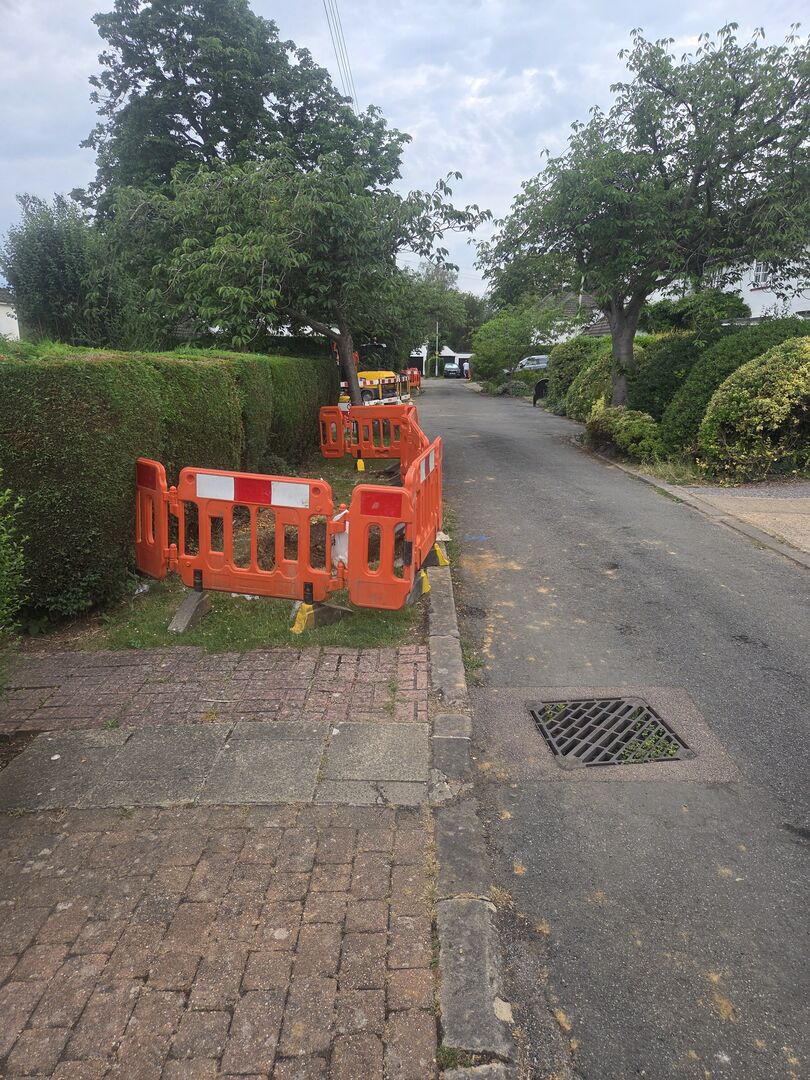


All the pipes up to the meter replaced for all houses.
All the meters moved outside to the front of the properties.
3 pictures of our cul de sac, but the whole area being done with lots of digging!
However I honestly doubt we will ever see hydrogen?
Not without incident as they cut through the electricity supply to our house in the road...
This topic was modified 4 months ago by Jeff

27/06/2026 10:45 pm
I'm sorry to say but everything I can find out about 'hydrogen ready' says that's is a scam by the fossil industry to extend it's lifetime further.
How is a technology that has a conversion efficiency from electric energy to heating energy of about 70% ever going to.compete with one that has a conversion efficiency of 300-400%?
Hydrogen has a role in applications where a real time electricity supply isn't an option, but it has no material role in domestic heating.
The government will need to do due diligence before dismissing it, in order to avoid being sued by rich fossil companies (with the support of an orangeman) just as it needed to do due diligence before proceeding with plug in solar, but the outcome is inevitable unless it takes more than 3 years to get to the point of rejecting it and the next government, like the current US Government, doesn't care about facts (which, sadly, is entirely possible).
This post was modified 4 months ago 2 times by JamesPa
4kW peak of solar PV since 2011; EV and a 1930s house which has been partially renovated to improve its efficiency. 7kW Vaillant heat pump.

27/06/2026 11:34 pm
Hydrogen has a role in applications where a real time electricity supply isn't an option, but it has no material role in domestic heating.
A lot of science and studies are questioning even that. It's just so dangerous, so voluminous for a given energy and so annoyingly good at escaping and damaging materials that it's not usable. Even shipping which is the classic "large not grid attached" case the only uses for hydrogen being trialled are burning stuff made with hydrogen and other materials not hydrogen on its own.
All the rail pilots have been dismal, hydrogen buses have tanked and even HGVs are going electric.
It also sucks as a storage medium - poor efficiency, horrific safety risks.
It's great for some industrial processes and we need it to make some fertilizer products so we can stop using methane and steam.
28/06/2026 9:20 am
Hydrogen has a role in applications where a real time electricity supply isn't an option, but it has no material role in domestic heating.
A lot of science and studies are questioning even that. It's just so dangerous, so voluminous for a given energy and so annoyingly good at escaping and damaging materials that it's not usable. Even shipping which is the classic "large not grid attached" case the only uses for hydrogen being trialled are burning stuff made with hydrogen and other materials not hydrogen on its own.
All the rail pilots have been dismal, hydrogen buses have tanked and even HGVs are going electric.
It also sucks as a storage medium - poor efficiency, horrific safety risks.
It's great for some industrial processes and we need it to make some fertilizer products so we can stop using methane and steam.
Interesting, I was trying above to be generous towards the global industrial scum promoting this technology for domestic heating.
Im beginning to think that both the gas and electricity grids should be re-nationalised as a matter of urgency. Then we can stop wasting money on upgrading the gas grid for a future that makes no sense, stop the abomination of centralised control of heating systems to balance the grid, promoted by the industry because it justifies lots of highly profitable investment in infrastructure, and instead spend the money on selective upgrades of the electricity grid only and domestic storage to load balance. Whilst the people in control are motivated solely by profit for their own silos, extracted from the poor to make the rich even richer, we cant make holistic decisions about our critical national infrastructure in the interests of the general public and based firmly on science.
I would be willing to be that the cost of the works @jeff posted about would have bought everyone affected a heat pump and an induction hob, rendering the pipework unnecessary and probably with money to spare.
This post was modified 4 months ago 6 times by JamesPa
4kW peak of solar PV since 2011; EV and a 1930s house which has been partially renovated to improve its efficiency. 7kW Vaillant heat pump.
1


28/06/2026 10:46 am
I think we're still going to try hydrogen for residential heating on a small scale, then walk it back after a few buildings get launched into low earth orbit, hopefully not too many... but let us all spend a solemn minute of silence remembering SOLAR ROADWAYS which actually got built at a cost of tens of millions of taxpayer money, in spite of all the unanimous calculations that proved it could never work...
We have been massively subsidizing "renewables" with feed in tariffs, which reduces the profitability of stuff that actually works and we actually need (ie, nuclear) while thankfully increasing the profitability of other stuff that works (ie, hydro and pumped storage), increasing fossil consumption (see Germany lol), and also making electricity unaffordable and the grid less stable. Result is, to compensate for this renewable retardation, I had to install 12kW PV 🤣 🤣 🤣 🤣
The situation is the same in France, perhaps even more ironic, since we had a decarbonized grid with tons of nuke to start with, it worked absolutely fine, and the greens almost wrecked it 🤣
Always compost your greens.
Remote control of big consumers like heating systems and EV charging would not be such a bad idea, in fact it would be quite useful, as it would allow to make better use of nuclear capacity, absorb excess renewables, and stabilize the grid. I expect them to spend 10 years scratching their heads then come out with a "design by committee" smart grid API that will be incompatible with all the hardware that will have been installed in the mean time, of course.
28/06/2026 10:53 am
Remote control of big consumers like heating systems and EV charging would not be such a bad idea, in fact it would be quite useful, as it would allow to make better use of nuclear capacity, absorb excess renewables, and stabilize the grid.
As it happens I agree, but the current proposal is centralised remote control which I struggle with. I have no problem with remote control tarrifs that I can choose between, in fact I have one albeit only for my EV
I think we're still going to try hydrogen for residential heating on a small scale, then walk it back after a few buildings get launched into low earth orbit, hopefully not too many...
I do hope not, but sadly the industry may make it impossible for the government to do otherwise. Just observe the recent efforts by a much less powerful industry to stop plug in solar!.
Such a waste of resources, which I would be willing to bet many in government recognise, but are in practice powerless to stop.
This post was modified 4 months ago 3 times by JamesPa
4kW peak of solar PV since 2011; EV and a 1930s house which has been partially renovated to improve its efficiency. 7kW Vaillant heat pump.

28/06/2026 11:52 am
I attended a NESO workshop in Somerset in the middle of last week. Due to their remit to cover all energy developments, hydrogen was one of the fuels which was addressed... as were Distributed Heating networks.
No one was considering hydrogen being sent through the gas network to all houses. The physics of such an approach are daunting. Natural gas based on hydrocarbons has a calorific value above 37MJ/m³, whereas hydrogen is 12MJ/m³. So both pressure and flow-rates would need to increase if sufficient energy (in MJ) were to be supplied to every property.
Discussion about hydrogen was focused on using it adjacent to the location in which it was produced. In the main that means it would be created using electrolysis and then used in Gas Turbine generators. Hydrogen is simply the interim storage mechanism.
This is already being trialed at Langage CCGT plant near Plymouth. The area has massive surpluses of electricity from renewable energy generation using solar and wind-farms. To reduce the amount of excess electricity which gets discarded by the DNO, Langage uses it to produce green hydrogen, which is light to transport and store nearby.
Whilst I'm sure Langage would like to take this trial forward and transport their hydrogen more widely, that is exploratory at this stage.
You may rightly point out that producing green hydrogen using electrolysis is very inefficient.
However, there is another reason this is a serious consideration for the West Country. The vast majority of electricity generation in Devon, Cornwall and Somerset is exported to the grid using inverters. Not only can they fail instantaneously, but they offer no inertia to the grid.
As a consequence NESO have been looking around to find where they can source inertia from rotating turbines because it's needed to balance Reactive Power.
This post was modified 4 months ago by Transparent
Save energy... recycle electrons!
28/06/2026 12:04 pm
Thanks. I also have no problem with Hydrogen produced by electrolysis being used as storage near to the site of production. My only problem is the idea of domestic heating based on piped hydrogen and the complete con that are 'hydrogen ready' boilers, which is clearly a scam/diversion by the fossil industry.
This post was modified 4 months ago by JamesPa
4kW peak of solar PV since 2011; EV and a 1930s house which has been partially renovated to improve its efficiency. 7kW Vaillant heat pump.

28/06/2026 12:58 pm
However, there is another reason this is a serious consideration for the West Country. The vast majority of electricity generation in Devon, Cornwall and Somerset is exported to the grid using inverters. Not only can they fail instantaneously, but they offer no inertia to the grid.
In fact inverters with a bit of local energy storage could also do that, if programmed accordingly. Sadly it doesn't seem the current hardware is programmed to do it.
As it happens I agree, but the current proposal is centralised remote control which I struggle with.
What is the proposal? It'll probably spread across EU and get here too...
28/06/2026 1:02 pm
As it happens I agree, but the current proposal is centralised remote control which I struggle with.
What is the proposal? It'll probably spread across EU and get here too
@transparent will know (and has posted) the detail, so far as I am aware its local to the UK not EU.
4kW peak of solar PV since 2011; EV and a 1930s house which has been partially renovated to improve its efficiency. 7kW Vaillant heat pump.

28/06/2026 1:31 pm
The world is a long way from ‘Hydrogen Ready’, no doubt it should be the future but there are a lot of hurdles to overcome. Not least long term investment … which the UK successive governments have proved themselves brilliant at!
https://www.sciencedirect.com/science/article/pii/S0360319925000382#sec6
Jump to section 8 for a quick view.
28/06/2026 2:07 pm
As it happens I agree, but the current proposal is centralised remote control which I struggle with.
What is the proposal? It'll probably spread across EU and get here too
@transparent will know (and has posted) the detail, so far as I am aware its local to the UK not EU.
See my post here in the topic Delivering a Smart and Secure Energy System (SSES), which is an idea originating in DESNZ.
The governance and preparation of the secure system to dispatch SSES commands is at an advanced stage.
However, there are a couple of issues which may thwart the launch of the SSES Flexibility Service:
1: A change of the Secretary of State for ESNZ
2: The fact that domestic electricity consumption is falling, and the SSES strategy is targeted at domestic heat-pumps for its first iteration
On 27th May’26 Ofgem revised downwards the Typical Domestic Consumption Values (TDCV) which are used to inform the public of the average rise and fall of domestic energy prices. The TDCV reflects the widespread reduction of energy demand. Less generation is required.
On 11th June’26, Simone Rossi, CEO of EDF Energy UK, called on the British Government to pause the approval of more solar farms and wind farms. He asserted that the UK's renewable capacity is already outpacing both transmission grid limits and overall electricity demand, resulting in billions of pounds being wasted on payments to switch off turbines.
"We should stop building wind farms and focus instead on raising demand for
electricity ... As a country we don't need more electricity generation capacity. We need
to use the generation capacity we have already got.
"We've always got it wrong. We've always thought electricity demand was going to
increase, but it decreased ... So now we have this large [generating] infrastructure,
twice as much as we need, which means we also need to build twice the [transmission]
grid."
I don't totally agree with Simone Rossi, but I'd still like Members here to explore more of what he said/wrote.
For example, if the sources of generation were to double, but are sited close to where it will be stored or consumed, then you wouldn't require twice the capacity on the Transmission Grid. That's only required if you need to move large amounts of power elsewhere.
The Great Grid Upgrade being proposed by National Grid Group is being bolstered by Ofgem's TM04+ regulations. In brief, those state that a demand connection may not be rejected on the grounds of
- location: where the applicant wishes to build a data centre, for example
- need: that the applicant's proposal has little benefit to GB PLC
A different SoS for ESNZ could easily reduce future electricity bills by telling Ofgem to tear up their TM04+ rule-book.
This post was modified 4 months ago by Mars
This post was modified 4 months ago 2 times by Transparent
Save energy... recycle electrons!
1
Page 1 / 3
Next
SPONSORS
Degrees of Separation

Latest Posts
-

@etchedpixels I read something about that years ago. I ...
By RonV. , 21 minutes ago
-
RE: Heat pump branding. Clever, contemporary… or a bit too much?
@majordennisbloodnok Those energy pioneers have a lot t...
By Toodles , 37 minutes ago
-
This post is about how I successfully configured a buff...
By Tony.Stolz , 3 hours ago
-
The installer visited yesterday and suggested the noise...
By JamesChatz , 5 hours ago
-
RE: Heat Geek installations: share your experiences
I struggled with this problem as well. An independent t...
By L8Again , 5 hours ago
-
RE: HeatGeek vs Octopus surveys: puzzling disparity - any ideas why?
Your house sounds a lot like mine. 2 surveyors each sp...
By JamesPa , 7 hours ago
-
RE: Heat Geek Zero Disrupt: Are We Sleepwalking Into Another Race to the Bottom?
Thats true only if you do the wrong experiment. Done c...
By JamesPa , 8 hours ago
-
RE: How should the Boiler Upgrade Scheme be reformed?
@temperature_gradient Isn't that just describing a regu...
By Prunus , 8 hours ago
-
RE: battery storage without solar
As of October 1st they need specific qualifications to ...
By EtchedPixels , 21 hours ago
-
RE: Renewables & Heat Pumps in the News
With regards to the BUS grant raid, I gave it more thou...
By ASHP-BOBBA , 22 hours ago
-
RE: Why are ASHP installs so expensive?
The whole system seems to work on the basis of...
By ian33a , 22 hours ago
-
RE: Missing flow temperature in Heat Geek proposal
Good plan. If you can get half hourly meter readings a...
By JamesPa , 1 day ago
-
RE: Heat Pumps Without Grants: Would You Have Installed One & Will You Now?
@editor Most certainly. The heat pump was an ideal s...
By Abernyte , 1 day ago
-
RE: Does anyone have experience of a smart water meter?
Yep I caught our slow leak from a £100 bill rise 8)
By EtchedPixels , 1 day ago




SPONSORS