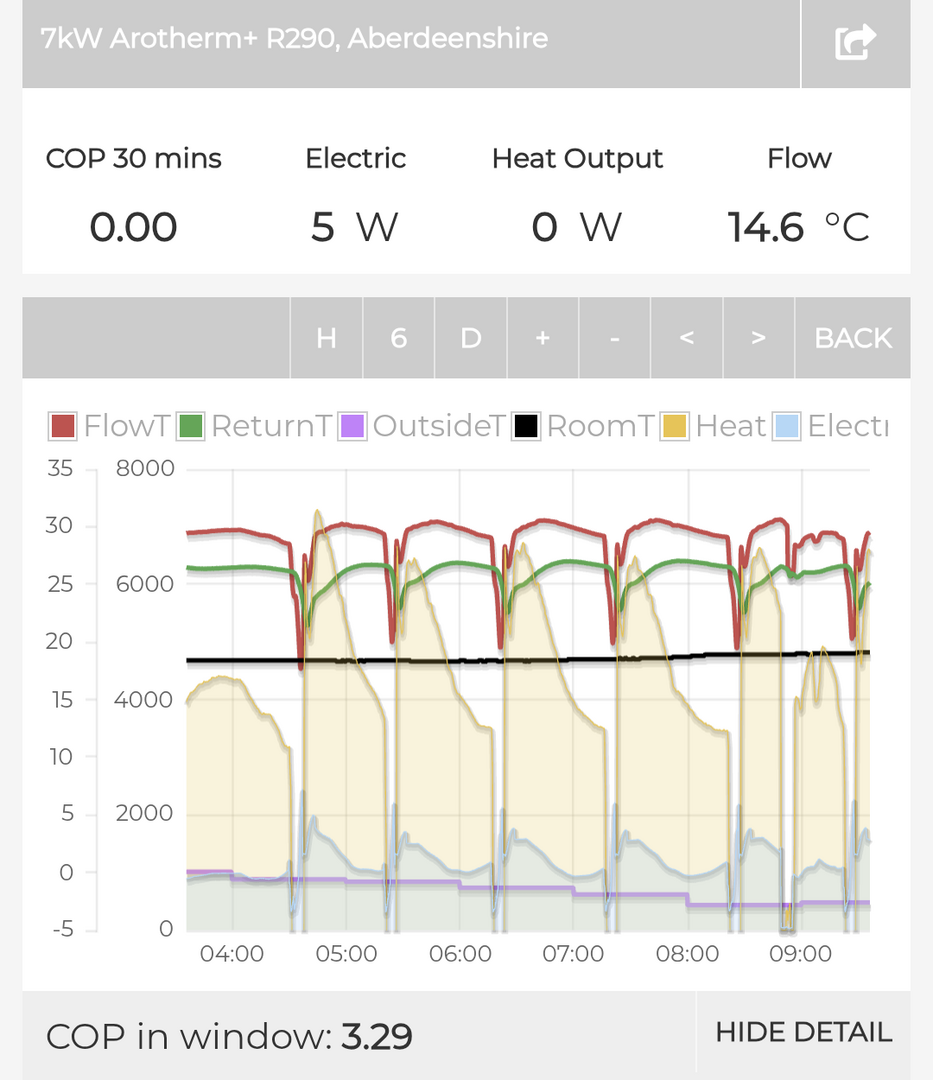
The defrosts look normal except that the flow temp doesnt get back to 31. Yet the gradient of the rising edge is the same as immediately after the defrost and your expanded plot where you explain whats going on shows it level at the top not continuing to rise until the next defrost. Also the temp it reaches starts rising again for the last three of the defrost cycles, which wouldn't obviously be the case if something is 'wrong'.
It is usual for the flow temp to start to drop as a heat pump approaches a defrost, here's a 7kW Vaillant like yours doing the same (if less pronounced):
Also the last three defrosts happened after sunrise and so the OAT would have been higher and that would have allowed the heat pump to achieve the target flow temp, where before the lower OAT prevented it.
The question of why a seemingly oversized heat pump is unable to achieve the target flow temperature could be due to humidity or its handling of the defrost condensate. Both can greatly effect the performance of a heat pump.
Thats an interesting point - @trebor12345 does condensate collect near or under the heat pump or is it drained away.
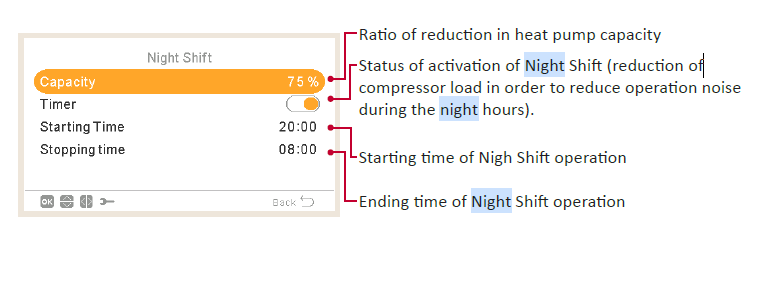
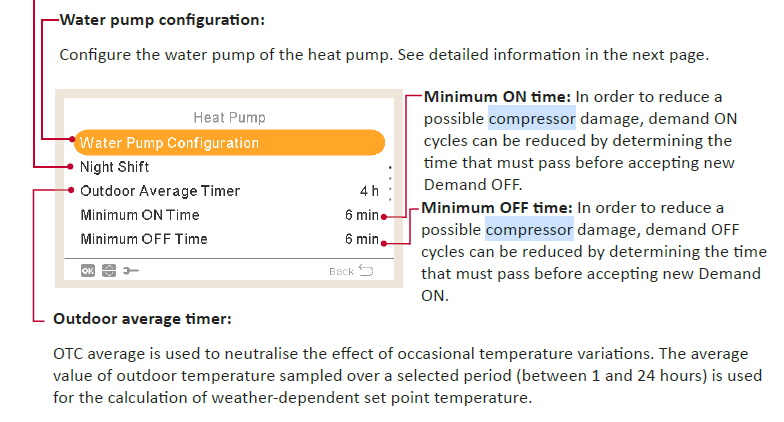
We now know that @trebor12345 heat pump is in noise reduction (hitcahi call it night shift) mode at least part of the time. On my Vaillant NR mode prevents full recovery from defrost.
If my Vaillant is in NR (the equivalent of Hitachi Night Shift) mode it doesnt recover properly from defrost, causing FT to drop about 5C. Very similar symptoms in fact. I have less spare capacity than you but for some reason your defrosts are more frequent, so the two will balancee out (and anyway Im not sure defrost cares that much about spare capacity, the amount of fins that need to be cleared is the same).
Quite possibly this is the explanation for your defrost behaviour.
Is it on 24*7 or only part time? I presume you mean 'capacity' = 80%
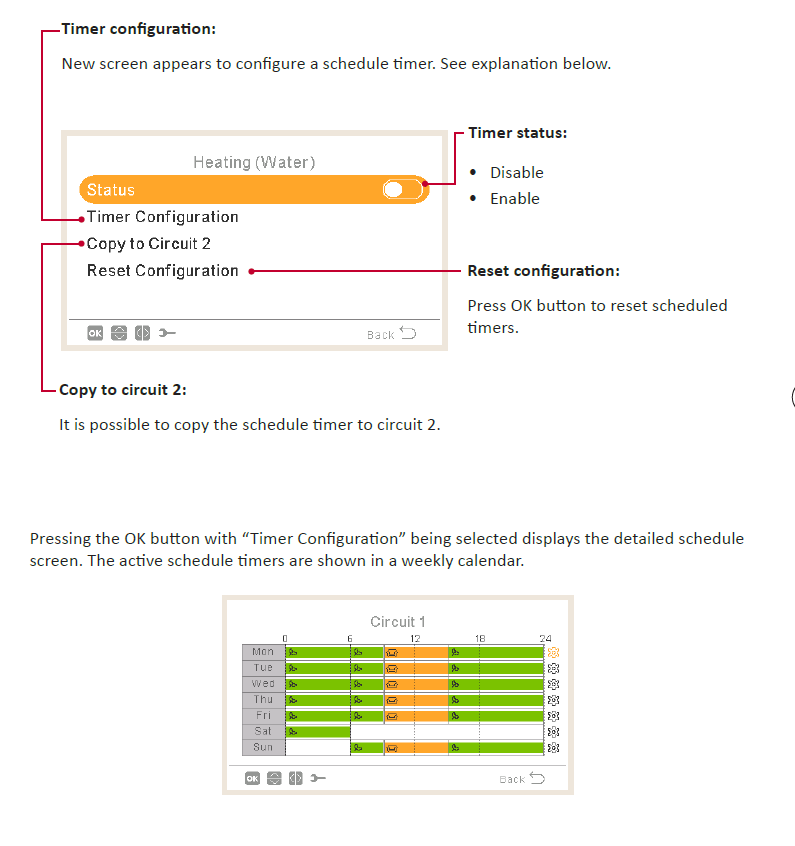
Also it might is worth checking the timer in case its switched to 'eco' mode (basically a setback) for a period.
I think it likely that one or both of these explains your defrost behaviour. Only by changing things and observing the effect can you be certain however.
At this stage I think the question becomes, are you willing to/do you want to start changing things in order to (hopefully) get better stability (which is, I believe, your core problem).
I think its fairly obvious what to do in general terms and I can suggest a starting point from which to tweak. However you will have to change, for example, night shift mode and weather compensation settings and if you aren't comfortable doing that then there is not much more that can be done. Exactly the same would apply to another heat pump.
This post was modified 3 months ago 8 times by JamesPa
4kW peak of solar PV since 2011; EV and a 1930s house which has been partially renovated to improve its efficiency. 7kW Vaillant heat pump.
2024 build bungalow
Southern england 179 m2 High level of insulation Underfloor heating All 12 circuits are fully open all the time 1 thermostat in family room 7KW heat pump 50 litre buffer tank (4 port)
3.6KW solar panels Energy used by heating 2527 KWh - 7527 KWh (SCOP 3.5 approx)
If you put in the first part of the model number it finds relevant manuals. Best to apply a filter for english language
The controller manual is here. Obviously I dont now if you have the exact same controller, but its unlikely to make much difference. If you dont Im sure the manual for your specific controller will be there somewhere
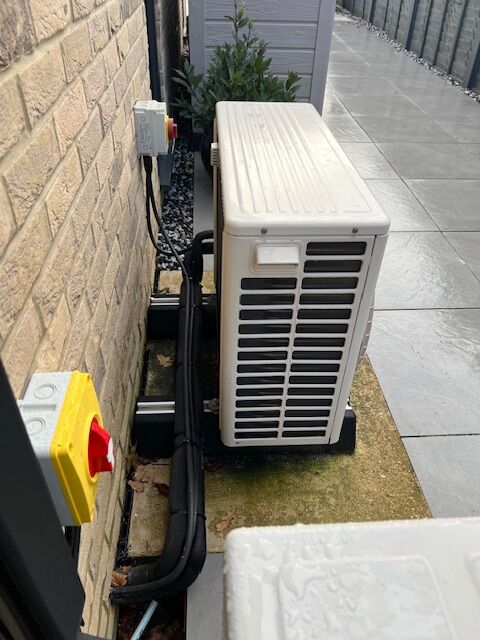
The heat pump sits on a level concrete plinth. There is a black Acro drain against the wall, but being a level plinth its not effective. Water from the HP does accumulate below, but must go somewhere. BTW, and this is sad, I have measured the amount of water that drains from the HP, it's 1 litre for every defrost cycle.
2024 build bungalow
Southern england 179 m2 High level of insulation Underfloor heating All 12 circuits are fully open all the time 1 thermostat in family room 7KW heat pump 50 litre buffer tank (4 port)
3.6KW solar panels Energy used by heating 2527 KWh - 7527 KWh (SCOP 3.5 approx)
You need to create a fall somehow from where the water exits the heat pump. Mine has a drain hole in the bottom of the outdoor unit to which a pipe is connected running to a drain. The pipe has a trace heater running through it to stop it freezing, fed from (and presumably controlled by) the heat pump. No idea how the drain from your unit works, the installation manual for the ODU will say. Builder/installer should have dealt with this!
I doubt this is causing your defrost problem, there looks like adequate clearance. Its just a safety hazard!
4kW peak of solar PV since 2011; EV and a 1930s house which has been partially renovated to improve its efficiency. 7kW Vaillant heat pump.
Yes water from the HP does tend to collect under the unit. There is a drain but its not effective. I will send a picture later.
@trebor12345, a few questions if you don't mind...
Does the water come from drain holes in the bottom of the heat pump or is there a pipe to carry the water to the drain? If drain holes, how many are there and (if you have watched it defrost) how many are actually used? If there is a pipe, is it insulated?
Yes water from the HP does tend to collect under the unit. There is a drain but its not effective. I will send a picture later.
@trebor12345, a few questions if you don't mind...
Does the water come from drain holes in the bottom of the heat pump or is there a pipe to carry the water to the drain? If drain holes, how many are there and (if you have watched it defrost) how many are actually used? If there is a pipe, is it insulated?
Water comes out of 2 holes in the bottom of the heat pump. One in the middle and one to one side.
2024 build bungalow
Southern england 179 m2 High level of insulation Underfloor heating All 12 circuits are fully open all the time 1 thermostat in family room 7KW heat pump 50 litre buffer tank (4 port)
3.6KW solar panels Energy used by heating 2527 KWh - 7527 KWh (SCOP 3.5 approx)
2024 build bungalow
Southern england 179 m2 High level of insulation Underfloor heating All 12 circuits are fully open all the time 1 thermostat in family room 7KW heat pump 50 litre buffer tank (4 port)
3.6KW solar panels Energy used by heating 2527 KWh - 7527 KWh (SCOP 3.5 approx)
Water comes out of 2 holes in the bottom of the heat pump. One in the middle and one to one side.
There is no pipe.
Thanks, if the water can drain out of the heat pump without any issues in sub-zero temperatures then that's one possible issue ruled out.
But if the water doesn't run away and collects under/beside the heat pump then it will increase the humidity around the heat pump which isn't ideal and will increase the frequency of defrosts needed.
As you can see from the picture there is about 4 inches between the HP and the plinth.
It looks like the 2 holes are just holes in the metal casing, no fancy heating.
Noted. Somehow it needs a slope if its causing a problem, if not I wouldn't worry, no need to make work
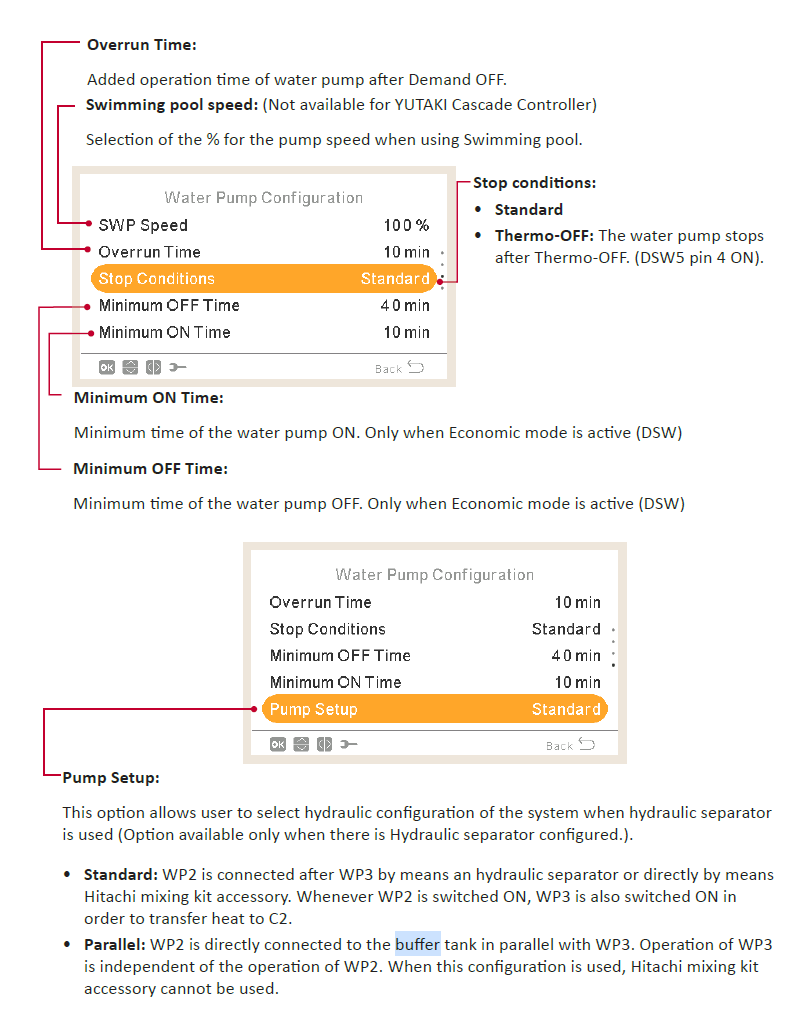
Whilst you are checking things it would be worth checking current values of the three bottom parameters in 'heat pump configuration'.
Also the settings on this page.
All helps build a picture. The hysteresis (4C you said) on the 'thermal off' is, I fear going, to work out too big when the FT is low (ie in warmer weather). No idea exactly where this is set but its in one of these menus! I wouldnt suggest changing it yet but it may need to be changed. When its warm you are likely to be running at an FT of 23-25 to achieve balance of heat lost and heat added. Waiting for that to drop by 4C before the heat pump turns on is unlikely to work.
4kW peak of solar PV since 2011; EV and a 1930s house which has been partially renovated to improve its efficiency. 7kW Vaillant heat pump.
I think your way forward is to get this pump operating in weather compensation mode. That should avoid the need continually to tweak settings (once it is set up) and, because WC reacts to OAT not IAT, deal at least in part with the fact that there is a delay between your heat pump doing anything and the house reacting, which is I suspect the principal cause of your instability.
Subject to any new revelations I would suggest you start with parameters like this:
Night shift OFF or, if noise is a problem, timed for the night time hours only.
Secondary pump on 24x7 until we find a way to sync it (I think its already like that), thermostats etc to max (ditto)
Heat pump on 24*7, no setback/eco etc
Pure weather compensation, all room influence disabled
Thermal off hysteresis 1-2C (we need to work out how to adjust that parameter or indeed whether its the best one to use to control short cycling). If you feel more comfortable then leave this for now, but be ready to change when it becomes obvious its a problem (which I am pretty sure it will)
Weather compensation. There seem to be multiple ways to program the weather compensation which, without having the unit in front of me, are impossible to decipher exactly. From the manual I would go for
Water calculation mode: Gradient, set up so that initially
FT 20C at 20C
FT 35C (maybe a bit lower) at -2 or whatever your design temperature is.
Vertex offset 0C
I think you can then just adjust one variable - gradient, to change the curve. This makes things simpler.
My suggestion is that you read the relevant bits of the manual, note the current settings and then see how what it does on the UI relates to the manual. Hopefully the graph, shown on page 77, is displayed in the UI so you can see whats going on.
The weather comp settings are pure guesses based on what you have said.
Adjust the gradient to get the house temp right, but do so very slowly no more than 1C increase in the cold end FT every 24 hrs (which is probably a change in gradient of 0.05 - but the UI will have a minimum increment so probably use that)
Monitor iat and ft during setup period if you can
If you start with this you can then look at cycling etc and decide whether a further tweak is required. For example it may be best to set it to operate say 3 equally spaced periods each day to deal with the oversizing. However I would personally worry about this only after you have got the house to the point where it is comfortable without continually adjusting everything.
Do take some time to understand the relevant bits of the manual before you change anything and ask if anything is unclear. Go slowly and methodically.
I should caution that I am not a heat pump installer, just an ordinary homeowner (albeit one with a background in physics and engineering) who has spent a couple of years studying this stuff to inform his own purchase, and has since optimised the setting of his own heat pump. Anything you do is therefore at your risk. Take notes!
This post was modified 3 months ago 3 times by JamesPa
4kW peak of solar PV since 2011; EV and a 1930s house which has been partially renovated to improve its efficiency. 7kW Vaillant heat pump.