
Notifications
Clear all
Joining the Renewable Heating Hub forums is completely free and only takes a minute. By registering you’ll be able to ask questions, join discussions, follow topics you’re interested in, bookmark useful threads and receive notifications when someone replies. When choosing your username, please note that it cannot be changed later, so we recommend avoiding brand or product names. Before registering, please take a moment to read the Forum Rules & Terms of Use so we can keep the community helpful, respectful and informative for everyone. Thanks for joining!

Topic starter
10/03/2026 3:51 pm
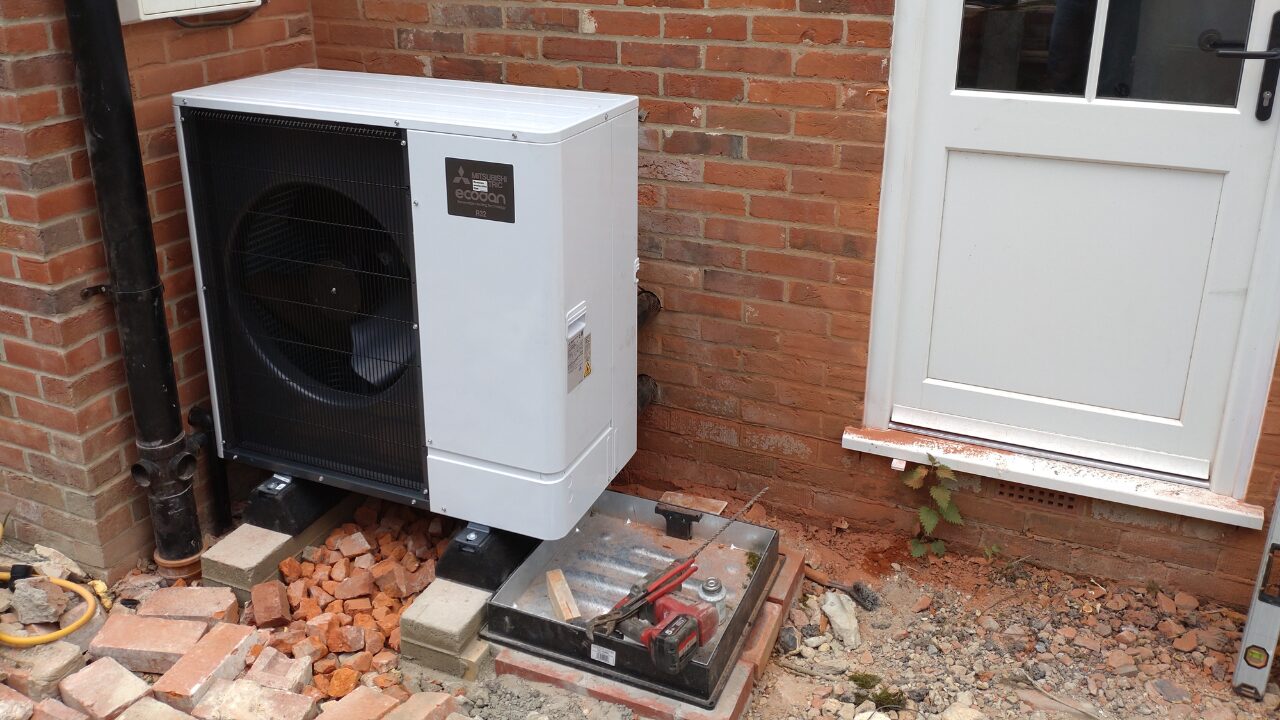
Overall, I’m not impressed with either the installation or the 11.2 kW Mitsubishi Ecodan heat pump that was installed in our home.
Our cottage consists of three sections, all two storeys. The original part of the house dates back around 150 years and was built as a traditional farm worker’s cottage: two up, two down with solid flint and brick walls. In the late 1960s it was extended, adding a kitchen and toilet downstairs and a bathroom and bedroom upstairs, built with cavity walls.
Then in 2022 we added another extension, which includes a new kitchen/diner downstairs and a bedroom with en-suite upstairs. At the same time the original lounge and dining rooms were knocked through to create one larger room, while the old 60s kitchen was repurposed to accommodate the new staircase and a lobby area.
All the windows in our home are now double glazed and the loft has around 200 mm of insulation. Because the house was effectively being torn apart during the building work, it seemed like the perfect opportunity to install a heat pump system.
We selected the installation company from three renewable firms operating locally. After speaking with each of them they seemed the best option and, being a family business, I expected a more personal service. However, it quickly became apparent that they regarded anything outside the heating system itself as “someone else’s problem”. They suggested we bring in a plumber for other work because they were “heating engineers” (cough) and therefore charged more for their services.
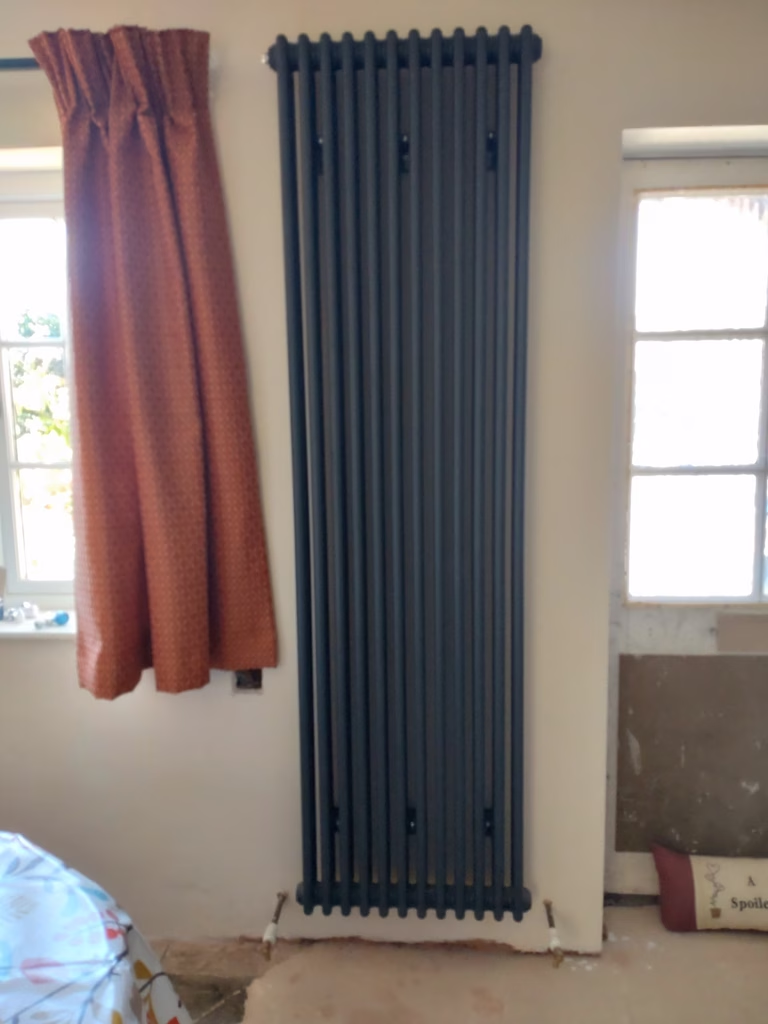
They visited to carry out a survey and take measurements for the heat loss calculations. I’ve never actually seen those calculations. What I did receive was a table recommending radiator sizes based on standard white K-style radiators. My wife and I felt those weren’t particularly suitable for an older cottage, so we opted for more traditional cast-style radiators with equivalent outputs. Two of the radiators in our lounge are absolutely enormous, but at least they look appropriate for the property.
There was never any real discussion about which heat pump would be installed. It was simply going to be a Mitsubishi Ecodan because, I was told, they are “the best on the market”. When I asked whether the hot water tank could go in the loft the suggestion was treated as if I’d asked to install it on the moon.
From the beginning I often felt more like a problem to be managed than a customer.
In the end I bought and fitted all the radiators myself (if you want a job done well, do it yourself!). The installers then returned to complete the rest of the system. The plumbing itself is neat and tidy, but the design decisions behind it leave a lot to be desired. For example, pipes were run straight through our downstairs toilet, the plumbing for the outside tap is now obscured by the hot water tank, the outside tap itself sits behind the heat pump, and the waste for the washing machine is completely inaccessible. There is also no practical way to plumb in a waste pipe for the sink without major disruption.
Most of our house uses radiators, except for the new kitchen which has underfloor heating. The system design uses a single heating circuit with no volumiser or buffer tank, all run by a single circulating pump operating at a fixed speed. There is no facility for the heat pump to control the pump speed, although whether that is a limitation of the Ecodan itself I honestly don’t know.
The flow and return pipes to the heat pump are 38 mm copper. Pipework to the radiators runs through the floor void in plastic pipe, with 15 mm copper drops either concealed in the walls or rising up through the floorboards.
There are no heat meters or meaningful flow measurements installed, which means accurately monitoring or improving the efficiency of the system is practically impossible. Even the temperature sensors used by the Ecodan are attached to the pipes with cable ties. The flow sensor itself has a 25 mm bore which appears to restrict the otherwise 38 mm plumbing, but I’m not a hydraulics expert so perhaps there is some logic there that escapes me.
The underfloor heating in our kitchen consists of two loops, each with its own balancing valve. There is also an electronic flow control device, but it is not wired into the system.
Legionella protection for the hot water cylinder is operated using a completely separate timer switch rather than the FTC6 controller. The explanation given was that if the controller failed we could still have hot water. That sort of makes sense, but it adds extra complexity and more clutter on the wall. Since neither the FTC6 nor the timer is synchronised to the internet they both slowly drift over the year and need to be corrected manually every so often.
Initially I had hoped to use the Drayton Wiser control system after reading about Drayton partnering with Panasonic on heat pump control technology. I asked the installers if something like this could be incorporated. I suspect that was the moment they lost any real interest in making the system work properly.
The heating system was completed in April 2022 and soon afterwards the heat pump was switched off for the summer.
Winter 2022/2023 arrived and our heat pump would run for about 20 minutes and then stop for four minutes. The cycle repeated endlessly. The house did stay uniformly warm, but the running costs were eye-watering.
I contacted the installers and they blamed the Wiser system, so that was removed. Unfortunately nothing changed in terms of operation... still the same 20-minute run followed by four minutes off. However, with the Wiser system gone the house was no longer evenly heated. Upstairs was hot while the kitchen and lounge were noticeably colder.
Getting the installers to return would involve paying a call-out fee each time, so at that point I realised I was essentially on my own.
I built a crude logging device to try to understand what the controller was doing and experimented with a few adjustments, but nothing brought any meaningful improvement. Eventually that winter ended.
Winter 2024 brought little more joy. Mitsubishi customer support was not particularly helpful. Even after sending logs and photos showing how the system was behaving the response was minimal. A few settings were “tweaked” and frost mode was turned off, but that was about it.
I installed a power meter and upgraded my logging setup. Through trial and error I managed to get the heat pump to run for longer periods, but communication with Mitsubishi was slow and progress was limited. Around this time I also began to suspect that the heat pump might simply be oversized for our house.
The system sometimes failed to enter or exit setback mode correctly and the circulation pump would run for no obvious reason. At one point Mitsubishi support told me not to use MELCloud to control the heating schedule. They did manage to fix holiday mode though… by not using MELCloud!
Then came winter 2025. With renewed determination I decided that this would be the year I finally got the system behaving properly, one way or another.
Our daytime temperature set point is 18C and the night-time set point is 16C. At 05:30 the temperature increases to 17C and then to 18C at 06:30 in an attempt to reduce the large power surge when the heating first turns on. This helps slightly but doesn’t completely eliminate the rather dramatic power draw.
By adjusting the permitted flow temperature overshoot I’ve managed to extend the running duration of the heat pump. It now runs continuously until the room temperature exceeds the set point by around 1C, with roughly 1C of hysteresis before heating demand returns.
More recently I switched the controller into Auto Adaptive mode. In practice there appears to be little difference compared with standard weather compensation. The heat pump still starts at exactly the same time every day regardless of indoor or outdoor temperatures, and as the room temperature approaches the set point there is no reduction in output to prevent overshoot.
Typically the unit runs at around 1 to 1.5 kW when outside temperatures are between 5C and 7C, operating for five or six hours before switching off completely until later in the afternoon.
Out of curiosity I carried out my own heat loss calculation using the HeatPunk website. The result came out at around 8.2 kW, which does make the 11.2 kW heat pump look somewhat oversized for our property.
One recent episode neatly sums up the experience. We had been away for a few days and the system was set to holiday mode. When we decided to return early I tried to cancel the holiday setting using the MELCloud app so the house would warm up before we arrived. Nothing happened. Even after returning home and cancelling holiday mode on the controller itself the heating refused to start. Fortunately our log burner was ready for the challenge. In the end the only way to get the system running again was to power-cycle the entire Ecodan.
As for the Ecodan itself, my impression is that it is essentially an industrial unit being shoehorned into a domestic setting using rather dated technology.
I’ve worked in electronic design for nearly 40 years (which is a slightly alarming thought). DIP switches were largely designed out of modern electronics back in the 1990s, yet the Mitsubishi FTC6 controller still relies heavily on them. The controller itself is enormous for what it actually does… roughly the size of a small briefcase.
Despite its size there is no built-in provision for internet connectivity, remote thermostats or modern programming features. All of that requires additional hardware and extra cabling. In contrast, a modern smartphone manages to incorporate a high-resolution display, Wi-Fi, Bluetooth, NFC and a sophisticated user interface in something that fits in the palm of your hand.
The FTC6 user interface is clunky, overly complex and not particularly intuitive. Even when connected to the internet it cannot automatically set the date or adjust for daylight saving time.
MELCloud, the remote control app, feels like it was designed for facilities managers overseeing multiple buildings rather than homeowners trying to control their own heating. In my experience it is slow, unreliable and prone to jumping back to the home screen without warning. Even simple tasks require far too many button presses.
Because it is cloud-based, control reliability depends entirely on communication working correctly. If a command fails to reach the system, the heat pump may continue running when it shouldn’t or fail to start when needed.
The heating control algorithm also feels surprisingly crude. I installed a “smart” thermostat in another property back in 1998 that behaved far more intelligently than the FTC6. Auto Adaptive mode is supposed to modulate output to maintain a stable indoor temperature, but in our system there appears to be very little intelligent behaviour at all. The heat pump starts at the same time every day regardless of conditions, and there is no gradual reduction in output as the target temperature is approached. The result is consistent temperature overshoot followed by roughly a one-degree drop before heating restarts.
In summary, I’m not particularly impressed with the installation company, the Ecodan system or Mitsubishi’s support. Over the coming summer I’ll be looking seriously at alternative options to improve (or possibly replace) the system entirely.
This topic was modified 2 days ago by Mars


10/03/2026 3:59 pm
DIP switches were largely designed out of modern electronics back in the 1990s, yet the Mitsubishi FTC6 controller still relies heavily on them.
I have to admit that made me laugh... Hard to believe we’re still flicking DIP switches in 2026 on a controller!
Get a copy of The Ultimate Guide to Heat Pumps
Subscribe and follow our YouTube channel!

10/03/2026 4:36 pm
I tend to disagree that DIP switches are obsolete. Surely they provide a inexpensive, clear and utterly reliable means of configuring a multi use system without having to rely on having it powered on or using a complicated software BIOS. Why is making every thing so damn complicated seen as a virtue. Whatever the cause of the OP's dissatisfaction it cannot all be laid at the door of Mitsubishi whose systems seem to be of high quality and reliable.
1

10/03/2026 5:59 pm
Welcome to the forums.
Firstly can I say that many people do have excellent experiences with Mitsubishi heat pumps and I am sure you could too, however you may have to jettison some of the assumptions you are making to achieve this.
Its true that heat pump interfaces could be better, but that is true of boilers as well. The problem is that houses and heating systems are very different and no manufacturer has yet worked out how to self adapt for every combination, which is anyway impossible unless they also have control of the emitters, which generally they dont. Furthermore they are unlikely to have control of the whole system for the foreseeable future, because it would be resisted by the industry (particularly the aftermarket controls industry) and customers alike. There is in fact a fully self adapting add on system made by Adia, that controls emitters and heat pump and works it all out, but its not that frequently installed because of the cost of replacing every TRV head.
So unfortunately some tuning is necessary unless you buy into the Adia system. However before you do that (if you wish to) can I suggest you read this introduction to heat pumps so you have some useful background. If you try to operate it like a boiler (which I have the impression you may be doing) you cant expect it to work well; you have to forget more or less everything you thought you know about operating boilers, much of which was wrong for boilers and is doubly wrong for heat pumps. Don't even think about using Drayton Wiser or any other third party smart stat system btw unless its specifically designed for heat pumps, it will mess things up big time. The only smart controllers I know specifically designed for heat pumps are Homely, Adia and Havenwise.
As I say your heat pump needs tuning to your house and also needs to be operated low and slow. The most important thing is to get the weather compensation curve adjusted. To do that turn off smart mode, turn all your thermostats and TRVs up to full so they are effectively disabled, operate 24x7 then adjust the weather compensation curve one degree per day until the house is at the right temperature. Start it set to something like 30C at 15 OAT and whatever the design flow temperature was (45?) at whatever your design OAT is (2?, 3?). If you dont know what the design figures are just start at the current figures (but please tell us what they are). Once its close you may want to change by only half a degree per day. If rooms settle at different temperatures balance the radiators, there is an article about how to do this here. Expect this process to take a couple of weeks. Its best done when its cold, so depending on what the next few weeks bring you may well have to tweak next season, but once its done you can just leave it.
You may well find that, once you get it right, operating like this (ie in pure weather compensation mode) is very comfortable. Many here do that, including me, and certainly in my case the house is way more comfortable than it ever was with a boiler and its thermostats/TRVs. Once you have the basic adjustment right you can set TRVs in rooms that have lots of solar gain a couple of degrees above the desired temperature, to act as limiters not controllers, and you may want to try reenabling auto adapt. However first try running on pure WC correctly adjusted because until this is properly set up you aren't starting from the right place.
Thats a very short summary but if you read the articles I have pointed you to it will hopefully make more sense. Feel free to ask questions, no question is silly and people here are generally very helpful. However can I respectfully ask you to keep short and to the point and omit irrelevant detail, most people wont bother to read a very long post!
Finally please accept my apologies if you already know all of this. Its quite difficult to tell from you post how exactly you are operating the system and it may be that you are already operating in the way I suggest and have done the recommended tuning.
This post was modified 2 days ago 7 times by JamesPa
4kW peak of solar PV since 2011; EV and a 1930s house which has been partially renovated to improve its efficiency. 7kW Vaillant heat pump.
1
10/03/2026 9:46 pm
@abernyte, I’d have to respectfully disagree on that one.
DIP switches certainly have their place from a reliability and cost perspective, and I understand why manufacturers historically used them. But in modern systems they can also introduce a different set of problems... they’re easy to misconfigure, difficult for homeowners or even some installers to interpret and they’re not exactly transparent unless you’ve got the manual open beside you. It's pretty old school!
Most modern controls have moved toward software-based configuration with clear menus, logging and parameter visibility, which makes commissioning, troubleshooting and optimisation much easier. With DIP switches you’re often relying on someone physically setting tiny switches correctly and then hoping they were documented somewhere.
Just my personal opinion.
Get a copy of The Ultimate Guide to Heat Pumps
Subscribe and follow our YouTube channel!

10/03/2026 10:45 pm
I’ve worked in electronic design for nearly 40 years
Ecodan speaks a proprietary protocol on its connector "CN105". It's been reverse engineered and it is possible to use an ESP32 as an interface to Home Assistant for example. There are other similar projects.
It is also possible to buy the extremely expensive official Modbus interface (200€ for a MCU in a little box).

10/03/2026 11:26 pm
Given I am also an owner of a Mitsi Ecodan of similar vintage, I have a pretty good perspective on @chimpy’s comments. It strikes me there are several themes going on here, none of which are new and all of which resonate with previous threads here and even @editor’s podcast.
Firstly, this is yet another example of the consequences of choosing the wrong installer. @chimpy, you most certainly should’ve been given your heat loss survey and been included in the design process; an installation is a collaboration between installer and homeowner and that clearly failed here. I’m sure with hindsight you can see red flags you’d’ve preferred to pick up on earlier just as I’m sure that in an ideal world you shouldn’t’ve had to look out for them.
Secondly, whilst the design of the system doesn’t seem to have been as bad as some we’ve seen, it clearly also wasn’t stellar. There’s certainly work needed, even if it seems it’s not beyond redemption.
Thirdly, I find everything @chimpy said about Melcloud and the FTC to be bang on. It’s way behind the curve and Mitsi addons to gain connectivity beyond the in-house controller are far too expensive for what should be standard functionality. £150+ for modbus? Really? And if you do get modbus you can’t use the wifi adapter? Really? C’mon, guys, you can do better than that.
However, fourthly, whilst the heat pump itself may be a fairly pedestrian design there are far too many units out there working perfectly well to ignore. Old tech doesn’t always have to be a bad thing unless new tech is a noticeable improvement. That said, old or new, tech still needs support and it’s disappointing to hear Mitsi may have fallen short of their reputation here.
105 m2 bungalow in South East England
Mitsubishi Ecodan 8.5 kW air source heat pump
18 x 360W solar panels
1 x 6 kW GroWatt battery and SPH5000 inverter
1 x Myenergi Zappi
1 x VW ID3
Raised beds for home-grown veg and chickens for eggs
"Semper in excretia; sumus solum profundum variat"
1
Topic starter
11/03/2026 5:00 am
@editor I'm not so sure DIP switches are cost effective or more reliable. One byte of memory is eight switches or one package. There is no purchase cost, placement cost or reliability issues with a mechanical contact or solder joint, plus all the real estate used on a PCB for the components (switches & possibly resistors) and tracks. 🙂
1
Topic starter
11/03/2026 5:18 am
@jamespa Hi, thanks for your comments.
As you say, others have a more positive outcome with an ecodan, so this gives me hope.
I feel the biggest issue with my heat pump is it's way too powerful. The minimum input power is about 1.2kw, this doesn't significantly increase until below 3 to 4°C outside.
I've spent quite a while getting all the rooms to the desired temperature at the same time on both WC and auto adapt. I was hoping auto adapt might be more adaptable than it is.
I've read some people have had some success with quiet mode, I'll give that a go.
There is a bit of a compromise of the placement of the heat pump, (still plenty of space in front and to the side) so when it's cold and still out the air immediately around the cabinet gets 'stale'. If it was possible to move the internal thermostat, I think that would help.
Chimpy
1
Topic starter
11/03/2026 5:28 am
@majordennisbloodnok Hi, thanks for your message.
Ignorance is bliss until it isn't. The first time for everything is always a learning experience, I know much more about what questions to ask and where to look for advice now.
Yes, as you say others with ecodans have a successful efficient installation.
I'm still amazed there is no internet based time adjustment.
Chimpy
1
11/03/2026 9:01 am
I feel the biggest issue with my heat pump is it's way too powerful. The minimum input power is about 1.2kw, this doesn't significantly increase until below 3 to 4°C outside.
I think you said its an 11.2kW model and your house is a bit over 8kW. Thats certainly a bit oversized but not unusual by any means. In reality heat pump manufacturers mostly make two or three out of ~5kW, ~8kW, ~12kW, ~16kW (~1 ton, 2 ton and 3 ton, 4 ton in American speak) machines, with intermediate models often being firmware limited versions of the one above. Daiklin for example make only 8 and ~16, all the others are just firmware limited versions of these. Vaillant make ~5, ~7, ~12 (branded as 5, 7 and 12), the 10 and 3 are firmware limited.
The space between 8 and about 12 is pretty thin, I looked quite closely so I know. Although my house has a measured loss of 7kW the self surveyed loss using MCS assumptions, which I was working to for a while during my journey, is 10.5kW. I ended up with the Vaillant 7 (actually nearer 8) because the measurements eventually convinced me, and its just right. Possibly you could also get away with a 7-8 but you would need a measurement not a survey to determine that; fortunately you have the measurement kit - namely your heat pump!
This being the case with a house thats over 8, and allowing for DHW also, it would be quite normal to specify something like you have unless you, as a householder, are prepared to accept the risk that you may need supplementary heating and your installer will go along with this (most wont, some will if you insist).
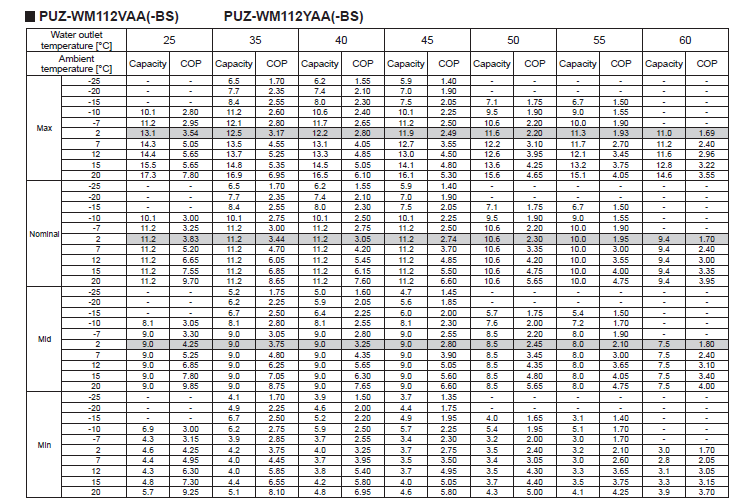
I reproduce the capacity and COP tables for the R32 11.2kW machine below. My min output power is 3.2kW and my machine bottoms out at 600W input; on the basis that your min output power is just over 4kW I would expect it to bottom out at about 900W input not 1.5kW. You should investigate, there may be a wrong setting somewhere. Whats your min FT set to - installers sometimes set it to 35-37 which is way too high but avoids call outs 'because the radiators aren't warm'.
I've spent quite a while getting all the rooms to the desired temperature at the same time on both WC and auto adapt. I was hoping auto adapt might be more adaptable than it is.
Auto adapt is, I understand, limited in its scope. I suspect this is a 'control theory' problem (given you spent time in electronics you may know something about control theory, houses have vast delays in their responses, 12-24 hours, which of course isnt great for any simple, or even not so simple, feedback circuit - which is one of the reasons WC is a major advance). Turn off autoadapt initially, get the WC right, then by all means experiment with turning it back on if it helps
There is a bit of a compromise of the placement of the heat pump, (still plenty of space in front and to the side) so when it's cold and still out the air immediately around the cabinet gets 'stale'. If it was possible to move the internal thermostat, I think that would help.
Yes I see that which may compromise performance (heat pumps after all rely on taking in ait at ambient temp, not air that they have themselves cooled). If by the 'internal thermostat' you mean the internal (to the outdoor unit) outdoor air sensor sensor, then ideally this should be somewhere else in the shade. Only a few heat pump manufacturers do this however. Often its in the input air stream (so its really an air intake sensor). Thats probably next best so long as its shaded.
Quiet mode clamps the compressor output but wont reduce the minimum. However it may reduce aggressive start ups that some heat pumps do, which will have a marginal effect
You might benefit from some monitoring. Melcloud/Melpump seems liked by many but I think the interface may be an add on (as the equivalent is with my Vaillant), but perhaps first turn off auto adapt, turn up all your thermostats and TRVs and optimise WC if you haven't already done that.
Hope that helps. Happy to answer questions, Im not a Mitsubishi expert (or indeed an anything expert, Im just an amateur) but most problems are not brand specific.
This post was modified 2 days ago 8 times by JamesPa
4kW peak of solar PV since 2011; EV and a 1930s house which has been partially renovated to improve its efficiency. 7kW Vaillant heat pump.
1

Latest Posts
-
RE: Octopus Cosy 12 Heat Pump Regret: Incredibly Loud, Poor Heating & Constant Hum - Help!
Balancing is a long process and its possible to mess th...
By JamesPa , 23 minutes ago
-
RE: Daikin Altherma 3 LT compressor longevity question
Up to a point yes. However every heat pump (and every ...
By JamesPa , 1 hour ago
-
Thanks everyone for the help, Havenwise now diasbled. q...
By Boycey , 3 hours ago
-
RE: Advice needed after a successful "leftfield" experiment.....
@pauli Depending on whether you can get an EV tariff, I...
By ChandyKris , 4 hours ago
-
-
RE: New Build ASHP Defects - Looking for Advice, Support & Shared Experiences
Is that a single pair only? If so it may be part if th...
By JamesPa , 6 hours ago
-
RE: Solar Power Output – Let’s Compare Generation Figures
@technogeek I think you are correct, but, it didn’t inf...
By Papahuhu , 6 hours ago
-
@batpred, you’re quite right; it does work well. I don’...
By Majordennisbloodnok , 7 hours ago
-

@Mars at the time of writing heating oil is £1.28 / ltr...
By TechnoGeek , 7 hours ago
-
RE: Ecodan Cylinder Possible Weeping Around Thermostat Port
Update: Mitsubishi sent an engineer around. It was li...
By Gruff2001 , 10 hours ago
-
RE: A Smarter Smart Controller from Homely?
@benson Agreed. I believe the COP gains with homely, i...
By Papahuhu , 10 hours ago
-
RE: Samsung Gen 7 16kW Integrated unit Modbus monitoring
The setup for this is a Samsung Modbus card. Connected ...
By antonical , 12 hours ago
-

RE: Forum updates, announcements & issues
@davidalgarve, if the emails are more than roughly a mo...
By Mars , 12 hours ago
-
How to Find All Your Posts and Topics on the Forum – A Quick Guide
If you’ve ever posted something on the forum and then s...
By Mars , 12 hours ago
-
RE: If a heat pump can only heat DHW to 50C then what? Issue with 18KW Heliotherm heat pump
Sorry to hear that but I'm not surprised TBH. Stratifi...
By JamesPa , 13 hours ago
-
RE: Say hello and introduce yourself
@pt151 welcome to the forums, and looking forward to he...
By Mars , 1 day ago
-
RE: Setback savings - fact or fiction?
The answer was in two parts in my reply, the second par...
By RobS , 1 day ago
-
Samsung Gen 7 16kW Integrated unit Modbus monitoring
Looking for some assistance to get modbus monitoring wo...
By antonical , 1 day ago
-
Ecodan control return to Melpump from Havenwise trial. settings check
Hi, Just got control back after being on the hav...
By Boycey , 1 day ago
-
RE: Refrigerant R32, is it now banned in the EU from 1st Jan 2027 for monobloc ASHPs?
I wonder if heat pump manufacturers will tone these sit...
By JamesPa , 1 day ago
-
RE: Who’s Caved and Switched the Heating On Already?
@editor yesterday we used 12kW of electricity for heat,...
By Judith , 1 day ago
-
RE: Rate the quality of your heat pump design and installation
Loss assessments can be a very serious case of GIGO. I...
By JamesPa , 1 day ago
-
RE: Who's your electricity provider and what's your tariff?
@jamespa Just bizarre. This is our data. I really don't...
By antonical , 2 days ago
-
RE: Mitsubishi Ecodan 11.2kW review
I think you said its an 11.2kW model and your house is ...
By JamesPa , 2 days ago