

Notifications
Clear all
Joining the Renewable Heating Hub forums is completely free and only takes a minute. By registering you’ll be able to ask questions, join discussions, follow topics you’re interested in, bookmark useful threads and receive notifications when someone replies. Non-registered members also do not have access to our AI features. When choosing your username, please note that it cannot be changed later, so we recommend avoiding brand or product names. Before registering, please take a moment to read the Forum Rules & Terms of Use so we can keep the community helpful, respectful and informative for everyone. Thanks for joining!

11/03/2026 11:14 am
As an aside, if your FTC6(?) is adding 2.8kWh to account for water pumps then your 8 hour (?) setback would save a third of that value (0.93 kWh) because the water pump will be off for that time.
Yes @robs you’re quite right there is an extra saving made during the setback period (because the circulation pump is not operating) but I haven’t deducted it from the MELCloud energy report. That might be seen as tampering with the data.
I outlined the breakdown of the 2.8 kWh energy add-on that MELCloud makes in a post earlier in this thread bottom of page 25. Copy below:-
No manual alterations are ever done. Since the system is operating 24/7 even on a setback. Therefore the inbuilt energy markup is the same for both 24 hour time periods and is quoted exactly as reported.
In our case our system is the FTC6 controller and is pre set with 2.8 kWh add on in a 24 hour period. So the pre installed consumption over estimates our daily use. This may be different for the newer FTC7 which may be more programmable.
if you only have 1 circulating pump like we have. Our circulating pump only consumes 29w per hour. (696w in 24 hours.) The FTC 6 monitoring system consumes around 600w in a 24 hour period. So our total monitoring/circulating consumption is 1.296 kWh per 24 hour period.
This means our data typically reports 1.5 kWh higher daily, than the actual energy use.
I do not deduct this amount so there is no question of altering the reported data. So as you can see there is nothing to hide it’s just the raw data.
11/03/2026 11:40 am
In our case as shown above the 2.8 kWh add-on is more than we actually consume.
Example: FTC monitoring PLUS PUMP CONSUMPTION = 1.296 kWh for the 24 hour period
So : 2.8kw - 1.296kw =1.504 kWh over compensation.k
Our only circulator pump would have used 232 wattHours during the 8 hour setback if it was continuously running.
So to correctly account for this the total over estimate should be 1.736 kWh in the 24 hour period.
This could indeed be the correction factor used to correctly raise the savings during the setback period. But for the sake of keeping the message simple I chose to ignore the extra saving of 232watts.
The data as reported by me in the above posts is unaltered from the MELCloud report so nobody can say they have been tampered with.
All reports therefore show identical compensation values from the MELCloud estimation system. All graphs have the same 1.504 kWh markup.
So the only differences in consumption are small but visible differences in ambient and the energy saved as a result of the setback.
This post was modified 7 months ago 3 times by SUNandAIR
11/03/2026 1:35 pm
Are you saying the 33kwh estimate and the 28.8 kWh estimate and for that matter the 28.5kwh estimate are each calculated so randomly by 40 to 60% that there would be no consistency or meaning to their values?
As I mentioned before (and above), MELCloud seems to be quite consistent in its inaccuracy. So it is no surprise that two similar days have a similar degree of inaccuracy, and hence similar reported energy consumption estimates.
Rob you haven’t answered the question. Or to be more precise your reply has become once again somewhat cryptic. It’s clear if it’s consistent to produce similar energy consumption estimates on similar climatic days it is consistent enough to report on the same climatic days on a setback.

11/03/2026 9:53 pm
As an aside, if your FTC6(?) is adding 2.8kWh to account for water pumps then your 8 hour (?) setback would save a third of that value (0.93 kWh) because the water pump will be off for that time.
Yes @robs you’re quite right there is an extra saving made during the setback period (because the circulation pump is not operating) but I haven’t deducted it from the MELCloud energy report. That might be seen as tampering with the data.
I outlined the breakdown of the 2.8 kWh energy add-on that MELCloud makes in a post earlier in this thread bottom of page 25. Copy below:-
No manual alterations are ever done. Since the system is operating 24/7 even on a setback. Therefore the inbuilt energy markup is the same for both 24 hour time periods and is quoted exactly as reported.
In our case our system is the FTC6 controller and is pre set with 2.8 kWh add on in a 24 hour period. So the pre installed consumption over estimates our daily use. This may be different for the newer FTC7 which may be more programmable.
if you only have 1 circulating pump like we have. Our circulating pump only consumes 29w per hour. (696w in 24 hours.) The FTC 6 monitoring system consumes around 600w in a 24 hour period. So our total monitoring/circulating consumption is 1.296 kWh per 24 hour period.
This means our data typically reports 1.5 kWh higher daily, than the actual energy use.
I do not deduct this amount so there is no question of altering the reported data. So as you can see there is nothing to hide it’s just the raw data.
Can I ask where the 2.8kWh figure comes from? I checked the FTC6 manual and it has the same settings for pump power as the FTC7 (see below from the FTC6 installers manual), so it also calculates the pump energy consumption using the pump power settings.
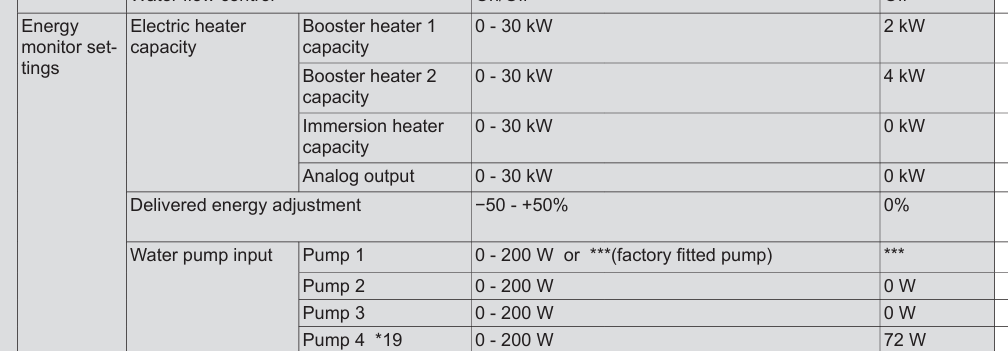
If your system is adding 2.8 kWh when you have an 8 hour setback (off period) it's presumably coming from an estimated 175W for each hour of the 16 hours of operating time. So ~165W for the pump(s) if we exclude the power consumption of the electronics. That's assuming the energy consumption estimate doesn't include water pump consumption when the system has switched the water pump off, hopefully it does this and not just assume the water pump(s) run all the time!
From your following post (reproduced below), 232Wh over 8 hours gives 29W water pump power consumption, thus 16 hours of 165-29 gives an over estimate for energy consumption of 2.18 kWh. So I think your system's estimates are even further out from reality than you suggest in the post below. Have you looked at the pump power settings on your FTC6? It would be interesting to know what they are set to that can result in the controller adding ~165W per hour to the energy consumption estimate.
In our case as shown above the 2.8 kWh add-on is more than we actually consume.
Example: FTC monitoring PLUS PUMP CONSUMPTION = 1.296 kWh for the 24 hour period
So : 2.8kw - 1.296kw =1.504 kWh over compensation.k
Our only circulator pump would have used 232 wattHours during the 8 hour setback if it was continuously running.
So to correctly account for this the total over estimate should be 1.736 kWh in the 24 hour period.This could indeed be the correction factor used to correctly raise the savings during the setback period. But for the sake of keeping the message simple I chose to ignore the extra saving of 232watts.
The data as reported by me in the above posts is unaltered from the MELCloud report so nobody can say they have been tampered with.
All reports therefore show identical compensation values from the MELCloud estimation system. All graphs have the same 1.504 kWh markup.
So the only differences in consumption are small but visible differences in ambient and the energy saved as a result of the setback.
I've not suggested that your figures have been tampered with just that MELCloud's estimates aren't very good. You only mention one water pump, so presumably you have an open loop system and no hydronic separation. I suspect that Mitsubishi's estimates are based on their standard cylinder/LLH setup that has a second water pump, and if they are estimating consumption from temperatures sensors and output power (that the controller can calculate from the sensors it has) then they have presumably included some level of inefficiency in their calculations for the LLH. If you also have an open loop system then your estimated consumption figures could well be as inaccurate as mine, but if you have a Mitsi cylinder & LLH they may be somewhat closer to reality.

11/03/2026 10:03 pm
Are you saying the 33kwh estimate and the 28.8 kWh estimate and for that matter the 28.5kwh estimate are each calculated so randomly by 40 to 60% that there would be no consistency or meaning to their values?
As I mentioned before (and above), MELCloud seems to be quite consistent in its inaccuracy. So it is no surprise that two similar days have a similar degree of inaccuracy, and hence similar reported energy consumption estimates.
Rob you haven’t answered the question. Or to be more precise your reply has become once again somewhat cryptic. It’s clear if it’s consistent to produce similar energy consumption estimates on similar climatic days it is consistent enough to report on the same climatic days on a setback.
The answer was in two parts in my reply, the second part that also answered some of your other points was:
"If you effectively eliminate the over reporting of MELCloud for a third of the 24 hour period (i.e. 8 hour setback) then a third of the over reporting will be absent from the reported estimate for that 24 hours. So the days with a setback will have lower consumption estimates solely due to the reduced period of over reporting."
So the two similar days with setbacks would be expected to be inaccurate by a similar amount and so have similar consumption estimates. While the day with no setback would have an extra 8 hours of consumption inflation and so would be expected to be even more inaccurate as a result.
13/03/2026 11:21 am
If your system is adding 2.8 kWh when you have an 8 hour setback (off period) it's presumably coming from an estimated 175W for each hour of the 16 hours of operating time. So ~165W for the pump(s) if we exclude the power consumption of the electronics. That's assuming the energy consumption estimate doesn't include water pump consumption when the system has switched the water pump off, hopefully it does this and not just assume the water pump(s) run all the time!
From your following post (reproduced below), 232Wh over 8 hours gives 29W water pump power consumption, thus 16 hours of 165-29 gives an over estimate for energy consumption of 2.18 kWh. So I think your system's estimates are even further out from reality than you suggest in the post below. Have you looked at the pump power settings on your FTC6? It would be interesting to know what they are set to that can result in the controller adding ~165W per hour to the energy consumption estimate.
@robs you really are making a very simple known correction value ridiculously ambiguous. And once again avoided answering my question. I have no intention in going down any random numerical rabbit holes you care or invent.
my statement is quite clear as shown below.
”
No manual alterations are ever done. Since the system is operating 24/7 even on a setback. Therefore the inbuilt energy markup is the same for both 24 hour time periods and is quoted exactly as reported.
In our case our system is the FTC6 controller and is pre set with 2.8 kWh add on in a 24 hour period. So the pre installed consumption over estimates our daily use. This may be different for the newer FTC7 which may be more programmable.
if you only have 1 circulating pump like we have. Our circulating pump only consumes 29w per hour. (696w in 24 hours.) The FTC 6 monitoring system consumes around 600w in a 24 hour period. So our total monitoring/circulating consumption is 1.296 kWh per 24 hour period.
This means our data typically reports 1.5 kWh higher daily, than the actual energy use.
I do not deduct this amount so there is no question of altering the reported data. So as you can see there is nothing to hide it’s just the raw data.
There is no difference in the corrections needed for the three 24 hour energy reports. Therefore they simply cancel each other out. Your obtuse interpretations seem to come from your own anxieties about data generally.
so to be clear your opening statement repeated below is not correct. Because the 2.8 kWh markup is made to all 24 hour periods.
If your system is adding 2.8 kWh when you have an 8 hour setback (off period) it's presumably coming from an estimated 175W for each hour of the 16 hours of operating time.
This post was modified 7 months ago by SUNandAIR
13/03/2026 5:04 pm
If your system is adding 2.8 kWh when you have an 8 hour setback (off period) it's presumably coming from an estimated 175W for each hour of the 16 hours of operating time. So ~165W for the pump(s) if we exclude the power consumption of the electronics. That's assuming the energy consumption estimate doesn't include water pump consumption when the system has switched the water pump off, hopefully it does this and not just assume the water pump(s) run all the time!
From your following post (reproduced below), 232Wh over 8 hours gives 29W water pump power consumption, thus 16 hours of 165-29 gives an over estimate for energy consumption of 2.18 kWh. So I think your system's estimates are even further out from reality than you suggest in the post below. Have you looked at the pump power settings on your FTC6? It would be interesting to know what they are set to that can result in the controller adding ~165W per hour to the energy consumption estimate.
@robs you really are making a very simple known correction value ridiculously ambiguous. And once again avoided answering my question. I have no intention in going down any random numerical rabbit holes you care or invent.
I posted an image from the FTC6 installer manual that clearly shows per pump power settings (like our FTC7) and a perfectly reasonable assumption of "That's assuming the energy consumption estimate doesn't include water pump consumption when the system has switched the water pump off, hopefully it does this and not just assume the water pump(s) run all the time!". I've merely used the 2.8 kWh and 232Wh figures that you posted to calculate the effect they would have with regards to the system's electricity consumption.
I answered your question, I even summarised my answer, but you might not like the answer as it challenges your assertion.
There is no difference in the corrections needed for the three 24 hour energy reports. Therefore they simply cancel each other out. Your obtuse interpretations seem to come from your own anxieties about data generally.
so to be clear your opening statement repeated below is not correct. Because the 2.8 kWh markup is made to all 24 hour periods.
Where did the 2.8 kWh figure come from? How do you know that the markup is the same for all 24 hour periods?
13/03/2026 7:17 pm
Where did the 2.8 kWh figure come from? How do you know that the markup is the same for all 24 hour periods?
Have you not worked that bit out yet. If you’ve learned how to adjust those settings, like you have stated you have. then presumably you’ve also learned how to check how the markup has been changed?

14/03/2026 10:33 am
Where did the 2.8 kWh figure come from? How do you know that the markup is the same for all 24 hour periods?
Have you not worked that bit out yet. If you’ve learned how to adjust those settings, like you have stated you have. then presumably you’ve also learned how to check how the markup has been changed?
I changed the pump power to the actual value to see if the energy consumption estimate improved but it is still woefully inaccurate. As I have an accurate method of measuring the energy consumption I don't generally use MELCloud's estimates.
15/03/2026 11:19 am
It’s been so long - and you still haven’t answered - I thought I’d repost the question again
Are you saying the 33kwh estimate and the 28.8 kWh estimate and for that matter the 28.5kwh estimate are each calculated so randomly by 40 to 60% that there would be no consistency or meaning to their values?
you have repeatedly stated MELCloud is ridiculously inaccurate yet the outside ambient temperature is accurate, the flow temperature is accurate, the return temperature is accurate and it has a built in flow meter.
The system doesn’t have an internal circulation pump, which could be of any number of pump combinations. So it has introduced a built in compensation value.
with a bit of knowledge it is possible to make comparisons across similar temperature days using the MELCloud reports. Without tampering with settings.
For good reason… There are also other compensation values… such as freeze stat function. Which can start the circulating pump just to circulate cold water back into the house. These are all unknown energy contributors.
MELCloud suits its purpose… it is not a laboratory grade monitoring setup.
This post was modified 7 months ago 3 times by SUNandAIR
15/03/2026 5:55 pm
It’s been so long - and you still haven’t answered - I thought I’d repost the question again
Are you saying the 33kwh estimate and the 28.8 kWh estimate and for that matter the 28.5kwh estimate are each calculated so randomly by 40 to 60% that there would be no consistency or meaning to their values?
I answered that days back, I even provided a summary of my answer (reproduced below).
So the two similar days with setbacks would be expected to be inaccurate by a similar amount and so have similar consumption estimates. While the day with no setback would have an extra 8 hours of consumption inflation and so would be expected to be even more inaccurate as a result.
If that is difficult to comprehend, does this help?
The atmospheric conditions on all three days were similar, but on the two days with a setback the heat pump ran for 16 hours and so there was only 16 hours of significantly inaccurate estimating. On the day without setback the heat pump ran for 24 hours and so there was 24 hours of significantly inaccurate estimating. So with an additional 8 hours of inflated estimates it is unsurprising that the day without a setback has a greater energy consumption estimate purely as a result of these 8 hours.
you have repeatedly stated MELCloud is ridiculously inaccurate yet the outside ambient temperature is accurate, the flow temperature is accurate, the return temperature is accurate and it has a built in flow meter.
The estimates measured against a 0.1% accuracy class energy meter are 15% to 77% inaccurate. As per previous posts: the temperature sensors are thermistors with +/- 0.5C accuracy and the flow meter is a vortex based Silka unit that is susceptible to turbulence in the water flow, so how accurate this can be is dependant on the installation.
The sensor values (except OAT) you mention are used to directly calculate energy delivered rather than energy consumed. Assumed COP values would be needed to estimate the energy consumed from these sensor values.
The system doesn’t have an internal circulation pump, which could be of any number of pump combinations. So it has introduced a built in compensation value.
with a bit of knowledge it is possible to make comparisons across similar temperature days using the MELCloud reports. Without tampering with settings.
For good reason… There are also other compensation values… such as freeze stat function. Which can start the circulating pump just to circulate cold water back into the house. These are all unknown energy contributors.
It does have a (very) simple compensation mechanism but changing the settings to better reflect the actual water pump power consumption, and so make the compensation mechanism more accurate, isn't tampering. The estimates have been compared to accurate monitored values and found to be inaccurate, and you're then comparing estimates generated with different inputs, i.e. number of hours operating, as if they were directly comparable - have you not come across cumulative errors before?
If you have an electrical energy monitor, and don't rely on estimates, then these "unknown energy contributors" become known.
Topic starter
20/03/2026 9:02 am
@robs, @sunandair — I expect you may already have seen this thread, but if you haven't, it contains an interesting analysis of possible MELCloud energy data reporting errors. The accompanying charts (you need to click on the link to get the relevant MEL Pump chart) also have an isolated defrost on the right hand side which on eyeball assessment looks like it may be energy neutral.
@sunandair — it does seem others are also sceptical about the credibility of Ecodan data. In his opening post @sheriff-fatman says (emphasis added) 'I've discovered that the accuracy of the Ecodan's own daily reporting of energy use, which is of questionable accuracy to begin with, significantly deteriorates when the system is running in Mitsubishi's own Auto-Adaptation mode'. I appreciate that part of your logic is that you are looking at relative differences in your data, and therefore any errors should in theory cancel out, but that makes a big unverified assumption, that the error is constant. Even if it is constant, the actual value of the difference remains uncertain. I have to say that without independent energy data monitoring, which I don't think you have in any shape or form, please correct me if I am wrong, your reliance solely on MELCloud data does compromise the strength of your findings.
Midea 14kW (for now...) ASHP heating both building and DHW
3


SPONSORS

Degrees of Separation

Latest Posts
-

RE: Replacing Storage Heaters with a Heat Pump in a Stone Cottage
You could be right. I am debating with myself about doi...
By Paul1098 , 9 hours ago
-
RE: tepeo ZEB UK Support & Info Thread
OK so ZEB is basically a variant on a storage heater, b...
By JamesPa , 15 hours ago
-
RE: PV and battery long payback - sense check query
@energystoragetech it's highly improbable that @davidb ...
By Transparent , 21 hours ago
-
RE: Heat Geek installations: share your experiences
@editor I suspect that the Heat Geek online quote is a ...
By AndrewJ , 21 hours ago
-
RE: Adding additional Solar Panels to a DC coupled battery system
Ah, yes. Thanks for clarifying.
By Transparent , 21 hours ago
-
RE: Vaillant ecoTEC Plus - Flow Temp and Set Up
@trebor12345 I have been meaning to get home assista...
By Batpred , 1 day ago
-
RE: Indevolt Batteries UK Support & Info Thread
SunSynk hybrid inverters also have the capability to as...
By Transparent , 1 day ago
-
RE: Is This Initial Free Quote From Octopus Trusted Partner Reasonable?
If you've got a sash window or a door you can remove th...
By EtchedPixels , 2 days ago
-
RE: Are We Sleepwalking Into Another Race to the Bottom?
Roughly how most air/air is done except that step 3 doe...
By EtchedPixels , 2 days ago
-
RE: Nook batteries from Octopus
@batpred If your energy use is low enough that just get...
By EtchedPixels , 2 days ago
-
RE: Missing flow temperature in Heat Geek proposal
I suspect 4 yrs ago, their approach had not got to this...
By Batpred , 2 days ago
-
RE: battery storage without solar
Also don't forget that in you may not be able to use th...
By JamesPa , 2 days ago
-
RE: Tesla Powerwall (2) Calibration Cycles
One practical safeguard is to separate the calibration ...
By EnergyStorageTech , 2 days ago
-
RE: Getting closer to a finished Haier system
Apart from sealing the external Primary Pro joints and ...
By Singlespeed , 3 days ago





SPONSORS

