
Notifications
Clear all
Joining the Renewable Heating Hub forums is completely free and only takes a minute. By registering you’ll be able to ask questions, join discussions, follow topics you’re interested in, bookmark useful threads and receive notifications when someone replies. When choosing your username, please note that it cannot be changed later, so we recommend avoiding brand or product names. Before registering, please take a moment to read the Forum Rules & Terms of Use so we can keep the community helpful, respectful and informative for everyone. Thanks for joining!
Air Source Heat Pumps (ASHPs)
380
Posts
21
Users
50
Reactions
61.9 K
Views

05/11/2025 10:31 am
I'm asking what is the equivalent data/display from a Shelley so called 'integrated power meter', given that what we actually want to measure and record is energy use over time (kWh use per hour/day/whatever).
The Shelly provide “Current” (amp), “Power” (watt) and “Voltage” (V) for the current state and “Total energy” (kWh) as a counter since the last reset. I suspect that the device you referred does (almost) the same.
For myself the reason to use the Shelly devices is that they integrate perfectly with Home Assistent.
1
05/11/2025 10:46 am
doing what it says on the tin
But what does it actually say on the tin, in words that a thicko like me can understand? Having read most of the Shelly web page linked to above, I am none the wiser.
The Eastron meter has a visual cumulative kWh used display I can read manually, with a modbus option for getting the same kWh data into HA or whatever. What I am asking for is a similar description of what a Shelley device can do. If anyone can add pros and cons of the two devices, so much the better.
Midea 14kW (for now...) ASHP heating both building and DHW
05/11/2025 10:50 am
The Shelly provide “Current” (amp), “Power” (watt) and “Voltage” (V) for the current state and “Total energy” (kWh) as a counter since the last reset. I suspect that the device you referred does (almost) the same.
For myself the reason to use the Shelly devices is that they integrate perfectly with Home Assistent.
Thanks, that is exactly what I was hoping for (and apologies for my immediate past comment, posted before I saw your reply).
In summary, the two are different ways of doing almost but not quite the same thing. The differences are the Shelley device has more variables, and more ways of communicating, but doesn't have modbus.
Midea 14kW (for now...) ASHP heating both building and DHW

05/11/2025 11:23 am
@mosibi are you able to give an idea of how inaccurate the midea consumption data is at all ie how your Shelly data compares to what the control panel indicates?

05/11/2025 11:29 am
Ah, understood. @cathoderay.
Eventually, the two are not the same product. The Eastron is a meter pure and simple whilst the Shelly is a smart switch with metering capabilities. That, I suspect, is why the Eastron has a display. Shelly does also have a range of energy meters but once again the emphasis is on the IoT idea of data being crunched elsewhere so none of them have a display. For simple displaying of the information one would be relying on the app or a link with another system such as Home Assistant.
For simplicity, I suspect the Eastron would be the ideal. For meters feeding into a central point Shelly energy monitors might be a good alternative. For monitoring a single outlet, something like the EM Mini Gen4 (which can be installed behind the socket) or for monitoring something beefier - a heat pump, for example - something up to the Pro 3EM 120A. None, as you say, does modbus though, although the range of other communication methods is wide.
105 m2 bungalow in South East England
Mitsubishi Ecodan 8.5 kW air source heat pump
18 x 360W solar panels
1 x 6 kW GroWatt battery and SPH5000 inverter
1 x Myenergi Zappi
1 x VW ID3
Raised beds for home-grown veg and chickens for eggs
"Semper in excretia; sumus solum profundum variat"
05/11/2025 11:39 am
are you able to give an idea of how inaccurate the midea consumption data is at all ie how your Shelly data compares to what the control panel indicates?
I can't do it for a Shelley device, but I can for Eastron kWh meter - the Midea energy in data is an underestimate of the total energy in to the heat pump, as measured by the Eastron meter, by a factor of around 1.18 (ie I have to, and do, multiply the Midea reported data by 1.18 to get it approximate to the Eastron value), and it is the up-rated value I use for my COP calculations. I have assumed without any real evidence that the extra energy is used by ancillaries eg the circulating pump.
@majordennisbloodnok — thanks, a useful expansion on the pros and cons.
Midea 14kW (for now...) ASHP heating both building and DHW
1
05/11/2025 9:15 pm
@benson I checked the last week of data and i must say that is pretty accurate in those days, where the Shelly measures for example 4.65, the heat pump states 5 kWh. But this is only a quick check, to have a better insight, more data is needed.
I would not be surprised that with more data I would have something in line with what @cathoderay states.
2
06/11/2025 11:25 am
@benson I checked the last week of data and i must say that is pretty accurate in those days, where the Shelly measures for example 4.65, the heat pump states 5 kWh. But this is only a quick check, to have a better insight, more data is needed.
I would not be surprised that with more data I would have something in line with what @cathoderay states.
I have just looked at my heat pump 'long interval' (27 March 2023, because that is when I started full monitoring, to 3 Nov 2025) energy in data as measured by (a) the external Eastron kWh meter and (b) the Midea total cumulative kWh in data and (c) my calculated (minute by minute volts x amps) energy in data they are not that far apart:
Eastron total: 15883 kWh
Midea cumulative total: 14955 kWh
Calculated total: 15176 kWh
Assuming the Eastron is the correct value, then my calculated value is out by a factor of 1.046574303 (ie needs to be multiplied by that number to get the Eastron value), ie it is pretty close, within about 5%. The Midea cumulative total is less accurate, but still not too bad, within 6%.
Midea 14kW (for now...) ASHP heating both building and DHW
1

20/12/2025 1:11 pm
Hi all - haven't been on here for a while as I was in ASHP monitoring mode although I still don't have great data and it's generally been a bit too warm for good test conditions. All I can feel fairly confident about is that the estimated heat loss of 14kW is (no surprise) overstated and probably by 15-20%. I think reality is in the 11-12kW range.
I have been "fighting off" my original installer's desire to fit a 20kW cascade and their other option was a Grant R32 17kW which I still think is way oversized. I suggested the Grant 15.5kW 290 but now I see that the regs on siting of the 290 heat pumps is very restrictive and may not work with our building/plot layout, in particular the requirement to have 1m clearance around the pump. So much more risky than propane tanks!
Of course, my original installer is making life difficult by insisting that they will only fit an ASHP with a minimum output of 14kW (to match the estimated heat loss) at -5C and 50C flow temperature, which they claim are MCS requirements. They have no interest in what the actual heat loss from monitoring is, which is very frustrating.
Anyone have datasheets for their heat pump, which show that the published data notes at least 14kW at -5/50C? I'm struggling to find alternatives and considering just asking them for a partial refund (cost of ASHP and installation of pipework) and getting my own choice of installer and system but no idea whether they will consider that. I assume there are lots of examples on here of ASHPs that are massively oversized due to installer reliance on predicted, over-estimated heat loss calcs but that redress is like banging your head against a buffer tank? A classic tale of installer impracticality and veering from undersizing to massive oversizing.
Regards

20/12/2025 1:29 pm
the requirement to have 1m clearance around the pump. So much more risky than propane tanks!
For clarity there is no requirement for clearance behind (other than for airflow of course - typically 200-300mm) and you can have a window directly above so long as no opening part is lower than the top of the pump casing.
They have no interest in what the actual heat loss from monitoring is, which is very frustrating.
If it matters in your case, find another installer!
I assume there are lots of examples on here of ASHPs that are massively oversized due to installer reliance on predicted, over-estimated heat loss calcs but that redress is like banging your head against a buffer tank
Yes there are and many installers are immovable.
at -5C and 50C
Why 50C, is that what the emitters are designed for (lower would be better, and may open up another heat pump or 2)
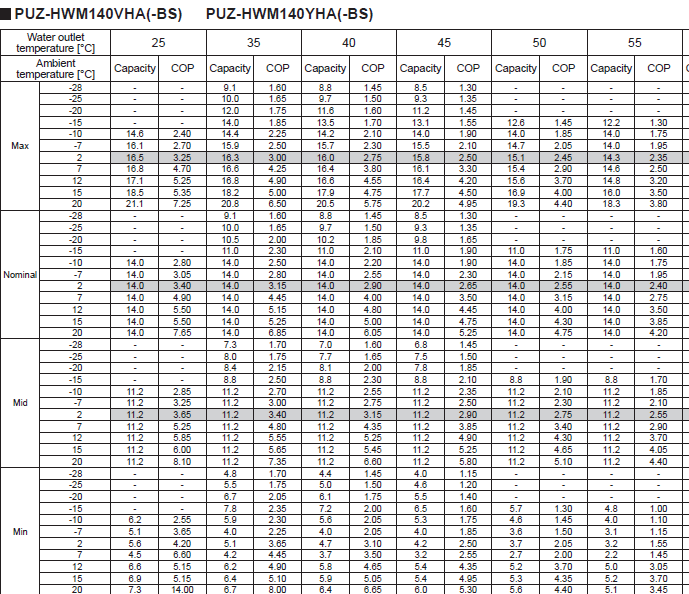
Anyone have datasheets for their heat pump, which show that the published data notes at least 14kW at -5/50C?
Obvious one I know of is the Mitsubishi, here is the R32 datasheet, they also do R290 of course. Samsung R290 also https://midsummerwholesale.co.uk/pdfs/samsung-r290-capacity-table.pdf, Bosch also; have a look on the Midsummer Wholesale site they seem to publish the capacity tables which can be tricky to find on manufacturers websites. There are definitely alternatives to the Grant!
This post was modified 3 months ago 2 times by JamesPa
4kW peak of solar PV since 2011; EV and a 1930s house which has been partially renovated to improve its efficiency. 7kW Vaillant heat pump.
20/12/2025 4:06 pm
@jamespa thank you. The "incentive" for using the original installer is that because they accept that they put in an undersized HP at the outset, they have agreed to replace it with a new HP at their cost (kit and installation). The downside is that they are being prescriptive on what they want to fit so I'm trying to find a reasonable compromise.
Regards
20/12/2025 4:07 pm
Also installers are insisting on min 14kW output at -5C/50C because that's what the heat loss estimate parameters were 🙄

Latest Posts
-

RE: Solar Power Output – Let’s Compare Generation Figures
@papahuhu Indeed we don’t! Much though I wish to be loy...
By Toodles , 2 hours ago
-
RE: Who's your electricity provider and what's your tariff?
@chandykris Thanks, that’s a fair point and I agree th...
By Eliuccio , 3 hours ago
-

As a full price electricity user (nae smart meter signa...
By Abernyte , 8 hours ago
-
Aerotherm 12+12kw cascade huge power utilisation
Looking for a little bit of advice. new inst...
By Hamish_mckay , 8 hours ago
-
Daikin high temperature heat pump
Hello, I have a DAIKIN ERSQ 016AAV1 16KW. I have a BRC2...
By gajolos , 9 hours ago
-
RE: Setback savings - fact or fiction?
I changed the pump power to the actual value to see if ...
By RobS , 10 hours ago
-
RE: Samsung Gen 7 16kW Integrated unit Modbus monitoring
@majordennisbloodnok Thanks I hope it helps someone. St...
By antonical , 22 hours ago
-
RE: NIBE Heat Pump Warranty: What's an Adequate Engineer Attendance Time?
Totally agree. However the manufacturers know that fe...
By JamesPa , 23 hours ago
-
-
RE: The law of unintended consequences....
Oh Thank you Major, I was just beginning to wonder wher...
By Toodles , 1 day ago
-

RE: Forum updates, announcements & issues
I know that the notifications are being delivered now w...
By Mars , 1 day ago
-
RE: Advice needed after a successful "leftfield" experiment.....
@pauli I have sent a direct message with the financial ...
By ChandyKris , 1 day ago
-
RE: Octopus Cosy 12 Heat Pump Regret: Incredibly Loud, Poor Heating & Constant Hum - Help!
Does it disappear when the heat pump is off? What abou...
By JamesPa , 1 day ago
-
RE: Fitting heat pump plumbing and pipes in advance?
Great tips, thanks. The PEX/Al/PEX option sounds much m...
By Jonatan , 1 day ago
-
RE: Struggling to get CoP above 3 with 6 kw Ecodan ASHP
Those control valves on the UFH manifold could be an is...
By Travellingwave , 2 days ago
-
RE: Daikin Altherma 3 LT compressor longevity question
Up to a point yes. However every heat pump (and every ...
By JamesPa , 2 days ago
-
RE: New Build ASHP Defects - Looking for Advice, Support & Shared Experiences
Is that a single pair only? If so it may be part if th...
By JamesPa , 2 days ago
-
@batpred, you’re quite right; it does work well. I don’...
By Majordennisbloodnok , 2 days ago
-
RE: Ecodan Cylinder Possible Weeping Around Thermostat Port
Update: Mitsubishi sent an engineer around. It was li...
By Gruff2001 , 2 days ago
-
RE: A Smarter Smart Controller from Homely?
@benson Agreed. I believe the COP gains with homely, i...
By Papahuhu , 2 days ago
-
How to Find All Your Posts and Topics on the Forum – A Quick Guide
If you’ve ever posted something on the forum and then s...
By Mars , 2 days ago
-
RE: If a heat pump can only heat DHW to 50C then what? Issue with 18KW Heliotherm heat pump
Sorry to hear that but I'm not surprised TBH. Stratifi...
By JamesPa , 2 days ago
-
RE: Say hello and introduce yourself
@pt151 welcome to the forums, and looking forward to he...
By Mars , 3 days ago
-
Samsung Gen 7 16kW Integrated unit Modbus monitoring
Looking for some assistance to get modbus monitoring wo...
By antonical , 3 days ago