

Notifications
Clear all
Joining the Renewable Heating Hub forums is completely free and only takes a minute. By registering you’ll be able to ask questions, join discussions, follow topics you’re interested in, bookmark useful threads and receive notifications when someone replies. Non-registered members also do not have access to our AI features. When choosing your username, please note that it cannot be changed later, so we recommend avoiding brand or product names. Before registering, please take a moment to read the Forum Rules & Terms of Use so we can keep the community helpful, respectful and informative for everyone. Thanks for joining!
Air Source Heat Pumps (ASHPs)
19
Posts
7
Users
3
Reactions
5,456
Views

13/12/2024 9:33 am
Thanks, we're planning on a large normal radiator. Heat Punk suggests that we need a 1800x600mm K2 radiator for a 45 degree flow temperature, but it's possible I've done it wrong! It's a 2x2.5m room with two outside solid brick walls, and I'm adding 70mm of PIR. I'm assuming that a TRV will prevent the room overheating while we insulate and upgrade the radiators in the rest of the house.
That is what I originally planned, then I fell back to 'ignore and rely on heat from adjacent room and steam when the bath is in use.@
The TRV will indeed prevent any overheating.
I had been considering turning the old 35mm copper pipe into a heated towel rail. If I do, it sounds like I should just use an electric element and not connect it to the heating.
Not sure about this! Personally I would either recycle the pipe or turn it into a sculpture.
4kW peak of solar PV since 2011; EV and a 1930s house which has been partially renovated to improve its efficiency. 7kW Vaillant heat pump.

13/12/2024 9:48 am
@jamespa An alternative is to use a dual fuel towel rail. Regards, Toodles.
Toodles, heats his home with cold draughts and cooks food with magnets.
1
13/12/2024 9:53 am
@jamespa An alternative is to use a dual fuel towel rail. Regards, Toodles.
I think thats what I meant by the suggestion to fit an electric element to a towel rail?
4kW peak of solar PV since 2011; EV and a 1930s house which has been partially renovated to improve its efficiency. 7kW Vaillant heat pump.
13/12/2024 10:15 am
@jamespa Sorry James, I mis-parsed your sentence there! The towel rail when heated by the heat pump will provide a low level warming / drying action to any towels but the plan we adopted is to have the electrical element switch on for a few hours in the evening but, with the valve shut to prevent the heating element having to warm circulating water throughout the system. I might add that I only shut one towel rail valve thus allowing for any expansion to take place without pressure on the rail and plumbing. Regards, Toodles.
Toodles, heats his home with cold draughts and cooks food with magnets.


13/12/2024 12:42 pm
Could I leave some pipes in that space, ready to be used in a year or two? Or some conduit to make it easier to feed pipes through? Or will an installer be able to push pipes in from the end if I can mark the right spot? It's about a 3 meter run, parallel to the joists.
That's not a particularly long run.
There are other pipe options than copper which provide better choices for retro-fitting below floors and above ceilings.
Pushing 3m of copper pipe beneath a floor means that you must have 3m of 'space' from which to push it.
PEX/Al/PEX is more commonly used for underfloor heating (UFH),
but is lightweight and can be pushed through a void easily.
It's semi-flexible, and lengths greater than 3m are supplied as a coil.

PEX means Cross-linked polyethylene, and the Al is for Aluminium between the two PEX layers.
Plumbing and heating outlets like BES offer a range of lengths at different bores, and fittings to convert back to copper pipe or brass-threaded couplings.
32mm pipe with a 3mm wall thickness each side gives you an internal bore of 26mm.
PEX/Al/PEX can be bent by hand, and the aluminium ensures that it stays in that shape.
With ingenuity you can guide it around corners!
Remember to slide on a length of pipe insulation before you put fittings onto it.
When fixing floors and walls in place I always leave lengths of polypropylene string to act as pull-throughs for cable at a later date.
Tie each end around an old nail to prevent it accidentally being pulled into a hole...
... and label the ends with PVC-tape.
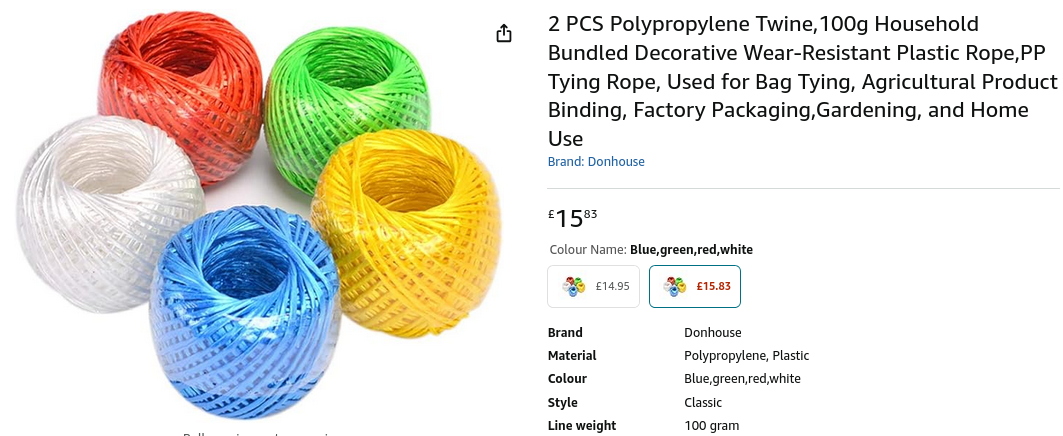
Colours help to differentiate strings emerging at the same spot.
The above set is from Amazon.
Other rivers are available.
Save energy... recycle electrons!

13/03/2026 10:38 am
Great tips, thanks. The PEX/Al/PEX option sounds much more practical than trying to maneuver rigid copper through a 3 m run, and the string idea is a simple but effective way to avoid fishing rods through finished ceilings later on. Having dealt with similar retrofitting challenges on heat pump installations before ( https://www.mesa-plumbing.com/heating/heat-pump-services/ ), I've seen how professionals approach forward planning like this, and it definitely saves a lot of headaches down the line.

18/03/2026 12:01 pm
@transparent i did alot
of research before opting for a Heat Pump, heat calc surveys, where to site HP, pipe routings, where to site DHW, and how to get heat round the house.
I opted to remove the ceiling as I didnt want to disturb upstairs rooms get the floors up, to allow changes to Flow Return pipes when old boiler removed, and upgrading feed pipes to each radiator upstairs to 15mm copper.
Warning for future readers of this post:
PEX is useful but be aware the internal diameter is smaller than same size copper pipe for the elbows, T’s etc as you have to fit those inserts to support the pipe which reduce ID so 22mm PEX has equivalent ID to 15mm CU, to maintain same Flow Rate.
If you cant get the flow rate high enough, you will need bigger emitters!
After my system was commissioned, I had issues with slow heat up times in bedrooms; Octopus suggested bigger radiators. I argued for a higher flow rate and had all the 10mm microbore removed and replaced with 15mm CU.
We split the cost 50/50 as it wasnt their preferred solution so wouldn’t absorb the whole cost
1
Page 2 / 2
Prev
SPONSORS

Degrees of Separation

Latest Posts
-

RE: Heat pump branding. Clever, contemporary… or a bit too much?
I think Heat Geek have done an amazing job on their bra...
By Tomtheheatingengineer , 5 hours ago
-
RE: HeatGeek vs Octopus surveys: puzzling disparity - any ideas why?
I have just had 3 heat loss surveys, one by heat geek o...
By David , 5 hours ago
-
RE: Heat Geek Zero Disrupt: Are We Sleepwalking Into Another Race to the Bottom?
I think that's the key question. After all inverter uni...
By Prunus , 7 hours ago
-
RE: battery storage without solar
As of October 1st they need specific qualifications to ...
By EtchedPixels , 7 hours ago
-
RE: How should the Boiler Upgrade Scheme be reformed?
A unit which uses water to transfer the heat/chill from...
By Temperature_Gradient , 8 hours ago
-
RE: Renewables & Heat Pumps in the News
With regards to the BUS grant raid, I gave it more thou...
By ASHP-BOBBA , 8 hours ago
-
RE: Why are ASHP installs so expensive?
The whole system seems to work on the basis of...
By ian33a , 8 hours ago
-
RE: Missing flow temperature in Heat Geek proposal
Good plan. If you can get half hourly meter readings a...
By JamesPa , 14 hours ago
-
RE: Heat Pumps Without Grants: Would You Have Installed One & Will You Now?
@editor Most certainly. The heat pump was an ideal s...
By Abernyte , 14 hours ago
-
Although regulations may well vary from country to coun...
By Majordennisbloodnok , 14 hours ago
-
RE: Does anyone have experience of a smart water meter?
Yep I caught our slow leak from a £100 bill rise 8)
By EtchedPixels , 14 hours ago
-
RE: Do You Need a Buffer Tank or Low Loss Header for Underfloor Heating in a Large Property?
@jamespa in some cases, failing the Turing test might b...
By GrahamF , 18 hours ago
-
RE: Passiv Smart Thermostat - Help & Forum Support
@energystoragetech The heat capacity of some...
By JamesPa , 19 hours ago
-
RE: tepeo ZEB UK Support & Info Thread
Sorry you are correct, I was remembering figures from t...
By JamesPa , 1 day ago




SPONSORS