Joining the Renewable Heating Hub forums is completely free and only takes a minute. By registering you’ll be able to ask questions, join discussions, follow topics you’re interested in, bookmark useful threads and receive notifications when someone replies. When choosing your username, please note that it cannot be changed later, so we recommend avoiding brand or product names. Before registering, please take a moment to read the Forum Rules & Terms of Use so we can keep the community helpful, respectful and informative for everyone. Thanks for joining!
An Ideal engineer advised me over the phone that the way I am running it is still not right - he thought by setting the Honeywell stat to 35C and running the WC at 4-5, the ASHP would constantly be trying its best to get to a high temp then shutting itself off, and repeating. We therefore changed it to 21C at the stat and WC 6 at the controller but it was too hot and my energy bill jumped up again for the day - I can't give exact data yet as it won't come in until tomorrow I think. He also felt I'd benefit from a Halo Lite and decommission the Honeywell as he thought the Halo Lite would teach the ASHP not to ramp up to max to try to reach desired temps. Does anyone agree with this approach?
Since you ask what others think, I think he is very probably talking rubbish and doesn't understand how ASHPs, or indeed weather compensation, works. The heat pump should control to the flow temperature set by the WC curve and how it does that will not be affected by the Honeywell. If it is controlling to the FT set by the WC curve when you have the Honeywell set to max and the WC curve adjusted to get the house at the right temperature, I would personally ignore him
What he may be talking about is cycling, which will happen at mild OATs and is inevitable.
He also felt I'd benefit from a Halo Lite and decommission the Honeywell as he thought the Halo Lite would teach the ASHP not to ramp up to max to try to reach desired temps. Does anyone agree with this approach?
No idea to be honest because they dont tell you in the blurb (well at least not in the blurb I have been able to find) what a Halo Lite actually does. Given the previous comment I doubt the engineer does either!
He also changed to WC to 6 and initially the whine was actually a lot better. However, it returned the following day and is probably even worse
Possibly it switched off due to being too hot> Anyway the whine returned the following day proving that this was just the 'change something, preferably something that I think the customer doesn't understand, hope it fixes the problem for long enough for me to get out of the door' approach to problem solving beloved of many poor tradesmen in many fields not just ASHPs
worst around the loft nerve centre and transmitting into the bedrooms below
Suggest you try to track down more precisely where it is coming from and possibly prod things (be careful!) to see if they are vibrating/prodding them changes what you are hearing. If its coming from the loft check the area around the secondary pump. Thats the most likely source. If not check local high points of pipework, you may have an air lock.
Fingers crossed I will eventually get a joint visit from the installer and Ideal - this is what the installer is trying to arrange. I have it the WC back to 4 was too warm and dear.
Good, find the right curve with the Honeywell set to max, monitor performance and cost. Then go from there.
To be clear Im not an Ideal, engineer, Im not a heat pump engineer, Im not a plumber. Just a home (and ASHP) owner with a degree in physics, a career in engineering (albeit telecoms not heat pumps) who has been studying this stuff for 3 years to inform my own install, and has a bit of a 'nose' for BS. Please do your own assessment as to whether you should trust anything I say, but note that I can (and will if requested) explain why everything I say is likely to be true.
If it helps I can confirm I operate my own ASHP according to the principles I have described and am very pleased with it. Its a Vaillant, not an Ideal, however they all are subject to the same laws of physics which in the case of an ASHP is pretty fundamental to how they work. Furthermore the Ideal is almost certainly a rebranded far eastern model (nothing wrong with that BTW) and the probability it does anything extraordinary is low.
This post was modified 2 months ago 7 times by JamesPa
4kW peak of solar PV since 2011; EV and a 1930s house which has been partially renovated to improve its efficiency. 7kW Vaillant heat pump.
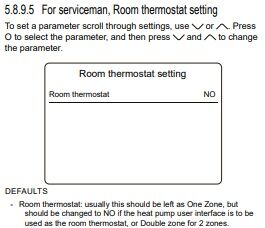
I suspect you are right regarding engineer which is why I've come here. House was still hot even after I changed WC on the iLetcomfort app so went back into loft. Engineer had changed my 'room thermostat' as seen here:
to 'Mode set' which meant controller was ignoring my app and staying on WC 6. I can't find what 'Mode set' is in the instructions so I changed it back to 'One Zone' this eve ing and regained control again. By changing it to 'Mode set' it had also wiped my DHW timer. Frustrating!!
I suspect you are right regarding engineer which is why I've come here. House was still hot even after I changed WC on the iLetcomfort app so went back into loft. Engineer had changed my 'room thermostat' as seen here:
to 'Mode set' which meant controller was ignoring my app and staying on WC 6. I can't find what 'Mode set' is in the instructions so I changed it back to 'One Zone' this eve ing and regained control again. By changing it to 'Mode set' it had also wiped my DHW timer. Frustrating!!
The sad fact is that you have to check everything some installers and maintainers do, or alternatively hover over them whilst they do their work.
In the last 18 months in which I had a gas boiler I turned down the flow temperature to the minimum possible, reducing running costs and improving comfort (a trick I had learned by reading about ASHPs). I then had it serviced (not sure why in retrospect), and afterwards I discovered that the serviceman had whacked the flow temp right up to max again.
This post was modified 2 months ago 3 times by JamesPa
4kW peak of solar PV since 2011; EV and a 1930s house which has been partially renovated to improve its efficiency. 7kW Vaillant heat pump.
Sorry no. There’s a reference at 5.8.9 in the manual to auto mode set under commissioning but as it’s part of the ‘Serviceman’ I haven’t bothered with it.
Ideal HP290 14kw heat pump, 2.99kw PV, Powerwall 2, Zappi charger, EV. Midlands location hybrid house part 1911, part 1970, part 2020s.
I rang Ideal to work out what it was and whether it was useful and they said that they thought it means 'auto mode so it can deliver the right temperature that you want'. So none the wiser.
I rang Ideal to work out what it was and whether it was useful and they said that they thought it means 'auto mode so it can deliver the right temperature that you want'. So none the wiser.
Sorry to hear that but not surprised. I am pretty sure this is a rebadged product which Ideal wont understand in depth, which is a pity because their R32 product (which frankly looked awfully like a rebadged Mitsubishi with a different controller) and the service had an excellent reputation. If only someone could work out which product they have rebadged the OEM website might be more helpful, as it was and is with the Grant R32 (actually Chofu) product.
It may be some sort of auto adapt which 'tweaks' the WC according to measured room temperature. Several heat pumps feature something like, I suspect the quality varies and also the effect depends on your house as well as the algorithm, which of course is undisclosed (in all cases SOFAIK).
Is there an Ideal forum somewhere, if so somebody may have worked it out. On the Openenergymonitor Vaillant thread there are explanations for several of Vaillants obnscure terms, which someone has worked out through reverse engineering or because they encountered a helpful and knowledgeable engineer. Maybe there is something similar for Ideal?
Unless I could find out what it does I would personally ignore it and work on pure WC unless there is actually a control problem that cant be solved more simply!
Excellent lateral thinking. Turns out it is a rebadged Midea M-Thermal Arctic. Went to its manual and got this info:
Method A(Mode set control) RT can control heating and cooling individually. When the hydraulic module is connected with the external temperature controller, ROOM THERMOSTAT is set to MODE SET on the user interface: A.1 When “CL” of the thermostat keeps closing for 15 s, the system will run according to the priority mode set on the user interface. The default priority mode is Heating. A.2 When “CL” of the thermostat keeps opening for 15 s and “HT” close, the system will run according to the non-priority mode set on the user interface. A.3 When “HT” of the thermostat keeps opening for 15 s and “CL” open, the system will turn off. (Mode set control) A.4 When “CL” of the thermostat keeps opening for 15 s and “HT” open, the system will turn off. The port closing voltage is 12 V DC, the port disconnection voltage is 0 V DC.
Method B (single-zone control) RT provides the switch signal to the unit. ROOM THERMOSTAT is set to ONE ZONE on the user interface: B.1 When “HT” of the thermostat keeps closing for 15 s, unit turns on. B.2 When “HT” of the thermostat keeps opening for 15 s, unit turns off.
Method C (double-zone control) The hydraulic module is connected with two room thermostats, and ROOM THERMOSTAT is set to DOUBLE ZONE on the user interface: C.1 When “HT” of the thermostat keeps closing for 15 s, zone1 turn on. When “HT” of the thermostat keeps opening for 15 s, zone1 turn off. C.2 When “CL” of the thermostat keeps closing for 15 s, zone2 turn on. When “CL” of the thermostat keeps opening for 15 s, zone2 turn off.
I'm afraid I still don't quite understand! Anyone able to translate? I know I don't need the double-zone control.
This post was modified 2 months ago by cmartinbwmba
I cant quite translate for certain but it seems priority mode and non priority mode refer to heating and cooling. Thus a heating/cooling thermostat (such things apparently exist) with two switches, CL - cooling? and HT - heating? can switch between the two. It makes sense and means that 'mode' means heating vs cooling. You dont want this setting unless you have suitable thermostat and the system is designed for cooling as well as heating.
Method B
Normal on/off control of heating by thermostat. You want this and then to set the thermostat to max so it is constantly calling for heat. Then you can adjust the WC curve correctly
After a few weeks of adjustment (removing smart TRVs, switching to pure WC, finding right schedule for DHW, changing from Octopus Flux to Cosy), I am much happier with my ASHP and its running costs. I realise weather has been slightly milder but have been managing to have consumption of around 15-25kWh/day for the heating as opposed to 25-35kWH like I had previously. I have to be honest I have also been running a setback overnight (due to the continuing high-pitched noise through the pipes) and found overall daily consumption to be significantly lower with no compromise in comfort (yet).
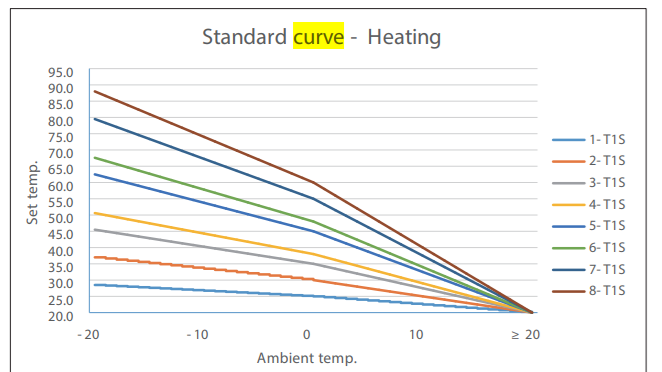
Re: WC curves - I have found that '4' is too cold and '5' is ever so slightly too warm - especially upstairs. My thoughts are that I could turn down the lockshields upstairs (how much of a turn would you start with for the lockshields? 1/2?) or try to create a custom curve between 4 and 5.
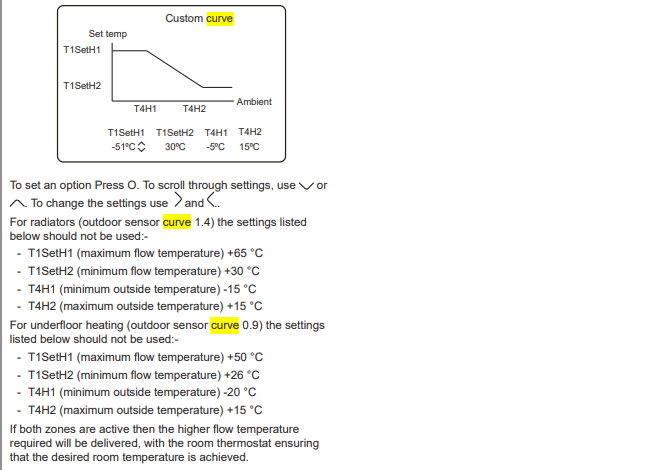
The manual does not give me any understanding as to how to set a custom curve:
Can anyone decipher and advise as to what T1SetH1, T1SetH2, T4H1 and T4H2 would be if I wanted to put between 4 and 5? Sorry to have to ask again but I really can't be sure what to do.
Regarding the noise I have been in the floorboards and the loft, removed some clips and am supporting the humming pipes with some foam for now. That has definitely helped and I am convinced that the issue is due to pipe resonance. The installers will be having a look this week but I'm not sure what else they'll be able to do. Maybe turn the flow rate down?