Joining the Renewable Heating Hub forums is completely free and only takes a minute. By registering you’ll be able to ask questions, join discussions, follow topics you’re interested in, bookmark useful threads and receive notifications when someone replies. Non-registered members also do not have access to our AI features. When choosing your username, please note that it cannot be changed later, so we recommend avoiding brand or product names. Before registering, please take a moment to read the Forum Rules & Terms of Use so we can keep the community helpful, respectful and informative for everyone. Thanks for joining!
Ecodan Pump Issues… Circulation pump turns off when heat pump compressor turns off
3) I have an ASHP with perfectly sized emitters at 104%
Interesting and great that you are able to run experiments. As a matter of interest what precisely do you mean by 'oversized'. Surely any emitters can be right sized at the right flow temperature and if they are oversized at the flow temperature at which you are running them will overheat the room unless turned off from time to time or flow restricted.
Perhaps I have just answered my own question - do you mean oversized but flow restricted to bring the output back to the right value?
@jamespa sorry James, yes larger surface area, messing with the DT. also this allows even lower running temperature, technically you could over size the emitters to run at 20.5 flow rate to heat a room at 20 if there is enough surface area but this would mean UFH in every surface on all 6 sides of the cube room.
So what I am effectively doing is using a DT of 6 rather than 5 and running at ever lower flow rates. Dont get me wrong, most ASHP especially Vaillant and Ecodan use 5dt at the plate but they fault over to 6 often, so they effectively float, its why I call it a test, it may be that I am wrong and overall it just makes the same outcome on bigger rads with restricted flow. I have balanced all the rads on this circuit as close to 6 as I can.
I have asked Mitsi several times in the past if there is a way to tweak the DT on the programming but they told me there is not they said and if i find a way to do this at the moment I would breach their warranties, so I accept this on my test units. I am sure in the very near future there will be a standard DT 7 across the plate on most brands which will help with most installations in homes keeping the 22mm loop on retrofits.
I don't think this test will make the system for energy efficient as such, just a larger heat transfer so all of the generated heat is usable, minimising wastage, but we are talking 3% not larger gains.
Okay, so simply I've got an oversized ashp which is required to produce more heat than can be expelled into the house, thus it constantly switches to idle because it can't keep the flow temp down.
So with this in mind;
1. I suppose I could switch freeze stat off which would prevent the freeze stat cycling? Its a glycol system so shouldn't freeze anyway.
2. Switch the pump speeds to maximum (5) for DHW and Heating on the FTC6 controller?
3. Switch quite mode onto 1 bar to limit the compressor and fan speed which in theory should limit the amount of heat being produced?
Does that make sense at all?
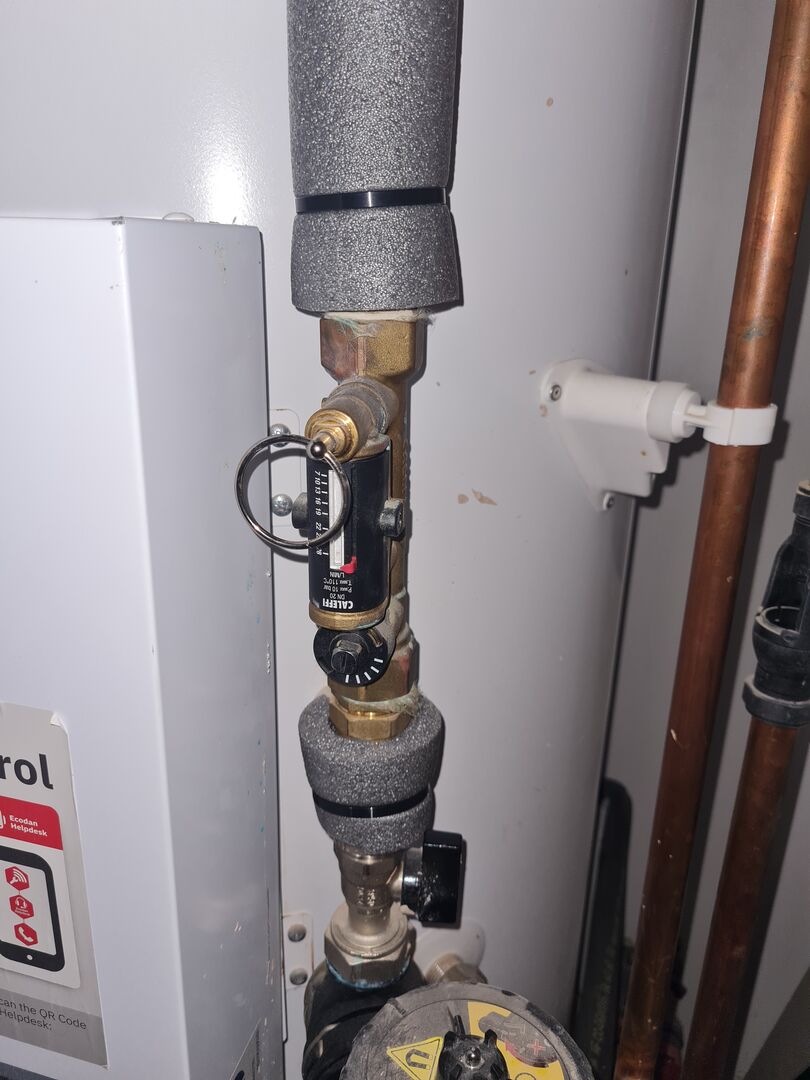
Also any ideas on the pumps? Why would there be a pump on the manifold? It would be good if I could get rid of the mixing valve and pump on the manifold.
With an ashp are the room stats normally linked to the circulation pump on the ashp? On mine they are linked to the pump on the manifold 🥴
@jamespa sorry James, yes larger surface area, messing with the DT. also this allows even lower running temperature, technically you could over size the emitters to run at 20.5 flow rate to heat a room at 20 if there is enough surface area but this would mean UFH in every surface on all 6 sides of the cube room.
So what I am effectively doing is using a DT of 6 rather than 5 and running at ever lower flow rates. Dont get me wrong, most ASHP especially Vaillant and Ecodan use 5dt at the plate but they fault over to 6 often, so they effectively float, its why I call it a test, it may be that I am wrong and overall it just makes the same outcome on bigger rads with restricted flow. I have balanced all the rads on this circuit as close to 6 as I can.
I have asked Mitsi several times in the past if there is a way to tweak the DT on the programming but they told me there is not they said and if i find a way to do this at the moment I would breach their warranties, so I accept this on my test units. I am sure in the very near future there will be a standard DT 7 across the plate on most brands which will help with most installations in homes keeping the 22mm loop on retrofits.
I don't think this test will make the system for energy efficient as such, just a larger heat transfer so all of the generated heat is usable, minimising wastage, but we are talking 3% not larger gains.
I may be wrong though and we will see.
Interesting. A higher DT of course means a higher flow temperature for any given average surface temperature (and thus output to room), thus reducing COP. However larger rads mean a lower flow temp for any given output (to room), thus increasing COP. Which wins or does it work out even, and are there any other effects to take into account? I would guess its too small to measure reliably, unless you have a house in a lab.
Because I don't have flow rate or return temperature monitoring other than with the Mk1 eyeball I don't actually know what my Vaillant is doing with flow rate and in particular whether its modulating it to maintain a particular DT. The impression I have (maybe wrongly - its from occasional observations rather than proper monitoring) is that its doing some flow rate modulation but not particularly actively, so DT varies. I think you are suggesting that both Vaillant and Mitsubishi do modulate pump speed to maintain DT - am I right?
4kW peak of solar PV since 2011; EV and a 1930s house which has been partially renovated to improve its efficiency. 7kW Vaillant heat pump.
@jamespa Yes, it is a balance of transfer using all components of the system so the flow, curve, plate exchange, expansion control and evaporator fan speed / exchange all make small adjustments to balance the whole system for a DT chase of 5. I am just messing around with the small amounts wasted which is very small BTW, it is defiantly not a peer review test, it more for fun because I can.
AAC Group Ltd covering the Kent Area for design, supply and installation of ASHP systems, service and maintenance, diagnostics and repairs.
Okay, so simply I've got an oversized ashp which is required to produce more heat than can be expelled into the house, thus it constantly switches to idle because it can't keep the flow temp down.
So with this in mind;
1. I suppose I could switch freeze stat off which would prevent the freeze stat cycling? Its a glycol system so shouldn't freeze anyway.
2. Switch the pump speeds to maximum (5) for DHW and Heating on the FTC6 controller?
3. Switch quite mode onto 1 bar to limit the compressor and fan speed which in theory should limit the amount of heat being produced?
Does that make sense at all?
Also any ideas on the pumps? Why would there be a pump on the manifold? It would be good if I could get rid of the mixing valve and pump on the manifold.
With an ashp are the room stats normally linked to the circulation pump on the ashp? On mine they are linked to the pump on the manifold 🥴
Thanks
Unfortunately it seems to be oversized. I can answer to you points as follows:
1) I would not recommend this unless you are sure you will check that the glycol content is at least 20% regularly, the frost setting is your last line of defence for plate X protection (I agree you do not need it with glycol but for the cost safe is safe)
2) Pump speeds need to be set at the correct setting to be near 32l/ps anything above or below is not useful, your issue is that you are unable to dissipate the heat, your emitters will be to small and your house is holding the heat to long. (you literally would need to place 4kW of rads in the loft and just expel the heat up there, you need additional emitters and somewhere to reject the heat) I am not suggesting this, I would ask your supplier for another assessment heat loss and to very kindly change the ASHP for one that matches that heat loss. I currently have 2 of these happening in Kent this quarter, clients have just accepted and paid the price (which they should not have to BTW but life is hard sometimes and they accepted this change and cost)
3) I think your are correct here as it slightly reduces capacity
No pump needed on the manifold, of the main Mitsi pump on the PP cylinder is not enough for the home we just change that for a better pump, there is a pump in the manifold because the company installing it used a blending set designed for a 80 DegC Boiler, you can get rid of both mixing and pump on the manifold with some other mods on the systems, you should also consider open looping half your UFH manifold once you have a correct capacity unit.
Its common to link the ASHP to the UFH controls like you have, we at AAC do not do this, we allow the room influence stats and the Mitsi controls to control everything.
Please note: all of the diagnostics here are just based on evidence provided and experience, for what you describe I would advise you speak with the installing company and see what they thank using examples we discussed and defiantly seek a professional in your area to help you with any changes.
AAC Group Ltd covering the Kent Area for design, supply and installation of ASHP systems, service and maintenance, diagnostics and repairs.
Would it not work that lowering the pump speed will give the system more time for the heat to be dissipated through the upstair rads?
Back to my original pictures of the pumps, it seems that the 2 cylinder pumps stop once the flow temp trips. The white vertical one also stops which leads to the upstair rads - would it not be better if I kept that running constantly to help dissipate heat more efficiently?
The manifold pump continues regardless if the ASHP is running or not, it's set to its maximum constant speed. But if the cylinder pumps are switched off will this still cycle or is it pointless?
Would it not work that lowering the pump speed will give the system more time for the heat to be dissipated through the upstair rads?
Back to my original pictures of the pumps, it seems that the 2 cylinder pumps stop once the flow temp trips. The white vertical one also stops which leads to the upstair rads - would it not be better if I kept that running constantly to help dissipate heat more efficiently?
The manifold pump continues regardless if the ASHP is running or not, it's set to its maximum constant speed. But if the cylinder pumps are switched off will this still cycle or is it pointless?
Thanks
Lower pump speed = less flow = lower heat transfer.
Speed 2 - 20lps at DT5 = 7kW
Speed 4 - 30lps at DT5 = 10.5kW
Also the ASHPO will have minimum flow rate and you will start having other tripping issues.
Your issue os the ~DT at room temperature and how well your home holds the heat, as the rooms heat up and the emitters are to small for the 11kW the transfer will reduce.
Its like your home is a 2ltr bucket which is leaking all the time in March at OAT 10Deg C, your HP minimum flow is 3ltrs so the last ltr needs to go somewhere or stop producing and short cycle, either make the home bucket bigger (open all the windows all the time, dump the heat somewhere else) or cycle or have a smaller HP. It will not matter what you do with the system set up as you have it, you cannot offset 7kW's (unless someone else on for forum has found a way to offset such an amount just by changing settings)
AAC Group Ltd covering the Kent Area for design, supply and installation of ASHP systems, service and maintenance, diagnostics and repairs.