Joining the Renewable Heating Hub forums is completely free and only takes a minute. By registering you’ll be able to ask questions, join discussions, follow topics you’re interested in, bookmark useful threads and receive notifications when someone replies. Non-registered members also do not have access to our AI features. When choosing your username, please note that it cannot be changed later, so we recommend avoiding brand or product names. Before registering, please take a moment to read the Forum Rules & Terms of Use so we can keep the community helpful, respectful and informative for everyone. Thanks for joining!
Ecodan Pump Issues… Circulation pump turns off when heat pump compressor turns off
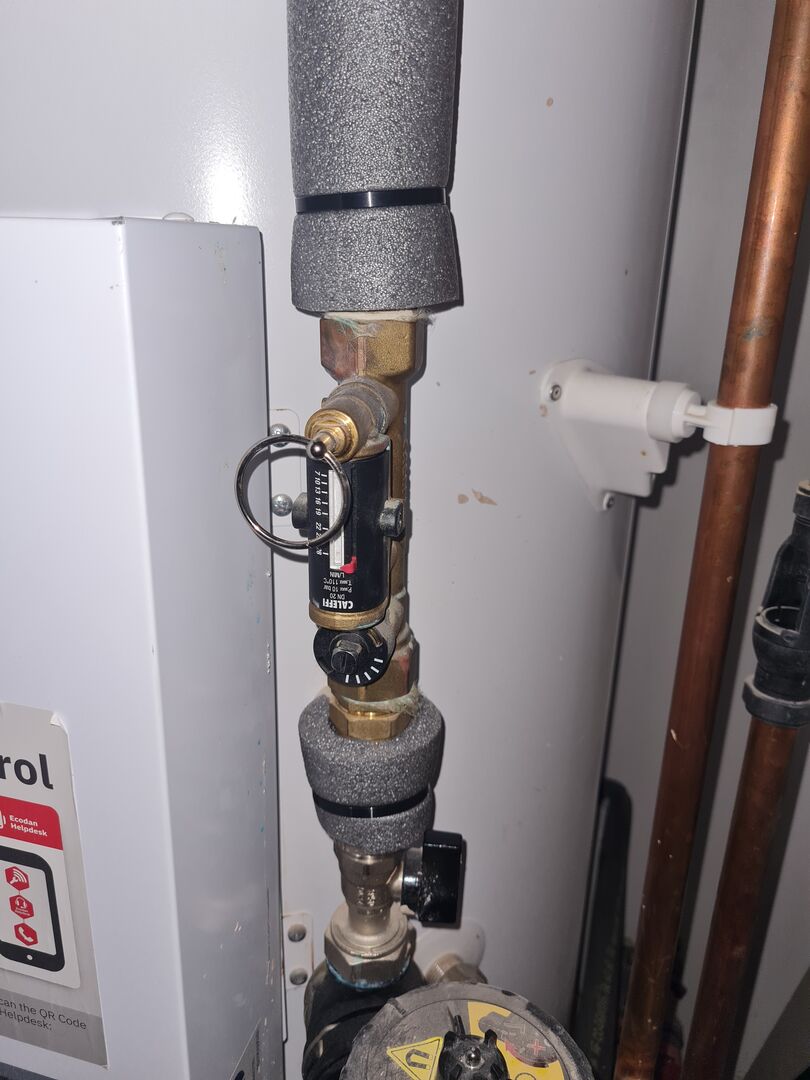
@f1p Perhaps they are not restricting and for some strange reason just installed it read the flow rate?
Completely not needed and adds a bit of resistance for something covered by the controller
Throwing ideas out there, to protect pipework if they use a particularly large primary circulation pump on the 11.2's and someone does increase the speed?
I don't see anything about requiring it in the install manual and I haven't seen one installed before so agree that it doesn't really seem necessary
@f1p I think it could me more there didn't realise the ASHP can indicate the flow when you are setting it up, where units do not have flow meters and were fixed speeds you would have to install an indicator but I think most brands now display the flow rate. I am trying to make stuff up to justify it 🙂
AAC Group Ltd covering the Kent Area for design, supply and installation of ASHP systems, service and maintenance, diagnostics and repairs.
The limit on this is 28L/Min, which I think I'm right in thinking the way they work will prevent the flow for the whole pump to never exceed 28L/min? The recommended is 32L/min....
Would this aid the cycling issues? Surely if the ashp can't deliver the required amount of flow to the emitters then the heat transfer will be less? Therefore having the overrun and cooldown.
Also with this in mind when the pumps (2x on tne tank, and white vertical one) shut off then will the water in the flow and return stay stagnant and slowly cool down?
Thanks everyone for the help, as time goes on I think I'm slowly getting my head around what's happening.
@ashp-bobba It was a very very rough guess the 4kw loss, I could be miles off, unfortunately I haven't seen the engineers calculations, plus I believe they used an external company to design the heating system, so I would like to think they would have spec'd appropriately 😀
@patch321 Ok fair enough with the heat loss (if a 2024 build and its to standard just calculate your home 30wp/m2 and it will be somewhere near that), at least we got the principle across of how oversizing effects a system. If you think the system is a lot closer to design then you could just do some balancing, remove some items and try to improve the system overall.
AAC Group Ltd covering the Kent Area for design, supply and installation of ASHP systems, service and maintenance, diagnostics and repairs.
@ashp-bobba I agree. I think I'll simplify the system just or my own sanity.
It's still oversized using the 30w/m2. I've got a garden office being built, might just run the pipes under the garden (about 15m) and use the ashp to heat the ufh... I'm sure that'll absorb some Kw 😀
Out of interest, when I come to simplify it, there is a pump running continuously (green pump on original post) for hot water, do you need that pump or is there a pump on the cylinder pre-installed which will do that job when it detects a pressure drop for example?
Thanks everyone for your help on this thread, been a big help 🙏