
Notifications
Clear all

06/01/2026 8:54 am
Subsequent to writing the above one more niggle occurred to me. Whilst you set up the upstairs you need to ensure that the heat pump isnt disabled because the heatmiser isn't 'calling for heat'. This is of course an undesirable consequence of multiple control systems - they fight both you and each other. There needs to be one boss!.
I presume that the 'boiler' light on the heatmiser indicates whether it is calling for heat or not, and I also presume that it does so if any one zone 'under its control' calls for heat. What we dont know is whether its connected up to the ecodan and how. Hopefully the heatmiser and the upstairs thermostats are wired in parallel (logical OR), so that if any one is 'on' the heat pump is 'on'. Or alternatively the heatmiser call for heat may just switch one of the pumps so that its not connected to the ecodan at all (if you follow the wiring you may be able to work that out). On the other hand....
The only way to find this out is either to inspect the wiring or play with the thermostats. If its not immediately obvious from the wiring I would suggest to start the procedure by turning down all the heatmiser thermostats until the Boiler light goes off. Then turn up the upstairs thermostats. If the heat pump comes/stays on they are in parallel. and you are good to go. If the heat pump stays off then we have a problem and we need either bypass the heatmiser or arrange that its permanently calling. The latter is probably most easily done by whacking one of the heatmiser thermostats up to max, so the zone never reaches temperature.
Let me know what you find and I may be able to come up with other suggestions. As I say heating systems need exactly one boss! Unfortunately UFH design is often done separately to whole system design (and whole system design is often poorly done) which unnecessarily complicates matters.
PPS Just checked the heatmiser manual The call for heat to the boiler from the heatmiser is just a volt free contact (which is what the Ecodan will have). So simply connecting the wires that go to LS and LR together is a backstop to ensure constant call for heat if the above doesn't work!
This post was modified 2 months ago 2 times by JamesPa
4kW peak of solar PV since 2011; EV and a 1930s house which has been partially renovated to improve its efficiency. 7kW Vaillant heat pump.

06/01/2026 9:47 am
+1 from me on @jamespa's advice.
From what it seems to me, you have a setup that is, apart from a few extra gadgets that would be best removed, exactly what most of us would want to aim for, so the problem for you is one of configuration. This, if we're right, is good news since the only cost is a bit of time and perhaps a few days of slightly compromised comfort whilst the trial and error goes on.
With regard to the running costs, one thing that hasn't been said - albeit hinted at - is that getting a heat pump, especially with solar PV and a battery, can significantly reduce costs but will also polarise those costs greatly. For instance, last January I exported almost nothing, the heat pump was going great guns and the EV was less efficient because of the cold so my net consumption for that one month was 24.43% of the annual total. The four cold months (Jan, Feb, Nov, Dec) accounted for 76.26% of the annual total - three quarters of the consumption in one third of the year. That's pretty scary when you're in the middle of it because it's natural to assume things stay pretty constant, but, as @jamespa said, things do balance out; May and June were months where we generated more than we used, even after taking the EV's voracious appetite into account.
105 m2 bungalow in South East England
Mitsubishi Ecodan 8.5 kW air source heat pump
18 x 360W solar panels
1 x 6 kW GroWatt battery and SPH5000 inverter
1 x Myenergi Zappi
1 x VW ID3
Raised beds for home-grown veg and chickens for eggs
"Semper in excretia; sumus solum profundum variat"
2

06/01/2026 12:06 pm
+1 from me on @jamespa's advice.
From what it seems to me, you have a setup that is, apart from a few extra gadgets that would be best removed, exactly what most of us would want to aim for, so the problem for you is one of configuration. This, if we're right, is good news since the only cost is a bit of time and perhaps a few days of slightly compromised comfort whilst the trial and error goes on.
With regard to the running costs, one thing that hasn't been said - albeit hinted at - is that getting a heat pump, especially with solar PV and a battery, can significantly reduce costs but will also polarise those costs greatly. For instance, last January I exported almost nothing, the heat pump was going great guns and the EV was less efficient because of the cold so my net consumption for that one month was 24.43% of the annual total. The four cold months (Jan, Feb, Nov, Dec) accounted for 76.26% of the annual total - three quarters of the consumption in one third of the year. That's pretty scary when you're in the middle of it because it's natural to assume things stay pretty constant, but, as @jamespa said, things do balance out; May and June were months where we generated more than we used, even after taking the EV's voracious appetite into account.
Worth also adding that, assuming you know the rough overall annual costs, then most, if not all, energy suppliers will enable you to pay via a fixed monthly direct debit, which will enable you to even out the cost over the year, if you prefer this to incurring it in real-time. I use my Octopus account in this way, allowing it to build credit in the summer and then letting this get utilised in the winter.
130m2 4 bed detached house in West Yorkshire
10kW Mitsubishi Ecodan R290 Heat Pump - Installed June 2025
6.3kWp PV, 5kW Sunsynk Inverter, 3 x 5.3kWh Sunsynk Batteries
MyEnergi Zappi Charger for 1 EV (Ioniq5) and 1 PHEV (Outlander)
User of Havenwise (Full control Jun-Dec 2025, DHW only from early Dec)
Subscriber to MelPump App data via CN105 Dongle Kit
2

Topic starter
06/01/2026 5:09 pm
Marvellous. And what tariff are you on with which supplier?
We're looking to go with Octopus, but waiting for the solar guys to talk us through everything.
Topic starter
06/01/2026 5:18 pm
Thanks, as always, @jamespa for your help and advice here. This sounds like a sensible way forward. The installer got in touch with us today and he will be coming round tomorrow, so I am going to scour your posts to come up with a list of questions for him. I think one of the major ones is understanding what all those pumps do and how the UFH and rads relate to one another. I don't know if it's possible, but I'm keen to understand whether it's possible to get another Mitsubishi wireless RC for downstairs and run the UFH off that. However, as it's all Heatmiser, I wonder if we're just a bit stuck with what we've got.
A couple of questions based on your very helpful way forward
Turn off all room influence on the mitsubishi controller, operate on pure WC
So, all thermostats on MAX, open or remove rad TRVs, and adjust the heating schedule to run permanently at 21c (rather than scheduling set-backs) for the time being?
If you are heating your DHW to more than about 48 you are wasting energy.
Heating is set to 48c, but we'll experiment with moving that down a touch.
PPS Just checked the heatmiser manual The call for heat to the boiler from the heatmiser is just a volt free contact (which is what the Ecodan will have). So simply connecting the wires that go to LS and LR together is a backstop to ensure constant call for heat if the above doesn't work!
A question I'll definitely be asking of the installer. Thanks so much to all of you for your support. Communities like this are a real godsend. I'll let you know how I get on tomorrow!
GF
06/01/2026 5:37 pm
I'm keen to understand whether it's possible to get another Mitsubishi wireless RC for downstairs and run the UFH off that
Doubtless its possible but Im not currently sure its necessary or even desirable. You have plenty of kit much of which is unnecessary and unhelpful, before spending money on yet more kit I would seek to get it working in the simplest way possible. The challenge, quite honestly, is to set it up in a way that disables most of the controls so that there is only one boss, ideally so that it runs purely on weather compensation with any remaining thermostats acting as limiters to deal with solar gain, not as controllers.
So, all thermostats on MAX, open or remove rad TRVs, and adjust the heating schedule to run permanently at 21c (rather than scheduling set-backs) for the time being?
Yes, to get the upstairs at a comfortable temperature and running on WC turned down as low as is consistent with heating the upstairs. Once thats working satisfactorily you can deal with the downstairs which for the time being can remain on thermostats provided you deal with the 'call for heat' issue mentioned above, if indeed there is one.
I'll let you know how I get on tomorrow!
Good luck. Depending on the installer they will either be helpful or give you a load of BS and tell you not to touch anything. If they do the latter, which on balance is probably the more likely, just note what they say and any nuggets of actual information and come back here! What you could really do with is a system diagram (electrical and plumbing) and almost the best thing the installer could do is provide one. Its unlikely to happen though, that mess of wires loosely hanging tells you something.
This post was modified 2 months ago 3 times by JamesPa
4kW peak of solar PV since 2011; EV and a 1930s house which has been partially renovated to improve its efficiency. 7kW Vaillant heat pump.
06/01/2026 5:55 pm
Marvellous. And what tariff are you on with which supplier?
We're looking to go with Octopus, but waiting for the solar guys to talk us through everything.
That makes plenty of sense. Perhaps more importantly, Octopus seem happy to accommodate people changing their minds quite regularly. When I last switched tariffs, they said I'd have to stay on that tariff for at least a month before being able to switch again, which is a far cry from the "at least a year" lock-in I was expecting. As a result, you can pick a tariff that works for you now (e.g. a tariff that gives really cheap night-time rates to fill the battery that you can then use during the peak rate) and then move to another tariff in a few months once you've got a better handle on the nuances and complexities. Remember, also, that you now need to consider import and export tariffs.
105 m2 bungalow in South East England
Mitsubishi Ecodan 8.5 kW air source heat pump
18 x 360W solar panels
1 x 6 kW GroWatt battery and SPH5000 inverter
1 x Myenergi Zappi
1 x VW ID3
Raised beds for home-grown veg and chickens for eggs
"Semper in excretia; sumus solum profundum variat"
2

07/01/2026 9:35 pm
Hi @green_fox
As a we have a PUZ-WM80VAA with FTC7 (the 8kW R290 Ecodan) I might be able to add some Mitsubishi specific info...
Immediate problems
- Lukewarm radiators upstairs: details on property and setup provided below, but temperature upstairs is set to 22c in day time with set back to 19c overnight (programmed via FTC7 and on a weather compensation curve). The upstairs struggles to get anywhere near 19c in the day time.
- Sky high consumption and delivery: In Jan 2026, 170 kWh consumption (16 DHW / 153 Heating) and 455 kWh delivered (37 DHW / 418) so far. This seems absolutely eye watering for five days use, particularly as there’s only two of us in the property with relatively modest temperature requirements. In December, the KwH delivered was around 2500! As you can imagine, we are petrified of the incoming bills.
- Auto Adapt error: when I try and switch the control function from compensation curve to AA, the FTC generates a P1 code after 2-3 mins.
As James has already said, better to have no set back if you are struggling with heating upstairs.
Are you getting the consumption and delivery figures from the FTC7 or MelCloud? The consumption figures are just estimates and not very accurate ones at that, in the past 12 months mine has over estimated by an average of 15%.
Putting P1 into https://les.mitsubishielectric.co.uk/installers/error-code-lookup gets:
| Code Text | Description | Cause | Check Procedure | Technical Support Notes |
|---|---|---|---|---|
| P1 | Room sensor fault. | Faulty thermistor, loose wiring connection on the PCB or sensor setting incorrect. | Check the thermistor for short or open circuit, check wiring connection. Check settings in the main controller, Initial settings>Room sensor settings>sensor settings>Sensor setting, then change the sensing point from TH1 to main R/C or Room R/C depending on what type of thermostat you are using. | |
| P1 | Return air thermistor fault (TH1).
PCB detects incorrect temperature reading from thermistor. |
Faulty thermistor - dead short/open circuit.
Damaged thermistor cable or poor connection to PCB. PCB incorrectly reading thermistor value. |
Check connection of thermistor on PCB and thermistor wiring.
Unplug thermistor and test resistance value - correct reading can be determined using Thermistor Value Look Up in app. Thermistor temperature type is 'NORMAL'. If all the above are correct then replace the PCB. |
Correct reading of thermistor can be determined using Thermistor Value Look Up in app.
Check whether the thermistor is for reading High temperature e.g. Discharge, or Normal running e.g. Ambient/Liquid, to determine which range to check against. |
So probably either the system is misconfigured or a problem with the thermistor (temperature sensor) in the wireless RC.
Current setup
DHW
- set to ‘eco’
- tank temperature is set to 48c with max temp drop of 10c
- Scheduled to heat up for three blocks: 5-6am; 12-1pm; 5-6.30pm. I appreciate this is probably very inefficient and egregious. While not very ‘green’, we both have a bath every other day and we’re struggling to ensure enough hot water even with a 300l tank.
300L should be plenty for two people, even with a bath every day. But is your hot water tank in an unheated room?
Pump setting: 5 for DHW / 5 for Heating (I haven’t messed with these since the system was installed)
Current flow rate at 1100hrs on 5/1/2026: 28
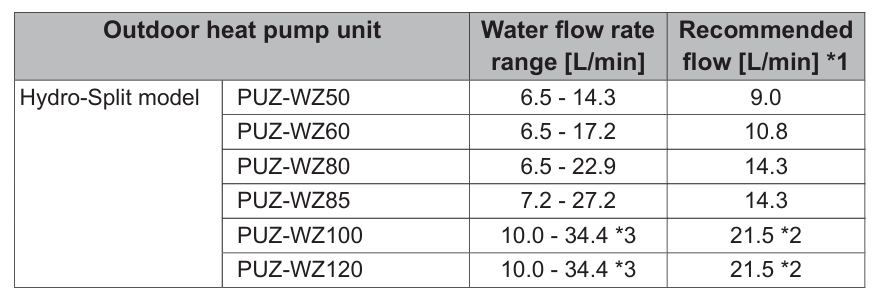
The pump setting (of 5) and flow rate (28 lpm) are way too much for a 6kW heat pump, a flow rate of 28 lpm is more than is recommended for the 12kW Ecodan! Mitsubishi's data book (Ecodan_ATW_Databook__PUZ-WZ__Vol.1_.0_.pdf) has the following table:
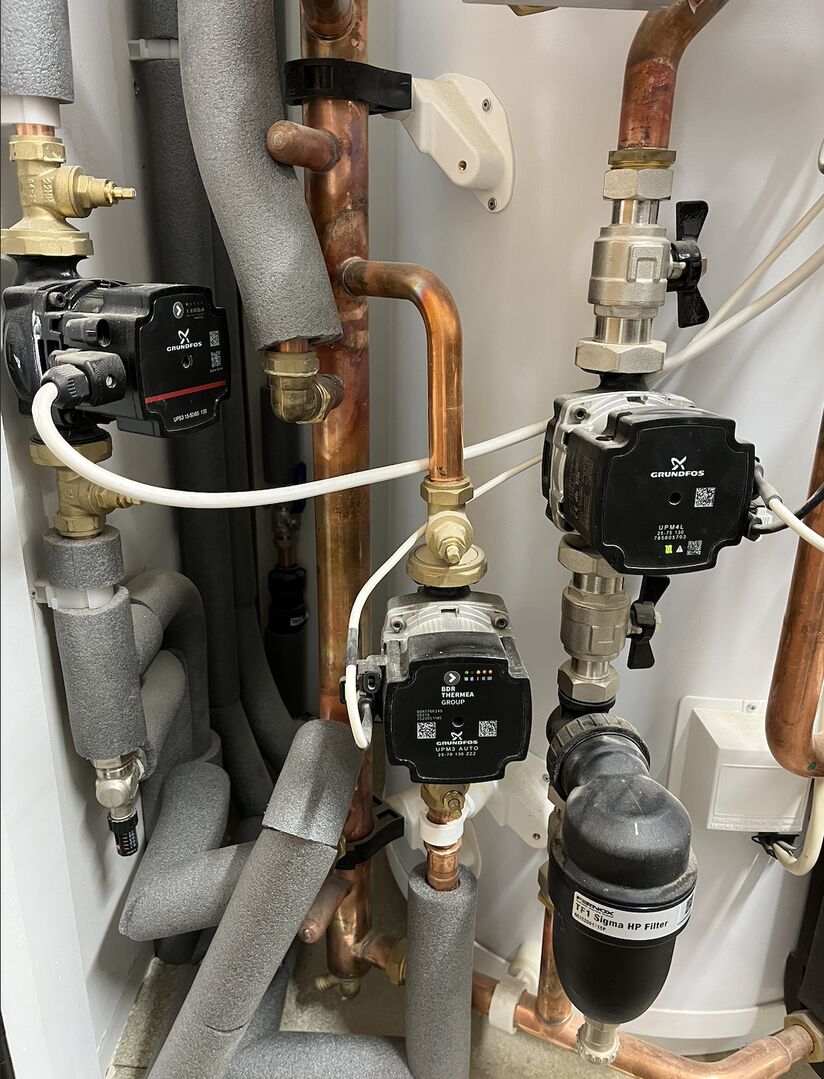
Looking at the photos the pump on your UFH manifold and the left most silver/black pump in your plant room are both running at their maximum (they have all three LEDs on). Those two pumps are also powerful ones (25-70 and 25-75), I can't read the numbers on the black pump on the left. You seem to have far more pumping capacity than 4 bed semi needs.
The two pumps on the left in the plant room (black and silver/black) are connected to the LLH (vertical "pipe" with multiple pipes connected into it on left of hot water tank), do you know which is connected to your radiators and which is connected to your UFH?
@jamespa There seems to be two secondary pumps on the UFH, one in the plant room and one at the manifold. The one at the manifold is a 7.5m head unit running at max, the other one could be the silver/black 7.0m head one in the plant room also running at max. So the cooler than ideal upstairs could simply be down to insufficient flow to the radiators because most of the flow is going to the UFH.
Final comment, did your installer leave all those copper pipes near your hot water cylinder uninsulated? Building regulations (and good practice) says that they should be insulated.
1
08/01/2026 10:59 am
@jamespa There seems to be two secondary pumps on the UFH, one in the plant room and one at the manifold. The one at the manifold is a 7.5m head unit running at max, the other one could be the silver/black 7.0m head one in the plant room also running at max. So the cooler than ideal upstairs could simply be down to insufficient flow to the radiators because most of the flow is going to the UFH.
I hadn't spotted that there were two pumps in the UFH (well spotted!) but I had recognised the risk that the upstairs rads weren't getting enough water which is why I wrote this in my 'recipe'.
If you have one, check the temperature drop ('DT') across the radiators with a thermocouple or thermal camera. It should be 3-8C, preferably towards the bottom end of this range. If its higher ask for advice on adjusting pumps etc before proceeding further - you may want to force more water upstairs and less downstairs to reduce the DT thus enabling you to reduce the FT.
4kW peak of solar PV since 2011; EV and a 1930s house which has been partially renovated to improve its efficiency. 7kW Vaillant heat pump.
Topic starter
09/01/2026 7:21 pm
Evening folks,
Just wanted to provide an update after a couple of conversations with the Ecodan installer. If I’m honest, I’m left feeling even more confused than before.
Let’s focus on the useful information to start:
- Radiators have now been re-balanced. Developer also attended to a rather… novel ventilation feature (window sills hadn’t been properly sealed so wind whistling in). This now means the gable end bedroom feels less chilly.
- Fenix thermostats for the upstairs bathrooms: these control UFH “mats” in the bathrooms. They have an air and floor sensor.
- Auto Adapt does not function as the DIP switch is off. No idea why and installer didn't seem bothered about it. That may account for P1 error code.
- I may have misheard the installer, so apologies if this doesn’t accord, but he said there’s a 45c flow temp to rads, but that this is then blended down to suit the “wet” UFH.
- Installer removed all Heating programming and re-set WC curve to 46c / -5c.
- Noted the hanging wires and the sparky is coming back to put those in some conduit.
- Additional lagging arranged for outside unit.
On to the confusing side of things:
- The various pumps (Pump 1 image below)
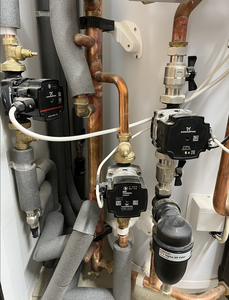
Installer advised the mid pump was for the rads, and the left hand pump was for “wet” UFH. I queried that the mid pump had the same number of lights on as the pump near the UFH manifold, but that observation wasn’t acknowledged.
- Advised setting the Heatmiser downstairs thermostats to 22c and leave them.
- I queried why the heat pump seemed to be cycling once an hour. He mentioned the defrost function, but that seemed a little off. Would it really be defrosting every hour?
- Over the past 24 hours, the temperature has been rather up and down. Is this normal in these cold conditions?
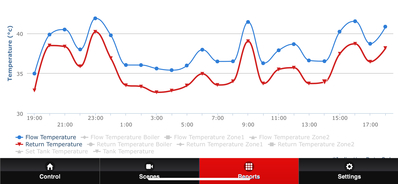
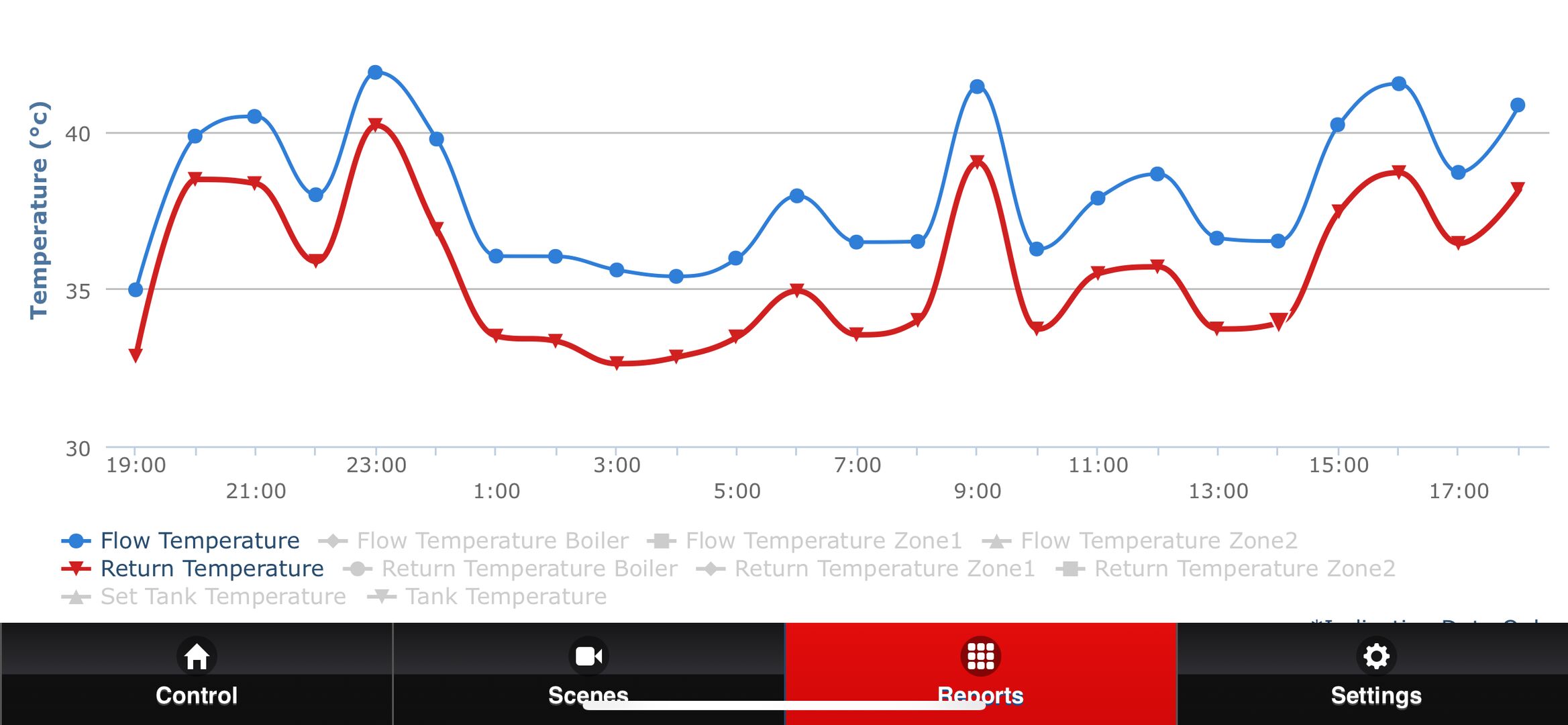
So, as far as I understand it, the house is now set to weather compensation curve, but what I’m less sure about is how the wireless RC and the Fenix thermostats interfere with / influence that.
Based on the above, I’m assuming that @jamespa's recipe still holds:
- Open the upstairs TRVs
- Set temperature to max on Wireless RC & also Fenix thermostats?
- Set WC curve to 50 / -5 and then adjust down from there?
- Attend to downstairs later
Thanks, as always, for your help and advice.
Have a good weekend and stay safe all.
GF
09/01/2026 8:35 pm
- I queried why the heat pump seemed to be cycling once an hour. He mentioned the defrost function, but that seemed a little off. Would it really be defrosting every hour?
In Ecodan world there are two bits of terminology that are easily confused.
Anti-freeze protection (which MelCloud shows as a running mode as Freeze Stat operation) is when it runs water at low temperature around the system, and kicks in at around 5°C outside temperature. It causes cycling when it's a factor, but is only typically an issue (on my system at least) at 4 or 5°C. Below that, the system is providing heat for longer periods consistently, so it doesn't kick in, except immediately after a DHW reheat.
Defrost mode, which doesn't show up in MelCloud as a specific mode of running, is when the heat pump periodically reverses it's operation and provides heat to the pump to melt ice on the fan blades. The heat pump will do this whenever it's required, so it occurs a few times a day at anything from 3°C or below, as a rough guideline.
I suspect by 'defrost function' he was referring to the freeze stat mode, as I've not hit a temperature yet where defrost occurs on an hourly basis, and I've had temperatures as low as -4°C in this cold spell. You can probably work out the context he meant depending on what temperatures you've been getting where you live today. If it's around the 4°C mark, as it has been here today, then that would definitely suggest anti-freeze mode rather than defrost.
130m2 4 bed detached house in West Yorkshire
10kW Mitsubishi Ecodan R290 Heat Pump - Installed June 2025
6.3kWp PV, 5kW Sunsynk Inverter, 3 x 5.3kWh Sunsynk Batteries
MyEnergi Zappi Charger for 1 EV (Ioniq5) and 1 PHEV (Outlander)
User of Havenwise (Full control Jun-Dec 2025, DHW only from early Dec)
Subscriber to MelPump App data via CN105 Dongle Kit
09/01/2026 9:02 pm
Fenix thermostats for the upstairs bathrooms: these control UFH “mats” in the bathrooms. They have an air and floor sensor.
I suspect these are electric mats not wet so totally separate from the rest of the system. This should be obvious by the presence eg of a switch. These don't need to be touched when tuning the system assuming my suspicion is correct.
4kW peak of solar PV since 2011; EV and a 1930s house which has been partially renovated to improve its efficiency. 7kW Vaillant heat pump.

Latest Posts
-
Issue with a Grant Air Source Heat Pump & Tado Smart Thermostat
Hi all I'm having some trouble with a Grant ASHP and ...
By Renewables345 , 30 minutes ago
-
RE: Underfloor Heating Installation Issues with Heat Pump
We suffered a water leak last year in two rooms and had...
By MartinHook_UK , 41 minutes ago
-
RE: Testing new controls/monitoring for Midea Clone ASHP
Now seems a good time to summarise the costs and effici...
By benson , 50 minutes ago
-
RE: Heat Pump vs New Gas Boiler for Inherited House - Worth the Extra Cost?
*** I now see @jamespa has already posted but will stil...
By cathodeRay , 2 hours ago
-

RE: Tell us about your Solar (PV) setup
@mk4 Charge to 100%, discharge down to 10%.
By bobflux , 2 hours ago
-
RE: Daikin Altherma 3 LT compressor longevity question
This mess is intriguing: I wonder if this represent...
By bobflux , 3 hours ago
-
RE: Connecting Growatt SPH5000 over wired ethernet rather than wireless
The simplest wired option is usually the Growatt Ethern...
By Jonatan , 8 hours ago
-
RE: Peak Energy Products V therm 16kW unit heat pump not reaching flow temperature
ASHPs do have a minimum compressor speed. The minimum h...
By bobflux , 14 hours ago
-

RE: Electricity price predictions
@jamespa And it seems some of the nasty public cloud...
By Batpred , 15 hours ago
-

RE: Jokes and fun posts about heat pumps and renewables
Technology is rapidly advancing. BBC News reported th...
By Transparent , 18 hours ago
-
What matters for flow and pressure drop is internal dia...
By bobflux , 19 hours ago
-

RE: Do Fridges and Freezers have COP ratings?
@editor Thank you all for your replies and submitted in...
By Toodles , 21 hours ago
-
I know and yes. The secondary deltaT wont necessaril...
By JamesPa , 1 day ago
-
RE: Designing heating system with air to water heat pump in France, near Lyon
Just love the way you put it! 🤣
By Batpred , 2 days ago
-
RE: Safety update; RCBOs supplying inverters or storage batteries
Thank you for sharing. So it seems that your Schneid...
By Batpred , 2 days ago
-

RE: Forum updates, announcements & issues
@upnorthandpersonal thanks for the thoughtful, consider...
By Mars , 2 days ago
-
RE: Solar Power Output – Let’s Compare Generation Figures
@mk4 All 21 panels have their own Enphase IQ7a microinv...
By Toodles , 2 days ago
-
RE: Setback savings - fact or fiction?
Great, so you have proven that MELCloud is consistently...
By RobS , 3 days ago
-
RE: Mitsu PUHZ120Y 'Outdoor Temp 'error?
Thanks David & James It almos...
By DavidAlgarve , 3 days ago
-
RE: Surge protection devices SPDs
@trebor12345 - your original Topic about the right type...
By Transparent , 3 days ago
-
RE: Help needed with Samsung AE120RXYDEG
@tomf I’ve been sent this from a service engineer at Sa...
By Mars , 3 days ago
-
RE: Buying large amp bidirectional RCD and RCBO
Yes... I went through this particular headache and ende...
By bobflux , 4 days ago
-
O-oh! Let's take this as an opportunity to 'pass the ...
By Transparent , 4 days ago