Joining the Renewable Heating Hub forums is completely free and only takes a minute. By registering you’ll be able to ask questions, join discussions, follow topics you’re interested in, bookmark useful threads and receive notifications when someone replies. Non-registered members also do not have access to our AI features. When choosing your username, please note that it cannot be changed later, so we recommend avoiding brand or product names. Before registering, please take a moment to read the Forum Rules & Terms of Use so we can keep the community helpful, respectful and informative for everyone. Thanks for joining!
It appears Output Power = 0kW because there was a DeltaT of 0 Which doesn't appear correct because it was 4C according to the data.
Like you say, i presume this is a timing/capture thing, in particular with the Home Assistant firmware which has different refresh rates for different parameters giving higher resolution when viewed there.
Just a note on the Thermo. Diff setting - it only applies in Auto Adapt. It appears you are in Compensation and therefore overshoot is only +1.0 This is the classic Flow Temp overshooting Flow Setpoint issue
The Ecodan was initially set to a +5/-5 tolerance, which is it's default option. I've subsequently adjusted this to +3/-7, but it still works around a 10°C tolerance around the flow temperature currently.
I wonder, @sheriff-fatman, if Mitsi have chosen to use a shared parameter between defrost cycle and freeze protection. If that were the case, we’d see a software-induced correlation rather than a physics correlation, but a correlation nonetheless.
“Curiouser and curiouser”, said Alice…
Frost Protect/Freeze Stat is an operation mode, where Defrost is a multi-stage status flag (however i only see two used).
In the firmware i inject defrosts to the Operation Mode status for easier viewing and understanding of users.
@robs Just to quickly fill in some of the gaps in the response, now that I have more time to post properly (I think the car moved about 10 metres in 30 minutes while sending the one last night, so I wasn't typing whilst moving but I didn't have the normal time to compose a post, and I didn't want to leave it unresponded overnight, given the time taken on your reply).
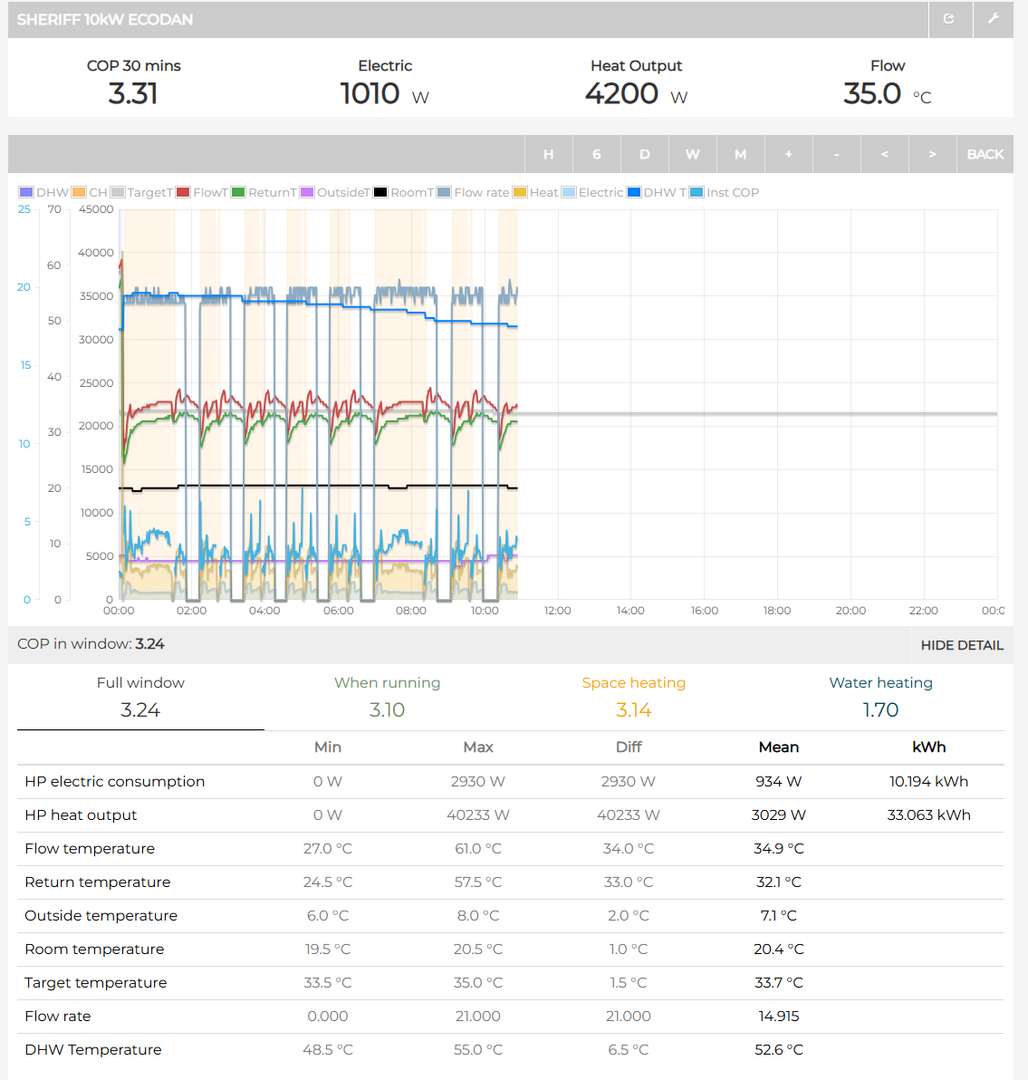
Just on this, as I'd spotted similar things with the output previously, there's an instant COP calculation of 3.63 in the same snapshot, which doesn't match the input and output figures, so I think there's probably an issue with how the output data is displaying from time to time. @f1p might be able to shed more light on this, as he makes and sells the dongle device, and liaises with the MelPump team, whom I believe are a separate entity. The dongle, as far as I recall, polls every 10 seconds so the 5 minute snapshots are summarising this data in some way, but this one is an example of where the output looks odd. The fact that the COP figure is non-zero suggests to me there's undisplayed data, and I assume its the output data where this manifests, based on the fact that it looks to be the obvious 'wrong' number.
No worries and hope you don't have to sit in traffic too often!
Is it possible to get Home Assistant to record data points more often than 5 mins? Every 1 minute would be good. Also, are some of the values averaged over the time period and others the current value at the time the data points were captured? That might explain some of the odd combinations of values.
From your earlier post, Phil has described the Thermo Diff setting and the 1C overshoot in another post. A conservatory would account for needing a 10kW heat pump but do you always heat the conservatory when you heat the rest of the house?
Just to clarify my point from yesterday evening's post, it's not the cycling itself that I'm querying, as I understand the general concept of what is going on and, like you, I have questions about how effectively the Ecodan is able to modulate down.
The databook says that your 10kW Ecodan can only modulate down to 3.5-4.0kW in mild temperatures (7-15C), but then it has the same compressor as the 12kW. For comparison the new 8.5kW can modulate down to 2.5-3.5 and the new 5/6/8kW Ecodans down to 1.8-2.0kW.
At slightly higher temperatures, as we experienced yesterday, it switches to idle for a period of time as part of the cycling process, which in turn increases the overall COP relative to it's output. I'm not sure if all heat pumps are designed to do the same thing, but in general terms cycling whilst constantly running is only something that seems to occur within a range of outside temperatures of 4-7°C.Below 4°C, it runs generally in equilibrium. Above 7°C it includes idle periods within the cycling loop, as it's doing currently, as shown below, and the idle periods are adding about 0.1 to the daily COP as per the summary stats, as there is still a diminishing delta T during these idle periods providing some heat output into the mix. Most of the data snapshots taken in your reply are at OAT of 9°C, and one of them looks to have picked up an idling period within this, so it's outside of the area where the freeze stat issue is occurring.
Heat pump cycling isn't sinusoidal, the ons and offs don't follow as a set period - the frequency of both is variable. One thing I have noticed with our Ecodan is that if the flow temperature gets too high and it cycles off then it is quick to restart but if the wireless remote stops the heat pump (e.g. because of solar gain) then the heat pump is slow to restart (the internal temperature needs to drop before the heat pump restarts). This difference could be the cause of your different types of cycling.
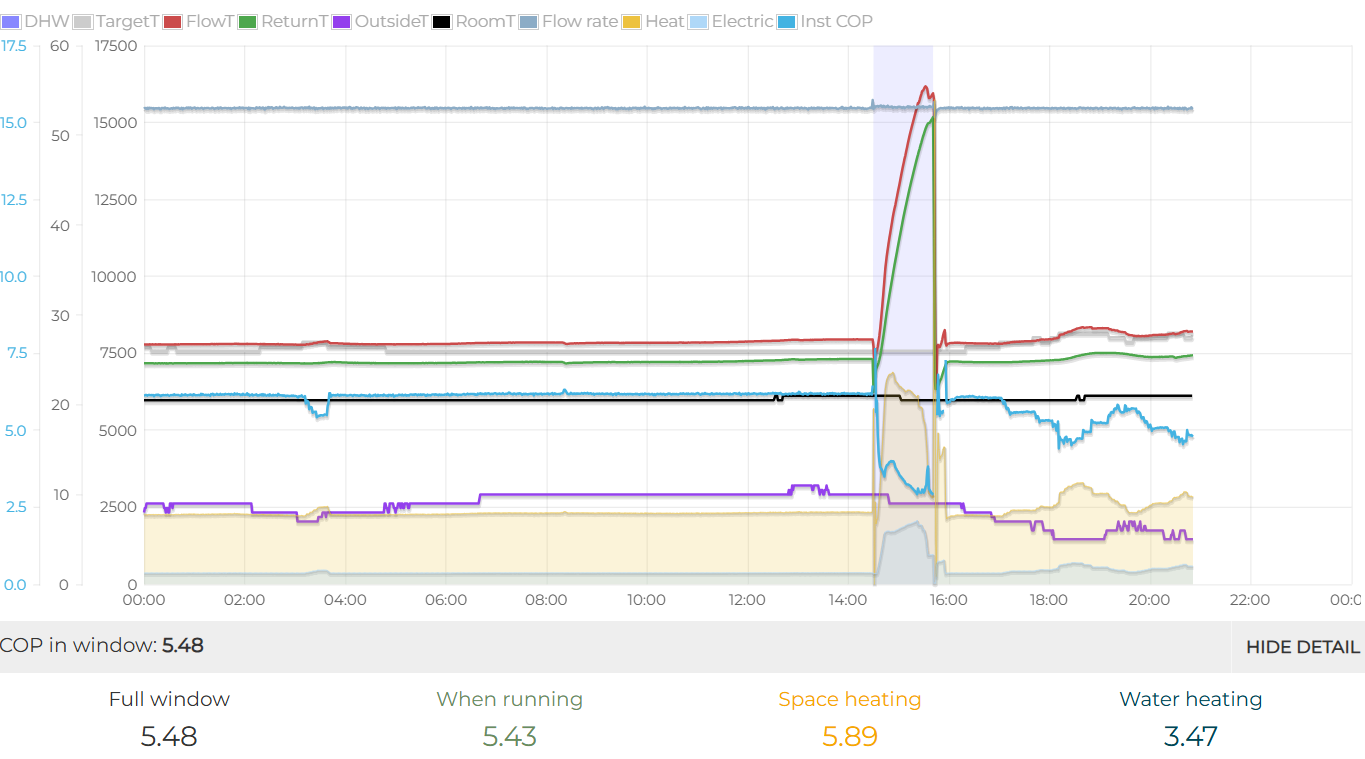
Your water flow rate doesn't seem very stable in the EmonCMS image above, Ecodans usually use constant flow rate pumps and so their flow rates don't vary much (see the example of our system below). Do you have TRVs or UFH thermostats opening and closing bits of the system?
If that's how the system will operate on weather compensation in warmer periods, then I can live with that, as it's going to be doing the same overall thing as the Havenwise control methodogy of having idle periods between 'blasts' of heat and the WC blasts based on flow temperature should overall be gentler and more consistent than those that were being driven by the internal room stats within Havenwise control. It seems a sensible way for the heat pump to run if it's unable to modulate down appropriately.
The bit that doesn't make logical sense to me, and which still remains unclear, is why there's a distinct pattern of behaviour within the small range of 4-7°C where the cycling activity is erratic at a specific temperature of 5°C, relative to the less frequent cycling around it, and why this behaviour improved via a change in the freeze stat protection settings.
In mild weather heat pumps need to cycle if they can't modulate down low enough, how the cycling is controlled is key to efficiency though.
Maybe a specific temperature at which the interaction of WC curve temp, heat pump flow temp overshooting and load/emitter output causes the most flow temperature overshoot cycling? But it could be a bug in Mitsubishi's software, with more mild temperatures forecast would you be willing to switch freeze stat off and see what happens in the 4-7C temperature range?
Is it possible to get Home Assistant to record data points more often than 5 mins? Every 1 minute would be good. Also, are some of the values averaged over the time period and others the current value at the time the data points were captured? That might explain some of the odd combinations of values.
In the Home Assistant firmware the data points are between 2s and 25s depending how important the values are, e.g. compressor frequency, flow, return temps are the most frequently refreshed
Thought I'd drop in and give you an update on our Ecodan 6kw heat pump situation. I'm now in a slightly more frustrating situation where I think I understand the system a little better now, but, despite some mild temps over the last wee while, our COP remains poor and energy usage very high.
Changes made since last update - Weather compensation curve adjusted as per @jamespa's recipe during Jan's cold snap to 44 / -5. This has resulted in a decent 19-20 upstairs temp. We can probably afford to go a little lower, but I don't want to play around with it during the mild spell.
- Reduced pump speed from 5 / 5 to 3 / 3. This has brought the flow rate down to approx. 21 l/m (delta-t still very poor often only 1-2c difference between flow and return).
- DHW reduced to 48c and scheduled to heat during solar window / cheap tariff, rather than automatically reheating throughout the day (which was the advice given by our installer).
- Downstairs UFH Heatmiser stats set at around 19-20c to stop overshoot and constant call for heat. Unsure if this is appropriate or not, or whether I should instead set them at an unachievable high temp, e.g. 25c, in order to keep the system as 'open' as possible.
Brass tacks – COP
- Jan 2026: 2.89
- Feb 2026 so far: 2.86
Any and all suggestions welcome. I'll be calling Mitsubishi this week for some further advice because, frankly, my partner is sick of me spending all my time in the garage with the Ecodan or on the MELCloud app.
- Reduced pump speed from 5 / 5 to 3 / 3. This has brought the flow rate down to approx. 21 l/m (delta-t still very poor often only 1-2c difference between flow and return).
The only time its worth worrying about DT is if its too HIGH or there is a problem with not getting warm enough. Otherwise low DT is good not poor! 21l/min corresponds to a DT of 5 at 7.3kW load, so your low DT is likely due to low load. Again, unless the house isn't warm enough don't worry about it.
-DHW reduced to 48c and scheduled to heat during solar window / cheap tariff, rather than automatically reheating throughout the day (which was the advice given by our installer).
- Downstairs UFH Heatmiser stats set at around 19-20c to stop overshoot and constant call for heat. Unsure if this is appropriate or not, or whether I should instead set them at an unachievable high temp, e.g. 25c, in order to keep the system as 'open' as possible.
If you are certain that there is a constant call for heat and you are happy with the room temperatures throughout the house then the thermostats are doing nothing and your room temperature is being controlled by weather compensation. If this is the case then its fine as is, although (depending on your comfort tolerance for overtemperature) you might want to push it up a degree or so, which (if in fact there isnt a constant call for heat) may enable you to drop the FT a degree.
Personally I would set the thermostats (downstairs and upstairs) at least 2 degrees above the target temp whilst you are experimenting, so there is no ambiguity and they are definitely doing nothing. You can always knock them back later if overshoot is a problem, even having dialed down the WC curve.
Can you confirm that the TRVs upstairs have been disabled either by removing the heads or setting them to max? Also can you confirm you are now running 24x7?
Do you have any way to determine the DT on the upstairs (radiator) circuit alone, that might tell us something important.
Can you please remind us whether you have a buffer, low loss header or plate heat exchanger between heat pump and emitters or a volumiser.
Finally, what was your consumption and heat delivered for the whole of January and roughly where are you (so we can sense check consumption etc.)
Lots of questions unfortunately but the more info you can provide the easier it is to spot opportunities.
This post was modified 8 months ago 10 times by JamesPa
4kW peak of solar PV since 2011; EV and a 1930s house which has been partially renovated to improve its efficiency. 7kW Vaillant heat pump.
I've got the R290 6KW version of the Mitsubishi heat pump and the 170 litre slimline cylinder. So a similar setup to you. I'm across in Falkirk, so not too far from you.
To get the best performance out of mine so far I've increased the radiator flow pump to Proportional Pressure (PP) 3, and slowed the heat pump side of the low loss header right down to speed 1 on the controller. The hot water is speed 2. To set PP3 on the pump on the pipe from the top of the low loss header heading down there is a pump, single press the button with the arrow pointing right until you get one green on the left and the yellow on the right.
From my reading of the specs speed 5 is too fast for the 6kW heat pump (certainly for the R290, R32 that you have will be similar). Also based on information from heat geek for maximum efficiency you need the radiator side of the low loss header to be going at least 25% faster than the heat pump side to allow for variations in heat output.
These changes helped too increase my delta T which was often as low as 2°C to more like 6 depending on outdoor temperature and heat demand.
In the installer settings it is possible to get the flow speeds, so be interesting to see what they are, and how that compares to the heat pump spec.
Agree with the other advice on the thread to maximise the trv setting as much as possible to avoid limiting the flow. I've only got TRVs in the upstairs bedrooms more as an upper limiter.