
Notifications
Clear all

Topic starter
05/01/2026 2:03 pm
Hello all,
I am very much hoping to draw on the expertise and good will of the RHH community as my partner and I seek to understand our Ecodan setup. I am a complete novice and am trying to act like a sponge and soak up as much advice and support as possible in the hope that I can pay that back in due course.
Bottom line upfront: we’ve just moved into a new build 4 bed semi in rural Fife. It’s an EPC A (98) with UFH, 12 solar panels & Fox ESS battery, and Ecodan ASHP. Sounds like a green energy dream, right? I wish…! A big part of the problem is that we moved into the property in December when everyone was knocking off for Christmas. As a result, no one has walked us through the Ecodan controls. The solar and battery are a mystery to us as, again, the installer hasn’t yet walked us through anything. I don’t even know if or what they’re connected to, although the Fox ESS display is on.
We’re in the middle of a cold snap here and, having come from a gas boiler property ‘down south’, we’re having to get to grips with the system quickly and clearly very inexpertly.
Immediate problems
- Lukewarm radiators upstairs: details on property and setup provided below, but temperature upstairs is set to 22c in day time with set back to 19c overnight (programmed via FTC7 and on a weather compensation curve). The upstairs struggles to get anywhere near 19c in the day time.
- Sky high consumption and delivery: In Jan 2026, 170 kWh consumption (16 DHW / 153 Heating) and 455 kWh delivered (37 DHW / 418) so far. This seems absolutely eye watering for five days use, particularly as there’s only two of us in the property with relatively modest temperature requirements. In December, the KwH delivered was around 2500! As you can imagine, we are petrified of the incoming bills.
- Auto Adapt error: when I try and switch the control function from compensation curve to AA, the FTC generates a P1 code after 2-3 mins.
Property details
4 Bedroom semi-detached. Around 180 sqm.
Downstairs: fairly open plan, but with separate utility room, hallway area, and downstairs shower room. UFH downstairs with Heatmiser thermostats in each room plus wood burner in living room.
Upstairs: four bedrooms (including a north-facing gable end), one main bathroom, two en-suites. Rads upstairs (with a Mitsubishi RC wireless). I think all rads are TRV. UFH in bathrooms and heated towel rails. Fenix thermostats for the three upstairs bathrooms.
To my eye, there is a lot of thirty party kit here. I’ve de-programmed the Heatmisers so they’re effectively ‘dumb’. I manually set the temperature to 22c in day and then set back to 19c overnight and leave them alone aside from that. I haven't done much with the bathrooms thermostats aside from setting them to 19c and leaving them.
Hardware
Ecodan 6kW PUZ-WM60VAA with FTC7 controller & 300l water tank
Mitsubishi wireless RC
UFH (may need some guidance on how to provide details on this, i.e. manifold, valves etc)
Solar + Fox ESS battery (not setup yet, so not benefitting from the meagre solar we’ve had the last wee while)
Current setup
DHW
- set to ‘eco’
- tank temperature is set to 48c with max temp drop of 10c
- Scheduled to heat up for three blocks: 5-6am; 12-1pm; 5-6.30pm. I appreciate this is probably very inefficient and egregious. While not very ‘green’, we both have a bath every other day and we’re struggling to ensure enough hot water even with a 300l tank.
Heating
- Downstairs: manually set the Heatmisers to 22c in day time with a manual set back to 19c overnight (from 2200-0700). I know they shouldn’t be treated like normal thermostats, so I’ve tried to keep it as low, slow, and simple as possible. If forum colleagues can think of another way of managing this in the short term then I’m all ears!
- Upstairs: schedule is 0000-0600 @ 19c; 0600-2200 @ 22c; 2200-2400 @ 19c. I’m using the WC curve control for this. The curve is 48c / -3c and 31c / 13c. As mentioned above, I’m struggling to get the upstairs above 19c. It’s usually hovering around 18.5c. I think part of the reason for this is the large master bedroom, which is a north facing gable end. It’s got a large rad, but seems very hard to keep warm.
Some indicative data
No idea if any of the below is useful, but some stats below:
Pump setting: 5 for DHW / 5 for Heating (I haven’t messed with these since the system was installed)
Current flow rate at 1100hrs on 5/1/2026: 28
Thermistor Readings on 5/1/2026 @ 1103hrs
TH1A 18c
THW1 29c
THW2 28c
THW5a 43c
THW5b 43c
TH7 1c
I welcome any advice that forum colleagues might have. I’ve got the MEL app downloaded so if you need me to provide any screenshots then let me know. Similarly, happy to take photos of the inside and outside units if that would be useful. As I say, very very new to this, so treat me like a primary school kid!
GF

05/01/2026 3:27 pm
I have a 11.2 kw ecodan in a 100 year old 4 bed croft house. So far this year we have used 170 kwh of electricity with a COP of 3.12. Outside temperature so far this year has been on average 1.4 oC with min -3.2 and max 6. You mentioned that produced heat is 455 from 170 electricity. That is a COP of approx. 2.67. Heat Geek are pretty good with their advice (not the only source though!) and I would recommend searching for their "3 Steps to maximise your heat pump (or Boiler) Efficiency". Basically open up all your TRV/Smart thermostats to max and let the heat pump do its thing. . Perhaps someone else can help with the room adaption mode error, i havent had that and I have found room adaption to be more efficient. One last point .. this is probably the worst part of the year with a heat pump and you should think about the cost throughout the year. My annual electricity use for the heat pump is around 3200 kwh. I spend on average less than 20p per kwh so £640 for the year. I understand your concern as yesterday we used 40 kwh just for the heat pump!

05/01/2026 3:34 pm
OK so you have read the introduction. As @majordennisbloodnok said this takes time. You have come to this at a great period for adjusting things, but also the one that is inevitably scary because its as cold as its ever going to be outside. The good news is that you have a sensible sized heat pump, not grossly oversized, and a good one at that. With UFH you should be able to achieve good efficiency assuming the rads upstairs are large enough (which we may be able to infer based on a question I will ask at the end).
- Lukewarm radiators upstairs: details on property and setup provided below, but temperature upstairs is set to 22c in day time with set back to 19c overnight (programmed via FTC7 and on a weather compensation curve). The upstairs struggles to get anywhere near 19c in the day time.
- Sky high consumption and delivery: In Jan 2026, 170 kWh consumption (16 DHW / 153 Heating) and 455 kWh delivered (37 DHW / 418) so far. This seems absolutely eye watering for five days use, particularly as there’s only two of us in the property with relatively modest temperature requirements. In December, the KwH delivered was around 2500! As you can imagine, we are petrified of the incoming bills.
- Auto Adapt error: when I try and switch the control function from compensation curve to AA, the FTC generates a P1 code after 2-3 mins.
- Lukewarm radiators upstairs: Radiators should feel lukewarm, dont worry about this, worry about room temperatures and consumption. Your radiators may need balancing' however to get upstairs at the right temp relative to downstairs, but thats a task for a bit later
- Sky high consumption and delivery It really is the coldest time of year, you will be using roughly three times now what you will be using for most of the heating season because (a) your house needs twice the energy because its so cold outside and (b) the heat pump is less efficient at low temperatures. My consumption, with a similar size house, is very similar. But over a season it works out about the same price as gas (20% cheaper last year, about the same projected this year). So please bear with this one and look again over a larger period. That said your current COP is 2.7, it should probably be a bit higher at this time of year and a lot higher for most of the season - see below for how you could likely improve it.
- Auto Adapt error: You may need a Mitsubishi expert for this, but ignore for now and keep autoadapt off!
So now lets look at your setup:
Heating
- Downstairs: manually set the Heatmisers to 22c in day time with a manual set back to 19c overnight (from 2200-0700). I know they shouldn’t be treated like normal thermostats, so I’ve tried to keep it as low, slow, and simple as possible. If forum colleagues can think of another way of managing this in the short term then I’m all ears!
- Upstairs: schedule is 0000-0600 @ 19c; 0600-2200 @ 22c; 2200-2400 @ 19c. I’m using the WC curve control for this. The curve is 48c / -3c and 31c / 13c. As mentioned above, I’m struggling to get the upstairs above 19c. It’s usually hovering around 18.5c. I think part of the reason for this is the large master bedroom, which is a north facing gable end. It’s got a large rad, but seems very hard to keep warm.
Thats unfortunately treating the heat pump like a boiler because (a) you are using thermostats to control it and (b) you are running part time and (c) you are operating at a fairly high flow temperature. You are also conflating upstairs control with downstairs control, which is never going to work satisfactorily. You are right that there is a lot of third party kit, too much - the ideal amount of third party kit is exactly zero! All of this is adding to running cost whilst detracting from comfort - its unlikely to be the most efficient and, as you have discovered, means some rooms arent getting to temp, so we need to set it up properly. This will take a couple of weeks to tweak but fortunately needs to be done only once. Finally running at 48C is much higher than is hopefully necessary if your rads have been properly sized to work with the UFH.
The basic idea of low and slow is to run the whole house 24x7 on weather compensation set to the lowest possible flow temperature consistent with heating your house, with thermostats either disabled or playing a secondary role. This, or something very close, will most likely give the greatest comfort for the lowest cost and is certainly where you should start* Once its basically working you might want to tweak to take advantage of a ToU tarrif if you have one (good idea as you have a battery)
Before we do that however we need two one more pieces of information namely
- how does the connection to your rads and the connection to your UFH relate. Basically are they receiving water at the same temperature or at different temperatures controlled by some sort of mixing valve (probably on the manifold). Can you clarify this please and if there is a mixing valve what's controlling it?
- when you say you are using the WC curve to control the upstairs setbacks, how exactly, what are you changing on what controller?
If you could respond with this I can suggest an outline process to tune it to a hopefully better starting point.
* This seem, and is, initially counterintuitive. However there is a common misconception (which the controls industry has drummed into us for their own benefit) that turning heating off means you are automatically spending less on heating. This is untrue. The house continues to lose energy even though its not being heated, and does so at very nearly the same rate unless it cools a lot (eg by 10C). This energy needs to be put back when you turn the heating back on, so your boiler/heat pump has to work much harder because its got to replace both the accumulated deficit and the energy still being lost whilst its on. Even with a boiler this can cause it to be less efficient, with a heat pump its a major loss of efficiency hence low, slow and generally continuous.
This post was modified 2 months ago 2 times by JamesPa
4kW peak of solar PV since 2011; EV and a 1930s house which has been partially renovated to improve its efficiency. 7kW Vaillant heat pump.

05/01/2026 3:52 pm
Something else I'll add to what @jamespa has said, @green_fox, is that once we've got your heat pump fine tuned a bit and working efficiently you may well be able to start thinking about your heat pump, solar PV and battery in a single more integrated way and manage them all in a way that allows you to look at better leccy tariffs. That could make a significant difference to your running costs purely by bringing down the average unit cost of your leccy. It's not something to consider right now - let's concentrate on the heat pump first - but there are considerably more improvements you can mull over after that work is done.
Just as an aside, what size is your Fox ESS battery?
105 m2 bungalow in South East England
Mitsubishi Ecodan 8.5 kW air source heat pump
18 x 360W solar panels
1 x 6 kW GroWatt battery and SPH5000 inverter
1 x Myenergi Zappi
1 x VW ID3
Raised beds for home-grown veg and chickens for eggs
"Semper in excretia; sumus solum profundum variat"
1

05/01/2026 4:09 pm
- Sky high consumption and delivery: In Jan 2026, 170 kWh consumption (16 DHW / 153 Heating) and 455 kWh delivered (37 DHW / 418) so far. This seems absolutely eye watering for five days use, particularly as there’s only two of us in the property with relatively modest temperature requirements. In December, the KwH delivered was around 2500! As you can imagine, we are petrified of the incoming bills.
Just to provide some immediate context around this, the last few days have been easily the coldest of this year's heating season, and you're at peak usage currently (my average outside temperature in Yorkshire has been negative for the last 3 days, so I suspect yours will be worse). My kWh delivered for December from a 10kW Ecodan system was just over 2,000kWh, so we're in the same overall ballpark, but remember that this figure isn't your consumption, which will be about 1/3 of this across the month (the January figures over the last 5 days suggest a COP of 2.68, but the December figure will be better than this, hence the approximation of a COP of 3 for now).
The other replies will provide some practical guidance to look at specifics within the system, but I just wanted to provide some general context for the figures you've stated, which don't look hugely out of line with my own data in general, and do reflect a particularly cold period of weather over the last 5 days. There will be very few days over the year where your heat pump will have to work as hard as it needs to currently.
What electricity tariff are you on, and is there any element of Time of Use within it (either as a heat pump tariff or an EV specific one?) If not, then looking to move onto something like this might enable an opportunity to immediately reduce the overall cost of usage if all of it is being charged at a standard rate currently.
130m2 4 bed detached house in West Yorkshire
10kW Mitsubishi Ecodan R290 Heat Pump - Installed June 2025
6.3kWp PV, 5kW Sunsynk Inverter, 3 x 5.3kWh Sunsynk Batteries
MyEnergi Zappi Charger for 1 EV (Ioniq5) and 1 PHEV (Outlander)
User of Havenwise (Full control Jun-Dec 2025, DHW only from early Dec)
Subscriber to MelPump App data via CN105 Dongle Kit
1
Topic starter
05/01/2026 5:18 pm
Thanks @skyecraig. I appreciate the moral support. As everything is so new and we've had no walkthrough, it's felt quite daunting, particularly with this cold snap. I am very thankful for all the positive engagement and am hoping I can start the fine tuning!
Topic starter
05/01/2026 5:27 pm
Hello @jamespa - thank you for such a fulsome and generous response. Honestly, I really appreciate that. I can see what you mean about the Heatmisers. I thought I was letting them do their thing, but clearly I am still programming them like a thermostat!
To your questions:
- how does the connection to your rads and the connection to your UFH relate. Basically are they receiving water at the same temperature or at different temperatures controlled by some sort of mixing valve (probably on the manifold). Can you clarify this please and if there is a mixing valve what's controlling it?
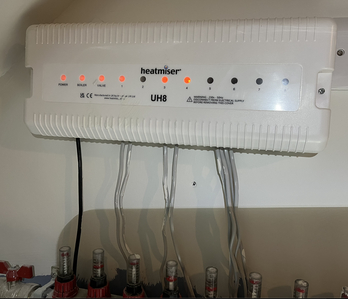
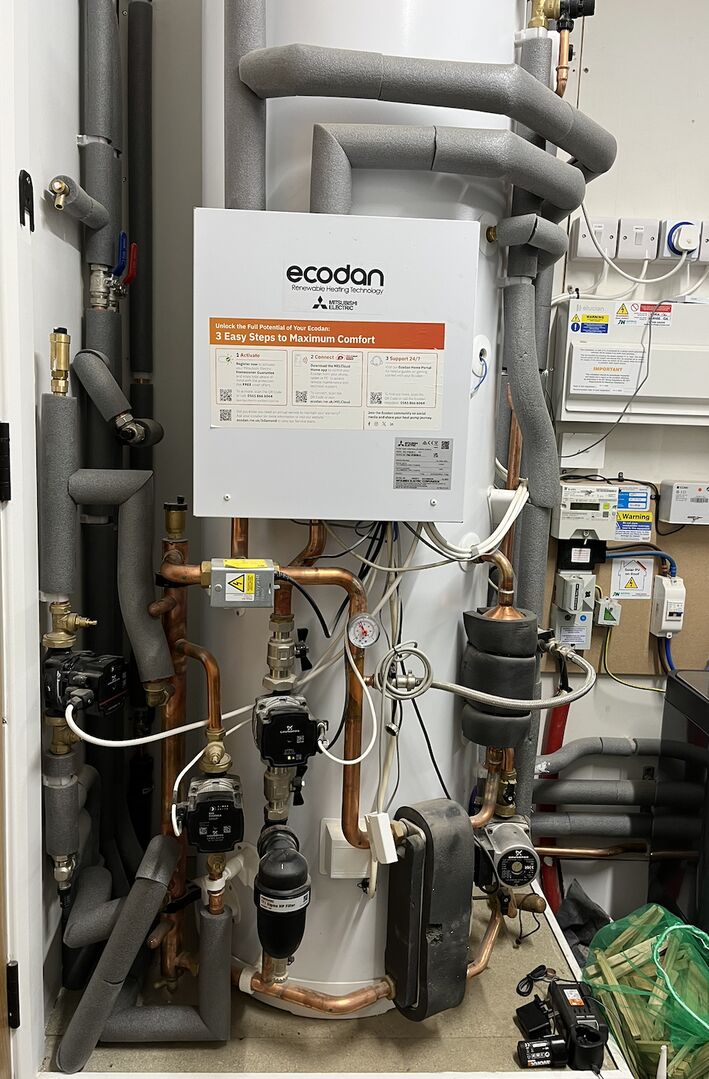
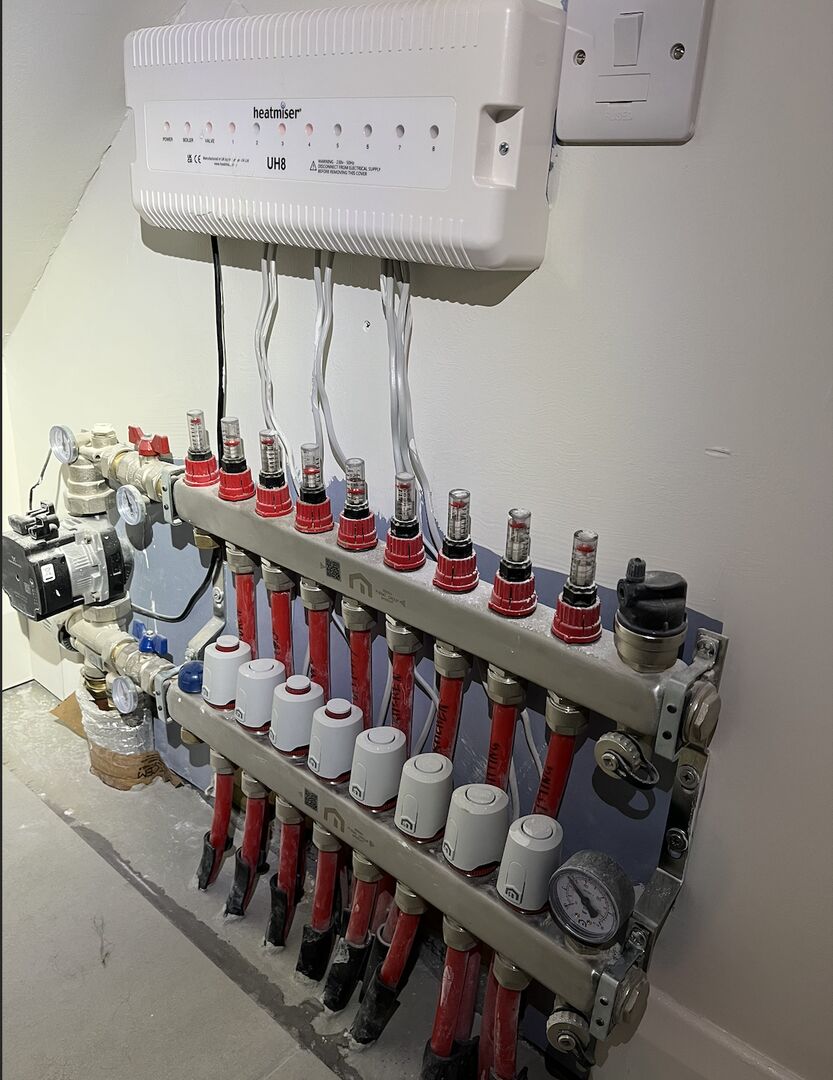
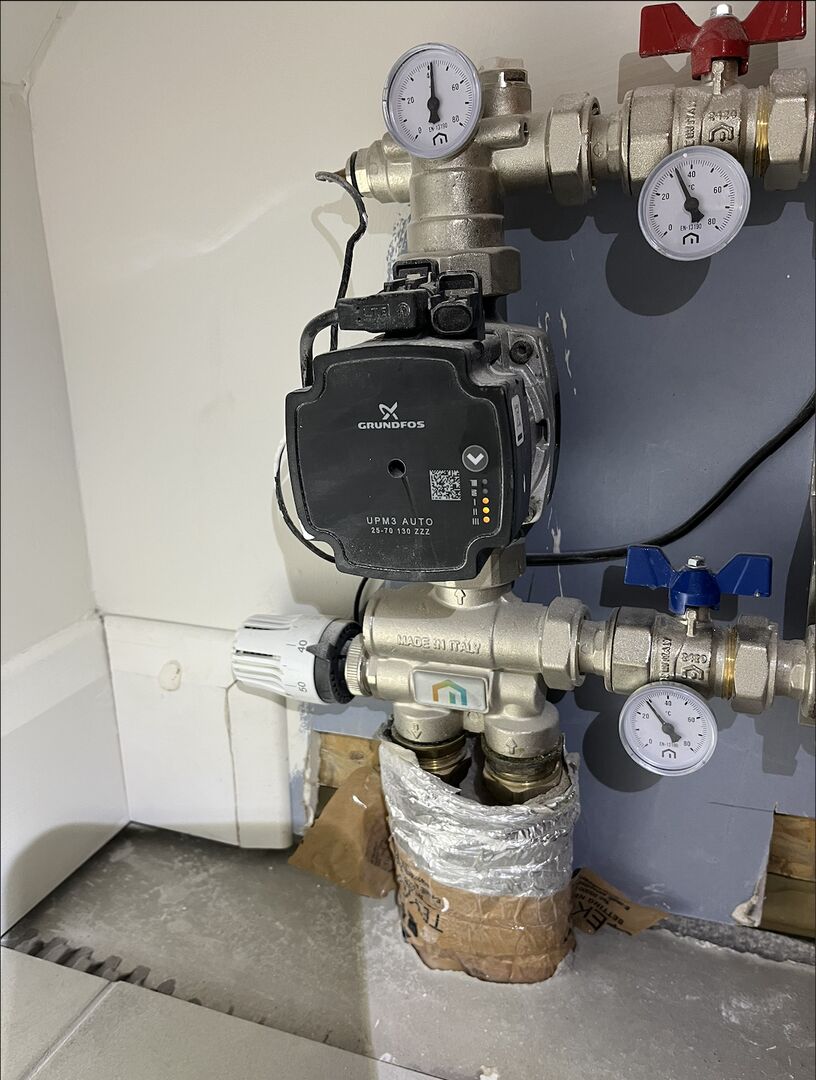
- Put simply, I am not sure. I've attached some images of the internal heat pump setup and also some images of the manifold. There looks to be some kind of mixing valve there (kind of like an old school radiator controller?). I am sorry that I can't provide more detail. As I say, we've been rather left in the dark here. I hope the images might provide the answer.
- when you say you are using the WC curve to control the upstairs setbacks, how exactly, what are you changing on what controller?
- I've just used the FTC to schedule the heating and have set the control logic to weather compensation curve (rather than Auto Adapt or Flow). I've not used the MELCloud app to do any changes to the heating side of things.
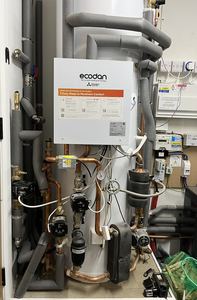
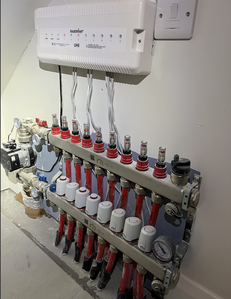
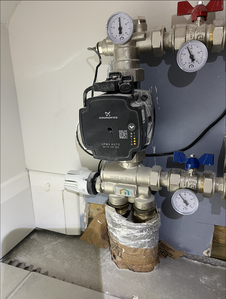
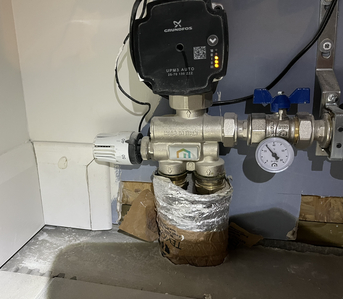
- I've just used the FTC to schedule the heating and have set the control logic to weather compensation curve (rather than Auto Adapt or Flow). I've not used the MELCloud app to do any changes to the heating side of things.
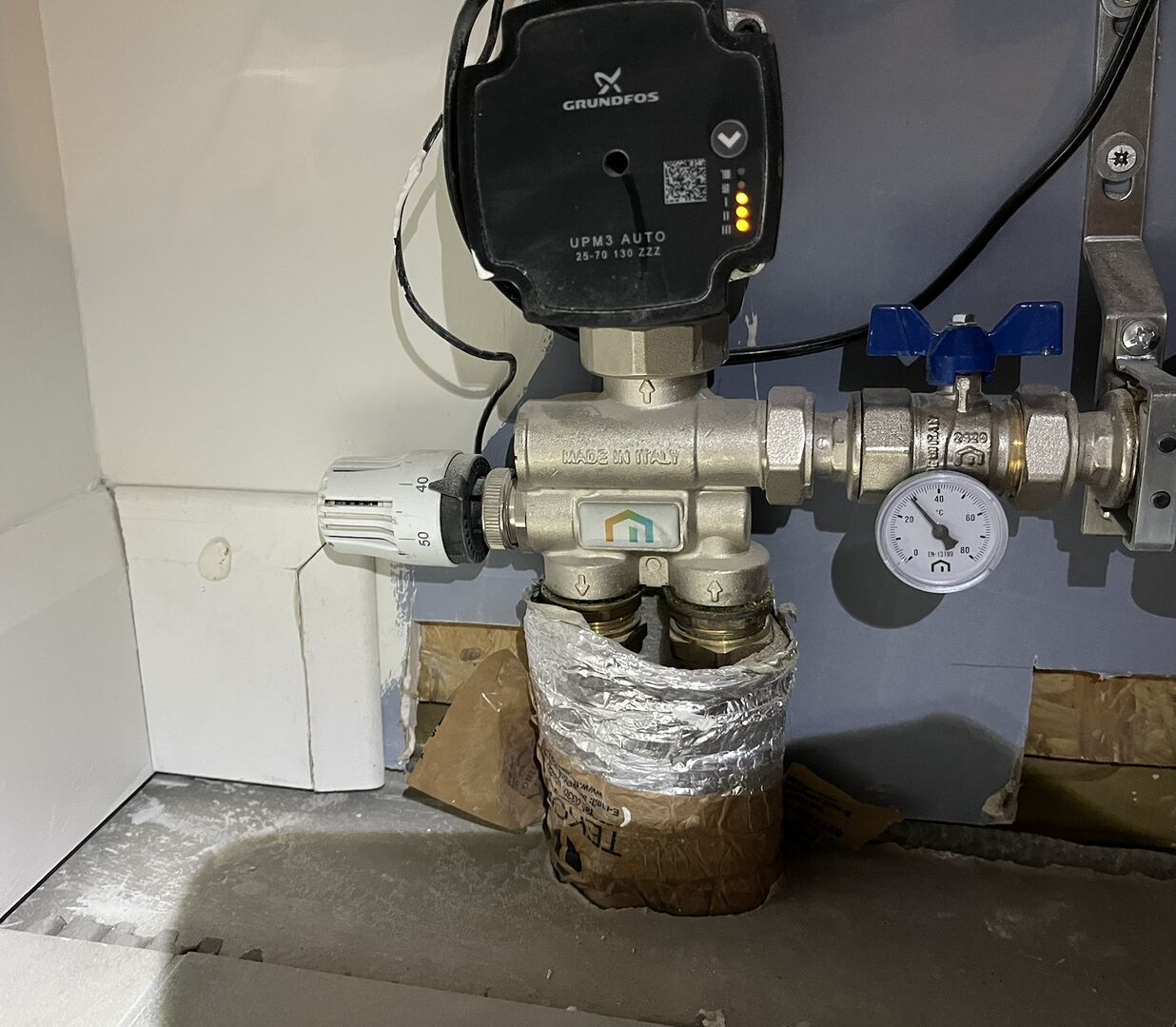
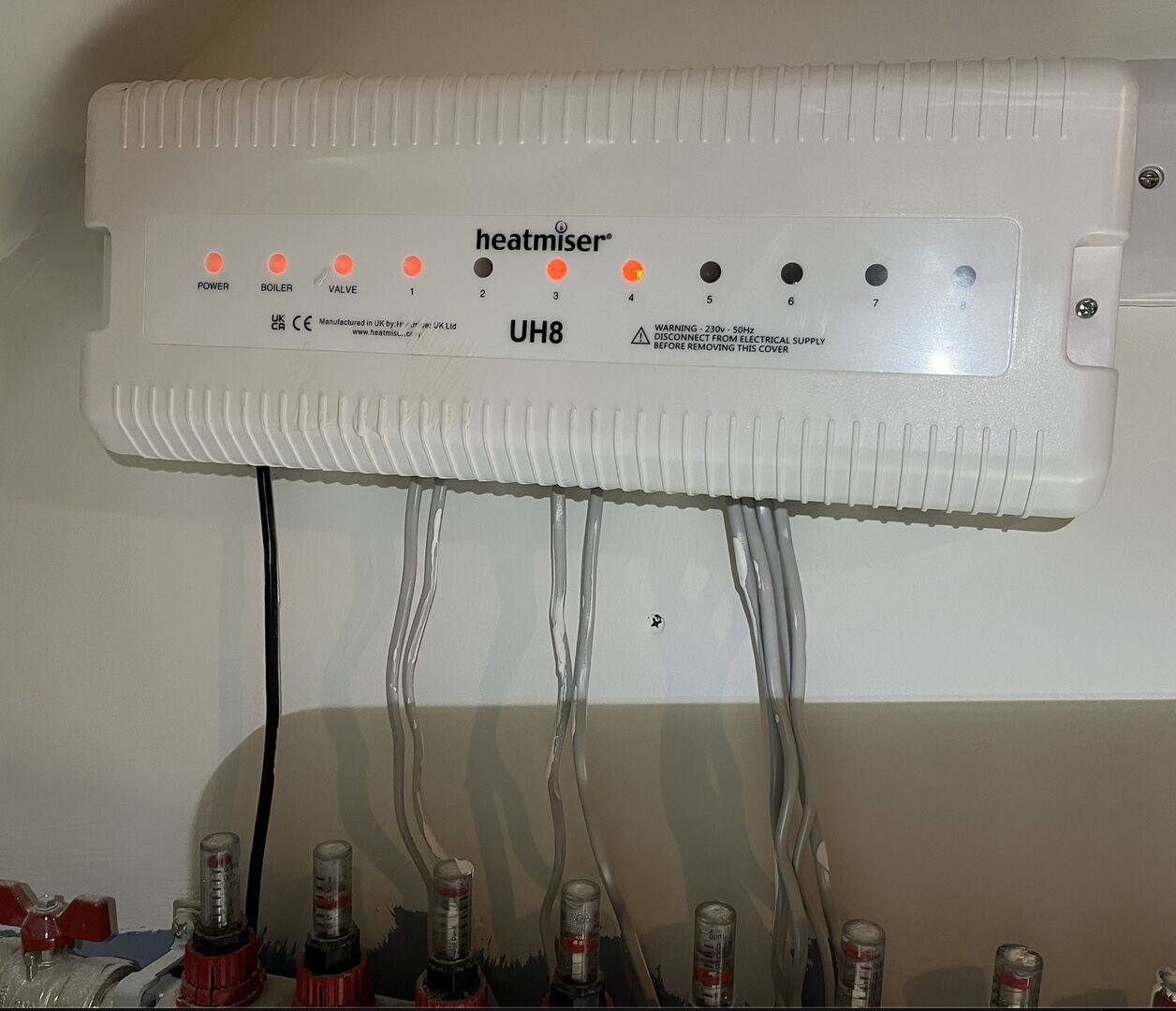
Topic starter
05/01/2026 5:32 pm
Very keen to do that, @majordennisbloodnok. Below is a rundown of our solar and battery hardware from our builder:
5.340 kW total solar power
12 x 445 watt solar panels
8.64 kWh battery storage (1 master and 2 modules - 2.88 kWh each))
5kW of inverter power
05/01/2026 5:49 pm
Excellent information and pictures and wow you have got a lot of kit.
A couple of observations and then (sorry) a couple more questions
Observations:
1. The DHW cylinder is the Mitsubishi one with external PHE. Nothing wrong with that at all but I think it also has a low loss header - basically a piece of pipe to which flow and return are all connected with separate pumps on the heat pump side and the emitter side, thus separating the two and potentially adding up to 15% to your heating bills unless correctly set up.
2. It looks, from your photos UFH2 and UFH 4 like the water to your UFH is being mixed down to a lower temp (40C).
3. (2) suggests that the rads are sized to operate at a higher temperature than the UFH (mistake - really). This means that the lowest flow temperature you can operate at is probably going to be dominated by your upstairs, so I am probably going to suggest running upstairs 24*7 without setback (if you wish at a lower constant temp) if at all possible
Questions
4. What room temperature do you need upstairs, is there a need for a daily variation or would a constant temp of eg 19-20C do?
5. What are your current weather compensation settings (flow temperatures vs outside temperatures)
6. How many water pumps can you see in total, can you identify what they are doing/how they are controlled?
7. How many thermostats/temperature sensors do you have and where are they?
You have some great kit, some of it could probably go on ebay but great all the same!
This post was modified 2 months ago 3 times by JamesPa
4kW peak of solar PV since 2011; EV and a 1930s house which has been partially renovated to improve its efficiency. 7kW Vaillant heat pump.
05/01/2026 5:58 pm
Very keen to do that, @majordennisbloodnok. Below is a rundown of our solar and battery hardware from our builder:
5.340 kW total solar power
12 x 445 watt solar panels
8.64 kWh battery storage (1 master and 2 modules - 2.88 kWh each))
5kW of inverter power
Marvellous. And what tariff are you on with which supplier?
105 m2 bungalow in South East England
Mitsubishi Ecodan 8.5 kW air source heat pump
18 x 360W solar panels
1 x 6 kW GroWatt battery and SPH5000 inverter
1 x Myenergi Zappi
1 x VW ID3
Raised beds for home-grown veg and chickens for eggs
"Semper in excretia; sumus solum profundum variat"
Topic starter
05/01/2026 6:22 pm
4. What room temperature do you need upstairs, is there a need for a daily variation or would a constant temp of eg 19-20C do?
5. What are your current weather compensation settings (flow temperatures vs outside temperatures)
6. How many water pumps can you see in total, can you identify what they are doing/how they are controlled?
7. How many thermostats/temperature sensors do you have and where are they?
Thanks @jamespa. I do feel a bit like an "all the gear, no idea" person! Details below:
4. There's no need for a daily variation. I'd be happy with 20-21 consistently upstairs.
5. Weather compensation settings are 48 / -3 and 30 / 13 (with a +1)
6. I think possibly 4? I've attached two photos. In Pump_1, I think the middle one relates to UFH. Not sure about other two. In Pump_2, that's the hot water circulation pump. In all cases, I'm really not sure how they are controlled. Sorry for that.
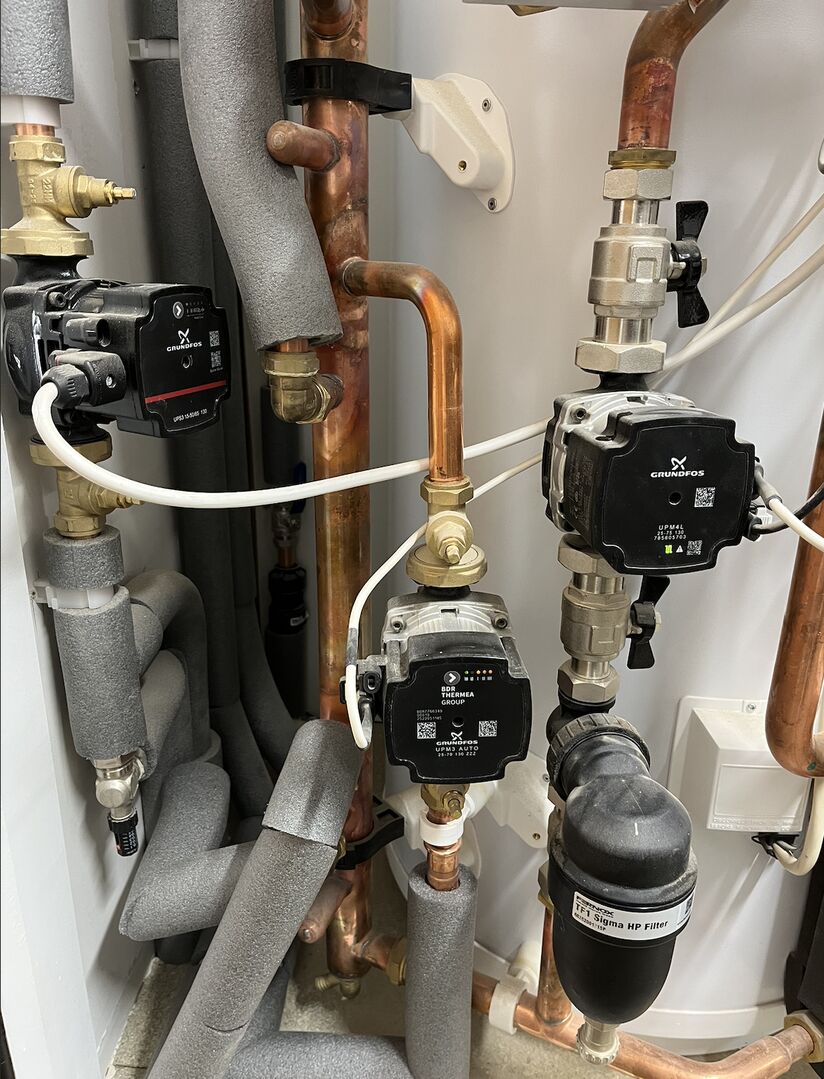
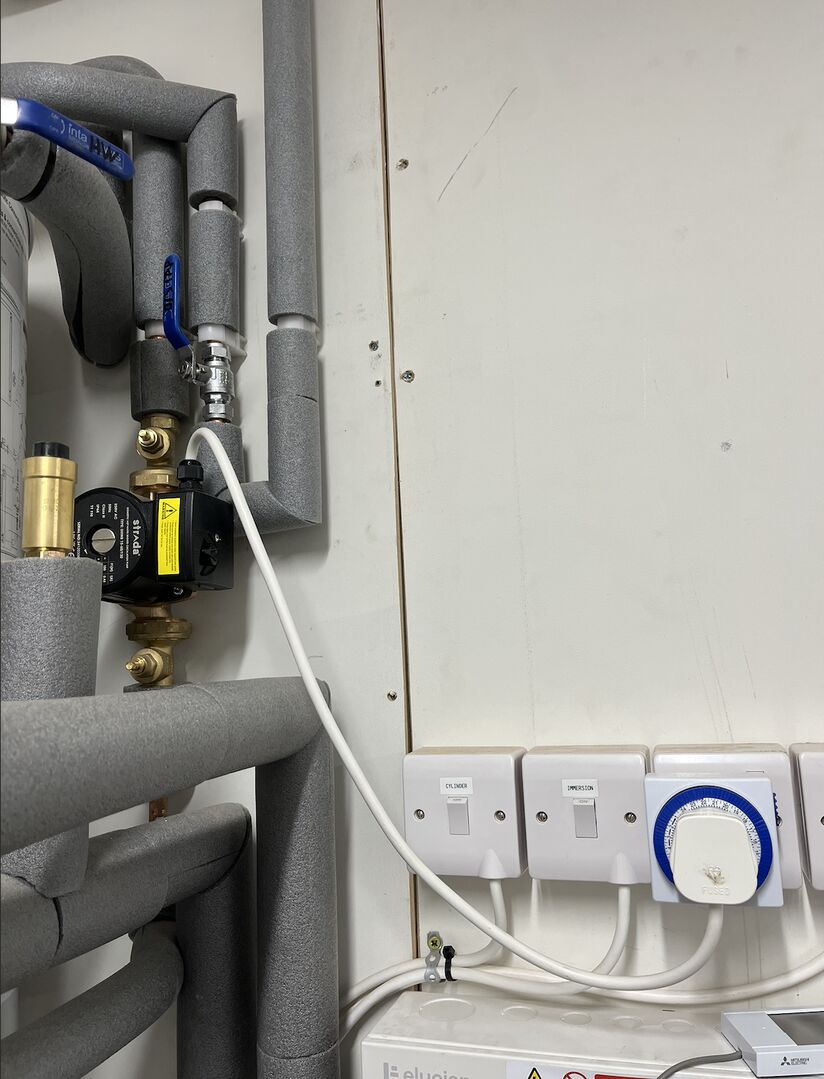
7. In short, we have too many thermostats. Details below:
- 6 Heatmiser thermostats downstairs
- 3 Fenix thermostats for the upstairs bathrooms
- 1 Mitsubishi wireless RC which is on the upstairs landing
05/01/2026 7:10 pm
. I do feel a bit like an "all the gear, no idea" person!
On the contrary you are asking all the right questions and providing well thought through answers. Its going to be difficult to give a 'prescription' because houses vary, but I am pretty confident you can work out the detail if someone points you in the right direction with a bit of explanation. I will have a go, feel free to ask questions and others may have better ideas.
The basic thing you should be aiming for initially (particularly since you have a battery so you can finesse ToU tarrifs using that) is constant low level heating with the flow temperature (FT) as low as possible. Ideally there would be no intervention from thermostats, the weather compensation of the FT would do it all, but that may not be possible given your set up with rads and UFH probably designed to operate at different flow temperatures. The observations I made above, particularly numbers 2 and 3, are key to what I'm about to suggest. If at any time these come into doubt it may be necessary to rethink.
So Im going to assume that (2) and (3) are correct. This means that the lowest FT consistent with heating your house will most likely be determined by the upstairs not the downstairs. So we will need to start there and only once that is right tweak the downstairs to work.
Leave the downstairs operated on thermostats, tweaked if necessary to get the temps you want downstairs. Even though the next steps focus on upstairs its important that the downstairs is at about the right temp (a) for your comfort and (b) because the downstairs will warm the upstairs so to get the upstairs right the downatairs must be at the right temperature. Then I would do the following upstairs:
Turn all thermostats and TRVs to max (or better still remove the TRV heads) so they have no effect.
Set to operate 24x7
Turn off all room influence on the mitsubishi controller, operate on pure WC
Before you start adjusting the WC curve, ask if -3 is a realistic minimum where you are. I would guess not. Bear in mind that the FT (and therefore emitter output) will flatline at lower OATs and thats not what you want. So I would set this parameter to perhaps -5 (if I were in SE England) or -10 (if I were is Scotland). I would probably set the max FT to 50, maybe even 52 at the same time to compensate. These are guesses in the right ballpark, not prescriptive. The basic idea though it to ensure that the WC curve copes with weather like the last few days, rather than flatlining at -3.
I would set the min FT pair to 27 FT/15 OAT which is closer to what you need
That gives a starting curve. Hopefully the upstairs will now overheat(!). If you have one, check the temperature drop ('DT') across the radiators with a thermocouple or thermal camera. It should be 3-8C, preferably towards the bottom end of this range. If its higher ask for advice on adjusting pumps etc before proceeding further - you may want to force more water upstairs and less downstairs to reduce the DT thus enabling you to reduce the FT.
Then, no more than one degree per day unless its seriously overheating, turn down the high FT end of the WC curve until the upstairs is just at a comfortable temperature. As you get close to the right settings you may have to go even slower on the changes. If rooms upstairs settle at materially different temperatures, you may need to balance the radiators. There is an article on this site about how to do that but feel free to ask
Once the upstairs is operating satisfactorily with the WC curve turned down as low as it will go you are at your best WC settings.
Its then a case of adapting the downstairs to cope. How best to do that will depend on the temperatures you settle at as a result of the above
Hope that makes sense. Ask if you dont understand and keep reporting what happens.
Just one further thing. If you are heating your DHW to more than about 48 you are wasting energy. Set to 48 or even 45 unless the result is that you run out of DHW (given the size of that tank unlikely!). Either is still hotter than you need so will get mixed down in the shower/tap, but heating to lower temp is more efficient.
This post was modified 2 months ago 2 times by JamesPa
4kW peak of solar PV since 2011; EV and a 1930s house which has been partially renovated to improve its efficiency. 7kW Vaillant heat pump.
Page 1 / 4
Next

Latest Posts
-
Issue with a Grant Air Source Heat Pump & Tado Smart Thermostat
Hi all I'm having some trouble with a Grant ASHP and ...
By Renewables345 , 30 minutes ago
-
RE: Underfloor Heating Installation Issues with Heat Pump
We suffered a water leak last year in two rooms and had...
By MartinHook_UK , 42 minutes ago
-
RE: Testing new controls/monitoring for Midea Clone ASHP
Now seems a good time to summarise the costs and effici...
By benson , 50 minutes ago
-
RE: Heat Pump vs New Gas Boiler for Inherited House - Worth the Extra Cost?
*** I now see @jamespa has already posted but will stil...
By cathodeRay , 2 hours ago
-

RE: Tell us about your Solar (PV) setup
@mk4 Charge to 100%, discharge down to 10%.
By bobflux , 2 hours ago
-
RE: Daikin Altherma 3 LT compressor longevity question
This mess is intriguing: I wonder if this represent...
By bobflux , 3 hours ago
-
RE: Connecting Growatt SPH5000 over wired ethernet rather than wireless
The simplest wired option is usually the Growatt Ethern...
By Jonatan , 8 hours ago
-
RE: Peak Energy Products V therm 16kW unit heat pump not reaching flow temperature
ASHPs do have a minimum compressor speed. The minimum h...
By bobflux , 14 hours ago
-

RE: Electricity price predictions
@jamespa And it seems some of the nasty public cloud...
By Batpred , 15 hours ago
-

RE: Jokes and fun posts about heat pumps and renewables
Technology is rapidly advancing. BBC News reported th...
By Transparent , 18 hours ago
-
What matters for flow and pressure drop is internal dia...
By bobflux , 19 hours ago
-

RE: Do Fridges and Freezers have COP ratings?
@editor Thank you all for your replies and submitted in...
By Toodles , 21 hours ago
-
I know and yes. The secondary deltaT wont necessaril...
By JamesPa , 1 day ago
-
RE: Designing heating system with air to water heat pump in France, near Lyon
Just love the way you put it! 🤣
By Batpred , 2 days ago
-
RE: Safety update; RCBOs supplying inverters or storage batteries
Thank you for sharing. So it seems that your Schneid...
By Batpred , 2 days ago
-

RE: Forum updates, announcements & issues
@upnorthandpersonal thanks for the thoughtful, consider...
By Mars , 2 days ago
-
RE: Solar Power Output – Let’s Compare Generation Figures
@mk4 All 21 panels have their own Enphase IQ7a microinv...
By Toodles , 2 days ago
-
RE: Setback savings - fact or fiction?
Great, so you have proven that MELCloud is consistently...
By RobS , 3 days ago
-
RE: Mitsu PUHZ120Y 'Outdoor Temp 'error?
Thanks David & James It almos...
By DavidAlgarve , 3 days ago
-
RE: Surge protection devices SPDs
@trebor12345 - your original Topic about the right type...
By Transparent , 3 days ago
-
RE: Help needed with Samsung AE120RXYDEG
@tomf I’ve been sent this from a service engineer at Sa...
By Mars , 3 days ago
-
RE: Buying large amp bidirectional RCD and RCBO
Yes... I went through this particular headache and ende...
By bobflux , 4 days ago
-
O-oh! Let's take this as an opportunity to 'pass the ...
By Transparent , 4 days ago