

Notifications
Clear all
Joining the Renewable Heating Hub forums is completely free and only takes a minute. By registering you’ll be able to ask questions, join discussions, follow topics you’re interested in, bookmark useful threads and receive notifications when someone replies. Non-registered members also do not have access to our AI features. When choosing your username, please note that it cannot be changed later, so we recommend avoiding brand or product names. Before registering, please take a moment to read the Forum Rules & Terms of Use so we can keep the community helpful, respectful and informative for everyone. Thanks for joining!
Energy Storage
34
Posts
9
Users
4
Reactions
3,674
Views

Topic starter
27/05/2026 12:46 pm
I have read threads on this forum and know there is knowledge of V2H etc etc within the community. I am also aware that the technologies are developing quite fast and some of the electrical stuff is a bit beyond me. That said I am interested in views on how the technology and regulations are developing and potential for adoption in my situation.
Our house has a 3.5kW ASHP and finally a working smart meter. Our second vehicle is dying (K reg Golf) and won’t go past the MOT in September. We live on an island so most of our driving is quite short distances. An EV would make some sense. We currently have no battery storage of any sort. Ideally I would like to use a time of use tariff to charge the car and use that energy during the day to power the house - when the vehicle is not in use. Our house typically uses max 10 to 15kWhrs a day. Is the concept of pursuing V2H a logical direction to go and should that influence our choice of EV if we buy one now - or should we wait a few more months or years?
This topic was modified 5 months ago by Mars

27/05/2026 1:43 pm
V2H/V2g is imho a logical direction to go but the technology is not quite/only just available which is a problem if the need is urgent. Octopus power pack is about the only concrete offer I know of and it depends on a charger which is described as 'v2g ready', ie it doesn't yet support v2g but may in future.
An EV with an EV tariff (eg go or intelligent go) is anyway a good match with a heat pump, it's what I have and it works out well. Do your dhw at night and if you wish have a modest nighttime 'set forward' and your average leccy price for the heat pump alone will likeky be cheaper than the standard tarrif, because it's colder at night so the heat pump is running harder.
If the need is urgent perhaps consider an older EV for not a lot of money, or alternatively an EV that supports v2g for when the chargers are available.
If you haven't driven an EV I recommend you take a test drive. Many, perhaps most, find them a first class driving experience. Even James May (interviewed last night on R4 following the release of the electric Ferrari) had to admit that fossil fuel cars objectively make little sense, that this has been known for a century, and the only thing that has kept them going was the lack of battery technology.
4kW peak of solar PV since 2011; EV and a 1930s house which has been partially renovated to improve its efficiency. 7kW Vaillant heat pump.

27/05/2026 1:51 pm
Hi, David
I'm far from an expert, so take my comments purely as the opinions of the layman I am. However, I've been trying to look into this for some time and, in short, what looked like it was almost ready for market a couple of years ago still hasn't quite got there.
If I were in your situation, I'd do three things:
- Assume V2H (or, indeed V2X - the electrical version, not the smart vehicle version) is not going to be implemented before your need to confront a car purchase comes around.
- Base your EV purchase - if you go down that route - on a manufacturer and vehicle that support bidirectional charging. I know, for instance, my VW ID3 doesn't because it's only a 58kWh battery but the 77kWh models do.
- Get a wallbox that supports bidirectional charging (once again, if you decide to go ahead with an EV). That does narrow down the list a lot, but I know there are several available.
This doesn't answer your question, but it does decouple whether or not to go EV from the question of when V2H will be available mainstream. If you follow points 2 and 3 you won't be making any significant compromises (unless you don't like any of the wallboxes available) whilst still leaving your options open.
105 m2 bungalow in South East England
Mitsubishi Ecodan 8.5 kW air source heat pump
18 x 360W solar panels
1 x 6 kW GroWatt battery and SPH5000 inverter
1 x Myenergi Zappi
1 x VW ID3
Raised beds for home-grown veg and chickens for eggs
"Semper in excretia; sumus solum profundum variat"
1

28/05/2026 11:55 am
I have read threads on this forum and know there is knowledge of V2H etc etc within the community. I am also aware that the technologies are developing quite fast and some of the electrical stuff is a bit beyond me. That said I am interested in views on how the technology and regulations are developing and potential for adoption in my situation.
This is not yet common but options are starting to emerge. Octopus has a car lease bundle using V2G.
Our house has a 3.5kW ASHP and finally a working smart meter. Our second vehicle is dying (K reg Golf) and won’t go past the MOT in September. We live on an island so most of our driving is quite short distances. An EV would make some sense. We currently have no battery storage of any sort. Ideally I would like to use a time of use tariff to charge the car and use that energy during the day to power the house - when the vehicle is not in use. Our house typically uses max 10 to 15kWhrs a day. Is the concept of pursuing V2H a logical direction to go and should that influence our choice of EV if we buy one now - or should we wait a few more months or years?
Given the current instability impacting fuel prices I wonder why so many people choose to continue to pay 5-10x more for their driving than with an EV (assuming they can charge it at home).
Using the octopus eligibility criteria as a checklist may help see if it works for you. As you may want to lease/buy another suitable car and manage the EV charger install yourself (The Octopus bundle is based on a lease of the BYD Dolphin and a Zaptec charger). This is what they say is needed:
- A G99 license (permission from your network operator to export power to the grid) is required. Approval can take up to 12 weeks and is not guaranteed, as it depends on local grid capacity and your home setup.
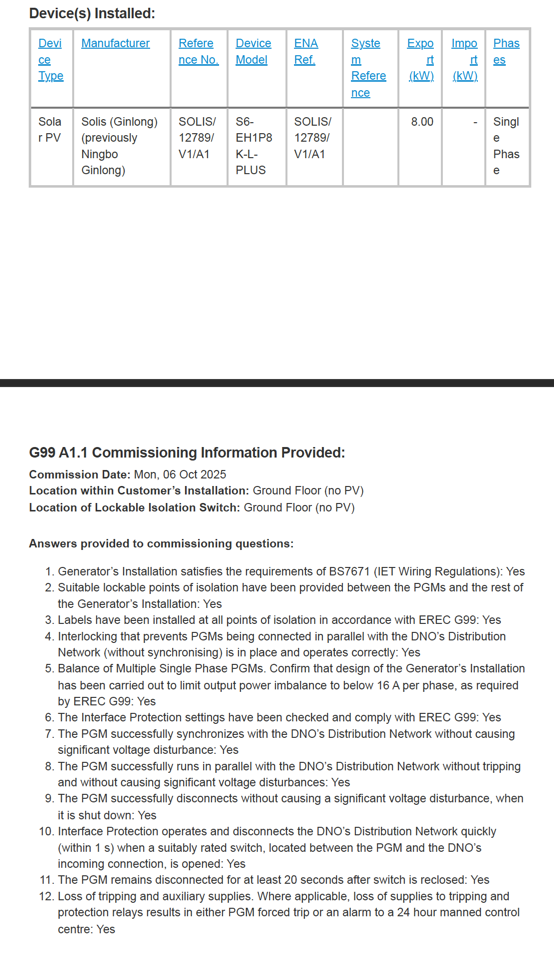
I found this process possible to do as DIY with my DNO being UKPN and my inverter being type approved. I would say the applicant needs to have a reasonable understanding of electrics. More details here. This thread is also useful. My initial G99 application is below:
- A schedule that fits.
Goes without saying, you need to be able to have the car plugged for the charge and discharge times. Having something clever to switch the pump off during short periods when the car is not connected is possible to program, but would not come "off the box".
- Off street parking and ability to charge your EV at home.
I assume your home fits this requirement.
- A working half-hourly smart meter.
You already have this..
- Single-phase power at your property (most UK homes do).
Technically even with a three phase supply the system would also work. The meters work on a vector based concept. More info from @transparent here.
- You cannot have looped supply
I believe some DNOs would not approve export in these less common cases. But your goal being to offset your consumption, I am not sure if it would even apply. This thread may help.
- you must have a 100 amp fuse
I believe this is not a technical requirement, but very useful specially if your supply is 60A. It should not cost you to have it upgraded.
- A Zaptec Pro charger
Octopus mentions this particular one (from a Norwegian company that seems to be affordable), but others may also be suitable. You need to engage an electrician for the installation. They will probably do similar checks for your earthing arrangements etc that the one that installed your heat pump did. This charger and others was discussed a few months ago in this thread.
Hope that helps!
8kW Solis S6-EH1P8K-L-PLUS hybrid inverter; G99: 8kW export; 16kWh Seplos Fogstar battery; Ohme Home Pro EV charger; Vaillant Arotherm Pro 7kW; 100Amp head, HA lab on mini PC

28/05/2026 12:45 pm
- A Zaptec Pro charger
Octopus mentions this particular one (from a Norwegian company that seems to be affordable), but others may also be suitable. You need to engage an electrician for the installation. They will probably do similar checks for your earthing arrangements etc that the one that installed your heat pump did. This charger and others was discussed a few months ago in this thread.
Bear in mind that Octopus mentions this charger as compatible (along with just one model of car) with their Power Pack tariff, and that's for vehicle to grid, not vehicle to home. The Zaptec Pro wallbox would certainly be able to support any V2H solution that comes along since it's the bidirectional charging that's important, but you most certainly don't need to limit yourself to that particular make and model of wallbox unless you want to take up Octopus' Power Pack tariff (whose terms need to be studied quite carefully to see if the tariff fits your situation, given how experimental the tariff is).
105 m2 bungalow in South East England
Mitsubishi Ecodan 8.5 kW air source heat pump
18 x 360W solar panels
1 x 6 kW GroWatt battery and SPH5000 inverter
1 x Myenergi Zappi
1 x VW ID3
Raised beds for home-grown veg and chickens for eggs
"Semper in excretia; sumus solum profundum variat"

28/05/2026 10:03 pm
The technology is developing very rapidly right now but there’s no standard interface they are all proprietary. I’ve been doing some research in case my trusty 26 year old Toyota doesn’t get through the summer MOT.
https://www.carwow.co.uk/editorial/going-electric/ev-charging/what-is-bidirectional-charging#gref
https://driivz.com/glossary/vehicle-to-home-v2h/
These articles above give some background
more focussed update are here
https://www.ukgei.co.uk/blog/which-electric-cars-support-vehicle-to-home-v2h-in-the-uk-2026-guide
And here https://www.bestchargers.co.uk/v2h-compatible-cars/
Frustratingly I cannot refind the very useful article I read which made it clear there are 2 options now, Kia EV2 and Volkswagen ID models with the 77kWh battery and later this year the new version of the Nissan Leaf will be on the market. But this is the screen capture of what Gemini found when I tried to locate it

This post was modified 5 months ago by Judith
2kW + Growatt & 4kW +Sunnyboy PV on south-facing roof Solar thermal. 9.5kWh Givenergy battery with AC3. MVHR. Vaillant 7kW ASHP (very pleased with SCOP >4) open system operating on WC
Topic starter
28/05/2026 10:25 pm
Thanks to everyone for their responses - which I have only just seen. I had assumed that, as the originator of the topic, I would automatically be emailed when posts had been added to the thread. It would appear I am learning the hard way.
i have only scanned the posts so far. I will look rather more diligently tomorrow. Thanks again.
29/05/2026 9:22 am
@davidb if you tick the box which says subscribe to the thread then you’ll get notified.
2kW + Growatt & 4kW +Sunnyboy PV on south-facing roof Solar thermal. 9.5kWh Givenergy battery with AC3. MVHR. Vaillant 7kW ASHP (very pleased with SCOP >4) open system operating on WC
Topic starter
29/05/2026 10:02 am
@judith thanks Judith. Yes, I have now done that and hence I have just been notified of your post. I guess I expected the system to automatically include the originator of the topic in subsequent posts. It seems fairly obvious that I would want to see anything related so was simply a little surprised not to be notified of any responses as the default. I still have a lot to learn about using the forum software effectively……
1
29/05/2026 10:45 am
The technology is developing very rapidly right now but there’s no standard interface they are all proprietary. I’ve been doing some research in case my trusty 26 year old Toyota doesn’t get through the summer MOT.
https://www.carwow.co.uk/editorial/going-electric/ev-charging/what-is-bidirectional-charging#gref
https://driivz.com/glossary/vehicle-to-home-v2h/
These articles above give some background
These are useful, they introduce the various types of V2x. One of the articles seems to have been written by AI and not really proofread. And I could not see much indicating it has been checked against UK regulations..
This is my understanding:
- V2L: this enables electrical appliances to be plugged to an EV. I think about it as if glamping with your car and wanting to enjoy coffee from your favourite machine on your trip..
- V2H: this is where you are aiming to use the EV battery to supply electricity for home use. There are certainly cases where you would not need to comply to the same UK regulations that apply for simple V2G. One example is if you are off grid, meaning no grid supply. I assume @davidb is not aiming for this, so G98/99 applications are needed. So you would want to make sure the EV (that works as an inverter) is type approved to avoid a laborious process to demonstrante compliance. Disclaimer: I did not check if any EVs have been taken by their manufacturer through type approval and even whether the G100 process is applicable.
- V2G: essentially this is the generic case where you just want to plug your EV with your bi-directional EV charger to a grid supplied site and be able to export. G98/G99 apply.
- In order to allow it to work in islanding mode (so it can supply the site in case of power failure like in V2H), this would require a manual switchover or some rewiring of your home. I assume most people would prefer the expediency of an almost standard EV connection and not be concerned about the promise of power in the absence of a working grid supply. For automatic operation in the event of grid failure, the EV charger also needs have anti-islanding capability. There are too many options to consider commenting on, without further information from @davidb on what his goals are. We had a very relevant discussion a few months ago, focusing on safety and specifically earthing arrangements for inverters able to work in islanding mode.
- Another consideration as @majordennisbloodnok mentioned, are tariffs, time of use and variations of these. Octopus for example created tariffs that they tag as "intelligent" that enable a model where a consumer essentially lets them control the use of their battery or high powered appliance (in the case of the EV V2G bundle offer, a BYD EV) in exchange for some benefit. The one that I mention seems to be a tightly integrated setup that may work for some households. The EV intelligent go tariff that we are currently on requires octopus to connect to the EV or the EV charger via API. It required a bit of setting up with the charger and car apps. There is always the risk that support for our EV or EV charger is not maintained, so careful reading of T&C advised!
By "working in islanding mode", I mean when an inverter continues to power some circuits (based on batteries or solar), even when the grid fails.
Anti-islanding is what all inverters connected to grid supply must have: they must stop any possibility to export power to the grid (automatically) until "the grid is back".
8kW Solis S6-EH1P8K-L-PLUS hybrid inverter; G99: 8kW export; 16kWh Seplos Fogstar battery; Ohme Home Pro EV charger; Vaillant Arotherm Pro 7kW; 100Amp head, HA lab on mini PC

29/05/2026 5:53 pm
Your understanding is basically correct but what matters for off grid is if the inverter is grid forming or grid tied. V2L is grid forming so does work during an outage.
There is one useful quirk. Once we get "plug in solar/battery" then it is possible for you use the V2L on a car as an 800W "plug in battery". Bit of a hack and slightly less efficient but it's doable and there are both hacky and now some slightly nicer ways to do it.
Other consideration IMHO is usage patterns and relative costs, especially now you get a 32kWh battery for £3500 quid. There's not a vast saving between the current prices of V2H/G kit and just having 32kWh more house battery. The house battery also doesn't go shopping or disappear to work when it would have been useful. Both V2H/G and battery prices are continuing to tumble so it's hard to know how this will play out but IMHO there's a decent chance that V2G/H will end up as a technology that never quite made it due to pricing.
For off grid you are still bound by BS7671 and building regulations if it's anything over a certain size or you live in it rather than use it as a shed or similar. So G98/G99 won't matter but all the real hard stuff certainly does.
"you must have a 100 amp fuse"
Nope - and most DNO policies are now that 100A is not available and anyone on 100A will be downgraded to 80A as and when any replacement or similar is done.
3 phase is not a problem in fact it can often make life simple as you just run a single phase to the garage that doesn't have any other big load on it.
This post was modified 5 months ago 2 times by EtchedPixels
29/05/2026 7:26 pm
Technically whether it is grid tied or grid forming may be a good way to view it.
It seems the regulation point of view is a better way to slice it, as @davidb is discussing V2H as a grid tied system. G98/G99 apply, with all the benefits and consequences.
Your comments on the market evolution may be right... nothing tells me much effort it being put by car manufacturers to simplify adoption. And the Octopus scheme has all the signs of a pilot scheme.
For V2G, what would be needed to use it: the EV charger can cost a few hundred, + an RCBO and cabling? Of course the paperwork can add significant cost.
As there´s an inherent appeal of getting an EV "to work" when we know it is parked most of the time, there may be many of us on this path.
This post was modified 5 months ago by Batpred
8kW Solis S6-EH1P8K-L-PLUS hybrid inverter; G99: 8kW export; 16kWh Seplos Fogstar battery; Ohme Home Pro EV charger; Vaillant Arotherm Pro 7kW; 100Amp head, HA lab on mini PC

Page 1 / 3
Next

SPONSORS
Degrees of Separation

Latest Posts
-

RE: Heat pump branding. Clever, contemporary… or a bit too much?
I think Heat Geek have done an amazing job on their bra...
By Tomtheheatingengineer , 5 hours ago
-
RE: HeatGeek vs Octopus surveys: puzzling disparity - any ideas why?
I have just had 3 heat loss surveys, one by heat geek o...
By David , 5 hours ago
-
RE: Heat Geek Zero Disrupt: Are We Sleepwalking Into Another Race to the Bottom?
I think that's the key question. After all inverter uni...
By Prunus , 7 hours ago
-
RE: battery storage without solar
As of October 1st they need specific qualifications to ...
By EtchedPixels , 8 hours ago
-
RE: How should the Boiler Upgrade Scheme be reformed?
A unit which uses water to transfer the heat/chill from...
By Temperature_Gradient , 8 hours ago
-
RE: Renewables & Heat Pumps in the News
With regards to the BUS grant raid, I gave it more thou...
By ASHP-BOBBA , 8 hours ago
-
RE: Why are ASHP installs so expensive?
The whole system seems to work on the basis of...
By ian33a , 9 hours ago
-
RE: Missing flow temperature in Heat Geek proposal
Good plan. If you can get half hourly meter readings a...
By JamesPa , 14 hours ago
-
RE: Heat Pumps Without Grants: Would You Have Installed One & Will You Now?
@editor Most certainly. The heat pump was an ideal s...
By Abernyte , 14 hours ago
-
Although regulations may well vary from country to coun...
By Majordennisbloodnok , 15 hours ago
-
RE: Does anyone have experience of a smart water meter?
Yep I caught our slow leak from a £100 bill rise 8)
By EtchedPixels , 15 hours ago
-
RE: Do You Need a Buffer Tank or Low Loss Header for Underfloor Heating in a Large Property?
@jamespa in some cases, failing the Turing test might b...
By GrahamF , 18 hours ago
-
RE: Passiv Smart Thermostat - Help & Forum Support
@energystoragetech The heat capacity of some...
By JamesPa , 20 hours ago
-
RE: tepeo ZEB UK Support & Info Thread
Sorry you are correct, I was remembering figures from t...
By JamesPa , 1 day ago


SPONSORS