

Notifications
Clear all
Joining the Renewable Heating Hub forums is completely free and only takes a minute. By registering you’ll be able to ask questions, join discussions, follow topics you’re interested in, bookmark useful threads and receive notifications when someone replies. Non-registered members also do not have access to our AI features. When choosing your username, please note that it cannot be changed later, so we recommend avoiding brand or product names. Before registering, please take a moment to read the Forum Rules & Terms of Use so we can keep the community helpful, respectful and informative for everyone. Thanks for joining!
Energy Storage
34
Posts
9
Users
4
Reactions
4,040
Views

29/05/2026 8:18 pm
@batpred It's a particular problem for manufacturers because it involves putting stuff into the car. Stuff in the car has a bunch of inconvenient properties
- The consumer has to pay for it up front whether they use it or not (even if it's an add on module you've got to test and certify with or without it, test updates work in both cases, test all the other tools work in both cases, fit an automotive grade connector to attach it etc).
- It takes up room
- The manufacturer owns the guarantee on it
- The manufacturer owns the battery wear consequences
- The manufacturer owns all the regulatory overhead (and not just the G98/G99 side and every other country equivalent differing set of regs but also simultaneously all the vehicle software and hardware safety standards)
As EV moves from the high end of the market down and competition intensifies there's no budget for any feature that doesn't matter in an "I'll pay more for that" way to a high percentage of customers. The more they can push out of the car the better.
The regulatory stuff for high speed metal boxes on wheels is unsurprisingly pretty brutal. ISO 26262 you'd do the paperwork to show it was ASIL D (lowest risk category so outside of the driving experience etc and isolated) but even then you've got quite an overhead and you've got to maintain all your evidence and the like. Any OTA or similar update functions to the code on it and ISO 21434 bites, and it goes on like this. The hardware side is also pretty similar - can the V2G bits survive a car crash, is there any conceivable way they could cause an electrical fault, fire or the like not just when stuck on a wall but when cooking in the sun or being hit by a truck and so on.
There's a lot of equivalent history in other products where trying to be clever with a highly expensive piece of equipment crashes and burns as the prices of that equipment falls. A classic modern example is the SSD (solid state disks) on a PC. We went from vendors trying to sell devices with a tiny SSD and a big hard disk with fancy software to use it as a cache, to fancy hardware acceleration for using the SSD as a cache, to "it's not worth the cost and complexity" very rapidly indeed.

29/05/2026 11:13 pm
We too are considering a new vehicle purchase soon.
We have an ASHP, solar and Tesla PW3, which was a real battle to get approved under G99
Currently, a single PW3 (13.5kWh) is just about sufficient in winter on a 3 times a day tariff like Octopus Cosy where we have 3 cheap rate slots per day (45kWh peak consumption per day).
We would love to add an EV, switch to a cheap overnight EV tariff, use the Tesla to power the house during the day and then use the EV (V2H) to see us through until the cheap overnight EV tariff starts again. This would be perfect if the EV was out and about in use during the day but back on the driveway by early evening to take over the house load from the Tesla PW3.
But I'm not currently seeing any systems offering this kind of flexibility right now. Maybe in a few years? So we are probably going to end up buying another ICE car for now. Happy for someone to convince me otherwise before I drop £25k on another ICE car.
Given how hard it was to get the Tesla inverter approved (limited to 5kW inverter rating and 5kW export limit), how receptive to V2H are my DNO likely to be? Do we then need a new G99 application every time we buy a new V2H-enabled car (new inverter) before we can plug it in to the wall charger? I hope we will get there soon, but I feel we are still a few years off this being reality yet?
Samsung 12kW gen6 ASHP with 50L volumiser and large radiators. 7.2kWp solar (south facing), Tesla PW3 (13.5kW). Net Zero
29/05/2026 11:22 pm
Did you get hard limited to a 5kW inverter rating or did you get a 5kW limit and not go for a G100 (which allows bigger inverter than export but isn't always allowed) ?
If they turned down a G100 type request you are likely to struggle as the G99 is based on the theoretical total inverter capacity - so if you had 5kW and another 5kW from the V2H they'd simply call it 10kW if grid tied. If you could get a G100 compliant setup you may be fine.
I don't know if there are any V2H non grid tie options for this - if you have the house switching between grid (or grid + Tesla battery) and a non grid tie inverter then you are not constrained in the same way. It's not often done in the UK, but it's common in other countries with restrictions or with corrupt energy companies that make grid tie insanely expensive/pointless to take this approach.
30/05/2026 8:35 am
Did you get hard limited to a 5kW inverter rating or did you get a 5kW limit and not go for a G100 (which allows bigger inverter than export but isn't always allowed) ?
If they turned down a G100 type request you are likely to struggle as the G99 is based on the theoretical total inverter capacity - so if you had 5kW and another 5kW from the V2H they'd simply call it 10kW if grid tied. If you could get a G100 compliant setup you may be fine.
I don't know if there are any V2H non grid tie options for this - if you have the house switching between grid (or grid + Tesla battery) and a non grid tie inverter then you are not constrained in the same way. It's not often done in the UK, but it's common in other countries with restrictions or with corrupt energy companies that make grid tie insanely expensive/pointless to take this approach.
In my case, our original offer was for a 7kW inverter limitation (matching our peak solar generation) and 1kW export. The low export rate was financially unworkable for us. The DNO then informed us of a fast track process which allowed a fixed '5+5' (5kW inverter and 5kW export) system to be approved, which at least gave us a usable amount of export at the expense of a 5kW inverter limitation.
If we were to make further G99 applications, we could probably get additional inverter capacity approved but only at the expense of export so we are kind of stuck between a rock and a hard place. Unfortunately we do not do sufficient mileage for any future EV to absorb the excess solar in summer at reduced export rates. I find it frustrating really, as approval would not change our summer export (we don't need V2G) when solar is plentiful (if anything it would reduce it if we charged the EV from solar), and with V2H we would be less reliant on the grid for imports during winter at peak times, so overall approval would be beneficial for the grid but the archaic G99/G100 process fails to recognise any of the benefits to the grid, only potential detriment.
Samsung 12kW gen6 ASHP with 50L volumiser and large radiators. 7.2kWp solar (south facing), Tesla PW3 (13.5kW). Net Zero


Topic starter
30/05/2026 11:10 am
Thanks to everyone who has responded. From my relatively uninformed perspective it all made for interesting reading. So a very big thank you.
What am I trying to achieve? Primarily, financial logic suggests it would be sensible to investigate how our situation might benefit (or not) from a time of use tariff. After 2 years we finally achieved a working smart meter in later February. The old car started to suggest it won’t pass an MOT in September - hence what might we consider as a replacement.
During March (first month or a working smart meter) our electricity records showed a high of 27kWhrs per day to a more normal level of around 15. Our small heat pump was operating normally during that period. The total for the month was 540kWhrs reducing in April and May. We are on a standard variable tariff with OVO.
The idea of buying a stand alone battery in addition to replacing the old petrol vehicle with an EV suggested looking seriously at what we should buy. Would a V2H set up eliminate or at least reduce the need for a domestic battery to ride out the high day rates. The replacement vehicle is for local use (we live on the Isle of Arran) so a small vehicle is all we need - max 20 miles daily and often much less. Longer trips with our main car.
Power cuts are more frequent here than in urban areas. We probably get 3 or 4 a year. Keeping lights, internet and mvhr on is the main priority. We have a wood burner for back up so the lack of power for the ASHP would not be a problem. In a power cut, a switch change over to run as an island would probably be fine.
I am not sure if that covers everything relevant. I should add that having a second vehicle is a nice to have so the expected MOT failure in September is not a hard deadline. I am simply trying to evaluate what might be our next logical steps.

30/05/2026 1:02 pm
Thanks, that clarifies your goal, which seems to be very common.
Clearly the V2G and V2H terms are not used consistently across the utility and motor industries..
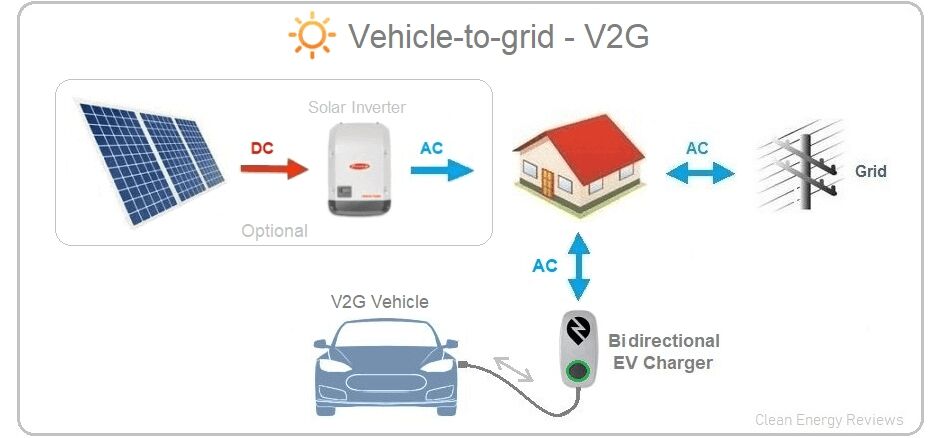
A system like the one in the V2G diagram below (reproduced from an article from Clean Energy Reviews) would not need an expensive EV charger.
According to Octopus, Nissan has received the UK's first G99 grid certification for V2G. Not sure if this is using a DC or AC charger.
There seem to be Humax V2G chargers available for a few hundred pounds..
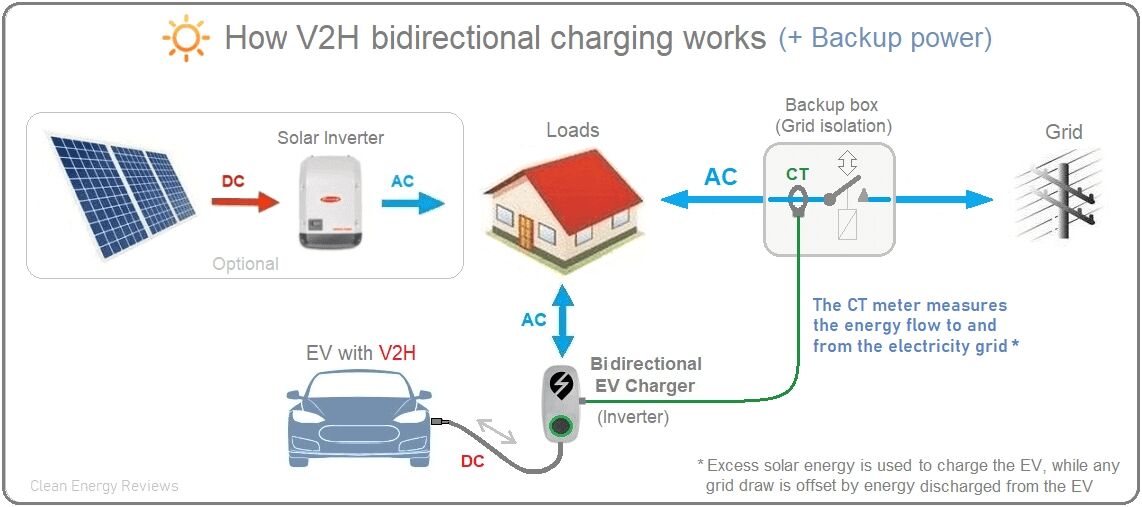
The V2H system described in the below diagram does need a DC (CCS) EV charger.. Apparently using anything like this here will still require G99 approval from the DNO.
UK-certified chargers are still based on the CHAdeMO, whereas CCS is the most common DC standard EVs use.
CCS compatible bi-directional chargers retail for up to a few thousand pounds (they include the DC/AC inverter) and include Wallbox Quasar 2 (apparently compatible vehicles include the Kia EV9 and Cupra Born 77 kWh), Indra Smart Pro V2H, Nissan Energy AC Charger. A quick search shows me Indra are not available off the shelf but they were made available via a pilot using the Nissan Leaf..
VW are expected to announce more on V2H (DC) for the UK this year.
The Best Chargers site seems to be keeping information about V2X enabled EVs and chargers up to date.
Hope that helps!
8kW Solis S6-EH1P8K-L-PLUS hybrid inverter; G99: 8kW export; 16kWh Seplos Fogstar battery; Ohme Home Pro EV charger; Vaillant Arotherm Pro 7kW; 100Amp head, HA lab on mini PC
Topic starter
30/05/2026 6:44 pm
Thanks @batpred It does and the article on chargers was really helpful.
A question. The article asks Do I need DNO approval? The answer given is Yes. Any V2H install exporting more than 3.68 kW requires G99 approval, which typically takes 30 to 60 working days.
My query is the G99 required if everything is going V2H? I am really not interested in V2G as the income is pretty small. I would rather consume it all myself and not be linked to the vagaries of that market. Given I am generating nothing (no PV), is a G99 still required? Even if I was only installing 8 panels that would be less than the limit for a G99? Am I missing something?
30/05/2026 8:07 pm
Thanks @batpred It does and the article on chargers was really helpful.
A question. The article asks Do I need DNO approval? The answer given is Yes. Any V2H install exporting more than 3.68 kW requires G99 approval, which typically takes 30 to 60 working days.
My query is the G99 required if everything is going V2H?
My understanding is that anything that is able to export and wired as such is in scope of the G standards.
I was probably lucky and my DNO is UKPN. My G99 took around one week from the point I submitted it until they approved it.
@transparent posted a very useful summary of the G standards here that may help..
8kW Solis S6-EH1P8K-L-PLUS hybrid inverter; G99: 8kW export; 16kWh Seplos Fogstar battery; Ohme Home Pro EV charger; Vaillant Arotherm Pro 7kW; 100Amp head, HA lab on mini PC

Topic starter
30/05/2026 10:42 pm
@old_scientist Thank you for the personal example and your conclusion to probably stay with ICE for your next car. It’s clear I don’t understand the regs re G99 etc. Your example couple with @judith comparing the price of a bi directional charger to the reducing price of battery storage is probably enough to limit my expectation just now. Help appreciated.
30/05/2026 11:08 pm
My apologies, I did not intend to discourage you! A Nissan EV with a Humax V2G charger seems to be the simplest option, excluding having a separate battery/inverter.
8kW Solis S6-EH1P8K-L-PLUS hybrid inverter; G99: 8kW export; 16kWh Seplos Fogstar battery; Ohme Home Pro EV charger; Vaillant Arotherm Pro 7kW; 100Amp head, HA lab on mini PC
30/05/2026 11:09 pm
@old_scientist Thank you for the personal example and your conclusion to probably stay with ICE for your next car. It’s clear I don’t understand the regs re G99 etc. Your example couple with @judith comparing the price of a bi directional charger to the reducing price of battery storage is probably enough to limit my expectation just now. Help appreciated.
@davidb you're welcome, and thank you for allowing me to jump in on your discussion 😀
I think the notion of having a large portable battery sat on the driveway for long periods that could be used to power our homes (or help balance the grid) is something that will clearly be hugely appealing as we move increasingly towards electrification with heat pumps etc. Hopefully one day this technology will be ubiquitous, but I feel we are currently a way off that being the case.
I am not a natural early adopter of new technology - I prefer to wait until it is a little more mature and unified standards have been agreed (I don't want a betamax). The other issue is currently the entry cost - for example a V2H/V2G supported VW ID3 (77kWh) model costs around £38k starting price, more than my budget for a 'new' car, and a significant price to pay for a home battery on wheels.
Hence my decision to not base my next car purchase on V2H/V2G. I'm excited by the possibilities, but I want a plug and play solution sat on my drive. Maybe in 5-10 years time.
This post was modified 5 months ago by Old_Scientist
Samsung 12kW gen6 ASHP with 50L volumiser and large radiators. 7.2kWp solar (south facing), Tesla PW3 (13.5kW). Net Zero
30/05/2026 11:09 pm
My apologies, I did not intend to discourage you! A Nissan EV with a Humax V2G charger seems to be a promising relatively simple option. Or having a separate battery/inverter.
8kW Solis S6-EH1P8K-L-PLUS hybrid inverter; G99: 8kW export; 16kWh Seplos Fogstar battery; Ohme Home Pro EV charger; Vaillant Arotherm Pro 7kW; 100Amp head, HA lab on mini PC
SPONSORS
Degrees of Separation
Latest Posts
-

RE: Indevolt Batteries UK Support & Info Thread
@editor Hi, To resolve this, please tap on the A...
By Indevolt Tech , 4 hours ago
-
RE: How will removing the standing charge on gas bills benefit heat pumps?
@toodles GIGO always stands! My Cosy 6, as you can...
By Watcher , 12 hours ago
-
RE: How much of your renewable and home setup would still work if the internet went down?
Interestingly we had an internet outage about a month a...
By Rob of York , 19 hours ago
-
RE: Double or Triple Glazed Windows?
Posted by: @singlespeed With 9 years repairing windo...
By Rob of York , 19 hours ago
-
@transparent we’re still running a secure version of PH...
By Mars , 23 hours ago
-
RE: How quickly would you want/expect heat recovery to take from setback?
Much longer than that here. The heating isn't even on. ...
By bobflux , 2 days ago
-
RE: Passiv Smart Thermostat - Help & Forum Support
Obviously the weather is changeable but there's a defin...
By Singlespeed , 2 days ago
-
RE: The Changing Jet Stream Could Challenge UK Air Source Heat Pumps
@rob-of-york I must admit that when we had a Daikin hea...
By Toodles , 2 days ago
-
RE: Forum updates, announcements & issues
Get the Renewable Heating Hub heads-up on WhatsApp. I...
By Mars , 2 days ago
-
RE: Safety study for plug in batteries out to tender - looks like Q3 2027 at best before legal
@editor I pointed out to the one of the Fuse execs that...
By dansus , 2 days ago
-
RE: 15kw pump for 225m2 1990's house - over kill?
@seaviews As well as loft insulation, there are othe...
By Rob of York , 2 days ago
-
RE: BT cuts you off, Plusnet blames Openreach... welcome to “seamless” broadband switching
Both of which (in most cases) use Openreach for the las...
By JamesPa , 2 days ago
-
RE: Renewables & Heat Pumps in the News
Yes, this is a swiss and german standard I believe, Vai...
By Batpred , 2 days ago
-
RE: Octopus Cosy 12 Heat Pump Regret: Incredibly Loud, Poor Heating & Constant Hum - Help!
@editor FWIW my problem was resolved, eventually, after...
By BigFish , 3 days ago





SPONSORS
