A slight change in the discussion which is beyond my technical comprehension, but does your hybrid inverter allow you to supply the house from your EV battery, ie a V2L (H) system? Thanks.
@jamespa re when to switch back, you would have to switch back on if the battery was flat! A look out of the window would tell us whether there was any mains to switch to, or it was torch time.
When I did the commissioning tests on the Solis, specifically switching off the main grid to the consumer unit, I just heard a few clicks after a few seconds. Same when switching the grid back on.
The inverter was then configured to use the grid, so while it had battery, it knew what to do.
No need to touch it and the lights do not even flicker...
The inverter is now configured to maximise self use, so a power cut overnight while it would be topping up the battery would be the only real test . We only get one power cut a year, usually very short, but now we will not need to set the clocks around the kitchen ..
Apart from when using the kettle, when the inverter fan usually starts, you would not notice it.
That's very slick and I like the idea in principle. My only worry with this arrangement is exactly what's been raised before; if you get a heat pump, it'll drain that 16kWh battery pretty quickly. It's unavoidable that power cuts tend to follow inclement weather, which is exactly the time your heating is more likely to be working harder. That means, when you eventually do get a heat pump as you say is your plan, your inverter and battery will have to treat each power cut as a "perfect storm".
All that said, even for my home's worst day on record that battery of yours would still give us four hours we wouldn't've had, and with a few judicious warning automations in Home Assistant to detect the power outage that'd be enough to give us plenty of notice to decide what's essential stuff that day, what to turn off and how to best husband the finite amount of power available.
105 m2 bungalow in South East England
Mitsubishi Ecodan 8.5 kW air source heat pump
18 x 360W solar panels
1 x 6 kW GroWatt battery and SPH5000 inverter
1 x Myenergi Zappi
1 x VW ID3
Raised beds for home-grown veg and chickens for eggs
"Semper in excretia; sumus solum profundum variat"
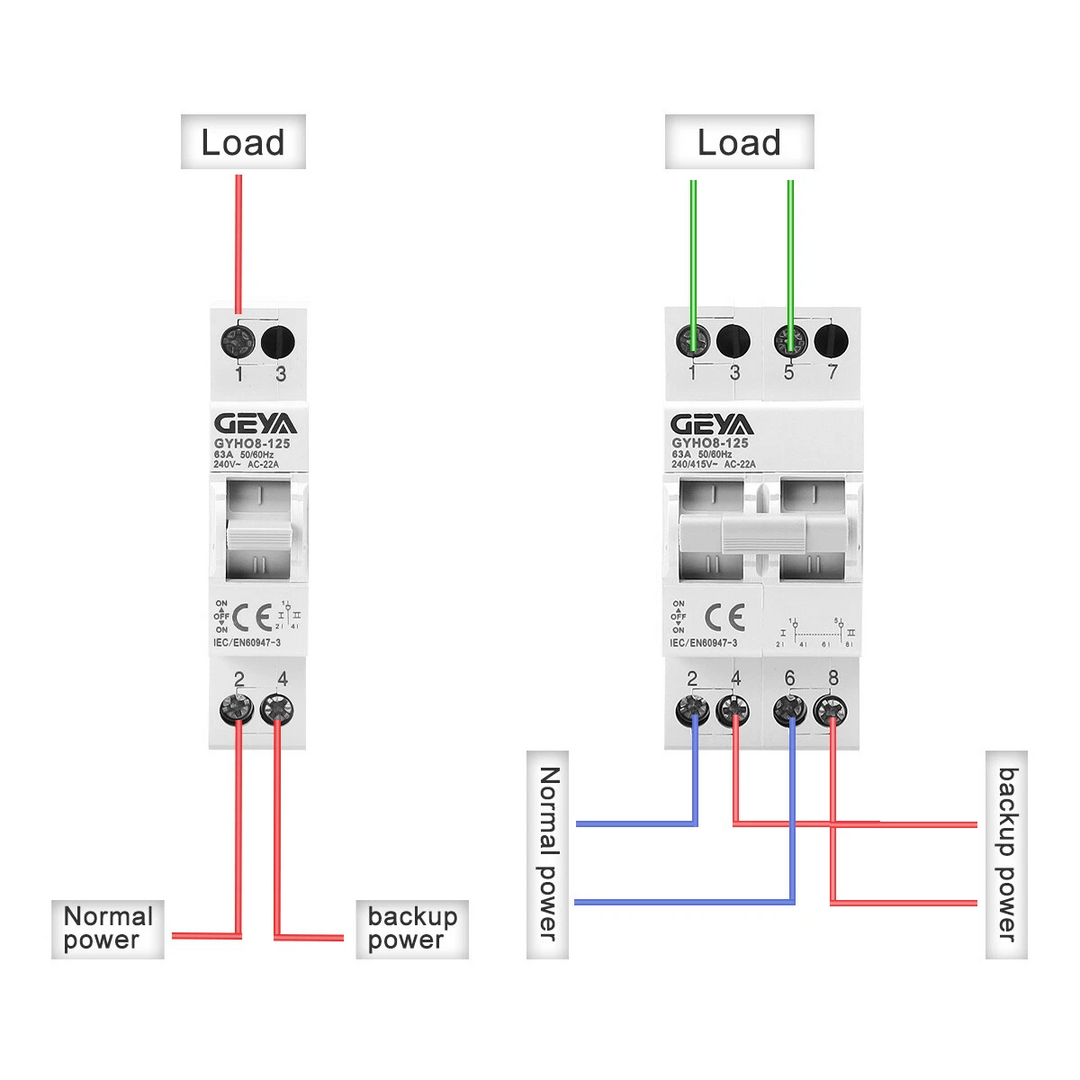
Certainly worthwhile considering Geya. They're a reputable Chinese manufacturer.
But not the left-hand of the two breakers because it's single-pole.
I'm unsure if it's clear from the photos, but these are centre-off switches.
Have you experience with using these manual change-over switches @batpred ?
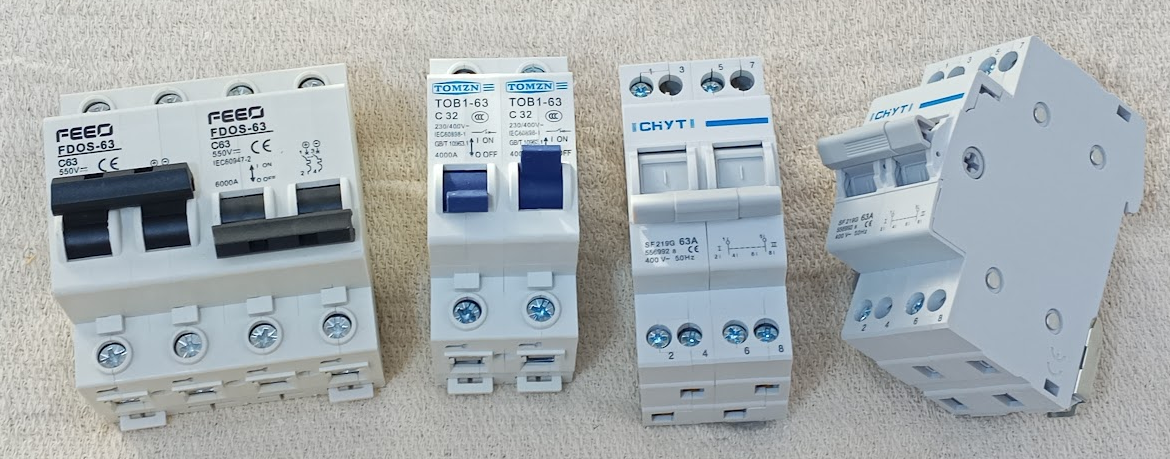
The range of changeover switches to select from is quite wide. Buyers need to be aware of what to look out for:
On the right are two AC centre-off double-pole manual changeover switches by CHYT, rated at 63A. That current rating is dictated by the size of the internal contacts and the maximum 10mm² wire-size which can be accepted by the terminals.
In the middle, with blue levers, is a single-pole AC manual change-over by Tomzn. Like the CHYT and the GEYA units, it's only 2-modules wide. It can accept 16mm² wires, and has inbuilt over-current protection. Ie it operates as an MCB, which the CHYT units don't.
On the left is a double-pole manual changeover unit by FEEO - another reputable manufacturer.
The unit in the photo is rated 63A 550v DC max. It can also be used for AC switching, but has small magnets next to the internal contacts which effectively break the switching arc when disconnecting Direct Current.
This post was modified 2 months ago 2 times by Transparent
The final straw was potentially having to install an 8ft earth rod in my driveway where all the cables and drain pipes/sewer run.
Hadn't thought about earthing yet.
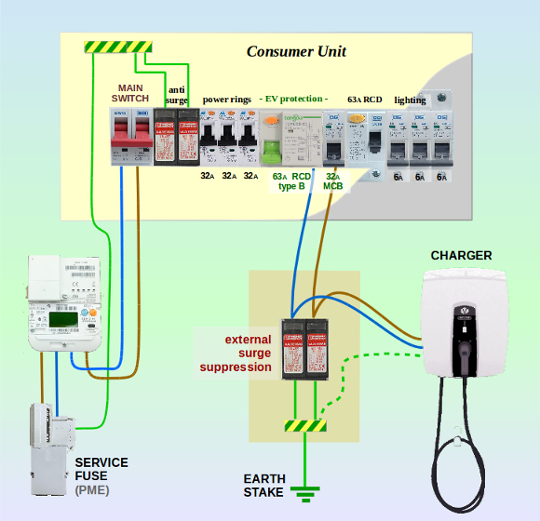
Earthing is definitely a subject which is best approached by a local electrician who already understands the ground conditions in the area.
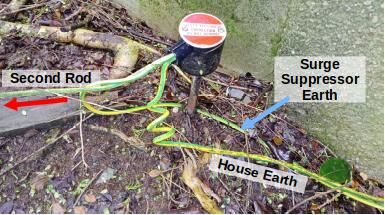
I have two 1-metre copper rods in series, with 5m between them. That brings the Earth-Loop resistance well below the required 200Ω max, even in the driest weather. The 10mm² earth wire is looped into the brass clamp on the first rod before running above ground to the second position.
There are also earthing grids available, which were brought out mainly for the EV-charger market. They provide good contact overall, without driving a rod deep into the sub-soil.
This post was modified 2 months ago by Transparent
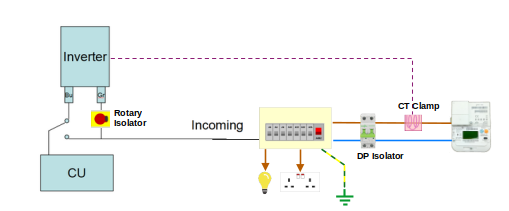
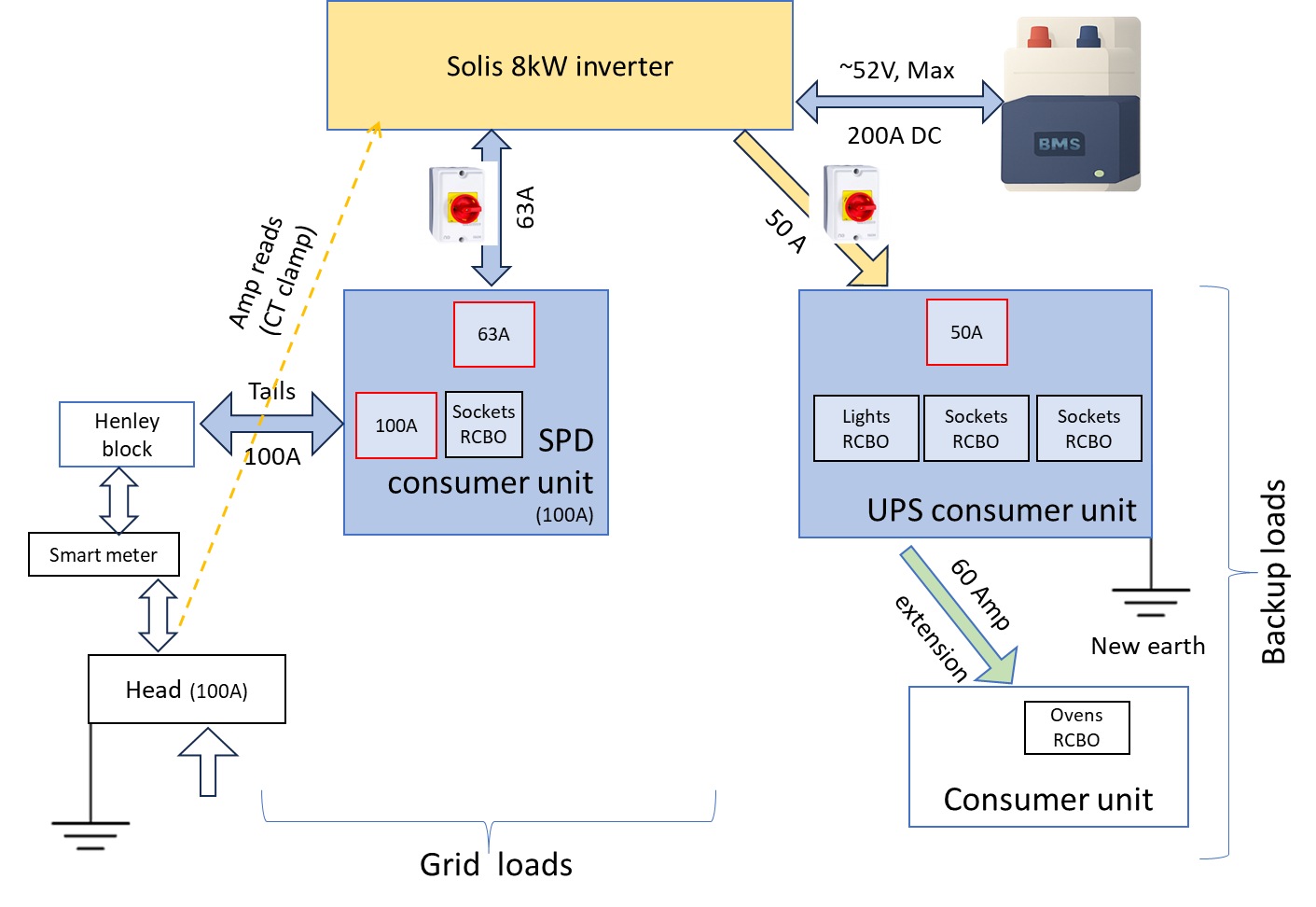
You must have a (rotary) isolator in the supply to the inverter
The CU on the right has a light and a power socket in the room where your inverter and battery are sited. You can then work on the system without being in the dark.
I've added a double-pole isolator on the main tails between the Smart Meter and the first CU. That means an electrician can work in that CU without pulling out the Service Fuse and then asking the DNO to re-seal it.
The house earth will come from that 1st consumer unit.
@transparent thanks. Is the change of earth requirement (ie current arrangement not being sufficient) a consequence of islanding or something else? It's probably enough to put me off islanding!
4kW peak of solar PV since 2011; EV and a 1930s house which has been partially renovated to improve its efficiency. 7kW Vaillant heat pump.
You must have a (rotary) isolator in the supply to the inverter
The CU on the right has a light and a power socket in the room where your inverter and battery are sited. You can then work on the system without being in the dark.
I've added a double-pole isolator on the main tails between the Smart Meter and the first CU. That means an electrician can work in that CU without pulling out the Service Fuse and then asking the DNO to re-seal it.
The house earth will come from that 1st consumer unit.
This really helps. But I cannot work out the icon on the right, I assume the utility meter?
The house earth is usually provided by the DNO... My suggestion would be to only show an (optional) earth on the new consumer unit to the left. Some DNOs or inverter manufacturers would insist on this new earth for islanding mode. In my case, the DNO earth is bonded with a few pipes and that is what serves the backup/ups loads.
The DP isolator you show may not be needed, as the CU has a DP switch anyway?
8kW Solis S6-EH1P8K-L-PLUS hybrid inverter; G99: 8kw export; 16kWh Seplos Fogstar battery; Ohme Home Pro EV charger; 100Amp head, HA lab on mini PC
@transparent thanks. Is the change of earth requirement (ie current arrangement not being sufficient) a consequence of islanding or something else? It's probably enough to put me off islanding!
I think the assumption is that the inverter would be able to continue supplying power to the old consumer unit. In order to have a fully automatic system, the Solis will only provide backup/UPS power to the backup unit. It will not supply the grid unless the grid is live.
So the wiring becomes a bit different and I think simpler. Perhaps you wire the old consumer unit to the inverter backup. And then have a small CU that will be the main connection to the grid.
Usually, there is a Henley block in place (after the utility meter) that allow multiple CUs to be connected.
8kW Solis S6-EH1P8K-L-PLUS hybrid inverter; G99: 8kw export; 16kWh Seplos Fogstar battery; Ohme Home Pro EV charger; 100Amp head, HA lab on mini PC
My most recent certificate says my supply is TN-S, earthed via the 'suppliers facility'. From visual inspection the earthing 'via the suppliers facility' is a ~3mm (maybe 4) twisted bare cable attached to the metallic outer sheath of the incomer. Is different earthing required in islanding mode and why would that be? Sorry to ask - but earthing systems are not something I have (yet) studied).
The house earth will come from that 1st consumer unit.
@transparent In your diagram (for which many thanks) there is no obvious earth when its islanded if the rotary isolator is switched off. Of course it probably isnt, but what's to stop a mistake being made here. Am I missing something?
Is the change of earth requirement (ie current arrangement not being sufficient) a consequence of islanding or something else? It's probably enough to put me off islanding!
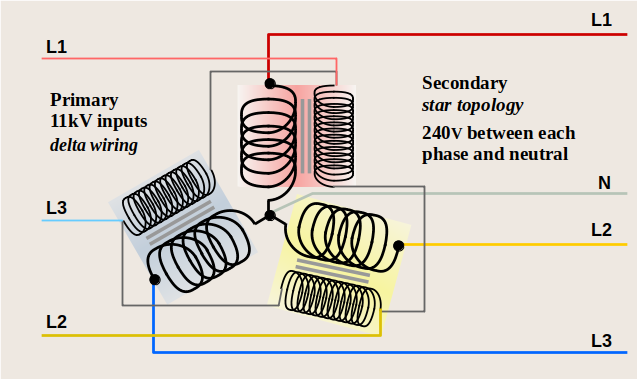
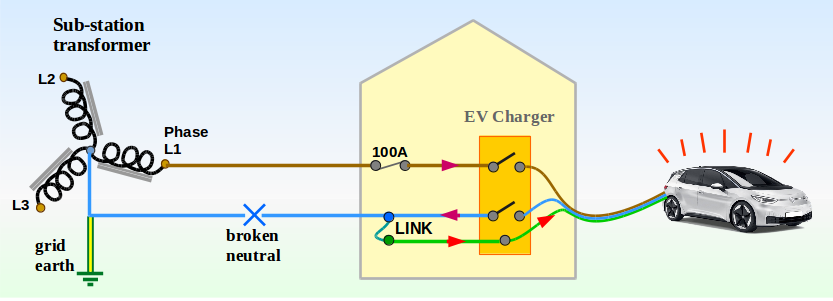
For a TN-C-S (PME) supply the earth to each property is provided via the neutral wire. Your house earth connects to the Neutral at the Service Fuse.
The Neutral is itself tied to earth in the 'centre' of the substation transformer windings.
But if there's a fault, it's possible this is due to a break in the Neutral feed. That would leave your house without any earthing point. All your mains apparatus would 'float' at about 80v - 100v.
That's particularly a problem for properties with an EV charger, because the metalwork of the car becomes 'live'.
To avoid this for a TN-S property, an EV charger must be provided with it's own separate earth.
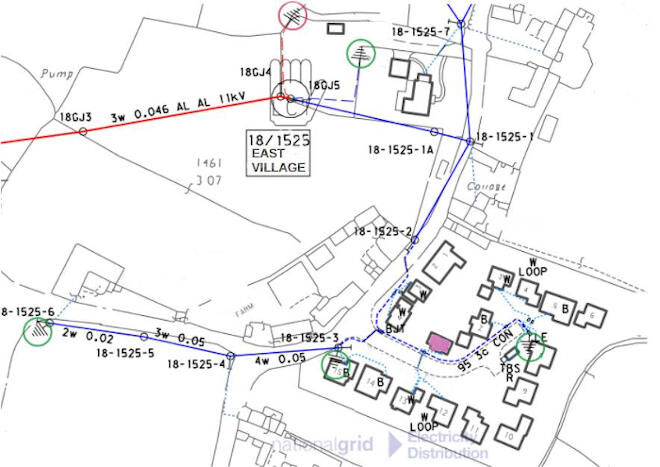
PME means Phase Multiple Earth, and the DNO would normally provide additional earth points further away from the local substation.
In the following (imaginary) village, the substation's Neutral earthing point is ringed in red, and the additional ones ringed in green.
When you add an inverter to a house its grid connection needs to sense that the grid is 'live'
It will check if there's a 50Hz oscillation, and then match its voltage on that port to the present grid voltage - typically 240v.
Without an earth-stake at your property, the inverter would still be able to supply power to the home, even if the mains incomer had a broken Neutral. That's dangerous, and the inverter is meant to go offline. But if it can 'see' a 50Hz signal, then there's a grey area of doubt. The inverter can't sense the difference between Neutral and earth because it has no earth-reference point.
If you were to touch a mains powered appliance, such as a toaster, then your body provides the path to earth.
For this reason all inverters should be earthed.
Note that the above explanation of how to stay alive does not contain the phrase "off-grid" or "islanding". The principle remains the same irrespective of whether you have an inverter which you are intentionally using off-grid.
In James's case, perhaps the simplest is to make the existing consumer unit become the UPS consumer unit and have a small new unit that connects to the head?
The Solis has a built-in ATS so all the switching is automatic. And the Sunnyboy would be plugged into the smart port of the Solis inverter.
8kW Solis S6-EH1P8K-L-PLUS hybrid inverter; G99: 8kw export; 16kWh Seplos Fogstar battery; Ohme Home Pro EV charger; 100Amp head, HA lab on mini PC
My suggestion would be to only show an (optional) earth on the new consumer unit to the left.
The house earth point should be in the same CU as the point of entry for the mains incomer.
It must not be in the 'consumer unit to the left' because that would mean the earth connection back to the CU with the incomer was being provided via the wire which supplies the inverter.
Not only is that earth wire unlikely to be adequately sized at 10mm² but the earth connection would be severed if the inverter were removed in future.
The Wiring Regulations must be complied with.
They aren't open to suggestion
This post was modified 2 months ago 2 times by Transparent