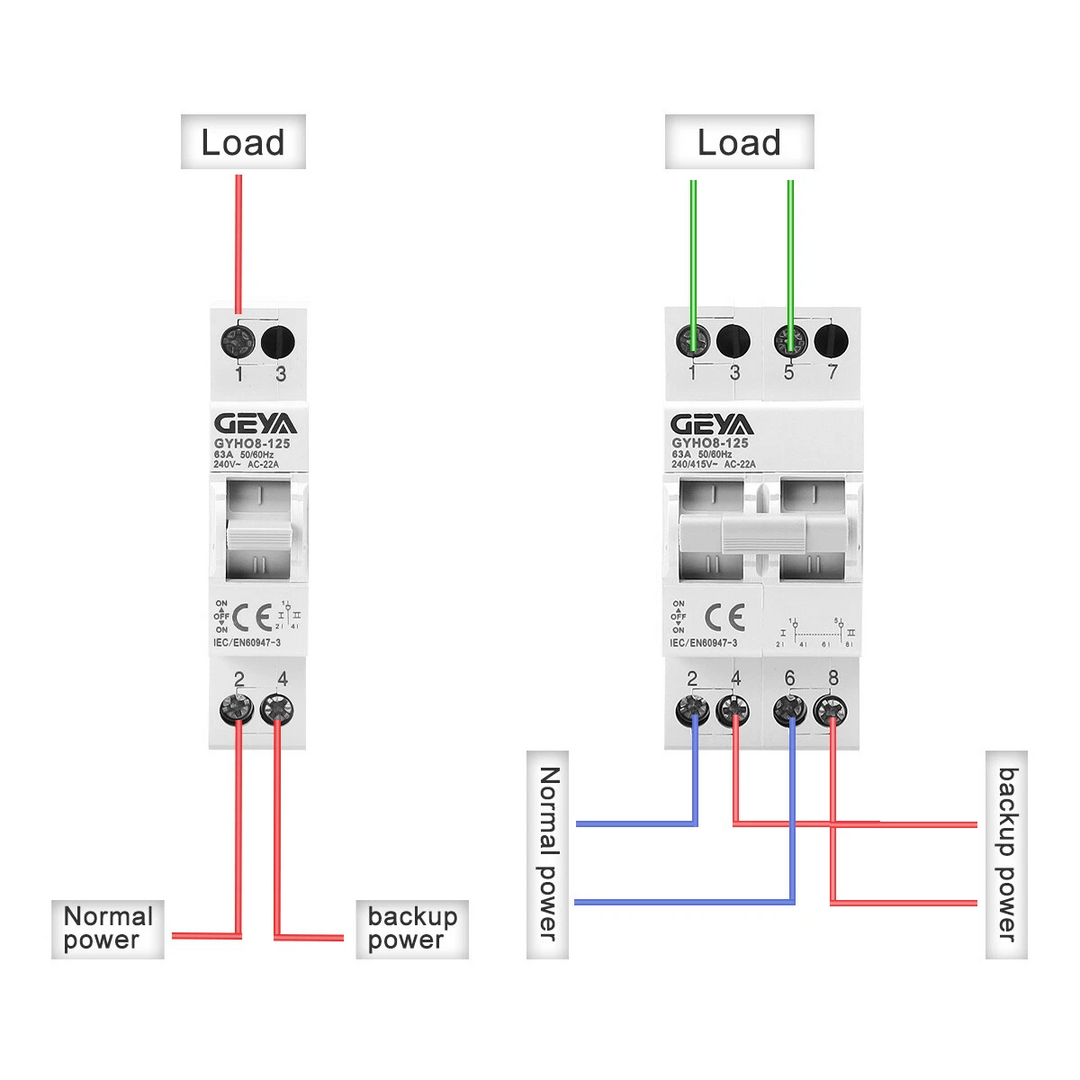
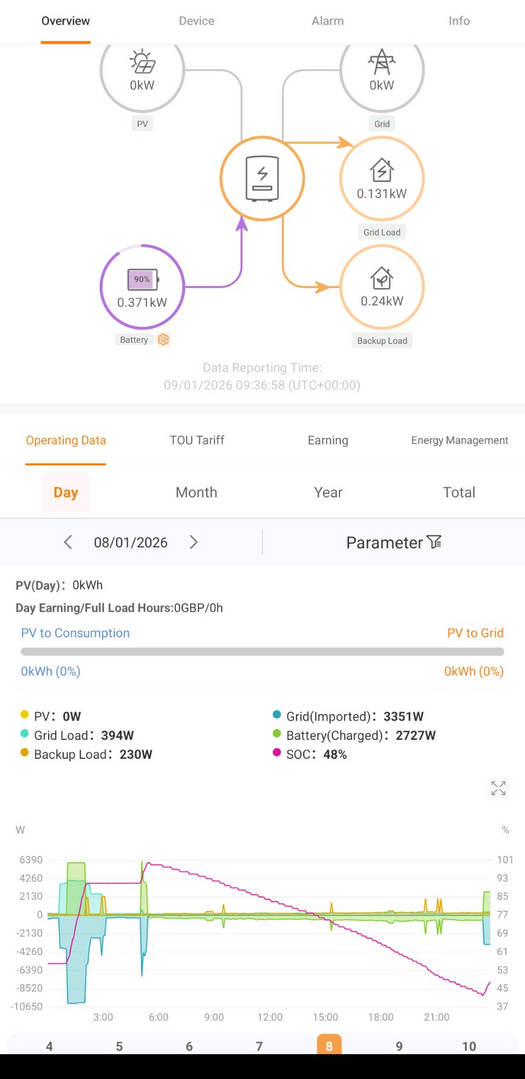
We have to have that manual changeover version of off grid because the output of the battery inverter is 3kW and the total house load could be more. So in the event of a power cut we have to walk around switching off high loads before switching over to battery, always assuming the battery has enough charge to be useful.
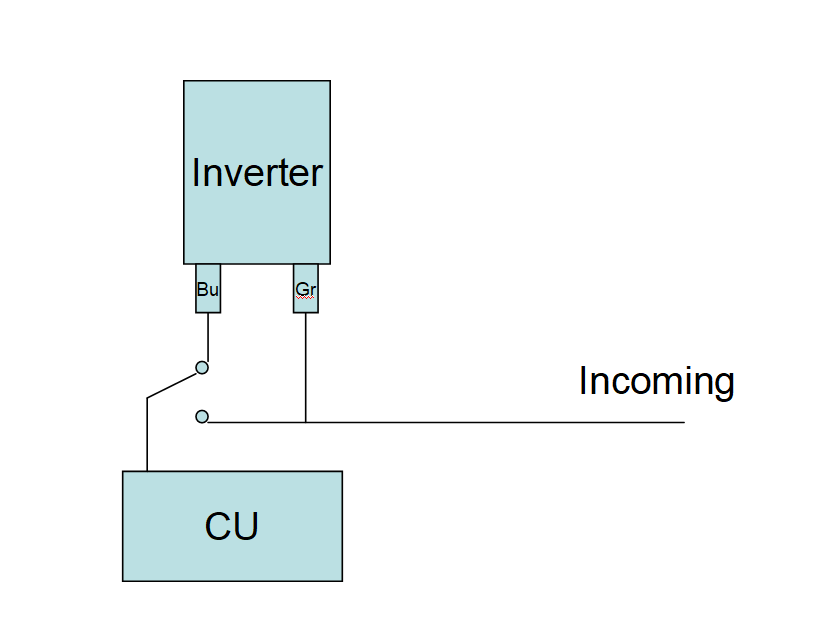
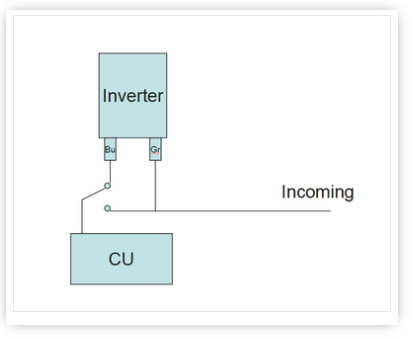
Thats interesting. Are you saying that all of your house circuits are connected to the inverter when it is operating off grid, albeit some of the load has been manually shed? How is this wired? - Like this? Is this 'legal' (cant see why it wouldn't be, its the arrangement on my Narrowboat!)
This would work for me. I have a 600W UPS, so not bothered about internet, computers etc thus a manual changeover with manual load shedding would be fine (perhaps with the exception of a light in the garage!)
How do you know to switch back?
This post was modified 2 months ago 4 times by JamesPa
4kW peak of solar PV since 2011; EV and a 1930s house which has been partially renovated to improve its efficiency. 7kW Vaillant heat pump.
But an electrician won't allow grid-connected and off-grid circuits to share the same CU. That would create a risk of an incorrect connection (or a fault) pushing power onto the grid during an outage.
You need a second/separate CU for loads/circuits which you wish to remain live during an outage.
Noted and safety issues are fair enough. The disappointment is (a) the extra CU and more particularly (b) the need to decide, at wire-time (and therefore fairly irrevocably) which circuits are to remain live, partially because I dont know what my future needs are but also because my answer to that in December is different to my answer in March and different again to my answer in June. If instead there were a disconnector between grid and (CU with attached inverter), grid is protected and I dont have to make this distinction until a power cut actually happens. Hey-Ho!
Now I understand why some have said they don't bother with islanding.
Consumer unit space is relatively inexpensive. Don't scrimp by buying a small one!
Definitely that one, my existing CU being a good example. That said you can no longer buy the inserts for my existing CU (which is about 15-20 years old) so too much planning ahead doesn't necessarily help!
This is why I gave up on the idea of islanding quite quickly. The final straw was potentially having to install an 8ft earth rod in my driveway where all the cables and drain pipes/sewer run. The risk of hitting one and placement to avoid was not very inviting!
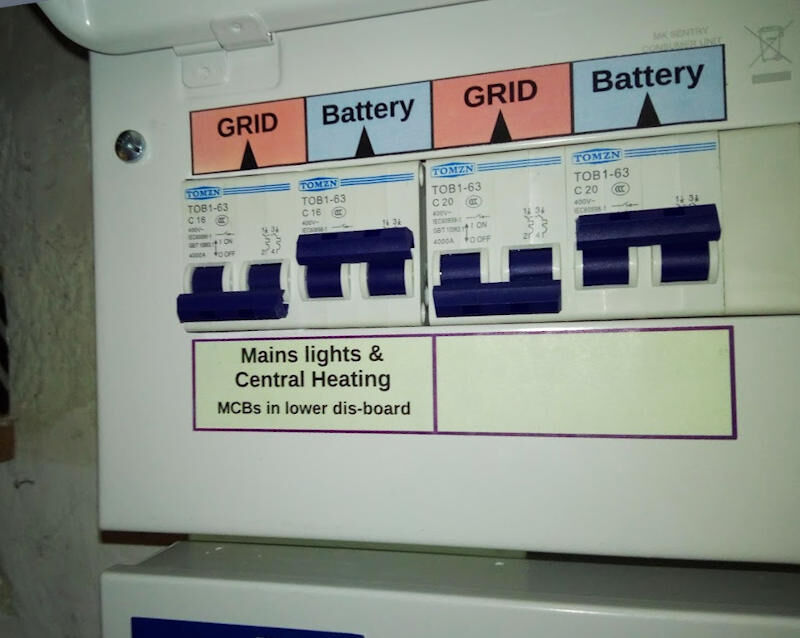
I do have some Manual Change switches within my off-grid system.
You can see that the left-hand one allows heating and lighting to be switched back to directly run from the grid.
That means I can be working on the inverters & batteries, either to correct a fault or to extend the system, whilst still having light and keeping warm!
Remember that every Consumer Unit must be capable of being isolated to allow an electrician to work safely.
The isolator must be double-pole and be labelled "Main Switch".
I do have some Manual Change switches within my off-grid system.
You can see that the left-hand one allows heating and lighting to be switched back to directly run from the grid.
That means I can be working on the inverters & batteries, either to correct a fault or to extend the system, whilst still having light and keeping warm!
Are those changeover switches, they are labelled as regular on-off switches?
Remember that every Consumer Unit must be capable of being isolated to allow an electrician to work safely.
The isolator must be double-pole and be labelled "Main Switch".
Noted. Mine has a 100A switch at the left end of the CU, but it doesnt look 'separate' and isnt labelled. That said I dont know how its wired internally. Personally, if I were working on it, I would want a separate switch immediately after the meter so I could disconnect the whole house including the CU, however the current arrangement is down to the electrician who put it in!
The final straw was potentially having to install an 8ft earth rod in my driveway where all the cables and drain pipes/sewer run.
Hadn't thought about earthing yet. Was this because the existing house earth was insufficient or down to it depending on the grid connection? My supply is listed as TN-S on the most recent certificate I have, earthed via the 'suppliers facility'. From visual inspection that looks like a ~3mm twisted bare cable attached to the metallic outer sheath of the incomer
This post was modified 2 months ago 3 times by JamesPa
4kW peak of solar PV since 2011; EV and a 1930s house which has been partially renovated to improve its efficiency. 7kW Vaillant heat pump.
Based on Solis documentation, the configuration of the CLS should be undertaken by an accredited installer. The process requires password access to an area of the Settings menu, and the use of a particular test to verify compliance.
It took me less than a minute to find online sites (UK, USA and Australia) which revealed that default password. None of those sites stated that the Installer should change that password after setting the Export Limit.
From what I can see, Solis have implemented a 'loose' level of compliance with the G100 documents they submitted to the ENA.
That makes some sense.
I found the Solis was quite open as a manufacturer. I hear some inverters (not sure if givenergy or synergy) leave it all locked to the original installer.
An intelligent end-user (or maybe we can call ourselves user) would usually prefer open to closed:
- should their needs change slightly, they do not have cost nor delay associated with having an installer to make that adjustment
- they do not want to worry about installer bankruptcy
- user free to decide to explore optimisations (installers are often conservative)
- there is of course the risk to the installer that you insist on having the latest firmware, benefit from the latest additions like Solis AI
- theoretical risk of making a mistake in config can be higher, but then you can contact the installer or manufacturer
My journey into open started with my vaillant gas boiler. We bought it with the house and none of the plumbers we contacted knew much about heat curves, etc. After a few months of continuous partial adjustments (and lots of unanswered calls) and suggestions of expensive repairs, I took the "bull by the horns".. Couple of calls to Vaillant and it has been "tamed". I even printed the manual - but I notice none of the plumbers got into reading it.
In terms of all the certification acronyms, as we saw with SGI-2, SGI-3 and the ratings in Amps, they can be very limiting..
As a domestic generator, the interest with certification is limited to the DNO and the utility being satisfied?
8kW Solis S6-EH1P8K-L-PLUS hybrid inverter; G99: 8kw export; 16kWh Seplos Fogstar battery; Ohme Home Pro EV charger; 100Amp head, HA lab on mini PC
I do have some Manual Change switches within my off-grid system.
Worth considering something like this?
They are bi-directional of course. Two sources or two loads flexibility..
They do not replace the rest of the compliance and safety kit but they are easy for an end user to remember? Our concept was that having it up is the typical mode of operation..
8kW Solis S6-EH1P8K-L-PLUS hybrid inverter; G99: 8kw export; 16kWh Seplos Fogstar battery; Ohme Home Pro EV charger; 100Amp head, HA lab on mini PC
@jamespa re when to switch back, you would have to switch back on if the battery was flat! A look out of the window would tell us whether there was any mains to switch to, or it was torch time.
A local friend has an automatic switch over system and is prone to power cuts out in the countryside. He ran for several weeks in summer via the battery (and lots of solar) before ringing his installer to complain about something and the guy spotted he was on battery mode. In winter that would not have been possible.Your simple diagram has the concept correctly but earthing is key. We’re set up on method 3 (but note the document goes into method 4 without a fresh heading)
Givenergy call it EPS which is more descriptive of just having a spare mains socket nearby.
This post was modified 2 months ago 4 times by Judith
2kW + Growatt & 4kW +Sunnyboy PV on south-facing roof Solar thermal. 9.5kWh Givenergy battery with AC3. MVHR. Vaillant 7kW ASHP (very pleased with SCOP 4.7) open system operating on WC
Since the inverter isn't between the mains and the CU, does this need an (automatic?) cut out device that is between CU and incoming feed. Surely it does?
yes, the circuit needs the usual protection, mcb and maybe rcd.
I assume that the AC coupling method involves the Solis S6 making grid power available on that port, but I assume the sunnyboy is happy to live off PV power whenever available (so when it boots again, it does its job).
Thats bothering me. Im pretty sure that the Sunnyboy needs to see grid before it will export in order for the grid to be protected. So far as I have been able to tell it does its job when AC power is provided (presumably whatever the source), whether or not there is PV
I am 99.99% sure the Solis will do this as required (just best to have the Solis distributor check). Essentially I think this means the AC frequency&phase needs to be passed from grid to the sunnyboy via the Solis, so it will adjust its output to that frequency&phase. I am not 100% if the smart port can take an inverter and also loads able to work in islanding mode. I think best to use the "backup" port for that, it is treated with higher priority anyway
Based on Solis documentation, the configuration of the CLS should be undertaken by an accredited installer. The process requires password access to an area of the Settings menu, and the use of a particular test to verify compliance.
yes, UKPN was not extra fussy. They were happy with the diagrams, transparency, etc. So they provided me with the G99 form.
When I showed it to an electrician, he was not very comfortable, not anything he had seen before. He did the usual tests anyway.
But I am confident that there are no safety issues and doubt that the most thorough sparky could find anything wrong. So it was my call. Apart from type testing, it was a matter of thinking about difficult problems like whether an isolator would switch the circuit off in 15 secs or so. Hard to get wrong.
I think I posted in the "getting ready for export" thread..
Well thats probably going to scupper the whole plan given the apparent reluctance of 'accredited installers' to do anything that they don't personally fit/control/is in any way out of the ordinary/isnt on a separate CU etc. I have an electrician who can certify anything electrical and will do out of the ordinary things so long as they are safe and compliant, but he isnt a solar/battery specialist or accredited by Solis or any other inverter manufacturer. I was hoping to get away with electrician plus me given how awkward the solar/battery industry seems to be.
I think it is not too difficult. Often a single electrician cannot do it all, they can get stuck with some stuff like all of it has to be provided by a single manufacturer.
Sometimes best to order the stuff and take key steps. Then it becomes less overwhelming. 😀
8kW Solis S6-EH1P8K-L-PLUS hybrid inverter; G99: 8kw export; 16kWh Seplos Fogstar battery; Ohme Home Pro EV charger; 100Amp head, HA lab on mini PC
Sometimes best to order the stuff and take key steps. Then it becomes less overwhelming
Thanks for all the help/comments. I completely agree with the above, I just want to be sure that there isn't an 'artificial' blockage at the end requiring someone who 'plays awkward' and for which there is no workaround. As I say the electrician I plan to use if I go ahead is very pragmatic, but he can't guess passwords or fake certificates (well he can probably do the latter, but wouldn't, and I wouldn't ask him to)
4kW peak of solar PV since 2011; EV and a 1930s house which has been partially renovated to improve its efficiency. 7kW Vaillant heat pump.
@jamespa re when to switch back, you would have to switch back on if the battery was flat! A look out of the window would tell us whether there was any mains to switch to, or it was torch time.
When I did the commissioning tests on the Solis, specifically switching off the main grid to the consumer unit, I just heard a few clicks after a few seconds. Same when switching the grid back on.
The inverter was then configured to use the grid, so while it had battery, it knew what to do.
No need to touch it and the lights do not even flicker...
The inverter is now configured to maximise self use, so a power cut overnight while it would be topping up the battery would be the only real test . We only get one power cut a year, usually very short, but now we will not need to set the clocks around the kitchen ..
Apart from when using the kettle, when the inverter fan usually starts, you would not notice it.
8kW Solis S6-EH1P8K-L-PLUS hybrid inverter; G99: 8kw export; 16kWh Seplos Fogstar battery; Ohme Home Pro EV charger; 100Amp head, HA lab on mini PC