Out of curiosity, I looked at the G100 Test documentation provided to the ENA's approved tester by Solis.
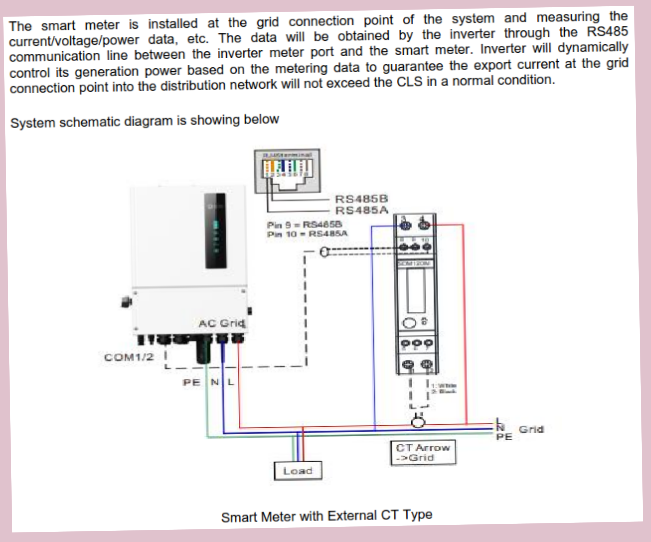
They use an external 'meter' with its own CT coil, connected to the 8kW inverter via RS485. This gets configured to the Customer Limit Specification (CLS) which the DNO has granted for that particular site.
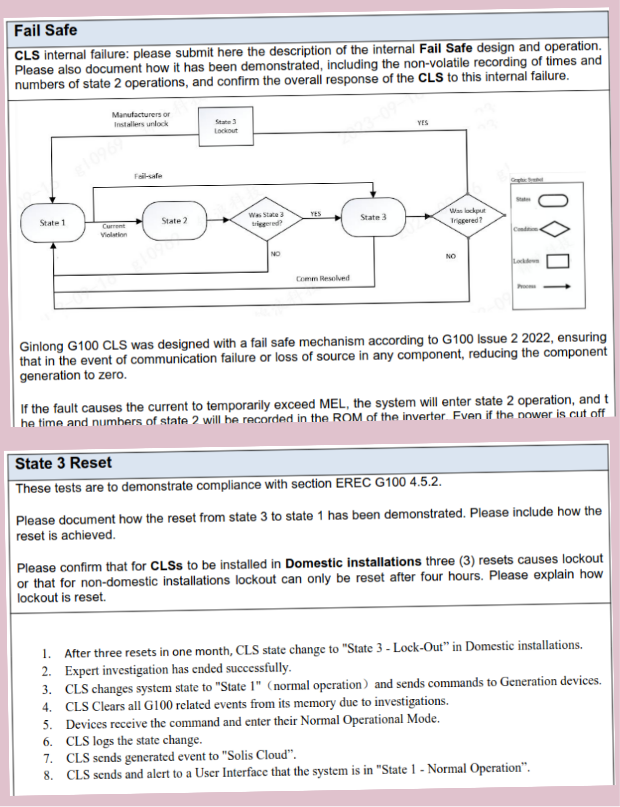
The declared Export Limitation Method includes three levels of 'fail safe' to guard against excess current.
In the extreme, these can cause the Solis inverter to lockout.
Off-site monitoring is required, using a cloud-based service run by Solis (Ginlong), with alerts being sent to the consumer. The 3rd level of fail safe appears to require the inverter to be sent a 'reset and restart' command from Solis themselves.
At this level of Compliance Documentation it isn't stated how the CLS is configured by the installer, nor how that can't be overridden by the customer at a later date.
Nor is the 'meter' with its CT Coil identified. It is implied that it is a component supplied by Solis.
In conclusion, this G100 certification relies on the customer retaining an Account with Solis, which allows monitoring and for commands to be sent. Should communications be broken, or if Solis doesn't continue that service, then I assume that the inverter will fall back to a 16A Export Limitation, or possibly to zero export.
However, that isn't stated, and it's possible that the meter will need to be unplugged (decommissioned) from the inverter, and the standard Solis CT coil installed in its place.
Whether individual customers are satisfied with such an arrangement will depend on their (technical) understanding of the Solis Export Limitation Mechanism.
This post was modified 2 months ago 2 times by Transparent
Thanks all for the help, this seems to be nearly as complex as heating!
My current thought process, and the remaining questions, are this:
New battery inverter with perhaps a 5kW max output which covers my peak use other than if heat pump, kettle and oven are simultaneously at max or I m charging the EV and heat pump is on max.
Charge batteries at night rate, discharge during day rate period when power would otherwise have been taken from the grid. Benefit by ~20p/kWh at current rates
During the daytime period export when solar generation exceeds house demand (as at present). I get 15p for export so its cheaper to charge the batteries at night than on the solar, and when there is excess solar its unlikely that I will need a top up of the battery for use later in the day
If I get 15kWh batteries initially that saves £600 pa at current prices.
The remaining questions in my mind are
Do I connect the Sunnyboy PV inverter through the new inverter or direct to the CU. The latter seems simpler from the PoV of managing export, but does it actually change which regulation it falls under? Surely it must because only the battery inverter is connected to the grid, so in this case I need a new approval for connecting a single 5kW inverter as opposed to an approval for connecting an additional 5kW on top of the existing 3.68kW. If I cant get that then I would need to limit export whilst hopefully retaining the 5kW capacity for inverter->house
Do I configure to allow islanding (and if I do what do I need to add)? This would be a great mental comfort albeit we rarely, at present, get power cuts. 15.5kWh would see me through 3hr-6hr power cuts on every day of the year even with the ASHP connected, and 24hr power cuts on many days or without the ASHP. If I do allow islanding I cant see the point in dividing the CU up into 'backup circuits' and 'other circuits'. In reality the only circuit that wouldn't be on backup is the ASHP and I can just switch it off!
Have I missed anything crucial?
4kW peak of solar PV since 2011; EV and a 1930s house which has been partially renovated to improve its efficiency. 7kW Vaillant heat pump.
Out of curiosity, I looked at the G100 Test documentation provided to the ENA's approved tester by Solis.
They use an external 'meter' with its own CT coil, connected to the 8kW inverter via RS485. This gets configured to the Customer Limit Specification (CLS) which the DNO has granted for that particular site.
...
I currently have this setup with the CT clamp/coil being connected "via" their (optional) meter to the inverter. It works without any dependency on the cloud. All access to the internet is via an optional datalogger (a USB dongle), that they provide and allows wifi and ethernet connectivity. From the fact that it is optional, the conclusion is that the system works independently of it being connected. And I confirmed this is the case. Soliscloud is a "nice to have".
The first setup that I had in term of CT clamp was without using the meter they provided. In this case, the CT clamp wires are connected to another input in the inverter.
Additionally:
- the configuration of whether to use the meter (and which brand) is via the inverter menus
- same for the direction the CT clamp
- same for multiplication factors (depending on the meter)
There is no dependency on soliscloud.
You may have got confused with the fact they relied on soliscloud to confirm (in this test) that the inverter was correctly enforcing the configured export limit. But the same information is displayed on the on-board LCD, so should anyone reduce the scope of the testing to this, they can.
Did you also verify the G100 certification?
I just went by the ENA statement that the inverter is approved for use as per G100.
8kW Solis S6-EH1P8K-L-PLUS hybrid inverter; G99: 8kw export; 16kWh Seplos Fogstar battery; Ohme Home Pro EV charger; 100Amp head, HA lab on mini PC
Do I connect the Sunnyboy PV inverter through the new inverter or direct to the CU. The latter seems simpler from the PoV of managing export, but does it actually change which regulation it falls under? Surely it must because only the battery inverter is connected to the grid, so in this case I need a new approval for connecting a single 5kW inverter as opposed to an approval for connecting an additional 5kW on top of the existing 3.68kW. If I cant get that then I would need to limit export whilst hopefully retaining the 5kW capacity for inverter->house
Do I configure to allow islanding (and if I do what do I need to add)? This would be a great mental comfort albeit we rarely, at present, get power cuts. 15.5kWh would see me through 3hr-6hr power cuts on every day of the year even with the ASHP connected, and 24hr power cuts on many days or without the ASHP. If I do allow islanding I cant see the point in dividing the CU up into 'backup circuits' and 'other circuits'. In reality the only circuit that wouldn't be on backup is the ASHP and I can just switch it off!
Have I missed anything crucial?
I believe the safest from a reg pov is to use scenario 2. Since your sunnyboy does not have a CT clamp and the G99 scheme expects one.
2) connect the sunnyboy to the "gen" port (also called smart port in the Solis S6). This may need AC coupling
The secondpotentialoption would be to make the existing inverter feed AC into the hybrid (possible with the gen port or the smart port of my Solis).
With smart port:
The Sunnyboy cannot generate more than your approved export.
The power is then fed to the Solis S6 and that inverter would apply the limit your DNO granted you.
I assume that the AC coupling method involves the Solis S6 making grid power available on that port, but I assume the sunnyboy is happy to live off PV power whenever available (so when it boots again, it does its job).
If it was me, I would:
1 - reach out to UKPN and confirm what is the maximum power they would allow on my connection if I use a G100 type-tested inverter and what paperwork they need
2 - contact supplier/installer of the inverter I want to use. Confirm they are happy to work rewire the sunnyboy as in the diagram and choose one
3 - get the paperwork going with UKPN
4 - get the installer/electrician to do its bit, ct clamp and all and leave the inverter working (including wifi, etc), routing the power from the sunnyboy to the grid
5 - wire the battery and configure it in the inverter (easy to do on a Solis)
6 - once ready to adjust to the new export limit, change the config in the inverter.
I think I did not miss any step?
With the Solis you would be able to optimise a bit further. I am considering having an agile type of export tariff. I plan to configure this tariff on the Solis (they have the full list for Octopus as far as I could tell). Then using Solus AI, it can dynamically work out when it is worth exporting based on battery capacity, predicted solar production, etc. I think they claim they take a weather feed.
8kW Solis S6-EH1P8K-L-PLUS hybrid inverter; G99: 8kw export; 16kWh Seplos Fogstar battery; Ohme Home Pro EV charger; 100Amp head, HA lab on mini PC
Do I connect the Sunnyboy PV inverter through the new inverter or direct to the CU. The latter seems simpler from the PoV of managing export, but does it actually change which regulation it falls under? Surely it must because only the battery inverter is connected to the grid, so in this case I need a new approval for connecting a single 5kW inverter as opposed to an approval for connecting an additional 5kW on top of the existing 3.68kW. If I cant get that then I would need to limit export whilst hopefully retaining the 5kW capacity for inverter->house
The configuration you will implement depends on what your DNO's Network Planner will approve.
Whilst both approaches you've described would appear to be technically achievable, it's the Regulations which need to be applied. So we can't answer this here on the Forum!
Do I configure to allow islanding (and if I do what do I need to add)? This would be a great mental comfort albeit we rarely, at present, get power cuts.
Both the Solis and Sunsynk (Deye) options allow islanding by default.
Each inverter family has an 'always on' port at 240v AC to which you will connect the house circuits/appliances which you like to remain live during an outage.
Other inverters probably also offer the same functionality, but neither @batpred nor I know enough on them to provide meaningful advice!
I understand what @batpred has just told us about SolisCloud not being required to implement a site-specific CLS above 16A by using an external meter.
That doesn't match what the G100 documentation states on the ENA site.
What he's just told us would appear to indicate that his own Solis inverter installation could not be recovered from a Lock Out. That's a Fault-State-3... which is probably very rare.
Solis inverters are sold worldwide, and different firmware is installed at the point of manufacture in order to comply with local regulations for different country groups.
Their inverters can accept a number of alternative external current meters, including those by Eastron and Acrel. Both of those manufacturers are known to me and have good reputations for accuracy and quality.
Based on Solis documentation, the configuration of the CLS should be undertaken by an accredited installer. The process requires password access to an area of the Settings menu, and the use of a particular test to verify compliance.
It took me less than a minute to find online sites (UK, USA and Australia) which revealed that default password. None of those sites stated that the Installer should change that password after setting the Export Limit.
From what I can see, Solis have implemented a 'loose' level of compliance with the G100 documents they submitted to the ENA.
This post was modified 2 months ago 2 times by Transparent
Both the Solis and Sunsynk (Deye) options allow islanding by default.
Each inverter family has an 'always on' port at 240v AC to which you will connect the house circuits/appliances which you like to remain live during an outage.
Since the inverter isn't between the mains and the CU, does this need an (automatic?) cut out device that is between CU and incoming feed. Surely it does?
I assume that the AC coupling method involves the Solis S6 making grid power available on that port, but I assume the sunnyboy is happy to live off PV power whenever available (so when it boots again, it does its job).
Thats bothering me. Im pretty sure that the Sunnyboy needs to see grid before it will export in order for the grid to be protected. So far as I have been able to tell it does its job when AC power is provided (presumably whatever the source), whether or not there is PV
Based on Solis documentation, the configuration of the CLS should be undertaken by an accredited installer. The process requires password access to an area of the Settings menu, and the use of a particular test to verify compliance.
Well thats probably going to scupper the whole plan given the apparent reluctance of 'accredited installers' to do anything that they don't personally fit/control/is in any way out of the ordinary/isnt on a separate CU etc. I have an electrician who can certify anything electrical and will do out of the ordinary things so long as they are safe and compliant, but he isnt a solar/battery specialist or accredited by Solis or any other inverter manufacturer. I was hoping to get away with electrician plus me given how awkward the solar/battery industry seems to be.
This post was modified 2 months ago 4 times by JamesPa
4kW peak of solar PV since 2011; EV and a 1930s house which has been partially renovated to improve its efficiency. 7kW Vaillant heat pump.
Since the inverter isn't between the mains and the CU, does this need an (automatic?) cut out device that is between CU and incoming feed.
No.
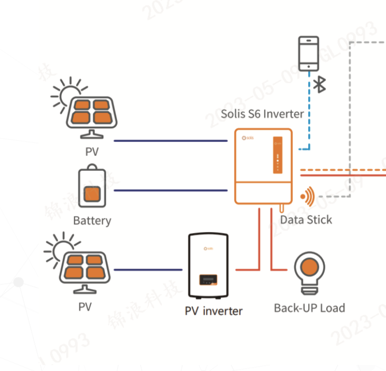
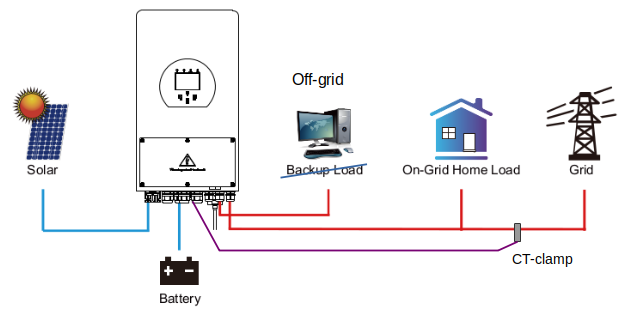
The Solis and Sunsynk inverters which we're discussing have two separate ports, both of which can supply household loads from your incoming solar.
One port connects to the grid, and will cease to operate when there is an outage. The other one remains live during a power-cut, and supplies its loads from solar input (if available) plus energy stored in the battery.
Here's the SunSynk basic diagram.
I've renamed 'Backup Load' as 'Off grid' because I think it better describes it's functionality.
You can have a new, separate CU fed from that Off-grid 240v output.
Based on Solis documentation, the configuration of the CLS should be undertaken by an accredited installer. The process requires password access to an area of the Settings menu, and the use of a particular test to verify compliance.
Well thats probably going to scupper the whole plan given the apparent reluctance of 'accredited installers' to do anything that they don't personally fit/control/is in any way out of the ordinary/isnt on a separate CU etc.
I view this in the opposite way to your conclusion.
The Solis implementation of G100 is sufficiently 'loose' that anyone can install a (supported) current-meter, and use the Firmware Admin password to set the Export Limitation to whatever is offered by your DNO.
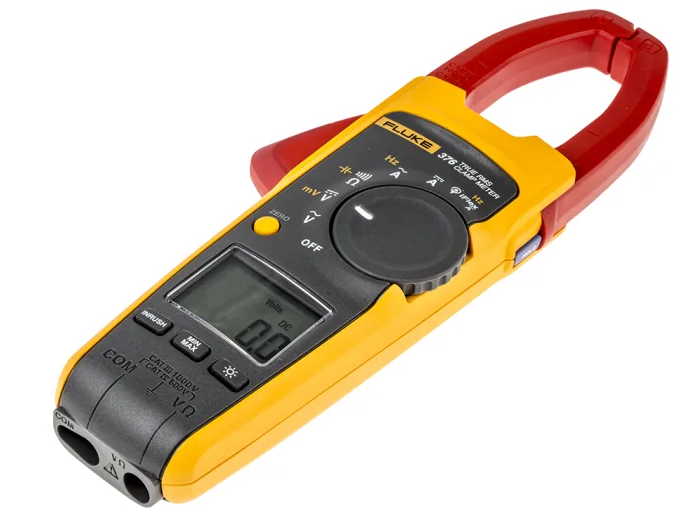
You can use a clamp-multimeter to provide reassurance that the current is indeed being limited, because no one checks that this gets done effectively anyway.
From what @batpred (and other online Forums) state, you also don't need to sign up to the SolisCloud, and if you also decide to not allow WiFi data to pass outside your house, no 3rd-party can send commands to your inverter.
The absence of external access means that your electricity supply is 'secure'.
If the ENA were minded to listen to feedback, we should be telling them that the lack of enforcement means that
export levels set by the DNO can be readily exceeded
Solis inverters can be shut-down (& restarted) using commands sent by unauthorised 3rd parties
This position isn't dissimilar to that taken by MCS when it asserts that it 'regulates' the installation of heat pumps! 🤔
This post was modified 2 months ago 4 times by Transparent
One port connects to the grid, and will cease to operate when there is an outage. The other one remains live during a power-cut, and supplies its loads from solar input (if available) plus energy stored in the battery.
Here's the SunSynk basic diagram.
I've renamed 'Backup Load' as 'Off grid' because I think it better describes it's functionality.
You can have a new, separate CU fed from that Off-grid 240v output.
Ah, so that places the 'off grid' port of the inverter between grid and load so protecting the grid. However it does introduce another complexity:
either the inverter must be capable of supplying my peak total load (in which case I can just connect the CU to the 'off grid port' and the incoming mains through a breaker to the 'on grid' port)
or
I have to split the CU into two in a way that is fixed in order to ensure that the load on the 'off grid' port is <= to the inverter capacity
This seems a bit naff in the shoulder season when I could easily run my entire house on including the heat pump say, 5kW peak in case of a power cut.
I view this in the opposite way to your conclusion.
The Solis implementation of G100 is sufficiently 'loose' that anyone can install a (supported) current-meter, and use the Firmware Admin password to set the Export Limitation to whatever is offered by your DNO.
Well indeed so, no further comment necessary!
This post was modified 2 months ago 2 times by JamesPa
4kW peak of solar PV since 2011; EV and a 1930s house which has been partially renovated to improve its efficiency. 7kW Vaillant heat pump.
either the inverter must be capable of supplying my peak total load (in which case I can just connect the CU to the 'off grid port' and the incoming mains through a breaker to the 'on grid' port)
or
I have to split the CU into two in a way that is fixed in order to ensure that the load on the 'off grid' port is <= to the inverter capacity
The latter is the case.
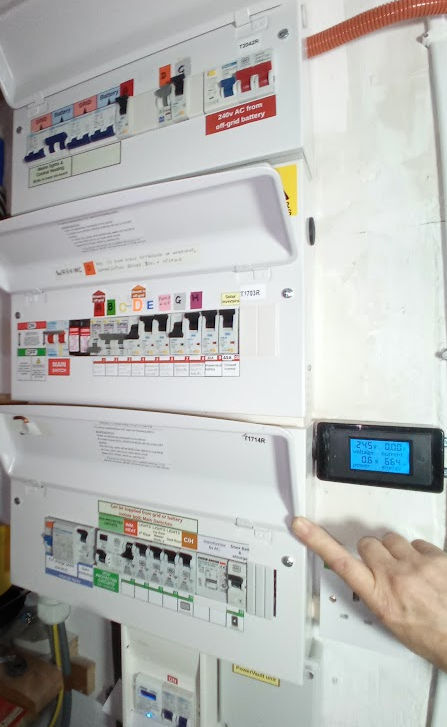
But an electrician won't allow grid-connected and off-grid circuits to share the same CU. That would create a risk of an incorrect connection (or a fault) pushing power onto the grid during an outage.
You need a second/separate CU for loads/circuits which you wish to remain live during an outage.
Here's three of my Consumer Units (I now have four!). The top one is off-grid.
The basic concept for deciding the number and size of of inverters and batteries is this:
If you need more power to run the home, then add inverters - that increases the kilowatts
If you need your stored energy to last longer, then add battery capacity - that increases the kilowatt-hours
You don't have to install everything at the outset, but leave space for additional capacity should it be required.
Consumer unit space is relatively inexpensive. Don't scrimp by buying a small one!
Personally I don't like having one large inverter because a fault then cripples the capability to run off-grid.
Since inverters tend to get proportionally more expensive at values above 5kW, I install several 5kW units until I'm confident that I can still run the majority of the home off-grid should one of them fail.
That's called N-1 Resilience.
Although these concepts may be new to you, you are asking all the right questions!
This post was modified 2 months ago by Transparent
But an electrician won't allow grid-connected and off-grid circuits to share the same CU. That would create a risk of an incorrect connection (or a fault) pushing power onto the grid during an outage.
You need a second/separate CU for loads/circuits which you wish to remain live during an outage.
Noted and safety issues are fair enough. The disappointment is (a) the extra CU and more particularly (b) the need to decide, at wire-time (and therefore fairly irrevocably) which circuits are to remain live, partially because I dont know what my future needs are but also because my answer to that in December is different to my answer in March and different again to my answer in June. If instead there were a disconnector between grid and (CU with attached inverter), grid is protected and I dont have to make this distinction until a power cut actually happens. Hey-Ho!
Now I understand why some have said they don't bother with islanding.
Consumer unit space is relatively inexpensive. Don't scrimp by buying a small one!
Definitely that one, my existing CU being a good example. That said you can no longer buy the inserts for my existing CU (which is about 15-20 years old) so too much planning ahead doesn't necessarily help!
This post was modified 2 months ago 3 times by JamesPa
4kW peak of solar PV since 2011; EV and a 1930s house which has been partially renovated to improve its efficiency. 7kW Vaillant heat pump.
Wholesalers and Electricians off-load the older styles to these online stores rather than hang onto them. That's because they don't like having trips where the cable entry points might beat different heights between old & new models.
Nor do they want to tie up working capital by holding onto older stocks.
When they meet an old installation like yours, it's cheaper for them to buy-in the trip they're then needing.
@jamespa you can route the off Grid port to a switch which goes to the house load. Wire your wifi to the inverter “live” common side and the house to either mains or the off grid port.
We have to have that manual changeover version of off grid because the output of the battery inverter is 3kW and the total house load could be more. So in the event of a power cut we have to walk around switching off high loads before switching over to battery, always assuming the battery has enough charge to be useful.
We've tested this but never had to use it in 3 years since we got the battery (and only one power cut in the previous 12 years here).
if your possible load is higher than the inverter output it is a risk to do otherwise.
2kW + Growatt & 4kW +Sunnyboy PV on south-facing roof Solar thermal. 9.5kWh Givenergy battery with AC3. MVHR. Vaillant 7kW ASHP (very pleased with SCOP 4.7) open system operating on WC