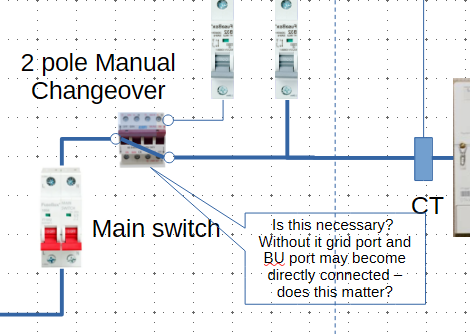
I'd like to respond to the text in a label on that diagram:
Yes, it certainly does matter if the Grid Port and the (Maintained) 'back-up' port could become connected!
That would be a serious breach of the regulations, and any electrician who agreed to undertake such a wiring configuration should lose their accreditation.
Your hybrid inverter would sense the absence of 50Hz at the grid port, and allow the Maintained Port to operate by using the inbuilt 50Hz frequency generator.
The 240v supply from the Maintained Port would energise the cable connecting your house to the local sub-station, which would put the DNO engineers at risk of electrocution.
2: Even if the engineers survive, complete the repair and didn't notice that your Feeder cable had become live on one phase, when they reconnect the 11kV supply to the transformer, your Maintained Port will be operating its 50Hz output unsychronised to the grid.
You will have pitted your inverter against the entire might of the British electricity grid.
It's a battle which should (rightly) cause all your fuses and trips to blow!
Thanks, I was beginning to conclude that would be the case.
Even if you were to have a Changeover Switch in this position, I would anticipate the electrician wanting it in a sealed/tamper-resistant enclosure.
Sorry but I dont understand this comment, can you clarify. The changeover switch as depicted in the diagram guarantees that grid port and backup port can never simultaneously be connected to the CU, and its necessary for me to execute the changeover. Are you talking about a changeover switch that isn't shown?
On Grid with battery charging from grid or solar excess
On grid with no battery charging
Off grid with solar self consumption
Off grid with battery charging solar excess
Off grid with power from battery/solar
As only the battery inverter is connected to the grid, I think it is the capacity of that only which ultimately matters for the connection, however this may depend on DNO interpretation.
I think this Solis allows it all. But with 2 and 5, since I only used the smart/gen port as an additional lower priority backup, I cannot confirm.
I asked Solis and I think they said yes - here are two successive emails from them:
Solis said the following about my arrangement as a condition for the PV inverter and solis inverter to play together nicely:
*
The existing PV inverter can be connected to the Smart port
The PV inverter capacity must be lower than the S6 hybrid inverter capacity.
*
I then said:
"Assuming I conform to the above then:
Will I be able to export excess PV whilst grid tied? Does the state of charge of the batteries affect the answer to this question?
Likewise will I be able to use excess PV to charge the batteries when operating off grid"
To which Solis replied:
"Export excess PV while grid-tied: Yes, excess PV can be exported to the grid when grid-tied. The battery state of charge does not prevent export. If the batteries are full or charging is limited, surplus PV will be exported (if export is enabled).
Charge batteries from excess PV while off-grid: Yes, when off-grid, excess PV from the AC-coupled inverter can charge the batteries, as long as PV power exceeds the load and is within the S6 charging limits."
4kW peak of solar PV since 2011; EV and a 1930s house which has been partially renovated to improve its efficiency. 7kW Vaillant heat pump.
My point was we would have been very happy for the DNO to impose a G100 LImit on the export for the site. Instead, they simply limited the inverter size and matched that to the export limit on the G99 approval. They could have said the 16kW inverter is fine with a G100 limitation of 10kW, or 3kw or whatever number! Which would have unlocked our plans.
Thanks for the clarifications. And I'd assumed a lower level of technical knowledge than you've now demonstrated.
The DNO which seems to work like this is UKPN.
Not only do they often approve export levels above G99(a) which is 16A per phase, but they also refer to limits which must apply to the equipment rather than the level of export.
I do talk with Network Planners in DNOs elsewhere in GB, and I appreciate that they see things differently to UKPN.
As it happens, the Regional Energy Strategic Plan (RESP) participants are about to start work writing the RIIO-ED3 contracts which will be agreed between each DNO and Ofgem. RIIO-ED3 becomes 'live' in April'27
Those documents would be an appropriate method to stipulate more accurately the way in which G99/100 applications should be assessed.
The measures would also apply retrospectively. That's because there are situations when inverters which have previously been installed are later found to be creating problems in an area. DNOs and Installers occasionally need to visit such a site and adjust equipment settings.
Even if you were to have a Changeover Switch in this position, I would anticipate the electrician wanting it in a sealed/tamper-resistant enclosure.
Sorry but I dont understand this comment, can you clarify. The changeover switch as depicted in the diagram guarantees that grid port and backup port can never simultaneously be connected to the CU, and its necessary for me to execute the changeover.
I'm talking about the need for an appropriate 'warning' of what's in the C/O switch enclosure.
For example, if a dwelling has sockets in a room which are supplied from different phases, then a "Warning 440v between appliances" label would be used.
In your case, the Hybrid inverter must wait for a randomised period of time after the 240v grid supply is re-energised, before it starts to operate again. That's a G98 requirement to prevent surges when a substation is brought back online, and for other safety reasons which aren't relevant here.
During that interval of around a minute, the C/O switch enclosure will have two separate 'mains' feeds, which aren't synchronised.
That's a point of extra danger which the electrician may wish to indicate.
Even if you were to have a Changeover Switch in this position, I would anticipate the electrician wanting it in a sealed/tamper-resistant enclosure.
There would be 440v between the incoming grid and the output of your Maintained port. They are effectively two independent phases at the moment when the grid becomes re-energised, and will be so for around 60-seconds due to the time-delays required for G98 certification.
[...]
When my switch is providing grid power to the inverter, it simultaneously stops providing power to the circuits. The risk you highlight is reduced, as 2 independent things would need to go wrong here for it to be an issue... My primary goal is still safe and fully automated switching from grid to off grid.
No, the risk of having 440v within that room is not reduced.
I'm specifically pointing out the condition which exists when the grid supply to the inverter is made 'live' after a period of disconnection.
The inverter doesn't immediately switch over to normal operation. The Maintained (backup) port continues to be supplied with power from the battery at a frequency of 50Hz created by an internal oscillator within the inverter.
There might indeed be a further fault which occurs within the inverter, but I haven't (yet) mentioned anything which "goes wrong", let alone two independent things.
I asked Solis and I think they said yes - here are two successive emails from them:
Solis said the following about my arrangement as a condition for the PV inverter and solis inverter to play together nicely:
*
The existing PV inverter can be connected to the Smart port
The PV inverter capacity must be lower than the S6 hybrid inverter capacity.
*
I then said:
"Assuming I conform to the above then:
Will I be able to export excess PV whilst grid tied? Does the state of charge of the batteries affect the answer to this question?
Likewise will I be able to use excess PV to charge the batteries when operating off grid"
To which Solis replied:
"Export excess PV while grid-tied: Yes, excess PV can be exported to the grid when grid-tied. The battery state of charge does not prevent export. If the batteries are full or charging is limited, surplus PV will be exported (if export is enabled).
Charge batteries from excess PV while off-grid: Yes, when off-grid, excess PV from the AC-coupled inverter can charge the batteries, as long as PV power exceeds the load and is within the S6 charging limits."
So it seems you just need a Solis S6 hybrid of at least 4kw!
The comments are all reassuring.
The only think that made me think is when they mention "within the S6 charging limits"
In some cases there can be limits set by the programming, additional to the hardware limit. Like I found that when my inverter is set to discharge a battery at a certain rate (for export), it seems to treat that as a temporary maximum rate for the period, that can lead to unintended imports. There may be similar situations when charging, where an effective limit applies limit due to the way you can program it. Nit picking and a bit of a gut feel. Since I do not have multiple DC sources I do not have experience to back..
8kW Solis S6-EH1P8K-L-PLUS hybrid inverter; G99: 8kw export; 16kWh Seplos Fogstar battery; Ohme Home Pro EV charger; 100Amp head, HA lab on mini PC
So it seems you just need a Solis S6 hybrid of at least 4kW
Yes probably. I must say I don't much care for the Solis instruction manual which does concern me, the Sunsynk one is much better. On the other hand Solis have answered my questions, I have yet to ask any of Sunsynk.
No, the risk of having 440v within that room is not reduced.
I'm specifically pointing out the condition which exists when the grid supply to the inverter is made 'live' after a period of disconnection.
The inverter doesn't immediately switch over to normal operation. The Maintained (backup) port continues to be supplied with power from the battery at a frequency of 50Hz created by an internal oscillator within the inverter.
Ok that makes sense technically, but it would be pretty six sigma stupidity to be working on the system internals when the grid has gone off and you haven't thrown either the isolator switches or the MCBs! You know there are two inverters one with a socking great battery attached, you are going to isolate them if you value your life.
Surely a label is sufficient protection, we can't make things completely immune to stupidity!
4kW peak of solar PV since 2011; EV and a 1930s house which has been partially renovated to improve its efficiency. 7kW Vaillant heat pump.
It's not just a grid outage that would cause the "two phases in a box" issue, but also any other on-site electrical work which gets undertaken in the future.
The grid supply may need to be switched off, depending on what was being changed or added.
Whatever I do on my own house is undertaken so that a future occupant, and an electrician not known to me, should be able to work safely on the electrical supplies even if they don't have a schematic to follow!
I have both grid-tied and maintained circuits at 240v AC, plus DC cables at 50v and 24v. Every piece of cable and all the wall-socket boxes get labelled with colours, numbers and explanatory text, such as "2-way switch for hall light".
Once you install a hybrid off-grid inverter, the opportunities for a mistake are much greater.
Yes probably. I must say I don't much care for the Solis instruction manual which does concern me, the Sunsynk one is much better. On the other hand Solis have answered my questions, I have yet to ask any of Sunsynk.
I also thought if the Solis manual and the datasheets would be more detailed on these aspects, that would reduce questions. As I was designing it, this convinced me that using the system with a battery and no PV would be unusual. I had it all validated by Solis Support before commiting. But when I asked for support, I saw not all engineers were familiar.
Confirming the configuration of the smart port was even more difficult. Anyway even if it is now connected to a small CU, I am still not using it...
8kW Solis S6-EH1P8K-L-PLUS hybrid inverter; G99: 8kw export; 16kWh Seplos Fogstar battery; Ohme Home Pro EV charger; 100Amp head, HA lab on mini PC
It's not just a grid outage that would cause the "two phases in a box" issue, but also any other on-site electrical work which gets undertaken in the future.
The grid supply may need to be switched off, depending on what was being changed or added.
One thing to be aware is that this 440V/different phases in various sockets should not normally happen, not with this Solis S6 hybrid. Potentially this could happen in cases where the grid input is outside G99 parameters. But that unusual case aside, the inverter guarantees that the backup is kept in phase with the grid, with the same voltage, etc. In case the grid is unavailable, that grid connected socket in the room will of course be off.
I am assuming none of the forum readers are aiming to run anything like a highly available data center at home, where multiple power supplies would be supplying the same server.. 😀
8kW Solis S6-EH1P8K-L-PLUS hybrid inverter; G99: 8kw export; 16kWh Seplos Fogstar battery; Ohme Home Pro EV charger; 100Amp head, HA lab on mini PC
One thing to be aware is that this 440V/different phases in various sockets should not normally happen, not with this Solis S6 hybrid.
Please re-read what I stated.
We're discussing 440v being present inside the enclosure which houses the change-over switch.
There needs to be a warning. An electrician can then be sufficiently aware of the situation to ensure that the cover of that enclosure is in place before switching the house back on following whatever work or tests might have been carried out.
Equally, an electrician will understand that the Change-over switch must not be positioned within a CU alongside MCBs supplying other circuits. We're discussing a situation where the change-over switch is in a separate enclosure, for reasons which I hope are now obvious.
If this were being done in my own house, I'd be fitting a Change Over Switch which cannot be live when the cover is removed. I would have neon indicators on the outside of the enclosure to show which poles of the switch are live, and I'd have a padlock feature which ensures that the switch can be locked in either position or off.
The possibility of there being 13A sockets in the same room, some of which might be fed by the Maintained port, whilst others are grid tied, is another situation which would require risk identification and warning/precautions.
But you're the first one to raise that potential safety hazard.
the inverter guarantees that the backup is kept in phase with the grid, with the same voltage, etc.
That is impossible.
A hybrid inverter cannot possibly synchronise the frequency and voltage of its Maintained port to a grid port which has no active mains supply!
When the grid port is made 'live' once more, the voltage and frequency get detected, but must not be switched into action by the inverter until a randomised delay has passed. That's a G98 requirement.
During that randomised delay, the grid may go down again, and may have surges and dips in voltage (brown-outs). No inverter manufacturer would risk breaching G98 rules and try to synchronise the voltage/frequency of the Maintained port whilst those fluctuations occur.
That would risk damage to the inverter's own electronics and possibly to appliances which are being kept 'live' from the Maintained output.
None of these issues can be any different on a Solis hybrid inverter than any other brand.
It would be a false reassurance to conjecture that Solis somehow caters for this differently, such that there is a lower level of risk.
Equally, an electrician will understand that the Change-over switch must not be positioned within a CU alongside MCBs supplying other circuits. We're discussing a situation where the change-over switch is in a separate enclosure, for reasons which I hope are now obvious.
Not to me I must say. Whats the additional risk exactly that is not covered by a label.
The possibility of there being 13A sockets in the same room, some of which might be fed by the Maintained port, whilst others are grid tied, is another situation which would require risk identification and warning/precautions.
In the setup I am proposing (as shown in the diagram I posted) that cannot occur because all equipment in the house is fed from the same supply, either the backup port or the grid but NEVER both, which being determined by the state of the changeover switch.
However in the more conventional setup, designed for automatic changeover and illustrated in both the Sollis and Sunsynk inverter manuals, the backup circuits are separate form the grid circuits so it definitely CAN happen.
the inverter guarantees that the backup is kept in phase with the grid, with the same voltage, etc.
That is impossible.
A hybrid inverter cannot possibly synchronise the frequency and voltage of its Maintained port to a grid port which has no active mains supply!
When the grid port is made 'live' once more, the voltage and frequency get detected, but must not be switched into action by the inverter until a randomised delay has passed. That's a G98 requirement.
During that randomised delay, the grid may go down again, and may have surges and dips in voltage (brown-outs). No inverter manufacturer would risk breaching G98 rules and try to synchronise the voltage/frequency of the Maintained port whilst those fluctuations occur.
That would risk damage to the inverter's own electronics and possibly to appliances which are being kept 'live' from the Maintained output.
er.. Obviously if there is no mains supply it cant synchronise, but in that case neither is there any additional risk,. However as soon as it returns the hybrid inverter could sense the voltage and frequency on the grid port whilst drawing negligible current. It can then synchronise its backup port to that (maybe to the phase and frequency only but not the voltage?). Then, after the randomised time, it can reconnects fully to the grid.
In view of your comments about two sockets in the same room, and given the conventional way a backup port is shown connected (ie some circuits on the backup port and some on the grid port) I would suggest that arguably it must do this to avoid 440V in the house!
But there is something wrong here as well. In a house with no inverter, or even in a house with an inverter where the grid is connected to the CU as well as to the inverter (ie all where the inverter is not capable of supplying the whole house capacity, which I would suggest is the majority), the house loads are imposed immediately the grid comes up, not after a randomised delay. So the randomised delay serves little or no purpose unless it affects export and battery changing only, which I grant it could, but is a different matter to the one we are discussing.
Furthermore if the ups and downs of the grid as it switched on are likely to damage electronics, which you suggest above, then everyone without an inverter faces this risk. Thus I imagine that electronics manufacturers design their equipment to be immune otherwise a lot of electronics would be dying on us when we get power cuts.
Either something in your argument has to give or (a) inverter manufacturers should be insisting that backup circuits are confined to separate rooms from any grid fed equipment, which is unlikely to be practical and (b) everyone should have a randomiser installed between their grid feed and the CU irrespective of whether they have an inverter (does the smart meter by any chance perform that function) and (c) everybody needs mains smoothing equipment installed to protect vulnerable electronics.
This post was modified 1 month ago 6 times by JamesPa
4kW peak of solar PV since 2011; EV and a 1930s house which has been partially renovated to improve its efficiency. 7kW Vaillant heat pump.
the inverter guarantees that the backup is kept in phase with the grid, with the same voltage, etc.
That is impossible.
A hybrid inverter cannot possibly synchronise the frequency and voltage of its Maintained port to a grid port which has no active mains supply!
Of course, and I am not sure who could have made such statement (an inverter synchronizing its Maintained port to a non-active mains supply)?
It is not possible for the voltage differential between a non active mains supply and the maintained port (that is 240V) to be 440V. So this is a non-risk.
When the grid port is made 'live' once more, the voltage and frequency get detected, but must not be switched into action by the inverter until a randomised delay has passed. That's a G98 requirement.
During that randomised delay, the grid may go down again, and may have surges and dips in voltage (brown-outs). No inverter manufacturer would risk breaching G98 rules and try to synchronise the voltage/frequency of the Maintained port whilst those fluctuations occur.
That would risk damage to the inverter's own electronics and possibly to appliances which are being kept 'live' from the Maintained output.
In theory, anything can happen with the grid supply.
You surely realise that you are describing power surges, etc, situations where the DNO would be providing faulty current and likely damaging customer equipment?
In those fault scenarios, I have more faith in that the Solis (and anything connected to the Maintained output) will not be damaged, not before the home appliances directly connected to the faulty grid suffer damage.
None of these issues can be any different on a Solis hybrid inverter than any other brand.
It is not possible for me to provide assurances for any other inverter. But Solis confirmed that the Backup port will be on the same phase as the grid (unless while operating off grid).