

Notifications
Clear all
Joining the Renewable Heating Hub forums is completely free and only takes a minute. By registering you’ll be able to ask questions, join discussions, follow topics you’re interested in, bookmark useful threads and receive notifications when someone replies. Non-registered members also do not have access to our AI features. When choosing your username, please note that it cannot be changed later, so we recommend avoiding brand or product names. Before registering, please take a moment to read the Forum Rules & Terms of Use so we can keep the community helpful, respectful and informative for everyone. Thanks for joining!

13/08/2025 12:53 pm
Is it best to cycle daily on a 80-20-80% regime
That's what most people do if the system offers such a configuration.
and how does the charge / discharge rate affect the battery given it can charge at 1.7kW, 3.3kW or 5kW?
There's an obvious risk of damage due to over-charging if your inverter/charger is permitted to reach the 100% level whilst still delivering maximum current.
It's best if the charger successively reduces the current as it approaches 90%.
But very few do this...
... even if the inverter manufacturer has stated that his product 'is compatible with' your chosen battery unit.
Whether the BMS can offer protection will depend on how much current it can shift away from the cells that reach their peak-voltage first.
Most BMS units are passive. They detect the cell with the highest voltage and burn off some of this using a resistor.
I prefer active BMS units, which take energy from the cell with the highest voltage, and deliver it to that with the lowest voltage.
If the general public were better informed on such matters, then I'd expect the inverter/charger manufacturers to include a reduced-current feature when approaching maximum charge.
But there are very few consumers who would even understand the meaning of such a feature if it appeared on the specification sheet.
Useful Energy Technology is being held back by lack of knowledge.
Save energy... recycle electrons!
1

13/08/2025 1:57 pm
@transparent Don’t know about other manufacturer’s offerings but in the case of the Tesla Powerwalls, the app indicates that once charging reaches the 90% level, the charging rate reduces and tails off completely as the battery reaches 100%. In my own case, with a 27KWh system, charging runs at ~10 KW and upon reaching the 90% level, starts dropping so that by the time it reaches ~95%, it has dropped to ~3.5 - 4 KW. and continues to drop further as it reaches close to full up.
Regards, Toodles.
Toodles, heats his home with cold draughts and cooks food with magnets.
1
13/08/2025 2:34 pm
That's the sort of good design we would expect from Tesla @toodles.
There is another reason why an inverter/charger should incorporate current limiting
... it's better for the grid.
If a home battery is to be recharged from the grid, then we don't want sudden on/off surges... especially at the start of a cheap-rate period.
Inverters should ramp-up their demand on the grid over several minutes, allowing time for NESO to adjust their draw from the available mix of energy sources.
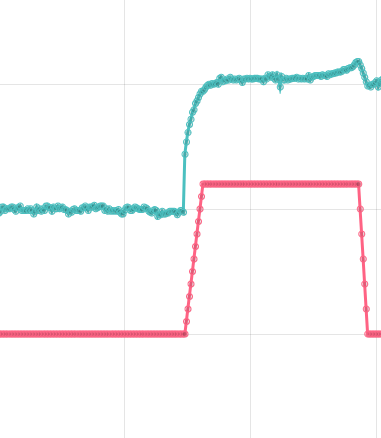
The red line shows an inverter ramping up the current it draws from the grid in twelve steps over a period of about 5 minutes.
The blue line has been superimposed, and shows the voltage measured at the battery terminals as a consequence.
Save energy... recycle electrons!
1

13/08/2025 4:53 pm
@transparent Don’t know about other manufacturer’s offerings but in the case of the Tesla Powerwalls, the app indicates that once charging reaches the 90% level, the charging rate reduces and tails off completely as the battery reaches 100%. In my own case, with a 27KWh system, charging runs at ~10 KW and upon reaching the 90% level, starts dropping so that by the time it reaches ~95%, it has dropped to ~3.5 - 4 KW. and continues to drop further as it reaches close to full up.
Regards, Toodles.
Same here @toodles, my single PW3 can charge at upto 5kW, and as it approaches 100% I see the rate fall off, sometimes only charging at a few hundred watts once it gets to 99%.
@transparent is it generally better for battery health to charge slowly (say at 2kW) or flat out at 5kW (other than the last few percent, as previously discussed), or is that going to make little difference to the lifespan of the cells (the important thing being the last few percent, not to overcharge)? I try to encourage mine to charge slowly so that more of the input power can be met by DC-coupled solar, and thus minimise any AC to DC conversion losses from grid charging, but that's more about maximising efficiency and minimising conversion losses than lifespan of the battery.
Samsung 12kW gen6 ASHP with 50L volumiser and large radiators. 7.2kWp solar (south facing), Tesla PW3 (13.5kW). Net Zero

13/08/2025 5:14 pm
@old_scientist There is an option in the Tesla app that controls the grid charge and can be set to ‘off’ if required which would ensure that only your very productive solar array charges the PW3. Regards, Toodles.
Toodles, heats his home with cold draughts and cooks food with magnets.
1

25/08/2025 2:33 pm
I see that @majordennisbloodnok mentioned this in @toodles ' thread 'Anyone still weathering it out with Agile?'
I assume that other energy providers will follow suit, I've been a happy customer of Octopus for the past 3.5 years and being on Cosy and the fixed export rate has worked well for my setup (Flux was great that first summer due to the high rates, but has not stacked up for me since).
I had assumed that this new market tracking export tariff would be similar to the Agile export tariff which most of the time (when I've checked it/I'm not an expert) seems to be below 15p.
So I'm interested to hear other people's views and opinions of what might happen.
Mitsubishi Ecodan 8.5kW
4.4kW Solar PV
5.2 kWh Battery Storage
1983 build, 300mm loft insulation, cavity wall insulation (beads)
25/08/2025 2:57 pm
Where did you see that?
My understanding is simply that Octopus Outgoing is no longer a fixed tariff, but is now more like a standard variable rate tariff for outgoing, currently still at the same 15p rate as it was before. The only difference is this rate is no longer fixed for 12 months but they can change the rate with whatever notice is required. I assume they may change the rate quarterly to reflect the current market.
Longer term, there may be a shift towards more dynamic export rates where they pay less during the day when solar is abundant and more at peak rate times when demand is high, but that is pretty much what Agile does on a daily basis. I can see it moving to an export rate of 8p during the day with a peak rate of 16p, which is kind of where the average on Agile outgoing has been over the last year.
Samsung 12kW gen6 ASHP with 50L volumiser and large radiators. 7.2kWp solar (south facing), Tesla PW3 (13.5kW). Net Zero
1
25/08/2025 3:41 pm
@old_scientist Thank you, that makes sense and I've re-read the email just now and it aligns with what you say.
Mitsubishi Ecodan 8.5kW
4.4kW Solar PV
5.2 kWh Battery Storage
1983 build, 300mm loft insulation, cavity wall insulation (beads)
1

25/08/2025 4:30 pm
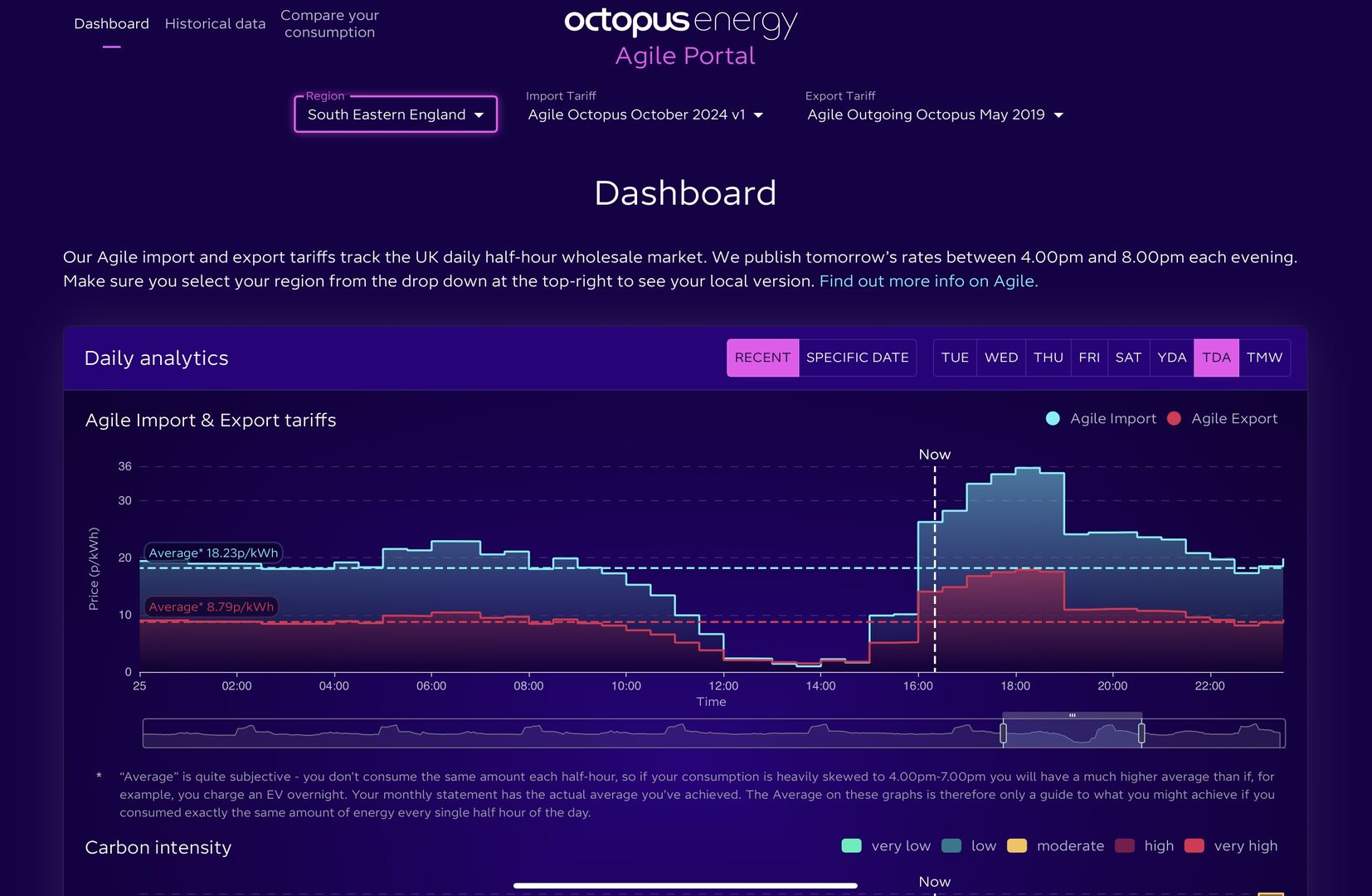
@trbob I have just extracted the details for Agile Export in the South Eastern part of England; this does suggest there could be slight improvements over ‘Outgoing Fixed’ (as it has been called) as long as one has energy storage and perhaps automation such as spoken about by @majordennisbloodnok, however, the gains are not huge for all that! Regards, Toodles.
Toodles, heats his home with cold draughts and cooks food with magnets.

29/08/2025 8:05 pm
Did the information in the title come from a personal email? @TRBob?
I couldn’t find any internet reference to it. Mind you all commentators on forums have said it’s too good to last.
2kW + Growatt & 4kW +Sunnyboy PV on south-facing roof Solar thermal. 9.5kWh Givenergy battery with AC3. MVHR. Vaillant 7kW ASHP (very pleased with SCOP >4) open system operating on WC
29/08/2025 8:16 pm
I’ve looked harder now (beyond OE’s site) and it’s not really news for some people https://forums.moneysavingexpert.com/discussion/6609111/outgoing-octopus-is-changing-to-a-variable-rate-tariff
But solar export is valuable to them in winter, May would be when they drop the price. Our year is up in November so we’ll see what they offer. After such a good summer of sun it’ll be missed.
2kW + Growatt & 4kW +Sunnyboy PV on south-facing roof Solar thermal. 9.5kWh Givenergy battery with AC3. MVHR. Vaillant 7kW ASHP (very pleased with SCOP >4) open system operating on WC

31/08/2025 8:56 pm
I’ve looked harder now (beyond OE’s site) and it’s not really news for some people https://forums.moneysavingexpert.com/discussion/6609111/outgoing-octopus-is-changing-to-a-variable-rate-tariff
But solar export is valuable to them in winter, May would be when they drop the price. Our year is up in November so we’ll see what they offer. After such a good summer of sun it’ll be missed.
I am pleased to see the change.
We definitely need to see suppliers move away from tariff that are financially unviable just to chase customer numbers and company valuations.
Else customers will make unrealistic assumptions when considering to invest in batteries, solar, EVs, heat pumps etc.

SPONSORS

Degrees of Separation

Latest Posts
-

RE: How quickly would you want/expect heat recovery to take from setback?
@jamespa And ‘Decorator’s Caps’ are relatively cheap an...
By Toodles , 54 minutes ago
-
RE: Renewables & Heat Pumps in the News
@majordennisbloodnok Best we keep that trident well pol...
By Toodles , 59 minutes ago
-
RE: Renewable Heating Hub Homeowners' Q&A Podcast
Come for the low-carbon homes. Stay for George Clarke’s...
By Mars , 1 day ago
-
RE: Octopus Cosy 12 Heat Pump Regret: Incredibly Loud, Poor Heating & Constant Hum - Help!
@razz, as we head into the heating season, I just wante...
By Mars , 1 day ago
-
RE: How should the Boiler Upgrade Scheme be reformed?
Not quite, regular A2W heat-pumps need a load of extra ...
By Temperature_Gradient , 3 days ago
-
RE: Heat Geek installations: share your experiences
one thing i learnt from reading people’s comments and e...
By Batpred , 3 days ago
-
RE: Cooling/heating with one unit
"The way we use A2A on a cheap overnight EV tariff is t...
By mrkfm , 3 days ago
-
RE: Do I add Air Con or MVHR to existing A2W ASHP?
We have ‘signed on the dotted line’ today for a Panason...
By Toodles , 3 days ago
-
RE: Heat pump branding. Clever, contemporary… or a bit too much?
...or it was there and was lost thanks to laziness and ...
By Majordennisbloodnok , 3 days ago
-
@bobflux Thank you for your response. I am trying to ...
By RonV. , 3 days ago
-
Bufferless design & control of Chinese air to water monoblock hybrid heat pump in Alberta, Canada
This post is about how I successfully configured a buff...
By Tony.Stolz , 3 days ago
-
The installer visited yesterday and suggested the noise...
By JamesChatz , 3 days ago
-
RE: HeatGeek vs Octopus surveys: puzzling disparity - any ideas why?
Your house sounds a lot like mine. 2 surveyors each sp...
By JamesPa , 3 days ago
-
RE: Heat Geek Zero Disrupt: Are We Sleepwalking Into Another Race to the Bottom?
Thats true only if you do the wrong experiment. Done c...
By JamesPa , 3 days ago





SPONSORS
