
Notifications
Clear all

Topic starter
03/01/2026 1:27 pm
Thanks I will try to put it down chronologically.
As background, here is my internal system, installed in an unheated garage. The only part you can’t see is a UPM4XL grundfos variable speed circulation pump that is tucked behind my hot water cyclinder. 50L volumiser on return before going back out of wall to heat pump sitting 4m away. Previously it was a 3 zone GCH system, but has been converted to one single zone, 26 rads. The only room “stat” is a homely node placed in the lounge where the existing Honeywell stat was before. The homely optimiser manages all inputs into the control system, the Samsung controller weather compensation is disabled as part of the homely install and it drives the system by links to the heat pump MODBUS.
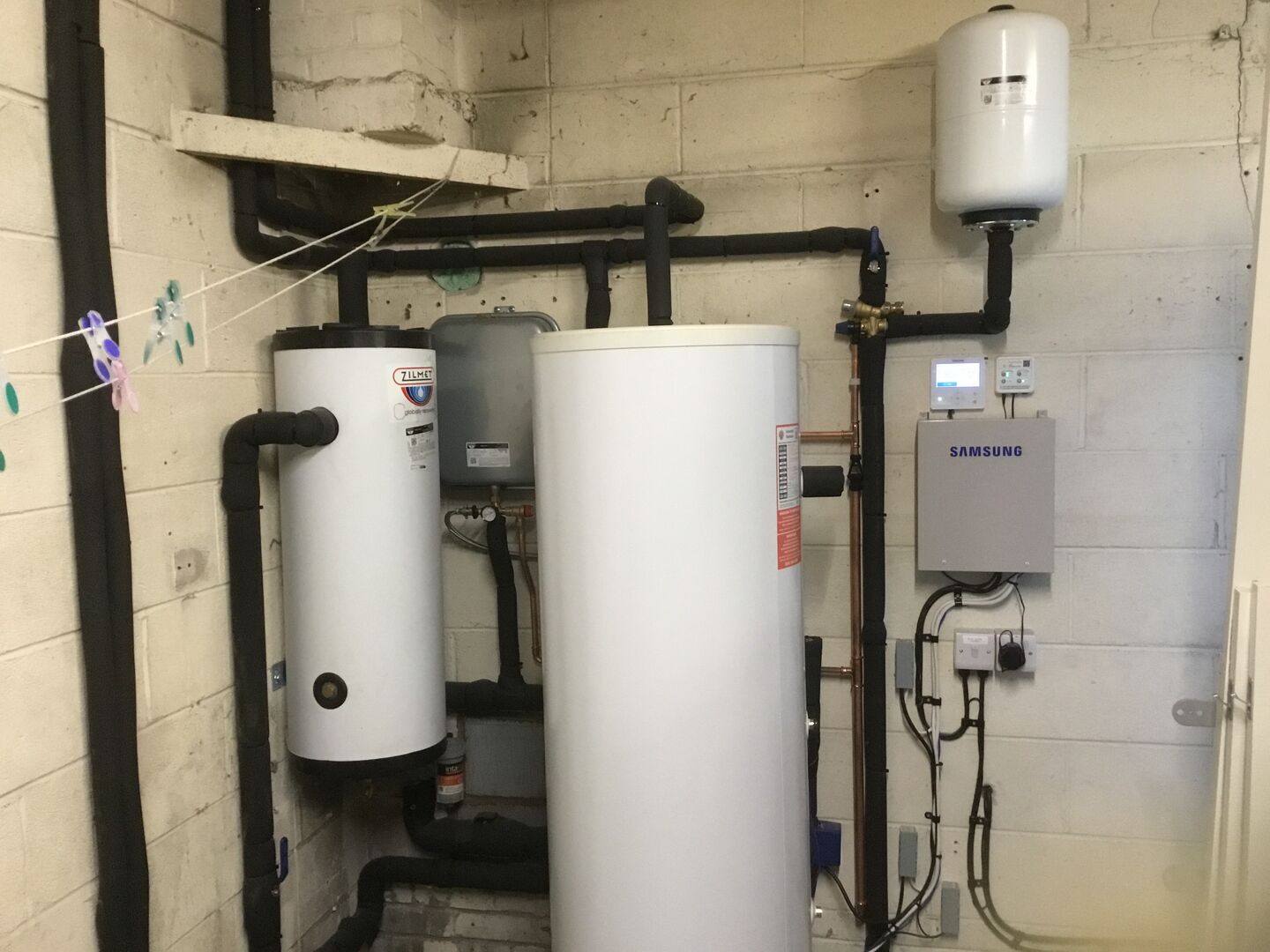
I will try to detail the events of one cycle.
1. 11.23 heat pump has been OFF for last 40 minutes.
2. 11.24 homely node registers a room temp drop down to 17.7C , this is setpoint, heating is started. At this point I am measuring a mid central radiator temp (the nearest rad to the node) of 25.3C.
3. Still 11.24. The homely decides to start the heating with an initial flow temp setpoint of 32.8C, it runs at about 4kW input, this heat appears instantaneously, so I assume it must predominantly be from the heat stored in the volumiser from the previous cycle.
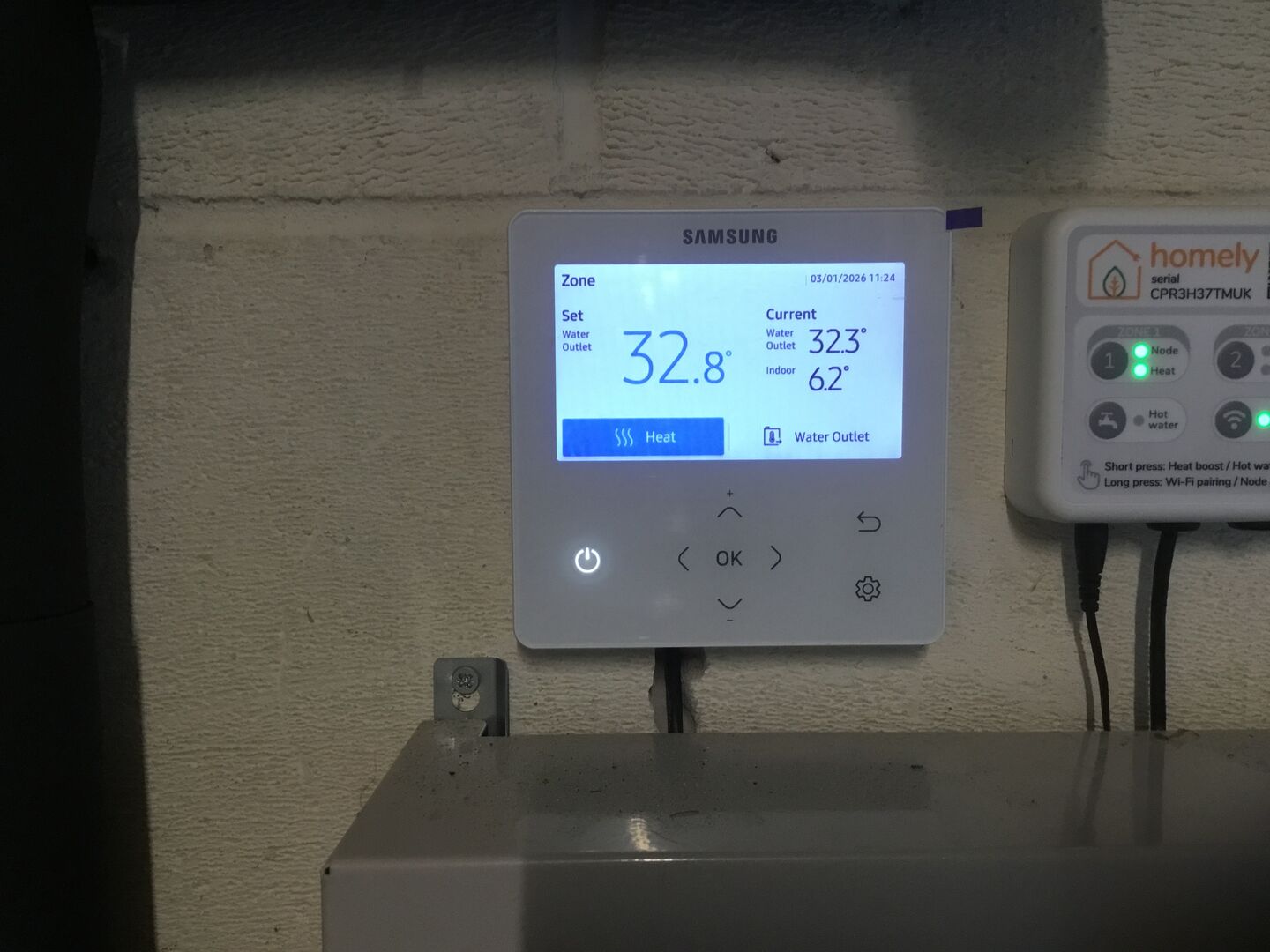
4. By 11.33 The heat pump stops, 0kW input. I don’t know why but you will see from below that the flow temp has dropped to 28.3C less than it was before starting 9 mins previously. The radiator temperature has dropped to 24C and the room temp has continued to drop to 17.5C. The control box “clicks” and a new setpoint of 50 C appears. The heat pump starts up again.
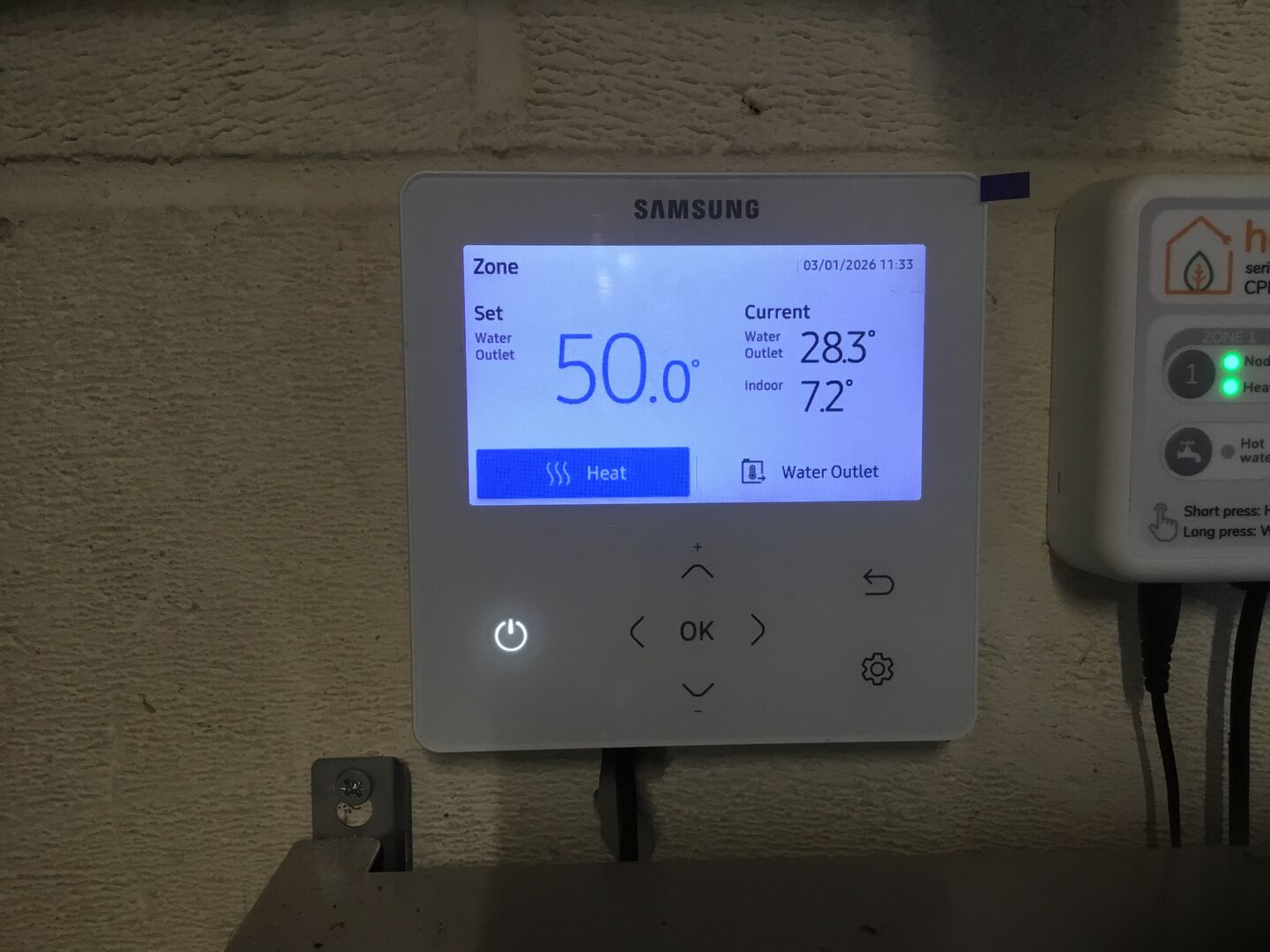
5. It then ramps up to near full power. By 11.50 the temp of the rad has reached its minimum of 23.2C and is starting to turn upwards. The room has also started to increase, by 11.48 it’s back up to 17.6 C.
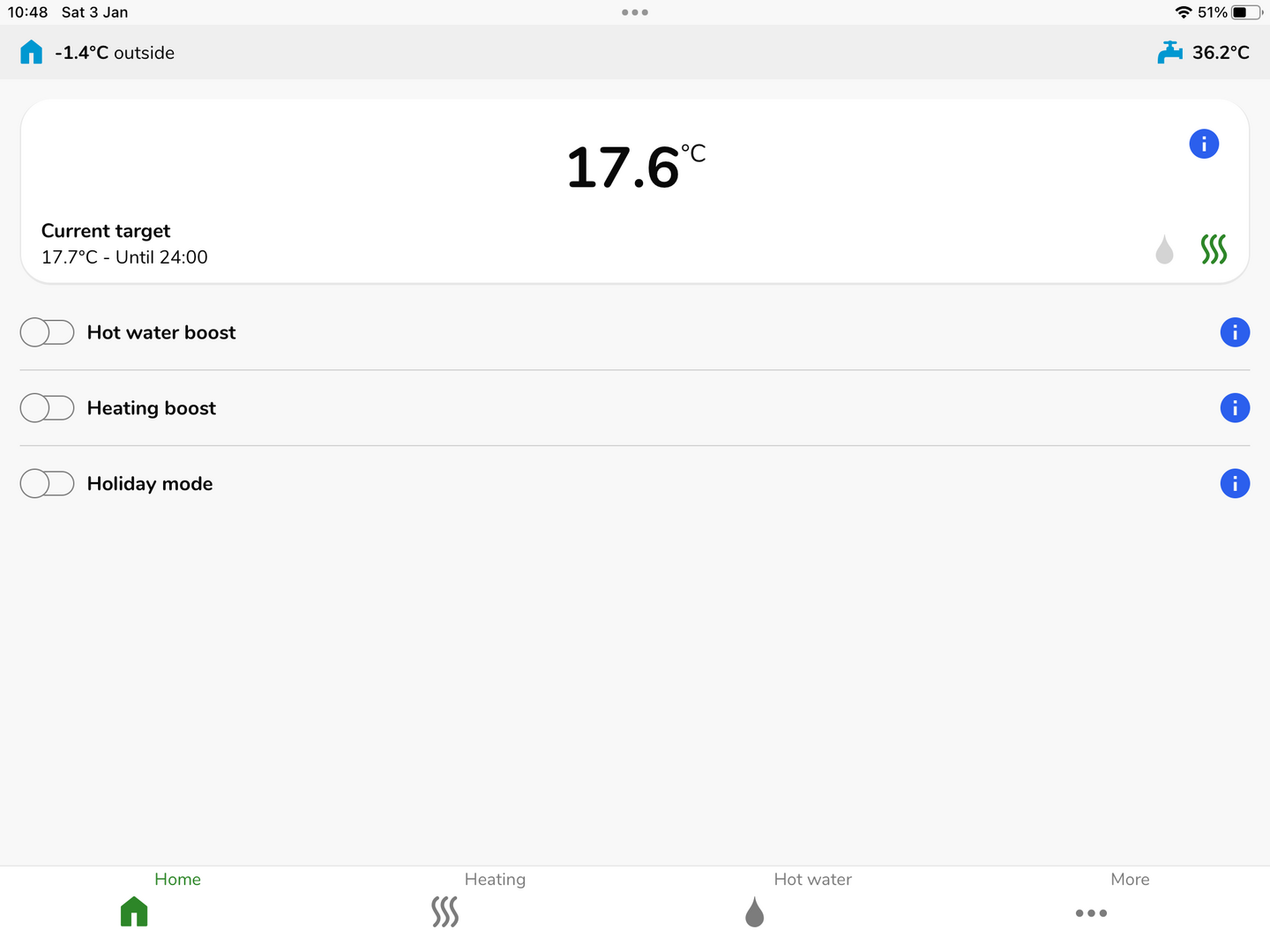
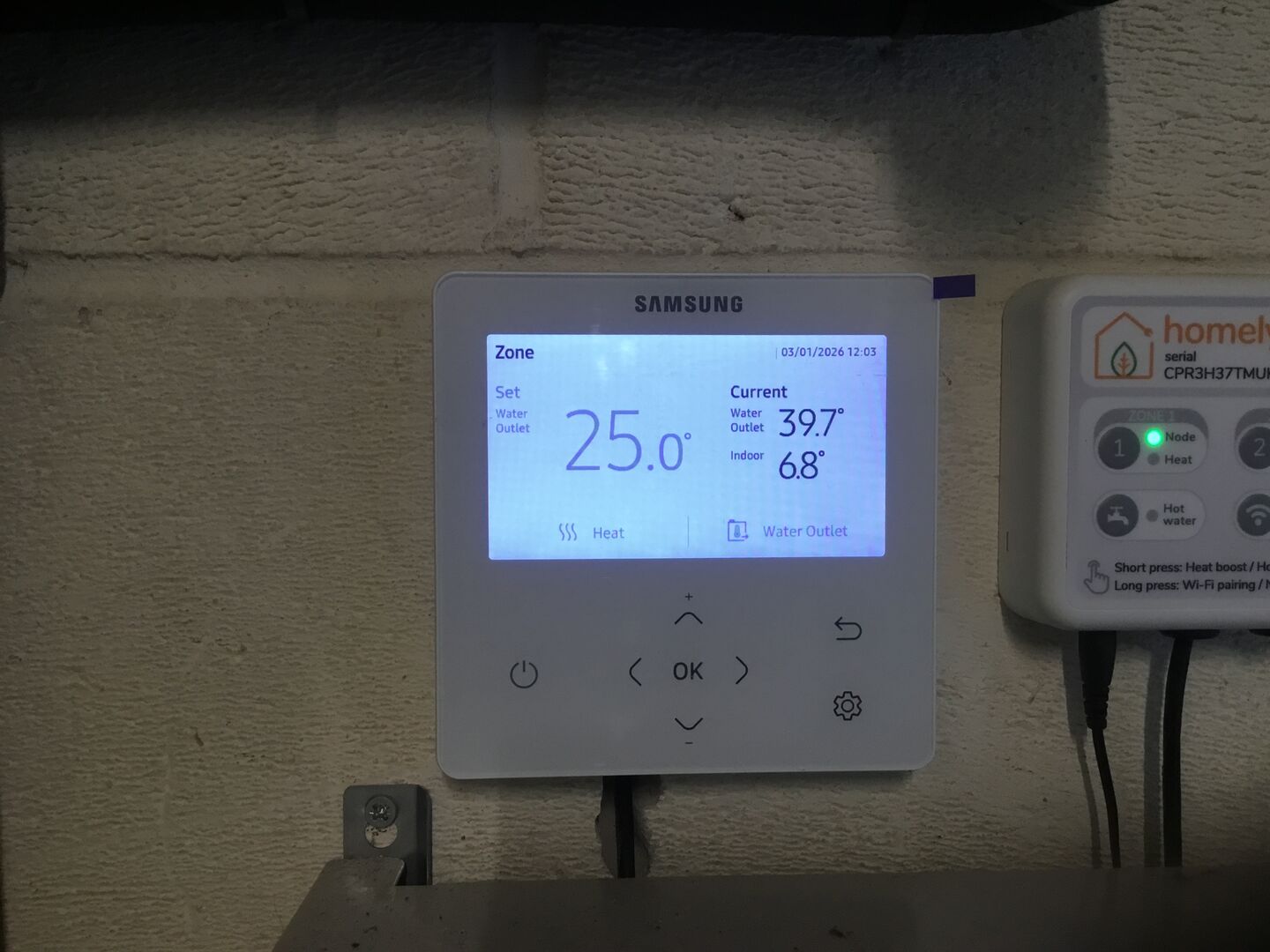
6. By 12.03 the flow temp has reached 39.7 and the heat pump turns itself off having reached a room temp of 18.0C although the circulation pump continues and the radiators rise to 26.6.
7. Then heat decay happens for the next 35 minutes whilst heat pump completely off, before restarting the cycle.
if you can make sense of that you are a better man than I.

03/01/2026 2:11 pm
OK @papahuhu that makes things clearer. I dont know what algorithm Homely uses (@toodles may be able to help here - if @toodles you do look at this please read the post above and give us any intelligence you can add about the sequencing)
In the absence of information from @toodles my first guess is that
11.24-11.33 is a sniffing run, ie homley is running the heat and water pump to find out whats going on in the circuit
11.22-12.03 is a heating run. For some unknown reason it sets the FT to 50 (I would have expected a lower value) but then, because it thinks the room has reached temp, it cuts off at 1203 (before the FT has been reached)
This is a mad way to run a heat pump, which is odd because Homely is generally thought to do a good job. However, given that it does this, its easy to see why the upstairs may not heat up if the installer hasn't properly balanced the system which, given what you tell me about him, is almost certain to be the case. This also means that the conclusion that the upstairs rads are undersized is further undermined. Note that this does not mean that the upstairs rads arent undersized, its just that there are other, more likely, explanations for what you see and no evidence to support undersizing at present.
Doing a heat loss survey at this point in time is essentially a distraction from actually understanding the problem, and if thats all the installer does next week it will simply delay resolving it. If this were my house I would probably
(a) wait a couple of hours to see if @toodles can shed any more light on the behaviour of your homely
(b) set aside some time to disable homely and run on the Samsung controller alone with some sort of WC curve programmed in, so you can find out what your system actually does when controlled in a more stable fashion (although that may turn out not to be possible given that your heat pump is oversized)
However I understand that this is a significant undertaking and you may, quite reasonably, prefer to put pressure on your installer to sort it quickly (which I stress again a heat loss survey is unlikely to do).
A simpler test might be just to relocate the pod upstairs temporarily. This will probably lead to overheating downstairs but will at least show you what happens if the heat pump is actually run for a substantial amount of time.
Happy to try to help if you want me to but at this stage it would be entirely understandable if you held off until the installer has visited. My only question about this is - is the installer visiting or is he just sending a surveyor?
Ps I'm not saying that a new heat loss survey is bad, only that I would have thought that the priority is getting the heating working at least tolerably well in which case a proper diagnosis of what is happening would be the first call. However that involves intelligent thought and understanding so I can see why your installer may prefer to avoid this!
This post was modified 2 months ago 2 times by JamesPa
4kW peak of solar PV since 2011; EV and a 1930s house which has been partially renovated to improve its efficiency. 7kW Vaillant heat pump.

03/01/2026 2:48 pm
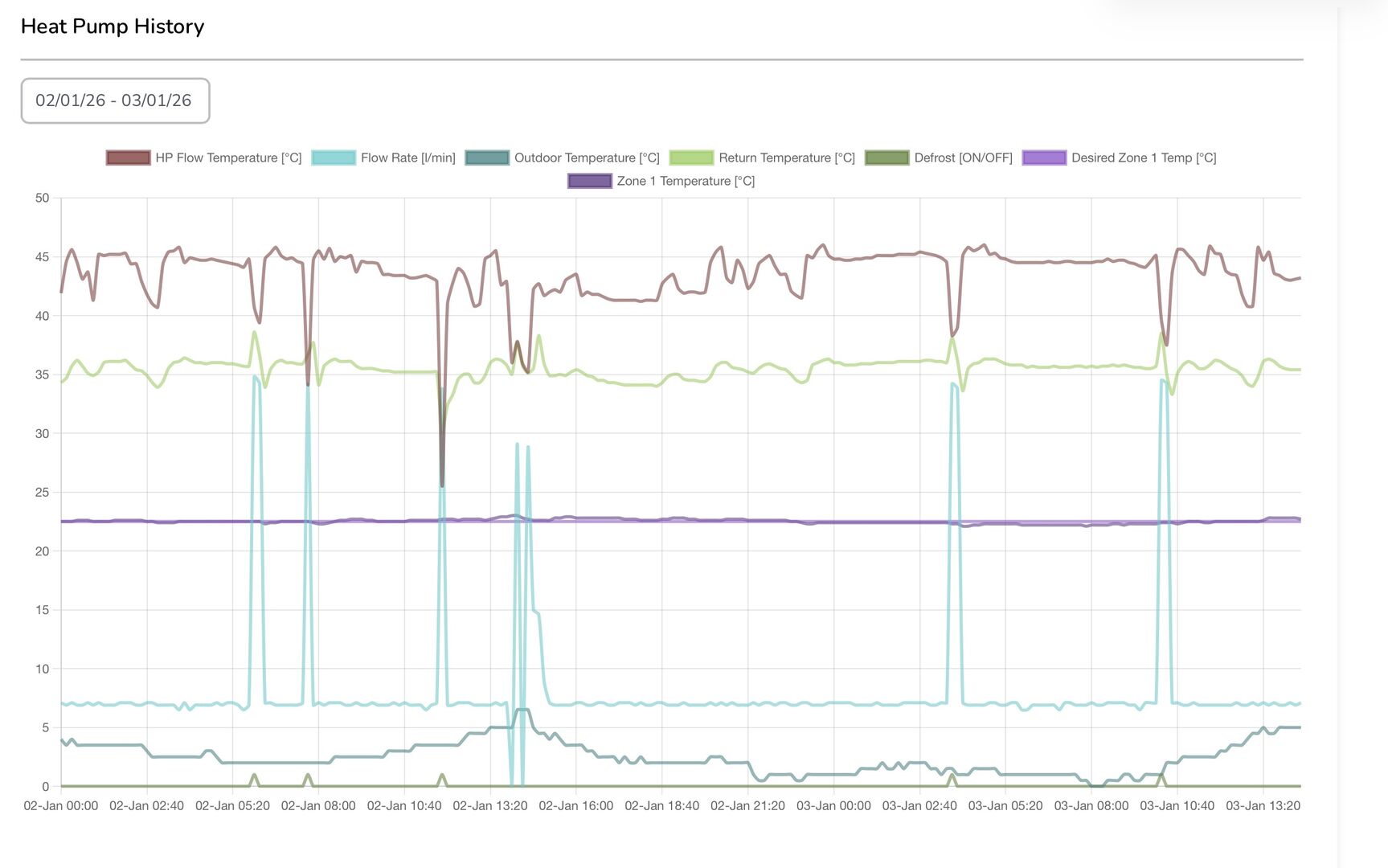
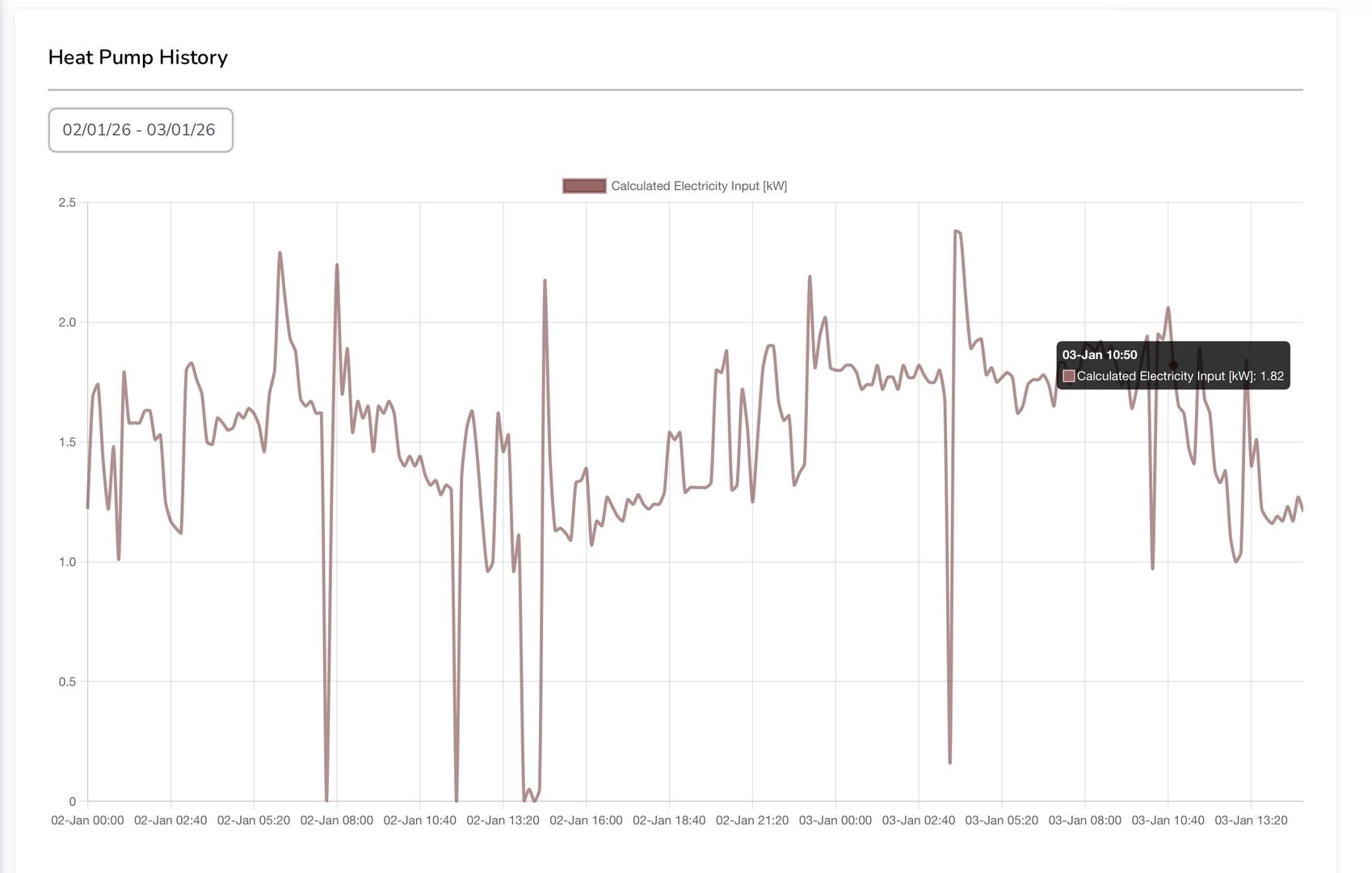
@jamespa @papahuhu If my Homely does ‘sniff’, I think this is at the start of a run as I have noticed that at switch on previous to a heating cycle, the heat pump starts up and the secondary pump starts to run and there is no evidence of heat being produced - or at least, very little power is drawn for several minutes. After that ‘pause’ power consumption ramps up and in today’s weather conditions, this will be 1.5 - 2.0 kW ish. I am only able to monitor the power consumed via my Tesla app so I am attaching a graph taken from midnight Friday 2nd. Jan to a few minutes ago. I hope the information on the parameters I have displayed may help. We keep a warm house with a target of 22.5 degrees C throughout 24/7 and we don’t normally see a drop below 22 or a rise above 23. Let me know if there is any other info I might be able to supply. Nearly forgot (well, I did, but have edited!) The flow temperature range set on the Daikin MMI is 30 - 45 degrees and I notice a slight overshoot occasionally. Regards, Toodles.
This post was modified 2 months ago by Toodles
Toodles, heats his home with cold draughts and cooks food with magnets.
03/01/2026 3:07 pm
And I thought it might be useful to show the power draw during this same period of time. Regards, Toodles.
Toodles, heats his home with cold draughts and cooks food with magnets.
03/01/2026 3:27 pm
OK Ive read this again and it just isnt making sense
1. 11.23 heat pump has been OFF for last 40 minutes.
2. 11.24 homely node registers a room temp drop down to 17.7C , this is setpoint, heating is started. At this point I am measuring a mid central radiator temp (the nearest rad to the node) of 25.3C.
3. Still 11.24. The homely decides to start the heating with an initial flow temp setpoint of 32.8C, it runs at about 4kW input, this heat appears instantaneously, so I assume it must predominantly be from the heat stored in the volumiser from the previous cycle.
4. By 11.33 The heat pump stops, 0kW input. I don’t know why but you will see from below that the flow temp has dropped to 28.3C less than it was before starting 9 mins previously. The radiator temperature has dropped to 24C and the room temp has continued to drop to 17.5C. The control box “clicks” and a new setpoint of 50 C appears. The heat pump starts up again.
5. It then ramps up to near full power. By 11.50 the temp of the rad has reached its minimum of 23.2C and is starting to turn upwards. The room has also started to increase, by 11.48 it’s back up to 17.6 C.
6. By 12.03 the flow temp has reached 39.7 and the heat pump turns itself off having reached a room temp of 18.0C although the circulation pump continues and the radiators rise to 26.6.
If I read this correctly you are apparently saying that that the house temperature has risen from 17.5 at 11.33 to 18 at 12.03, a rise of 0.5 degrees. However the radiator temperature has reached only 27 even though the flow temperature is 39.7. All this was today when its -1 outside. Your design flow temp is 50 and your estimated heat loss apparently justifies a 16kW heat pump.
Whilst Im not doubting your observations, I am finding it very difficult indeed to believe that they represent reality. How would the house temperature rise by 0.5C in 30mins with rads only at 27, and how come the rads are only at 27 when the flow temperature is 39.7? How, in fact (if this is reality) does the house ever heat up when its warm?
Something isn't right! Even if your actual loss is say 7kW (which is frankly more likely) its almost inconceivable that the house would heat this quickly, unless you have fan radiators (so only the air is heating) or high solar gain (which is just possible today - but isnt representative). Its also extremely concerning if rads are genuinely at 27 whilst the heat pump is producing water at 39.7. If these figures are true where is the energy being lost?
4kW peak of solar PV since 2011; EV and a 1930s house which has been partially renovated to improve its efficiency. 7kW Vaillant heat pump.
Topic starter
03/01/2026 3:43 pm
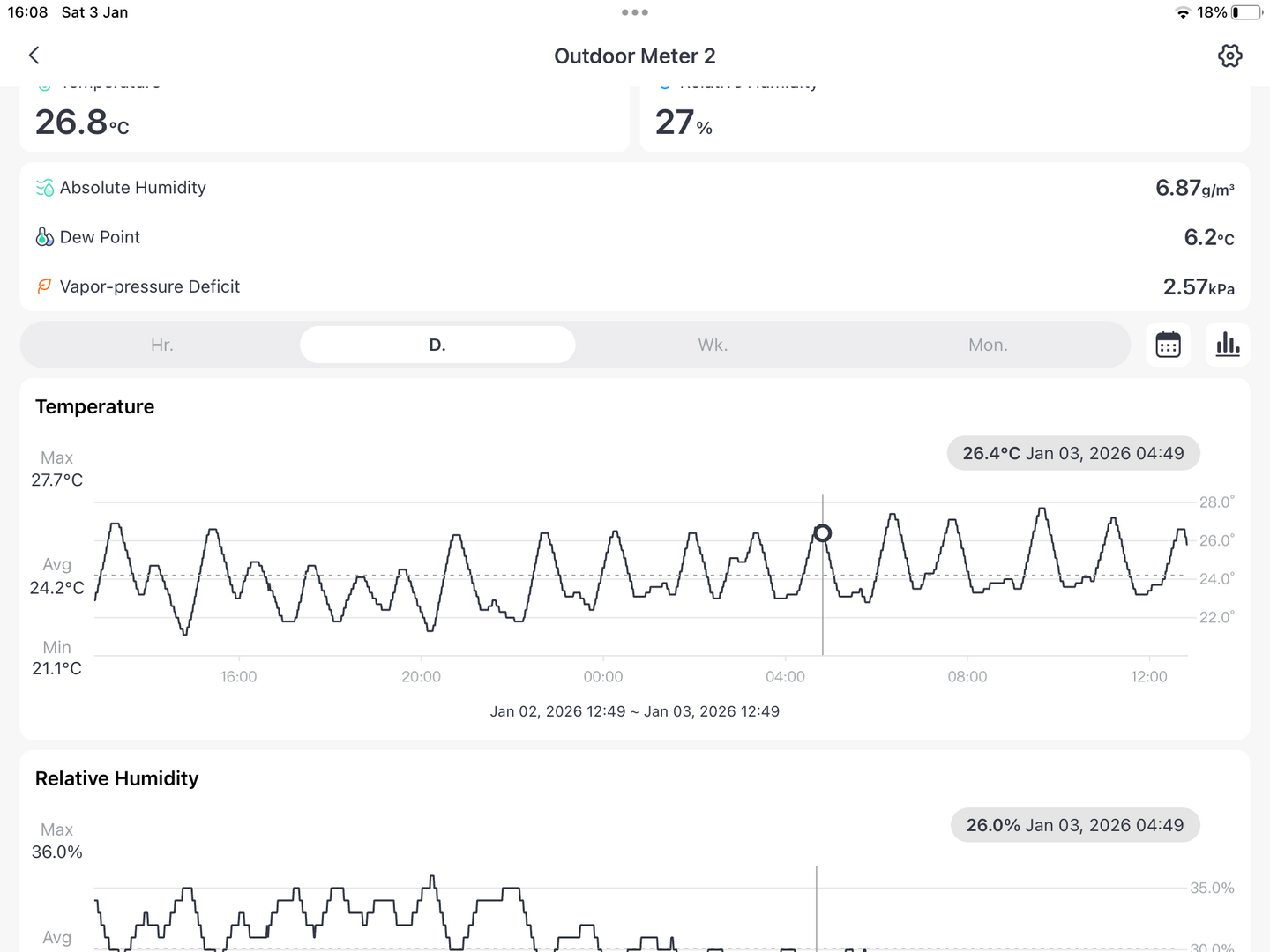
Yes, that’s exactly what is happening. The only thing to add to it is that it’s a relatively spacious room at 110m3 in volume according to the survey, it has cavity wall insulation and floor to ceiling oak panelled walls (which I suspect are insulated behind) there are 3 K2 rads, 1191W; 1340W and 930W output at 50C Im measuring the temp of one rad only, the one nearest the homely node.
I don’t know what more to say, the data is real. Here is the output from the rad, each “hill” represents one heating cycle, but heat pump actually starts and stops halfway up and halfway down the slope.
This post was modified 2 months ago 3 times by Papahuhu
03/01/2026 4:15 pm
At 27 (DT of 10 relative to room) your rad output is roughly 20% of the output at 50 (dt 30 relative to room), say 600W. The rads most of the time are cooler, in fact they aren't really heating up at all even though they are supposedly being supplied with water at 39C. If your house is anything even faintly close to say 7kW it's not going to heat that quickly with only perhaps average 300W for half an hour. when it's -1 outside. Something is wrong/homely is being influenced too much by local air temperature?
Perhaps try moving the pod somewhere well away from radiators or upstairs and check the rad sensor? Can you just clarify what the large tank is in the photo. Is it dhw only or is there a small buffer tank (with 4 connections) underneath, just out of the photo?
This post was modified 2 months ago 4 times by JamesPa
4kW peak of solar PV since 2011; EV and a 1930s house which has been partially renovated to improve its efficiency. 7kW Vaillant heat pump.
Topic starter
03/01/2026 4:30 pm
Hence my question on the forum 😀 But what, is the question.
The temp measuring devices I purchased are mid price range, not budget jobs. Accurate to within 0.1C. I have the measuring device sat midway on top of the radiator grille, I guess that could be reading lower than the feed water, but surely not by more than a degree or two.
The room feels like it is 18C so that matches with the homely data.
There’s zero other heating sources in the room apart from lighting and a couple of humans.
Unless the heat pump temp measuring device is completely erroneous. But that seems unlikely when I have data, albeit seemingly lower, from the rad. I assume they are all similar, they feel the same to the touch.
im stumped.
03/01/2026 4:35 pm
Are they properly in contact with the metal?
You could check them with iced water and boiling water or tuck them under the insulation of the flow from the heat pump for a comparison with what the heat pump says.
This post was modified 2 months ago by JamesPa
4kW peak of solar PV since 2011; EV and a 1930s house which has been partially renovated to improve its efficiency. 7kW Vaillant heat pump.
Topic starter
03/01/2026 4:47 pm
they are IP54 data logging temp and humidity sensors that send a Bluetooth signal back to my computer. Rather than PT100 type RTDs. But, yes it’s sitting on the radiator grille, centrally. I’m sure there’s a bit of a lag but seem to react to change within 60 seconds, I don’t know their measuring/recoding frequency but it’s 60 seconds or less
03/01/2026 4:57 pm
But, yes it’s sitting on the radiator grille, centrally.
Ah, now it makes more sense. If it's sitting on the grille it's measuring air temp not rad temp. They need to be properly strapped to the radiator itself, preferably near or on the input feed pipe. They may not be physically suitable.
This post was modified 2 months ago 2 times by JamesPa
4kW peak of solar PV since 2011; EV and a 1930s house which has been partially renovated to improve its efficiency. 7kW Vaillant heat pump.
Topic starter
03/01/2026 5:01 pm
I’ll gorilla tape another one it to the side of the radiator then, somewhere near the inlet. Then compare both readings and get back to you. Thanks.

Latest Posts
-

RE: Heat Pump vs New Gas Boiler for Inherited House - Worth the Extra Cost?
@fretless6, where are you based? I might be able to con...
By Mars , 2 minutes ago
-

RE: Underfloor Heating Installation Issues with Heat Pump
I'm going to install Thermacome ACOSI+ radiant ceiling....
By bobflux , 43 minutes ago
-
Issue with a Grant Air Source Heat Pump & Tado Smart Thermostat
Hi all I'm having some trouble with a Grant ASHP and ...
By Renewables345 , 2 hours ago
-
RE: Testing new controls/monitoring for Midea Clone ASHP
Now seems a good time to summarise the costs and effici...
By benson , 2 hours ago
-
RE: Tell us about your Solar (PV) setup
@mk4 Charge to 100%, discharge down to 10%.
By bobflux , 3 hours ago
-
RE: Daikin Altherma 3 LT compressor longevity question
This mess is intriguing: I wonder if this represent...
By bobflux , 4 hours ago
-
RE: Connecting Growatt SPH5000 over wired ethernet rather than wireless
The simplest wired option is usually the Growatt Ethern...
By Jonatan , 9 hours ago
-
RE: Peak Energy Products V therm 16kW unit heat pump not reaching flow temperature
ASHPs do have a minimum compressor speed. The minimum h...
By bobflux , 16 hours ago
-

RE: Electricity price predictions
@jamespa And it seems some of the nasty public cloud...
By Batpred , 16 hours ago
-

RE: Jokes and fun posts about heat pumps and renewables
Technology is rapidly advancing. BBC News reported th...
By Transparent , 19 hours ago
-
What matters for flow and pressure drop is internal dia...
By bobflux , 20 hours ago
-
RE: Do Fridges and Freezers have COP ratings?
@editor Thank you all for your replies and submitted in...
By Toodles , 22 hours ago
-
I know and yes. The secondary deltaT wont necessaril...
By JamesPa , 1 day ago
-
RE: Designing heating system with air to water heat pump in France, near Lyon
Just love the way you put it! 🤣
By Batpred , 2 days ago
-
RE: Safety update; RCBOs supplying inverters or storage batteries
Thank you for sharing. So it seems that your Schneid...
By Batpred , 2 days ago
-
RE: Forum updates, announcements & issues
@upnorthandpersonal thanks for the thoughtful, consider...
By Mars , 2 days ago
-
RE: Solar Power Output – Let’s Compare Generation Figures
@mk4 All 21 panels have their own Enphase IQ7a microinv...
By Toodles , 2 days ago
-
RE: Setback savings - fact or fiction?
Great, so you have proven that MELCloud is consistently...
By RobS , 3 days ago
-
RE: Mitsu PUHZ120Y 'Outdoor Temp 'error?
Thanks David & James It almos...
By DavidAlgarve , 3 days ago
-
RE: Surge protection devices SPDs
@trebor12345 - your original Topic about the right type...
By Transparent , 3 days ago
-
RE: Help needed with Samsung AE120RXYDEG
@tomf I’ve been sent this from a service engineer at Sa...
By Mars , 3 days ago
-
RE: Buying large amp bidirectional RCD and RCBO
Yes... I went through this particular headache and ende...
By bobflux , 4 days ago
-
O-oh! Let's take this as an opportunity to 'pass the ...
By Transparent , 4 days ago