

Notifications
Clear all
Joining the Renewable Heating Hub forums is completely free and only takes a minute. By registering you’ll be able to ask questions, join discussions, follow topics you’re interested in, bookmark useful threads and receive notifications when someone replies. Non-registered members also do not have access to our AI features. When choosing your username, please note that it cannot be changed later, so we recommend avoiding brand or product names. Before registering, please take a moment to read the Forum Rules & Terms of Use so we can keep the community helpful, respectful and informative for everyone. Thanks for joining!
Thermostats, Volumisers, Buffer Tanks, TRVs, Pumps, Piping, Valves, Radiators & Controls
17
Posts
7
Users
8
Reactions
1,750
Views

Topic starter
06/05/2026 9:55 am
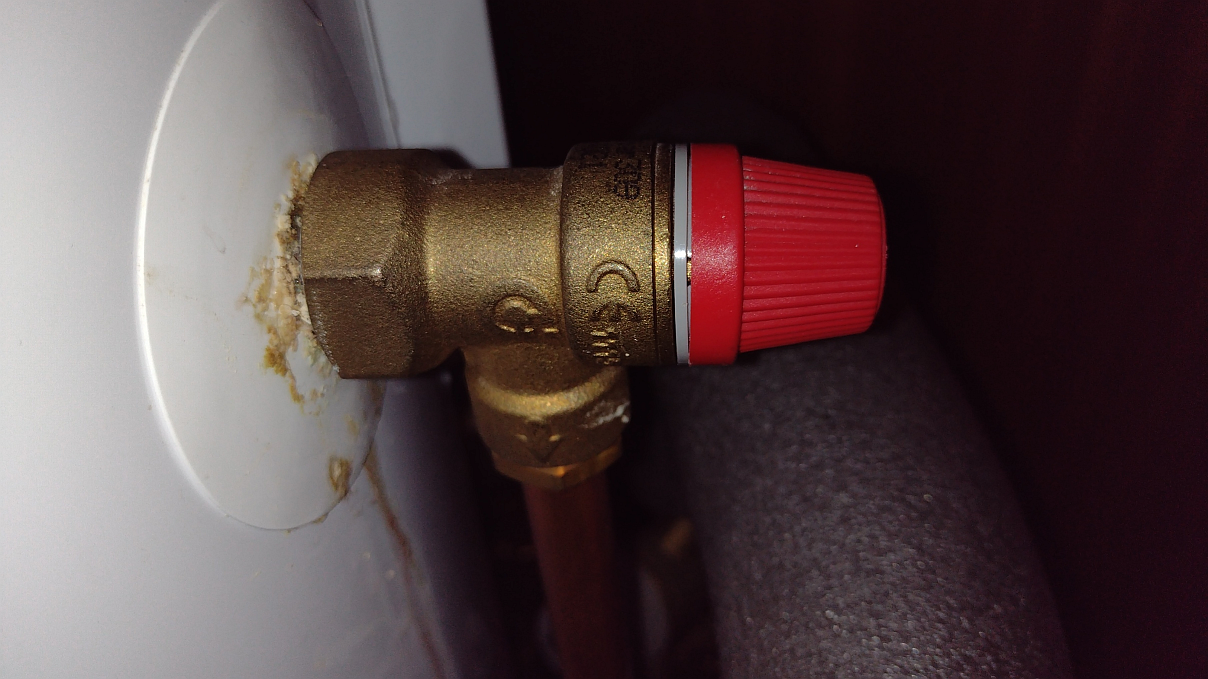
My installation is 4 years old. After about 18 months a brown coloured leak appeared around the press/temp relief valve on the DHW cylinder. It’s still unexplained. In any case, I considered the valve would need to be replaced or reseated. In case the leak worsened, I wanted to know how this valve was sealed to the cylinder protruding boss that accommodated the valve – was it a parallel or taper pipe thread? How was it sealed? Or was it a design that incorporated mating faces sealed with an O-ring?
No rational response and notable exasperation that I should ask such questions – presumably because they didn’t know. I was trying to be prepared in case I had to suddenly deal with it.
Last week, I experienced a leaking air vent on top of the buffer cylinder. I asked if they had a part number. The number I was given was a purge/bleed screw, which looked like a small screw with a hole to allow air escape when loosened. I now realise the air vent was added by the installers but it fitted into a ½” boss, not something that would accommodate a bleed/purge screw.
Other instances around guarantee registration (website registration on the card didn’t exist/German address on the card) were met with indifference.
I compare this with very positive help from Worcester Bosch over ten years, including guiding me in sorting plumber’s bodged repairs.
For the brown gunge leak, they suggested limescale. It still beats me why that should emanate from around that valve. Similarly, the leaking air vent was, on examination, due to an accumulation of brown oily gunge blocking its exhaust. Any suggestions as to what it is are most welcome.
This topic was modified 5 months ago by Mars

06/05/2026 1:14 pm
OK Im not sure if this relates to your comment about Vaillant in the intro thread, perhaps you could advise.
The brown gunge looks more like rust to me than limescale and I would think its due to a poorly fitted part (ie the valve) causing a very slow leak. If the cylinder had that fitted on arrival then you should have a claim against the cylinder manufacturer (they are often specced to last 25 years). If the plumber fitted it then thats more difficult, but if he is still around then I would personally say he should fix it.
Re the leaking air vent - this apparently often happens with autobleed valves, the one in my boiler did more or less what you describe. One possible fix (which is often recommended) is simply to disable the autobleed function by screwing the cap down - thats if it is in fact a bleed valve. However as its on top, Im wondering if its the pressure valve that you use to pressurise the expansion vessel (with air). A photo would help to determine, and others may have a comment/know more. If it is that valve then it shouldn't be wet!
Hope that helps.
This post was modified 5 months ago by Mars
4kW peak of solar PV since 2011; EV and a 1930s house which has been partially renovated to improve its efficiency. 7kW Vaillant heat pump.
1
Topic starter
06/05/2026 1:38 pm
@jamespa Limescale it isn't because I'm in a soft water area. In 10 years of a combi boiler I never experienced any limescale. I had no input to the installation - it was via a Scottish Government agency that had sub-contracted the whole thing to a heating firm (Everwarm) who were/are not too helpful.
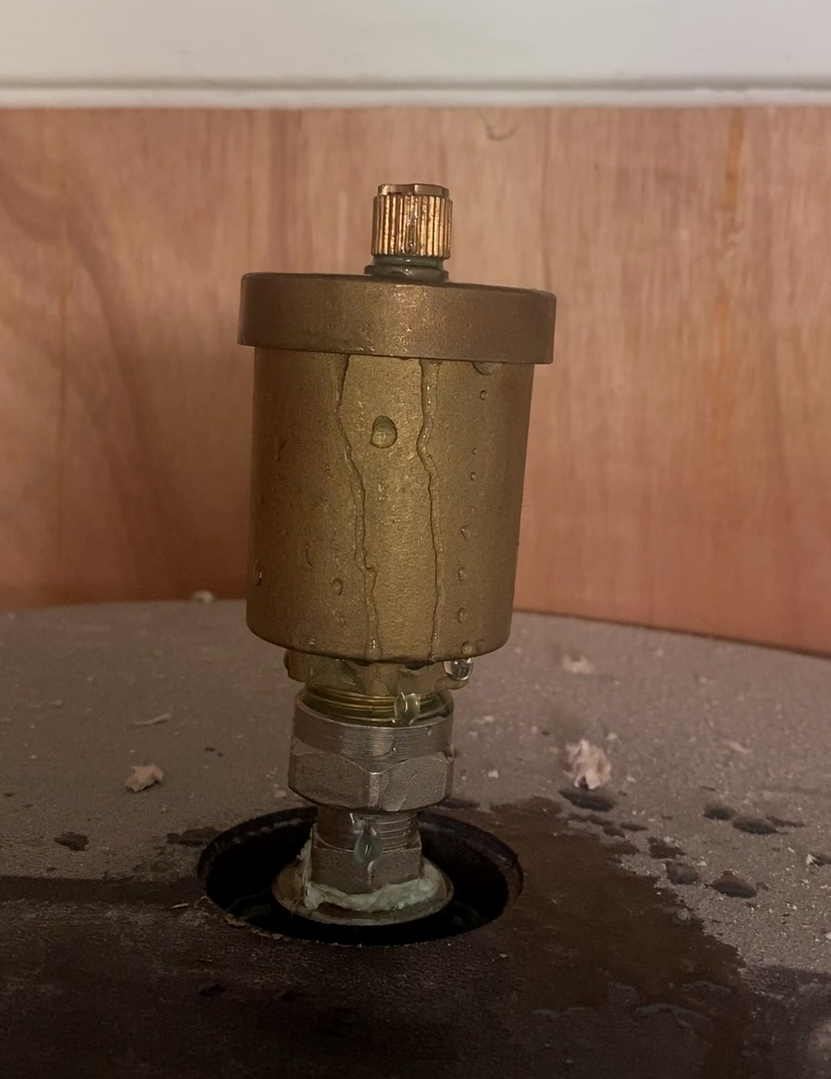
I suspect the goo in the air vent is the degradation of the glycol. I believe the air vent is just that. The heating circulating glycol/water mixture was being forced out of the air vent screwed cap. I managed to sort it by dismantling the vent, cleaning the goo (some had hardened), and applying a smear of silicone crease to the rubber seal. I's been ok for about 5 days now. I had been losing system pressure - now I know why. In order to deal with the vent I had to drain off some of the circulation mixture into a bucket - there were many 'bits' in it. The photo shows the vent - looks askew but isn't in reality. I'd like to have the glycol removed but it's difficult getting any interest in this area. How to dispose of 100 litres of glycol mixture?
I can't think where the rust comes in as the DHW cylinder is stainless steel. Only the shell is guaranteed 25 years it seems.
1
06/05/2026 1:49 pm
Ouch thats leaking quite a lot! it looks like its easily replaced by unscrewing the half inch nut about half way between the tank and the bottom of the valve.
Regarding the glycol can you confirm that the picture was of a buffer tank and there is no other separation between Outdoor unit and heating system, therefore that its glycol throughout the system. Also do you have antifreeze valves. There are many who still advocate glycol although I think numbers are reducing.
Glycol is classed as hazardous waste. Your local council should be able to advise how to dispose of it.
I can't think where the rust comes in as the DHW cylinder is stainless steel. Only the shell is guaranteed 25 years it seems
Maybe I misunderstood, the gunge in the picture in your earlier post looks like rust, but is this on a buffer tank or the DHW cyclinder, your post refers to both (how many leaks have you got?
Incidentally Im not sure stainless is quite rust free, particularly if there are chemicals involved.
This post was modified 5 months ago by Mars
4kW peak of solar PV since 2011; EV and a 1930s house which has been partially renovated to improve its efficiency. 7kW Vaillant heat pump.

Topic starter
06/05/2026 6:56 pm
@jamespa The leaking air vent in the photo is mounted on the top of the buffer cylinder. The brown stuff leak is from the surroundings of the press/temp relief valve on the DHW cylinder. The buffer cylinder is wall-mounted above the DHW cylinder. Maybe it is rust - it dries hard and is difficult to remove. I can't quite understand this though as this is the hot water and not directly connected to any chemicals.
06/05/2026 7:21 pm
@jamespa The leaking air vent in the photo is mounted on the top of the buffer cylinder. The brown stuff leak is from the surroundings of the press/temp relief valve on the DHW cylinder. The buffer cylinder is wall-mounted above the DHW cylinder. Maybe it is rust - it dries hard and is difficult to remove. I can't quite understand this though as this is the hot water and not directly connected to any chemicals.
Difficult to comment further without being there.
If you can tighten up things that are leaking its worth a try (a weep-leak on my DHW system developed about 9 months after installation - fixed in 10mins with a couple of spanners), otherwise needs replacing. In a hard water area it might just fill itself with limescale, but not in a soft water area.
This sort of problem is a pain but, unfortunately, a feature of plumbing, particularly plumbing that is regularly temperature cycled and thus constantly being stressed. There are probably plumbers that are masters in fixing this sort of annoying problem. If you can narrow it down to a thread or even an olive, a bit of LS-X might do the trick!
This post was modified 5 months ago 2 times by JamesPa
4kW peak of solar PV since 2011; EV and a 1930s house which has been partially renovated to improve its efficiency. 7kW Vaillant heat pump.
1

08/05/2026 3:15 pm
I'll suggest the brown gunge is a thread sealant such as Plumbers Mait.
It's a non-setting compound, used to 'make good' a screwed connection where the surfaces aren't fully seated.
Typically you'd find it used when screwing up a coupling which has an elbow incorporated in it. The coupling can't be fully tightened because the outlet has to point in a particular direction.
When I'm faced with such a problem, I tend to use a thin nylon washer which provides an extra bit if thickness, allowing the screwed surfaces to be fully tightened. I might also use a thread sealant, but I wouldn't rely on it alone. As it's a fluid, it can eventually be forced from between the threads due to pressure within the system.
Save energy... recycle electrons!
Topic starter
08/05/2026 8:28 pm
I'll take a photo of it if and when I next encounter it. It was all over everything in the air vent. Nothing would surprise me at what the installers did. Once installed, they're off and they don't do call outs. The temporary repair of the air vent began to fail with a drip appearing. I replaced the vent.
1


09/05/2026 9:18 pm
I had to drain off some of the circulation mixture into a bucket - there were many 'bits' in it.
Particles floating in the water are a problem with moving seals like air vents or pressure relief valves, they get stuck in between the rubber seal and the surface it's supposed to seal against and then you get a leak.
Photo of the water and bits please, with ruler or tape measure for scale. Are they attracted by a magnet?
> I can't think where the rust comes in
What parts of your installation are steel? Radiators?
How to dispose of 100 litres of glycol mixture?
Propylene glycol: safe, often used as food additive, you can probably flush it, unless contaminated with other stuff.
Ethylene glycol: toxic, treat as hazardous waste.
1


09/05/2026 10:14 pm
How to dispose of 100 litres of glycol mixture?
Propylene glycol: safe, often used as food additive, you can probably flush it, unless contaminated with other stuff.
I've spoken to installers about this before, and it's not quite that simple, unfortunately. Even propylene glycol (yes, technically food-safe in its pure form) becomes a different proposition once it's been sitting in a heating system. By that point it's carrying corrosion inhibitors, metal particulates, flux residues and whatever else the system has shed over the years. That cocktail absolutely should not go down the drain.
There's also a wider environmental point worth making. When glycol reaches waterways in any significant quantity, the bacterial breakdown process consumes so much dissolved oxygen from the surrounding water that it can effectively suffocate aquatic life, and notably, propylene glycol actually persists longer in the environment than ethylene glycol and consumes more oxygen while breaking down. So the "it's food-safe" argument doesn't hold up once you're talking about waterways.
The correct route is to treat it as trade waste. A local waste disposal contractor or waste facility will take it... some plumbing merchants also offer disposal services. It's worth ringing around.
Whatever you do, don't pour it on the ground either... glycol is toxic to animals even in relatively small quantities.
🔥 Britain’s Heat Pump Shitshow
How Installing a Heating System Became a National Nervous Breakdown
Free UK shipping.
📗 Heat Pumps Explained
A Jargon-Free Guide for Homeowners
Rewritten and updated for 2027
📘 From Zero to Heat Pump Hero
🛠️ Bodge Buster
New to heat pumps?
Take the Heat Pump Fundamentals course and use INTRO50 at checkout for 50% off.
Topic starter
09/05/2026 11:22 pm
Can't get anyone to take it - even the council. Those responsible for the environment really need to ensure a path for this. As for the installation, I had no say in this glycol system. I think it's a stupid idea. I'm left with the headache.
1
10/05/2026 11:16 am
Can't get anyone to take it - even the council. Those responsible for the environment really need to ensure a path for this.
Which level of council did you speak to?
District and Borough Councils have responsibility for Environmental Health and domestic refuse collection.
Country Councils and Unitary Authorities also have Environment Health, together with recycling centres, trading standards etc. They also appoint representatives to other statutory authorities such as the regional Rivers Authority, Water Supplier and the Environment Agency.
If 'the council' aren't providing you with guidance, then this should be taken up with the Councillors for your ward. Elected Members run the Council, even if they've appointed an Executive Board. Councillors can instruct their officers and hold them to account.
Save energy... recycle electrons!

Page 1 / 2
Next

SPONSORS

Degrees of Separation

Latest Posts
-

RE: Heat Geek Zero Disrupt: Are We Sleepwalking Into Another Race to the Bottom?
@editor I think you may be somewhat missing the point...
By JamesPa , 8 seconds ago
-
RE: Vaillant ecoTEC Plus with sensoCOMFORT and weather compensation
JamesPa Thank you for the reply. Its all about configu...
By trebor12345 , 2 minutes ago
-
RE: Heat Geek installations: share your experiences
My summary, highlighting the oddities.
By Batpred , 1 hour ago
-
RE: Missing flow temperature in Heat Geek proposal
That makes sense, even if few people would have a highe...
By Batpred , 2 hours ago
-
RE: Renewable Heating Hub Homeowners' Q&A Podcast
What a day yesterday! Two podcasts recorded, brilliant ...
By Mars , 21 hours ago
-
RE: Tesla Powerwall (2) Calibration Cycles
@davesoa I’m rather a Luddite, but when I was running I...
By Papahuhu , 22 hours ago
-
RE: Adding additional Solar Panels to a DC coupled battery system
I too use AI when researching online. It's able to co...
By Transparent , 1 day ago
-
RE: Getting closer to a finished Haier system
Theres comprehensive instalation and service manuals (I...
By Singlespeed , 2 days ago
-
RE: Indevolt Batteries UK Support & Info Thread
There is now a new Secretary of State for Energy Securi...
By Transparent , 2 days ago
-
RE: Do I add Air Con or MVHR to existing A2W ASHP?
@rob-of-york Looks like an impressive bit of kit. Just ...
By Batpred , 2 days ago
-
RE: DIY Heat Pump Installations: Navigating Legal and Regulatory Hurdles
The idealist in me says pioneers in this space should b...
By Batpred , 2 days ago
-
RE: How should the Boiler Upgrade Scheme be reformed?
Ah, that makes sense when a combi is in place. The boil...
By Batpred , 3 days ago
-
RE: Replacing Storage Heaters with a Heat Pump in a Stone Cottage
@bobflux Thanks, that gives me something to check the i...
By Paul1098 , 3 days ago
-
Over the years, due to the non barrier PEX underfloor h...
By bobflux , 4 days ago
-
RE: battery storage without solar
Indeed, current on the grid input = current used for ch...
By bobflux , 5 days ago


SPONSORS
