
Notifications
Clear all

Topic starter
11/01/2026 11:11 am
Hello all,
I'm new to the forum. Just had an octopus cosy 12 installed on Friday. Massively regret it already. It's incredibly loud, not looking very cheap, and doesn't heat the house very well.
Inside the house there's a constant hum, be it the pump itself, the various pumps, volumizer etc. and the sound of rushing water in the pipes. Utterly tired and depressed.
This topic was modified 2 months ago by Mars
1

11/01/2026 11:45 am
Welcome to the forum and I am sorry you are disappointed.
In fairness this time of year is by far the most expensive and the most noisy time for heat pumps. You daily consumption over the past few days is likely to be around three times the mid-season consumption, and this is also the time of year when heat pumps have to work very hard to defrost, which can be noisy. Most of the season it wont be doing this.
However you shouldn't be hearing the the various pumps, volumizer etc. and the sound of rushing water in the pipes. The latter suggests you may have air in the pipes which needs to be got out. I would ask Octopus to come back and take a look. It can take a while to get air out of any newly filled heating system BTW. I had a radiator that needed to be bled once a day for a month to stop gurgling sounds, even though auto-bleed valves are fitted. This is inevitable because the newly introduced water has dissolved air which comes out of solution over time, there is absolutely nothing an installer can do to avoid this.
If you post some more detail about 'doesnt heat the house very well' and a bit about your house we can help. Many people make the mistake of running heat pumps like a boiler, with on/offs, setbacks, thermostats and TRVs. You have to forget more or l;ess everything you thought you knew about running boilers (much of which was wrong even for boilers!). Heat pumps work best when run constantly with the weather compensation curve turned down as low as possible and influence from thermostats minimised or eliminated altogether. This is, in most cases, both the most comfortable and the cheapest (for once mother nature works in our favour). It takes a bit of a leap of faith but, done right, it may be much more comfortable than your previous system was. Give it a few weeks and post some more info and I'm sure we can help you improve the experience. Do get Octopus in about the noise however!
Also have a read of this introduction to give you some background.
4kW peak of solar PV since 2011; EV and a 1930s house which has been partially renovated to improve its efficiency. 7kW Vaillant heat pump.
2

11/01/2026 2:14 pm
@razz stick with it. There's loads of advice on here. The weather compensation thing is the way forward re actual operation. I had a 37 year old oil boiler replaced. I have tuned it with weather comp settings so it is running utilising the internal settings in the ASHP to ramp down rather than switching on and off with a room stat. This way we have a house that is warm throughout all the time (before we were cold some of the time and the bedroom was always cold ) and cost wise is about the same as when we were running with oil. Hope this helps. We are much more comfortable.
4
Topic starter
11/01/2026 3:53 pm
Thank you both for your kind comments. I've had an emergency engineer come by yesterday and dismiss it all.
I've asked for a more experienced one to come on monday.
I really hope it's all teething problems, cos it's just unbearable right now. The heat pump is just a few feet away from our rear extension and my poor mum can't sit in that room any more.


11/01/2026 3:57 pm
I've had an emergency engineer come by yesterday and dismiss it all.
🤣 what exactly did he dismiss and why?
Get a copy of The Ultimate Guide to Heat Pumps
Subscribe and follow our YouTube channel!
Topic starter
11/01/2026 5:11 pm
Well, the guy came out, turned the heat pump to max, we stood outside near it for a bit, and acted shocked that I thought the sound was loud, tbf, it didn't sound so bad (still quite loud).
We went inside and you could hear a low rumble, he was dismissive of it, saying the fridge in the room sounded louder, the fridge is loud, but it's not an annoying deep drone. You definitely can't hear the fridge in other rooms.
Then we looked in the cabinet with the tank and the (circulation pump?) and volumizer. He guessed that the noise in my room might be from circulation pump, so he turned the speed down on the motor (it hasn't helped).
We went into my room upstairs, and he could hear the low drone, but apparently it wasn't that bad. Then he left.
The sound is even worse in the actual bed, cos the mattress seems to act like a stethoscope for the droning sound of water/circulation pump and the heat pump. You can definitely hear when the heat pump comes on. Last night I had to flee to my front living room to get some sleep.
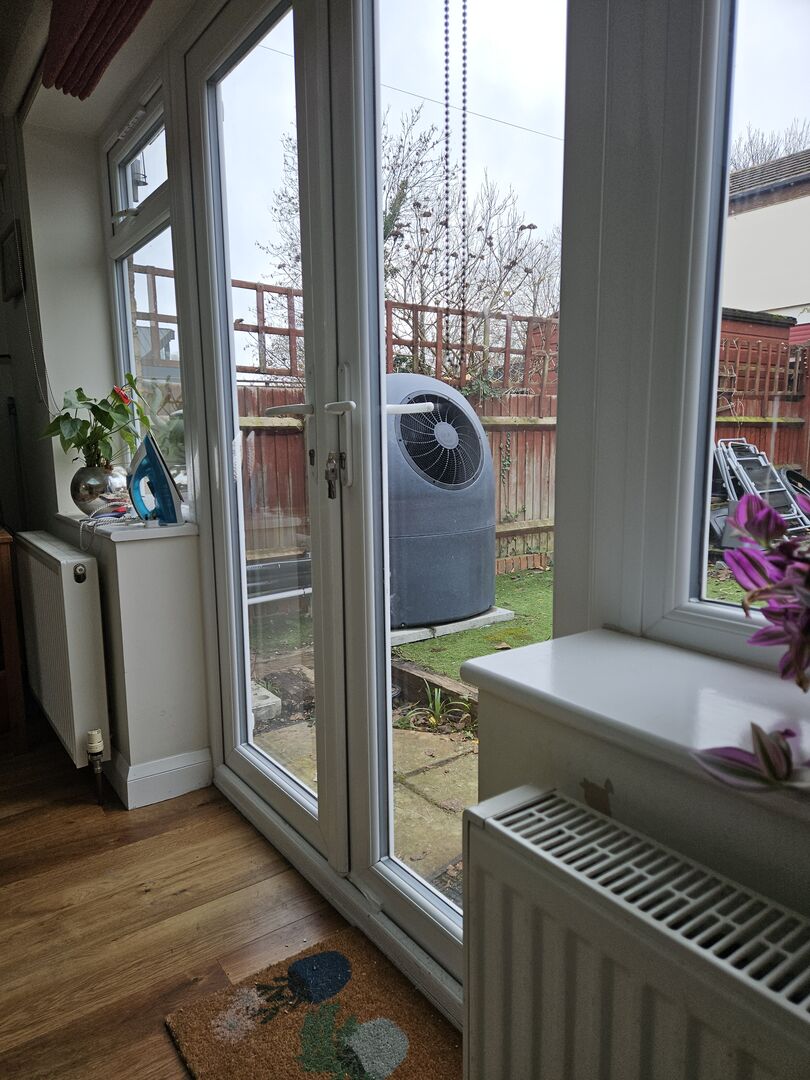
My mum watches TV sitting where the photo was taken from, and she can't any more cos of the rumbling of the HP. It's a low 180Hz (approx) sound, as per octopus recommended app Decibel X.
Some more pics, to give a context of what the system is like:
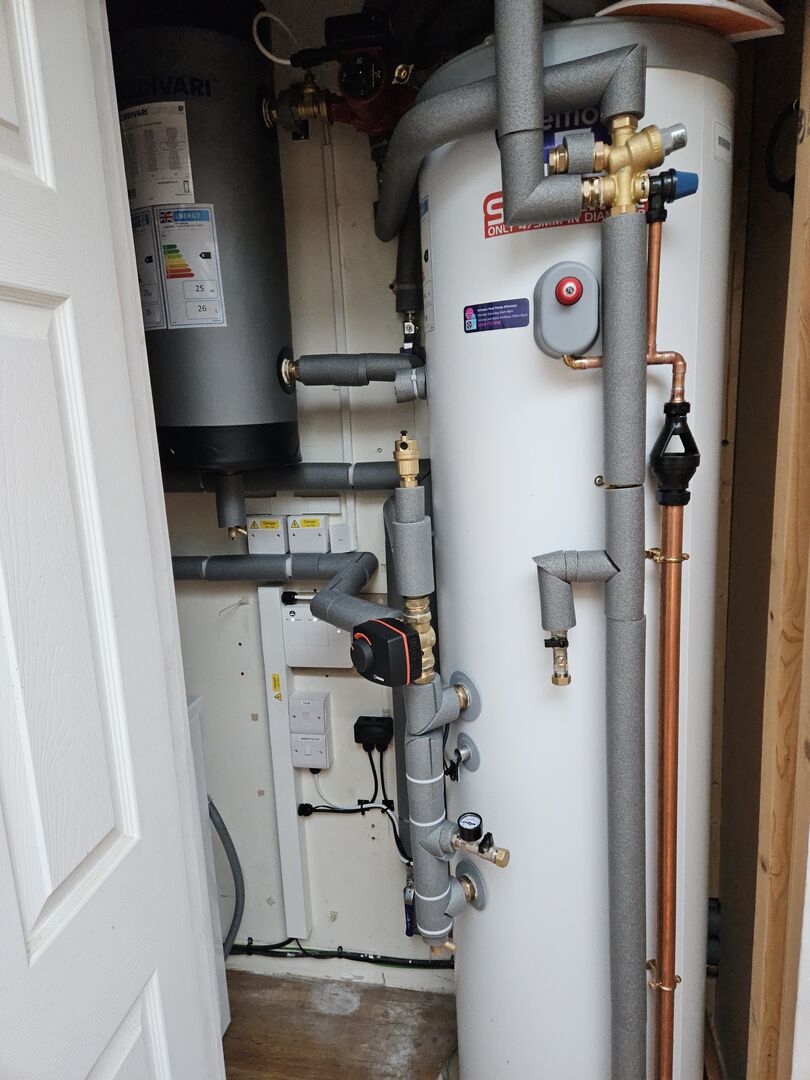
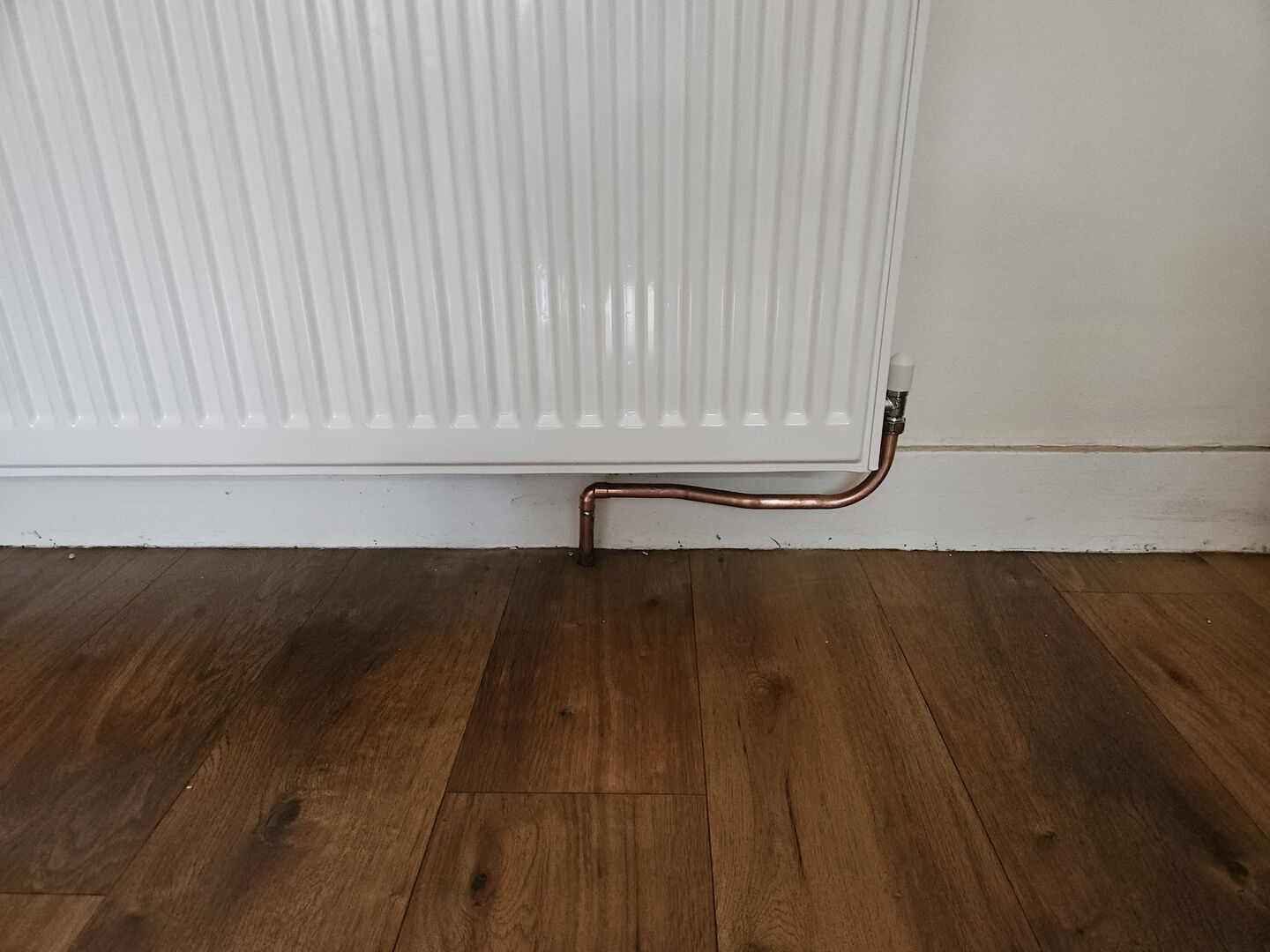
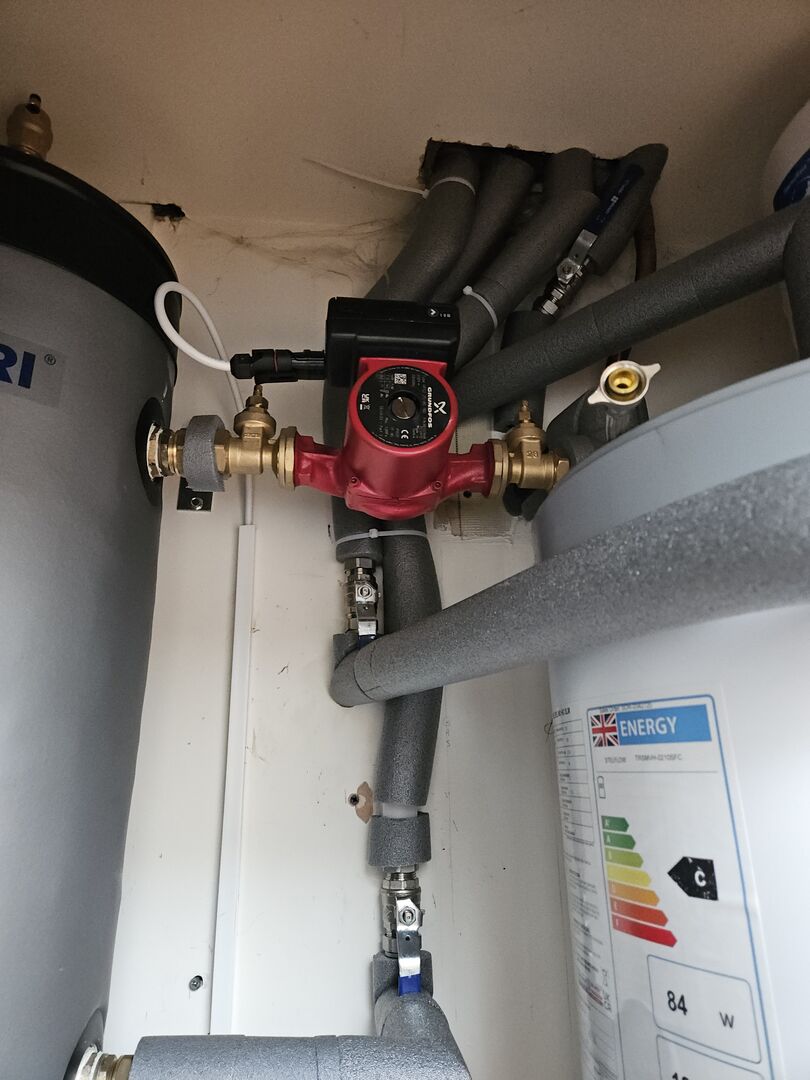
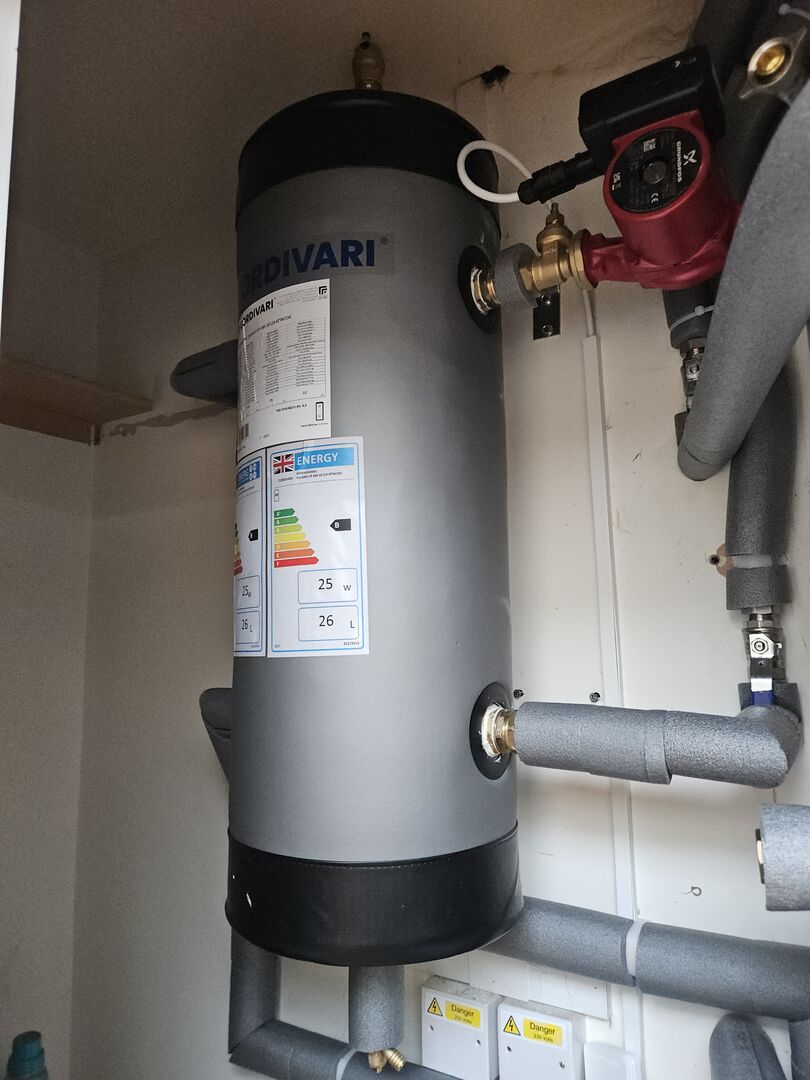
Also, when touching the various tanks and pipes, you can definitely feel the volumizer vibrating.
And a recording of the sound:
Door closed
Door open
2
Topic starter
13/01/2026 12:48 am
So, after much anguish, and even visiting the neighbour to see if the noise was coming from their place, it seems I MAY have identified a part of the problem.
The indoor buzzing is coming from the volumizer and the pump that connects it to the hot water tank. The volumizer and the pipes to it are all fitted securely to the wall, and passing on that vibration to the rest of the house.
I only realised how bad it was once it stopped.
Hopefully Octopus can do something about it. Lost a lot of sleep over this.
13/01/2026 8:31 am
So, after much anguish, and even visiting the neighbour to see if the noise was coming from their place, it seems I MAY have identified a part of the problem.
The indoor buzzing is coming from the volumizer and the pump that connects it to the hot water tank. The volumizer and the pipes to it are all fitted securely to the wall, and passing on that vibration to the rest of the house.
I only realised how bad it was once it stopped.
Hopefully Octopus can do something about it. Lost a lot of sleep over this.
Well done for identifying it, thats half the battle. Sometimes one component (in any system, not just heating) amplifies noise generated by another. The pump will likely be the source, the volumiser amplifying it. If thats a partition wall not a solid one then it could be acting as a sounding board.
Central heating circulators are often near silent so you may even have a faulty pump, if not some anti-vibration mounts may heap, or bolting things to the (presumably concrete) floor rather than the wall. Certainly this part of the system shouldn't be disturbing you.
Incidentally that looks like a 4 port buffer not a 2 port volumiser. I thought that Octopus didnt fit buffers. If you can persuade them to turn it into a 2 port volumiser it would be good, 4 port buffers typically reduce system efficiency and make fault diagnosis difficult. The better installers avoid them other than in truly exceptional circumstances.
This post was modified 2 months ago 4 times by JamesPa
4kW peak of solar PV since 2011; EV and a 1930s house which has been partially renovated to improve its efficiency. 7kW Vaillant heat pump.
13/01/2026 8:45 am
The pump will likely be the source…
I spoke to an installer last year who made a really important point that stuck with me. Circulation pumps don’t just make ‘disturbing’ noise on their own… the noise is often amplified by whatever they’re connected to. When pumps are hard-mounted into pipework that’s fixed to walls, the vibration has somewhere to travel and the building itself becomes a sounding board. That’s when you get reverberation, humming and low-frequency noise that seems to come from everywhere. Looking at Razz’s photo that appears to be the case.
More and more good installs are now deliberately moving circulation pumps away from wall-mounted pipework and instead mounting them against tanks or cylinders, or on short, well-supported pipe runs. In those cases there’s far less structure to carry the vibration, so the noise effectively dies where it’s created. Same pump, same flow… very different noise outcome.
Looks like you have a lot of space in the cupboard @razz so hopefully they can repipe things for you.
Get a copy of The Ultimate Guide to Heat Pumps
Subscribe and follow our YouTube channel!
1
13/01/2026 8:48 am
Incidentally that looks like a 4 port buffer not a 2 port volumiser.
I saw that too, but wasn’t clear what was happening pipe-wise on the other side of the tank, but looks like a 4-port buffer.
Get a copy of The Ultimate Guide to Heat Pumps
Subscribe and follow our YouTube channel!
13/01/2026 8:51 am
I saw that too, but wasn’t clear what was happening pipe-wise on the other side of the tank, but looks like a 4-port buffer.
Those two fat pipes on the other side of the tank must be going somewhere. It would also explain the need for a second pump (presumably there is one in the outdoor unit)
The outdoor unit is quite a distance away so a wild guess suggests they fitted a buffer and second pump to overcome excess resistance. AFAIK they could just have fitted a second pump in series which would surely have been better. To me this seems to have created more problems than it solved!
This post was modified 2 months ago by JamesPa
4kW peak of solar PV since 2011; EV and a 1930s house which has been partially renovated to improve its efficiency. 7kW Vaillant heat pump.
1
13/01/2026 8:54 am
not looking very cheap, and doesn't heat the house very well.
The heat pump was installed during a cold time so running costs will be higher than normal. It’s a lot milder now so your running costs should have dropped significantly.
Can you elaborate on the house not being well heated. Are some rooms warmer than others or uniformly cooler. Now that it’s milder, is the house more comfortable?
Get a copy of The Ultimate Guide to Heat Pumps
Subscribe and follow our YouTube channel!
Page 1 / 14
Next

Latest Posts
-
RE: Daikin Altherma 3 LT compressor longevity question
@bobflux With my limited HA skills I can't ad...
By Ubert767 , 57 minutes ago
-
Hi all I'm having some trouble with a Grant ASHP and ...
By Renewables345 , 1 hour ago
-
RE: Peak Energy Products V therm 16kW unit heat pump not reaching flow temperature
You are absolutely correct that the capacity table MUST...
By JamesPa , 1 hour ago
-

RE: Heat Pump vs New Gas Boiler for Inherited House - Worth the Extra Cost?
@fretless6, where are you based? I might be able to con...
By Mars , 2 hours ago
-

RE: Underfloor Heating Installation Issues with Heat Pump
I'm going to install Thermacome ACOSI+ radiant ceiling....
By bobflux , 3 hours ago
-
RE: Testing new controls/monitoring for Midea Clone ASHP
Now seems a good time to summarise the costs and effici...
By benson , 4 hours ago
-
RE: Tell us about your Solar (PV) setup
@mk4 Charge to 100%, discharge down to 10%.
By bobflux , 6 hours ago
-
RE: Connecting Growatt SPH5000 over wired ethernet rather than wireless
The simplest wired option is usually the Growatt Ethern...
By Jonatan , 11 hours ago
-

RE: Electricity price predictions
@jamespa And it seems some of the nasty public cloud...
By Batpred , 18 hours ago
-

RE: Jokes and fun posts about heat pumps and renewables
Technology is rapidly advancing. BBC News reported th...
By Transparent , 21 hours ago
-
What matters for flow and pressure drop is internal dia...
By bobflux , 22 hours ago
-

RE: Do Fridges and Freezers have COP ratings?
@editor Thank you all for your replies and submitted in...
By Toodles , 1 day ago
-
I know and yes. The secondary deltaT wont necessaril...
By JamesPa , 1 day ago
-
RE: Designing heating system with air to water heat pump in France, near Lyon
Just love the way you put it! 🤣
By Batpred , 2 days ago
-
RE: Safety update; RCBOs supplying inverters or storage batteries
Thank you for sharing. So it seems that your Schneid...
By Batpred , 2 days ago
-
RE: Forum updates, announcements & issues
@upnorthandpersonal thanks for the thoughtful, consider...
By Mars , 2 days ago
-
RE: Solar Power Output – Let’s Compare Generation Figures
@mk4 All 21 panels have their own Enphase IQ7a microinv...
By Toodles , 2 days ago
-
RE: Setback savings - fact or fiction?
Great, so you have proven that MELCloud is consistently...
By RobS , 3 days ago
-
RE: Mitsu PUHZ120Y 'Outdoor Temp 'error?
Thanks David & James It almos...
By DavidAlgarve , 3 days ago
-
RE: Surge protection devices SPDs
@trebor12345 - your original Topic about the right type...
By Transparent , 3 days ago
-
RE: Help needed with Samsung AE120RXYDEG
@tomf I’ve been sent this from a service engineer at Sa...
By Mars , 3 days ago
-
RE: Buying large amp bidirectional RCD and RCBO
Yes... I went through this particular headache and ende...
By bobflux , 4 days ago
-
O-oh! Let's take this as an opportunity to 'pass the ...
By Transparent , 4 days ago