Joining the Renewable Heating Hub forums is completely free and only takes a minute. By registering you’ll be able to ask questions, join discussions, follow topics you’re interested in, bookmark useful threads and receive notifications when someone replies. Non-registered members also do not have access to our AI features. When choosing your username, please note that it cannot be changed later, so we recommend avoiding brand or product names. Before registering, please take a moment to read the Forum Rules & Terms of Use so we can keep the community helpful, respectful and informative for everyone. Thanks for joining!
Next steps on my ASHP journey: Radiators and Pipework
Next steps on my ASHP journey: Radiators and Pipework
I’m taking a slow and cautious step-by-step journey along the path towards getting an ASHP. Below are my thoughts on replacement radiators, whether my current pipework is sufficient, and whether my hot water tank should be replaced. I’m a research scientist by profession, so like to understand and work things out for myself. However, I am also new to this area, so would much appreciate feedback and advice, including pointing out any faulty assumptions or missteps on my part.
Insulation
Back in 2023, we added as much retrofit insulation as was practical to our 1970’s 4-bed detached (146 sqm). That included toping up the loft insulation, adding underfloor insulation including above the integral garage, switching to high-performance double-glazed units, adding PIR insulation to the walls of the garage, and insulating the timber walls of the dormer. The house is now as well insulated as it reasonably can be.
Heat Loss
I have recently done heat loss calculations, both a theoretical room-by-room approach and a practical approach based on data from the heat energy going into the house and the temperature difference that created. See:
The heat loss worked out at about 6200W with at least 500W provided by other sources (electricity use, people, solar gain in the coldest months), so about 5700W needed from a heating source running for 24 hours per day.
Assuming hot water heating for two hours per day at 6000W, which is plenty for us, leaves 22 hours for heating, which comes out at about 6200W.
A 7kW heat pump would therefore appear to be sufficient. For example, a Vaillant Aerotherm 7kW, which provides its specified output or more at -5C or higher outdoor temperature and flow temperatures in the range 35-55C. It can also provide a flow temperature of 75C for heating hot water.
Radiators
The radiators are next on my to do list. The existing ones are type 10 and type 20 and have a combined output of about 12500W at DT50, at least they might have done when new. Most of them are the same age as the house, i.e. 55, and ready for retirement. Some are likely silted up, since a thermal camera shows the lower middle part of the radiator remains cold for a while on warm up. They often need bleeding and can be noisy – less so now that the gas boiler operates using weather compensation and flow temperatures are no more than 65C.
I have looked at the Stelrad radiator specs and chosen larger K2 radiators to match or slightly exceed the room-by-room heat loss at a flow temperature of 40C, i.e. a radiator temperature of 37.5C, assuming a 5C drop from flow to return. I calculated the radiator performance based on the published DT50 values, scaled according to (X/50)1.3, where X is the difference between the radiator temperature and the room temperature. This gives a scaling factor of 0.29 for DT20 and 0.24 for DT17.5.
The new radiator for the hallway is under-powered by 15% as there isn’t space for a larger size, and fitting a K3 would be problematic due to the extra width. Taking a pragmatic view, if the hallway only reaches 17C on the coldest days of the year then that’s fine. In practice, I expect it will take some heat from the adjacent rooms, which have overcapacity. Aside from that I was able to match very well the room-by-room heat loss.
In total, the new radiators have an output of 26300W at DT50 and 6300W at DT17.5. By comparison, the lowest temperature that the existing radiators could possibly support is 50C, i.e. a flow temperature of 52.5C. Since, they are old and likely have quite a lot less output than new, that figure is no doubt optimistic.
For the new radiators, the total water content is 117 litres, with an estimated further 18 litres in the relevant copper pipes. Total water volume 135 litres, which works out at about 21.7 litres per kW. According to the info on the Heat Pump Water Volume calculator this is in the good range (>20).
At a design flow temperature of 40C a Vaillant Aerotherm 7kW is expected to give a SCOP of 4.13, which would be nice.
Pipes
Copper pipe is used throughout. This is 22mm for 10m on the flow and return from the gas boiler, splitting into two 15mm pipes (upstairs and downstairs) that are each about 40m long. The upstairs and downstairs 15mm pipes are not equal in terms of the heat energy they need to transport. The downstairs one needs to carry about 3700W and the upstairs one about 2500W.
The Vaillant Aerotherm 7kW operates at a maximum flow rate of 0.333 litres per second, with the difference between flow and return temperatures varying with output. At a 5C temperature difference, this corresponds to 7kW output.
A flow rate of 0.333l/s down a 22mm pipe corresponds to a flow speed of about 1.0m/s. A flow rate of 0.333l/s down two 15mm pipes in parallel, i.e. 0.167l/s each, corresponds to a flow speed of about 1.15m/s, which is in the standard range of 1.0 to 1.5m/s, and a little above the quiet range of 0.5 to 1.0m/s. The UK good practice limit is 1.2m/s for central heating circuits, so this would be met.
The pressure drop for 0.333l/s along one 10m section of 22mm pipe followed by two parallel 40m sections of 15mm pipe, then one 10m section of 22mm pipe is theoretically: 3.6 + 25.8 + 3.6 = 33 kPa = 0.33 bar, or 3.3m head. However, this value is for straight pipe, without junctions and corners that cause significant extra resistance to flow. Taking a pessimistic view that junctions and corners may add up to 50% gives a pressure drop of 0.5 bar or 5m head. This appears to be within the acceptable range for most central heating pumps, including my current one that delivers 6m head.
The 22mm hot water pipes separate off the main flow and return pipes after about 3.5m and run for a further 6.5m to the hot water tank. As we only ever do space heating or hot water heating, not both at the same time, this arrangement appears to be fine with flow rates and pressures (1.0 m/s and 0.07 bar or 0.7m head) for the hot water circuit below those for the heating circuit.
Hot water tank
Unlike the radiators, our hot water tank is not in need of replacement. Hence an economic argument would be needed to do so. Heating the hot water in the existing tank could be done using 75C flow from the heat pump with a COP of about 2.4. Whereas with a new heat pump specific tank, this could be done at lower temperatures, with a once-a-week anti-legionella cycle, with an average COP of about 3.2.
Our annual energy requirement for hot water is about 1600 kWh. The annual energy saving with a new hot water tank would therefore be about 167 kWh due to the increased COP. Assuming current cheap overnight electricity prices this amounts to a saving of about £15 per year. Assuming a Vaillant UniSTOR hot water tank and installation at £1500, which is perhaps optimistic, this equates to a payback period of 100 years, and so does not make economic sense.
Conclusions and questions
I aim to replace all the radiators next summer, but not the hot water tank, and then see how I get on trying out a 40C flow temperature over the following winter using my gas boiler as the heat source. It appears that my pipework can support a 7kW heat pump, but not a 10kW one, so I’ll need to make sure that any survey prior to fitting a heat pump concludes that a 7kW unit is the correct size.
Question 1: Rather than match the calculated heat loss for each room, should I up-size the new radiators further, e.g. 70cm high instead of 60cm in some rooms? The idea being that they could then be balanced down to the right output. The extra cost would be relatively low, extra water volume would be added to the system, and there would be more scope to turn them up if needed to get the correct overall balance. Or is this a waste of money?
Question 2: Feedback would be most welcome on pipework considerations. For those with lots of experience in this area, would the normal expectation be that my 22mm/15mm pipework is likely fine for use with a 7kW heat pump? And are the upstairs and downstairs 15mm pipes capable of carrying 2500W and 3700W respectively?
Question 3: As an alternative to what I propose doing, is there an argument for getting a heat pump first and then changing the radiators later? Are there any advantages in doing the radiator changes at the same time as a heat pump is installed (aside from draining and filling the system one less time)?
Why do insulation first?
If I had not upgraded the insulation first, then the heat loss would be about 9400W, 52% more than it currently is. Hence the need for a 10kW heat pump instead of 7kW, at an additional cost of around £1000 and possibly higher installations costs too. Instead of 40C flow temperature with the new radiators, it would be around 47C, reducing the SCOP. The maximum flow rate for 10kW is 0.574l/s. This flow rate down a pair of 15mm pipes equates to 1.97m/s, which is well over the practical limit of 1.5m/s, likely to cause excessive noise and erosion of the lining of the pipes. Hence, the main 15mm pipework both upstairs and downstairs would need replacing, at significant cost and disruption. The pressure drop for the existing pipework would be 9.9 + 70.7 + 9.9 = 90.5 kPa, 0.9bar, or 9m head. This is again an underestimate due to junctions and corners. Even an optimistic uplift of only 10% gives a pressure drop of over 1 bar or 10m head, which is too high.
As expected, there are strong arguments for a "fabric first" approach, insulating as much as possible first. This reduces the energy required for heating due to the lower heat loss, and more so with a heat pump by enabling lower flow temperatures and hence higher efficiency. Insulating first potentially avoids the need for a more costly higher output heat pump, that may require expensive and disruptive changes to pipework that would not otherwise be required.
The radiators are next on my to do list. The existing ones are type 10 and type 20 and have a combined output of about 12500W at DT50, at least they might have done when new. Most of them are the same age as the house, i.e. 55, and ready for retirement. Some are likely silted up, since a thermal camera shows the lower middle part of the radiator remains cold for a while on warm up. They often need bleeding and can be noisy – less so now that the gas boiler operates using weather compensation and flow temperatures are no more than 65C.
I have looked at the Stelrad radiator specs and chosen larger K2 radiators to match or slightly exceed the room-by-room heat loss at a flow temperature of 40C, i.e. a radiator temperature of 37.5C, assuming a 5C drop from flow to return. I calculated the radiator performance based on the published DT50 values, scaled according to (X/50)1.3, where X is the difference between the radiator temperature and the room temperature. This gives a scaling factor of 0.29 for DT20 and 0.24 for DT17.5.
<snip>
Question 1: Rather than match the calculated heat loss for each room, should I up-size the new radiators further, e.g. 70cm high instead of 60cm in some rooms? The idea being that they could then be balanced down to the right output. The extra cost would be relatively low, extra water volume would be added to the system, and there would be more scope to turn them up if needed to get the correct overall balance. Or is this a waste of money?
Brilliant - you have done exactly what I did (with significant help pointing me in the right direction) when planning our ASHP installation.
We replaced all our existing radiators with Stelrad K2 models (except one narrower model in the downstairs hallway for size considerations).
The first thing I would say is don't get too hung up on matching radiator output exactly to the room heat loss - heat will naturally travel from room to room, so you can probably be 25-33% over or under in given rooms if needed and get away with it. That said, if you can try to go larger in difficult to heat rooms and rooms that you occupy most of the time, that helps.
Secondly, if you are replacing radiators anyway, go with the largest radiators you can reasonably accommodate in the space available. A 700x1800 will be a worthwhile upgrade over a more standard sized 600x1600 radiator. Do that in every room and you end up running at lower flow temps which improves efficiency and lowers running costs. We run at flow temps of 32-35C all winter and achieve a SCOP in excess of 4 as a result. Edited to add - we didn't design to a given flow temp and size radiators accordingly, we installed the largest radiators we could accommodate and then let the flow temps fall where they may (knowing roughly where that would be). It makes no sense to design to an arbitrary flow temp of 40C when you may be able to achieve flow temps of 36C or 37C by installing larger radiators.
Obviously there is a trade off in terms of cost - a standard 600x1600 radiator is cheaper than less common sizes, so is something to take into consideration. We missed a trick when adding an additional radiator to our most difficult to heat living space. We added an additional 600x2000 radiator to supplement the existing 600x1600 radiator. We kept the new radiator at 600mm to match the height of the existing unit, but could easily have gone 700m in height. Likewise I didn't realise that units up to 2400 were available so we could have gone even longer, or we could have opted for two additional 600x1600 units which would just about squeezed in. Think creatively - I was surprised at the height of some of the radiators they managed to squeeze in under low windows in the bedrooms - they upgraded a 400x1200 rad to 450x1400, and a 400x900 rad was replaced with a 600x1000 rad where looking you'd think they wouldn't be able to fit anything much larger.
This post was modified 1 month ago 2 times by Old_Scientist
Samsung 12kW gen6 ASHP with 50L volumiser and large radiators. 7.2kWp solar (south facing), Tesla PW3 (13.5kW). Net Zero
Question 3: As an alternative to what I propose doing, is there an argument for getting a heat pump first and then changing the radiators later? Are there any advantages in doing the radiator changes at the same time as a heat pump is installed (aside from draining and filling the system one less time)?
The obvious thing that springs to mind is that those rads may be be in a horrible state given their age, so unless they are all going to be removed and power flushed, I wouldn't want to connect them back up to a brand new pristine heat pump system. If you are going to replace them anyway, that alone is incentive to replace them at the same time. The other reason is you are delaying the financial benefits of running with lower flow temperatures due to larger more efficient radiators by delaying replacing them.
Plus radiators of different size may require their pipework to be in different positions, so far easier to do the job all at once, budget permitting.
This post was modified 1 month ago 2 times by Old_Scientist
Samsung 12kW gen6 ASHP with 50L volumiser and large radiators. 7.2kWp solar (south facing), Tesla PW3 (13.5kW). Net Zero
Question 2: Feedback would be most welcome on pipework considerations. For those with lots of experience in this area, would the normal expectation be that my 22mm/15mm pipework is likely fine for use with a 7kW heat pump? And are the upstairs and downstairs 15mm pipes capable of carrying 2500W and 3700W respectively?
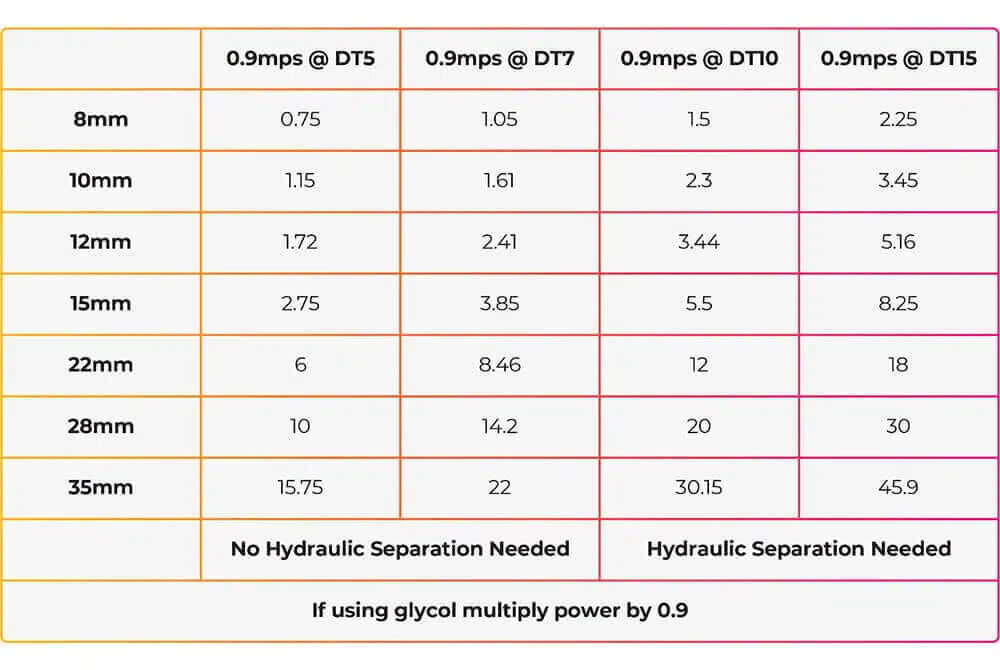
I'm sure you are familiar with the Heat Geek table, which shows for a dT of 5C, 15mm pipe can transfer 2.75kW of heat at 0.9mps, which would suggest your 2.5kW upstairs load is fine, but the 3.7kW downstairs load is marginal. Can you maybe start the downstairs run in 22mm copper and branch off into 15mm slightly later once you've shed some of that heat?
In reality it's unlikely to be an issue, but if it were me and I was re-plumbing from scratch anyway, I'd try to keep the backbone at 22mm and branch off in 15mm.
Samsung 12kW gen6 ASHP with 50L volumiser and large radiators. 7.2kWp solar (south facing), Tesla PW3 (13.5kW). Net Zero
The first thing I would say is don't get too hung up on matching radiator output exactly to the room heat loss - heat will naturally travel from room to room.
Secondly, if you are replacing radiators anyway,go with the largest radiators you can reasonably accommodate in the space available.
We generally keep all the internal doors open, except bathrooms and utility, and the heat does indeed even out very well over the whole house - one of the benefits of good insulation to the outside environment. That said the upstairs rooms typically ends up about a degree warmer than downstairs.
I'll get my measuring tape out again and get back to my spreadsheet with some larger radiator sizes. There are quite a few places where I can definitely go further in radiator height while remaining neatly under the windowsill level.
The obvious thing that springs to mind is that those rads may be be in a horrible state given their age, so unless they are all going to be removed and power flushed, I wouldn't want to connect them back up to a brand new pristine heat pump system.
The whole system was power flushed about 3 years ago and after about a week the magnetic filter stopped finding anything much to trap, so I'm not too concerned about the boiler picking up muck from them. I'm definitely not going to connect them to a brand new heat pump though!
I'm sure you are familiar with the Heat Geek table, which shows for a dT of 5C, 15mm pipe can transfer 2.75kW of heat at 0.9mps, which would suggest your 2.5kW upstairs load is fine, but the 3.7kW downstairs load is marginal.
I see HG are staying in the quiet range with their flow rate at 0.9m/s. By comparison, I'd need a flow rate of 1.22m/s to transfer 3700W at a dT of 5C down a 15mm pipe. That seems a bit on the fast side, so needs some consideration.
I’ve thought about the pipework and flow rate issues from first principles and tried to work out what will happen as follows:
Basics
1 Kg of water, i.e. 1 litre, of water cooling by 1 degree effectively emits 4200 Joules of energy. Doing so in 1 second is 4200W.
For a temperature drop of dT and a flow rate of fr in litres per second, the formula below gives the amount of energy transported per second:
4200 x dT x fr Watts
The flow speed fs for a pipe is given by the flow rate fr divided by the internal volume of a 1m length of pipe in litres:
fs = fr / vol1m
The volume of a 1m length of 15mm copper pipe is 0.145 litres.
Putting all this together, and considering 15mm copper pipe:
At a flow speed of 0.9m/s we get 2740W at dT5, as per the Heat Geek table.
At a flow speed of 1m/s, we get 3045W at dT5.
My proposed system
A Vaillant Aerotherm 7kW heat pump effectively runs at a fixed flow rate of 21l/min or 0.333l/s. When split into two 15mm copper pipes that have equal length and equal resistance to the flow this equates to a flow rate of 0.167l/s down each pipe, and hence a flow speed of 1.15m/s.
A flow speed of 1.15m/s gives 3500W at dT5 which equates to 700W per degree. (This is no coincidence, since overall, the heat pump delivers 7kW at dT5 for twice this flow).
My house needs 2500W emitted by the radiators connected to the upstairs 15mm pipe, and 3700W emitted by the radiators connected to the downstairs 15mm pipe.
The heat pump ensures a 40C flow to both upstairs and downstairs pipes and its pump provides a flow rate of 1.15m/s through each pipe. What happen?
The upstairs pipe flow temperature is reduced from 40C by 2500/700 = 3.6 degrees on its return, while the downstairs pipe flow temperature is reduced from 40C by 3700/700 = 5.3 degrees on its return. These two flows then merge back together into the return side 22mm pipe, producing water at 4.45 degrees below the original flow temperature, since (2500 +3700)/1400 = 4.45.
The above calculation assumes that the upstairs and downstairs radiators emit 2500W and 3700W respectively, which is the case at an average radiator temperature of 37.5. However, in practice the different drops in flow temperature will result in different average radiator temperatures of roughly 38.2C and 37.3C and hence slightly different amounts of power emitted. A little more for the upstairs radiators, which can be turned down very slightly, and a tiny amount less for the downstairs radiators, which I am just going to ignore, since it is "in the noise".
In conclusion, I think the 15mm pipe work should be fine as far as heat transport is concerned. It will just result in a slightly higher dT measured across the downstairs pipework, which is a non-issue.
A concern remains however with the flow speed of 1.15m/s through the 15mm pipe and whether that would result in an unacceptable noise – particularly upstairs at night.
A concern remains however with the flow speed of 1.15m/s through the 15mm pipe and whether that would result in an unacceptable noise – particularly upstairs at night.
In reality it's unlikely to be an issue, but if it were me and I was re-plumbing from scratch anyway, I'd try to keep the backbone at 22mm and branch off in 15mm.
I think the above says it. There is no hard and fast rule about velocity and of course bends, particularly elbows, are going to matter more than straight pipework. If you can easily do a bit of replumbing of the common bits (up to where the first rad branches off) then I would do so but I probably would just suck it and see if its going to be a PITA.
Im pretty sure you can adjust the Vaillant pump head (and hence flow rate) so an alternative is to turn it down a bit, slightly higher deltaT but insignificantly so.
4kW peak of solar PV since 2011; EV and a 1930s house which has been partially renovated to improve its efficiency. 7kW Vaillant heat pump.
Heat pumps that support a variable or adjustable delta T (dT), for example 7 or 10 degrees instead of 5.
Clearly there is a compromise here as a higher dT is going to lower average radiator temperature compared to the flow temperature. However, this is only by 1 degree for every 2 degree increase in dT, so not a huge efficiency loss.
If I can run at a dT of 7 degrees instead of 5, then the flow rate needed for 3700W through 15mm copper pipe works out at:
3700/(4200 x 7) = 0.126l/s
which equates to a flow rate of 0.87m/s, which is exactly where I want to be for quiet operation, and only compromises radiator temperature by 1 degree.
Regarding the pressure drop, I would have 0.251l/s flow through 10m of 22mm pipe, 0.126l/s through each of two 40m parallel sections of 15mm pipe and finally 0.251l/s flow through 10m of 22mm pipe on the return. That gives a pressure drop of
2.2 + 15.4 + 2.2 = 19.8kPa = 0.2 bar = 2m head.
With a 50% uplift assumed for bends and junctions, that gives a total of 3m head, which is considerably better than the 5m head with a dT of 5.
Thanks for the feedback, the pipe work is 22mm to the airing cupboard where the hot water tank is situated, and then disappears off into internal walls and floors as two 15mm pipe runs to the upstairs and downstairs radiators. It would be very disruptive and no doubt costly to get those runs re-piped.
Doing the maths, it looks like running at a dT of 7 would make a big difference to the flow speed and pressure drop, and so is probably the way to go. I'll dig around into which 7kW heat pumps can work like that - starting with the Vaillant. Other suggestions most welcome.
Doing the maths, it looks like running at a dT of 7 would make a big difference to the flow speed and pressure drop, and so is probably the way to go. I'll dig around into which 7kW heat pumps can work like that - starting with the Vaillant. Other suggestions most welcome.
The DT will be what the DT will be, its determined by the equations you set out above. This means that most of the time (with a constant flow rate like the Vaillant) it will be less than the max. SOFAIK most heat pumps complain about low flow rate but not high DT (obviously the two are linked) but others may know otherwise. Some heat pumps modulate the flow rate to achieve a constant DT (no idea why) but not Vaillant, at least not by default.
This post was modified 1 month ago 2 times by JamesPa
4kW peak of solar PV since 2011; EV and a 1930s house which has been partially renovated to improve its efficiency. 7kW Vaillant heat pump.
The DT will be what the DT will be, its determined by the equations you set out above. This means that most of the time (with a constant flow rate like the Vaillant) it will be less than the max.
My understanding is that the Vaillant 7kW normally operates with a constant flow rate of 0.333l/s, which then equates to 7kW at DT5. As you say, the DT will then vary with the power output, with DT5 effectively the max.
What I think I would need is the constant flow rate used turning down to about 0.25l/s, which corresponds to 7kW at DT7. That looks like it would then work with my mix of 22mm and 15mm pipework. Do you know if adjusting the flow rate used is possible in that way?
Back in 2023, we added as much retrofit insulation as was practical to our 1970’s 4-bed detached (146 sqm).
Pipes
Copper pipe is used throughout. This is 22mm for 10m on the flow and return from the gas boiler, splitting into two 15mm pipes (upstairs and downstairs) that are each about 40m long.
Is the pipework the original, like the radiators? If so then it will be 3/4 inch and 1/2 inch and not 22mm and 15mm. They are narrower internally, 1/2" has an ID of 12.7mm and 3/4" is 19.05mm.
Also, your calculated pressure drops seem quite low. I believe 0.126l/s of 40C water through one 40m section of 15mm pipe has a pressure drop of 29.44 kPa or 3.03 m. If you actually have 1/2 inch then a 40m section gives 40.81 kPa or 4.19 m. That's for new copper pipework and not including any fittings, also your old copper pipework will be more resistive due to wear.