

Notifications
Clear all
Joining the Renewable Heating Hub forums is completely free and only takes a minute. By registering you’ll be able to ask questions, join discussions, follow topics you’re interested in, bookmark useful threads and receive notifications when someone replies. Non-registered members also do not have access to our AI features. When choosing your username, please note that it cannot be changed later, so we recommend avoiding brand or product names. Before registering, please take a moment to read the Forum Rules & Terms of Use so we can keep the community helpful, respectful and informative for everyone. Thanks for joining!

17/09/2026 12:02 pm
I calculate that at a flow temperature of 47° the output of a delta T 50 1700W radiator would be 637 W , a 2100W radiator would be 787W. Either of these is lower than the 1170 W heat loss that heat geek found on their survey. Does my calculation seem reasonable.
I thought to get the government grand the installer how to show that all the rooms would be heated to an adequate temperature.
That calculation is reasonable, output is proportional to (average rad temp-room temp)^1.3.
I cant explain the Heat Geek design decision. There may be a valid reason you would have to ask. If its without fins then upgrading to the same size with fins is the obvious thing to do, if needed.
4kW peak of solar PV since 2011; EV and a 1930s house which has been partially renovated to improve its efficiency. 7kW Vaillant heat pump.


18/09/2026 3:28 pm
I’ve had another look at this thread because earlier today I’ve been sent some feedback from an installer, and the screenshots I’ve seen imply there is a growing suspicion in parts of the industry that Heat Geek are deliberately keeping the design flow temperature out of sight because it makes the Zero Disrupt proposition easier to sell.
That said, I also understand Heat Geek’s wider argument. Flow temperature isn’t the end result the homeowner is buying; comfort, efficiency and running cost are. If a system can deliver a reasonable seasonal COP with fewer radiator changes, despite occasionally running a little hotter, that may well be a better design than chasing an arbitrarily low flow temperature and spending hundreds or thousands replacing emitters.
But that still doesn’t explain why the design flow temperature shouldn’t be shown.
If my proposal has been designed around 42C, tell me. If it’s 50C, tell me. If the clever modelling says 55C or even 60C on the coldest design day is the optimum compromise because it avoids £2,000 of radiator changes while still delivering a guaranteed efficiency, tell me that too. I might completely agree with the decision or I might not. But I'd like to know.
I don’t think we should obsess over flow temperature as though the lowest number automatically wins, but I also don’t think an important design parameter should disappear because the algorithm has supposedly optimised everything else and they're scared to show the homeowner that their system might run at 55C on the coldest days of the year.
🔥 Britain’s Heat Pump Shitshow
How Installing a Heating System Became a National Nervous Breakdown
Free UK shipping.
📗 Heat Pumps Explained
A Jargon-Free Guide for Homeowners
Rewritten and updated for 2027
📘 From Zero to Heat Pump Hero
🛠️ Bodge Buster
New to heat pumps?
Take the Heat Pump Fundamentals course and use INTRO50 at checkout for 50% off.
18/09/2026 3:47 pm
I’ve had another look at this thread because earlier today I’ve been sent some feedback from an installer, and the screenshots I’ve seen imply there is a growing suspicion in parts of the industry that Heat Geek are deliberately keeping the design flow temperature out of sight because it makes the Zero Disrupt proposition easier to sell.
That said, I also understand Heat Geek’s wider argument. Flow temperature isn’t the end result the homeowner is buying; comfort, efficiency and running cost are. If a system can deliver a reasonable seasonal COP with fewer radiator changes, despite occasionally running a little hotter, that may well be a better design than chasing an arbitrarily low flow temperature and spending hundreds or thousands replacing emitters.
But that still doesn’t explain why the design flow temperature shouldn’t be shown.
If my proposal has been designed around 42C, tell me. If it’s 50C, tell me. If the clever modelling says 55C or even 60C on the coldest design day is the optimum compromise because it avoids £2,000 of radiator changes while still delivering a guaranteed efficiency, tell me that too. I might completely agree with the decision or I might not. But I'd like to know.
I don’t think we should obsess over flow temperature as though the lowest number automatically wins, but I also don’t think an important design parameter should disappear because the algorithm has supposedly optimised everything else and they're scared to show the homeowner that their system might run at 55C on the coldest days of the year.
All agreed.
On the wider point I am beginning to think that the industry (to be accurate the smart part of the industry) understanding of flow temperature is evolving and actually ours (or at least mine) might be a bit behind.
We sort of assume that if you increase FT by 1C that degrades performance by 3%. This is broadly, I think, still true although I much confess that the last time I ran the numbers was with an R32 heat pump.
However increasing design FT by 1C is not the same as increasing FT by 1C across the board. The FT theoretically required at an OAT close to IAT is still only just above IAT, so the effect of increasing design FT reduces as OAT increases. Since, most of the time, the OAT is nearer 7 than -2, increasing design FT is not as serious as we might first think. This is particularly the case if the SCOP is reasonably high, because a 3% increase on a reasonably small consumption is less significant in real terms than it is on a high consumption.
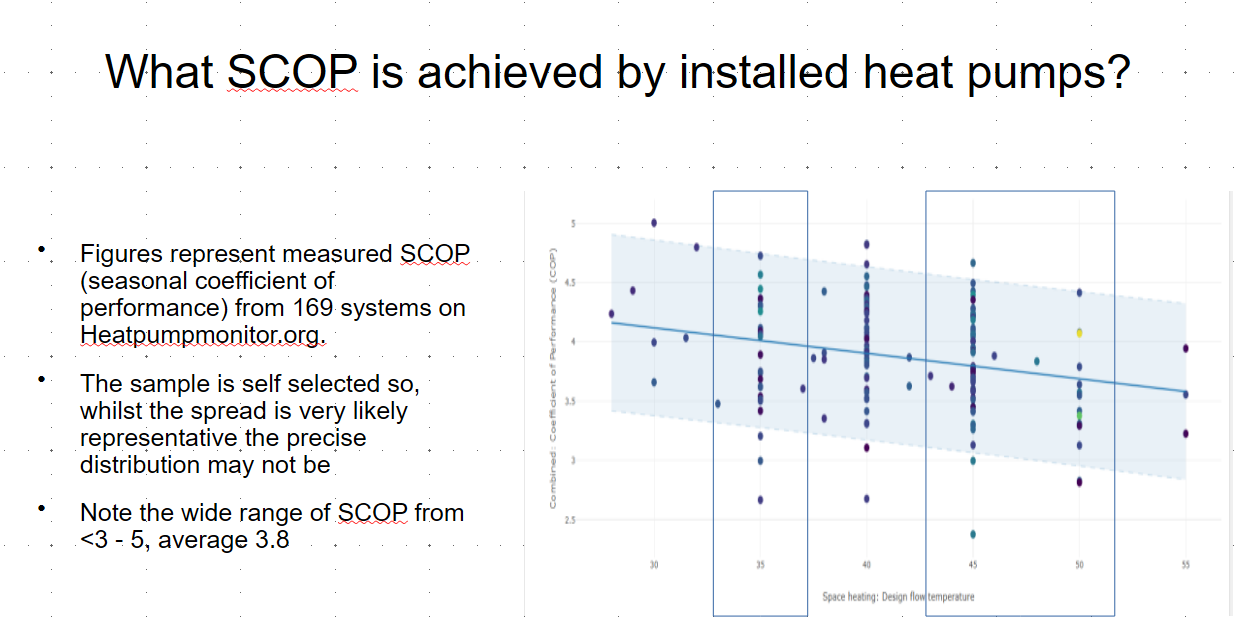
Some real world data is reproduced below, taken from openenergymonitor. The relatively slow variation of SCOP with design FT is quite noticable.
HG and Octopus have clearly cottoned onto this and realised that, by relaxing FT a bit, they can frequently reduce rad swaps significantly. Similarly with the cylinder replacement, if you need to operate at 65 or even 70 instead of 55 to get the cylinder heated to 50C, the extra cost, particularly if you do it at night on a ToU tarrif, is diddly squat by comparison with a £2K cylinder (including fitting)
To me the fact that some installers are doing this represents early signs of a maturing industry, which is good news, even if it grates slightly with purists. If only the cowboys would duck out altogether.
This post was modified 4 weeks ago 5 times by JamesPa
4kW peak of solar PV since 2011; EV and a 1930s house which has been partially renovated to improve its efficiency. 7kW Vaillant heat pump.
1

18/09/2026 4:11 pm
Sorry but what is “OAT” and “IAT”
One thing that struck me about the chart “ What SCOP is achieved by installed heat pumps?” Is the clustering of heat pumps around exactly 35° 40°, 45° and 50°. If each heat pump Installation had been optimised for its particular location I would expect a spread across the flow temperature range.
This post was modified 3 weeks ago by Mars

18/09/2026 4:18 pm
IAT indoor air temperature
OAT outdoor air temperature
These are installed heat pumps (each dot = 1 or more pumps
Clustering because the axis is design FT and people tend to design for 35, 40, 45 etc and size rads accordingly. Actual may of course differ.
4kW peak of solar PV since 2011; EV and a 1930s house which has been partially renovated to improve its efficiency. 7kW Vaillant heat pump.

18/09/2026 4:20 pm
Sorry but what is “OAT” and “IAT”
One thing that struck me about the chart “ What SCOP is achieved by installed heat pumps?” Is the clustering of heat pumps around exactly 35° 40°, 45° and 50°. If each heat pump Installation had been optimised for its particular location I would expect a spread across the flow temperature range.
OAT = Outside Air Temperature
IAT = Internal Air Temperature
As for the chart, you'll see the clustering around the 5 degree increments because the axis is for design flow temperature. The installers will almost never design around a flow temperature of 42, 28 or 37.5. The actual flow temperature after tweaking may well vary but the design flow temp will still stay at one of those convenient increments.
105 m2 bungalow in South East England
Mitsubishi Ecodan 8.5 kW air source heat pump
18 x 360W solar panels
1 x 6 kW GroWatt battery and SPH5000 inverter
1 x Myenergi Zappi
1 x VW ID3
Raised beds for home-grown veg and chickens for eggs
"Semper in excretia; sumus solum profundum variat"

18/09/2026 4:24 pm
@jamespa Just to reinforce your point about reducing radiator swaps, Mick Wall has just released this video about running costs; radiators and SCOPs:
A much overused phrase this days is ‘just because we can doing something, doesn’t mean we should’. By way of example, Sage has just released a £289 toaster with an electro-optical sensor which allows to owner to select their desired amount of ‘doneness’. I will stick with my cheap; reliable but variable ‘doneness’ toaster as toasting a second piece of bread is a cheaper overall option than spending £289 on a kitchen appliance.
in my view, the pursuit of high SCOPs at any cost is as more about installer bragging rights than the design of value for money installations.
Like you, Ì have kept my original hot water cylinder which since the system was installed in April has produced a reasonable COP of 3.2 including the weekly disinfection cycle. Undoubtedly, I could get a higher SCOP if I replaced the cylinder or fitted a heat exchanger but again that would be financial madness.
18/09/2026 4:57 pm
I'm trying to get some other quotes, I've just spoken to an installer and he said that he would be changing the cylinder because my cylinder coils wouldn't be big enough. I told him that I'd got a recently fitted unvented cylinder which I was keen to keep and that we didn't use much hot water anyway, (showers down the gym). He said he had to change it in case there was a spot check and if he hadn't he would be in trouble.
That's not my understanding of how it's supposed to work.
I've spoken to another installer and I'm booked in for them to phone me in 10 days time to discuss it!
I sent my details to another installer over a week ago and heard nothing I can't get him on the phone.
Octopus were a complete waste of time I'll do a post about their visit.
Can anyone suggest an installer in the South Birmingham north Worcestershire area.
18/09/2026 5:45 pm
I got fed up eventually with installers telling me what I wanted so I prepared a mini request for quotation (just a couple of paragraphs) setting out what I would and would not accept.
I also went about it systematically, I got a list of local installers from the MCS site and a list from valiant, which I had more or less decided was my chosen brand.
They all got the rfq and I waited for quotes. I chased a couple of tardy but hopeful ones giving them a deadline.
Some didn't reply, some told me that I needed something other than what I thought I needed, and some made a 'compliant' proposal. The latter group were considered.
Of course it's not guaranteed to work, in a professional capacity I have deployed the same process and just occasionally received no satisfactory quotes. But it is a way to filter out the crap without wasting their time or yours!
This post was modified 4 weeks ago by JamesPa
4kW peak of solar PV since 2011; EV and a 1930s house which has been partially renovated to improve its efficiency. 7kW Vaillant heat pump.

18/09/2026 6:12 pm
@jamespa My RFQ went out to 20 companies via email; in this mail I specified make of HP I had in mind, detailed lack of space for a conventional DHW tank and my need for a heat battery system (Sunamp) or similar and the need for a diverter so my solar system could be used to charge the heat battery when sufficient solar was available. They were informed of the existence of the Tesla Powerwall and then they were left to chose to reply or not. Many replied but one then withdrew when they realised my location was outside their area. I narrowed my choice down to 5 companies who looked most promising and ruled out several who were not prepared to fit a heat battery or who had no experience with them and stuck with a DHW tank or nothing offer.
I had a survey in the early days of Octopus Energy starting to install heat pumps but my requirements were ‘out of scope’ at that time - though they did explain that in due course, my requirements might be achievable but no timescale was available.
One company stopped responding during the process of arranging a survey with them when I sent photos for them to see what might be involved. I ended up with 3 quotes and chose from them - at no time did any of these companies imply that my requirements could be met by other schemes or that perhaps I didn’t know what I was talking about. Regards, Toodles.
Toodles, heats his home with cold draughts and cooks food with magnets.
2

19/09/2026 3:07 pm
@jamespa Just to reinforce your point about reducing radiator swaps, Mick Wall has just released this video about running costs; radiators and SCOPs:
A much overused phrase this days is ‘just because we can doing something, doesn’t mean we should’. By way of example, Sage has just released a £289 toaster with an electro-optical sensor which allows to owner to select their desired amount of ‘doneness’. I will stick with my cheap; reliable but variable ‘doneness’ toaster as toasting a second piece of bread is a cheaper overall option than spending £289 on a kitchen appliance.
in my view, the pursuit of high SCOPs at any cost is as more about installer bragging rights than the design of value for money installations.
Like you, Ì have kept my original hot water cylinder which since the system was installed in April has produced a reasonable COP of 3.2 including the weekly disinfection cycle. Undoubtedly, I could get a higher SCOP if I replaced the cylinder or fitted a heat exchanger but again that would be financial madness.
As a single point of reference, we had all 12 radiators replaced during our ECO4 install with larger K2 Stelrad types. Out of interest I costed the radiators at around £2,000 on Stelrad's website. Feel free to assume a labour amount for the time taken to replace them.
Our SCOP is around 4. If we assume a worst case scenario of a SCOP of 3 due to higher flow temps had they not been replaced, then the savings may be in the order of £150/year on running costs, so may recoup costs over the long term but certainly no quick payback.
On the flip side, had we not replaced the radiators and had chosen to reuse them, how many installers would have remove them to power flush them before connecting them up to a shiny new heat pump. I wouldn't want 20+ years of sludge from reused old radiators passing through my expensive new heat pump, so there is also a cost implication to undertaking that cleaning work, or perhaps most installers just view that as not our problem?
All of which makes the complexity and cost of a heat pump installation considerably more than a straight boiler replacement IMHO.
This post was modified 3 weeks ago 2 times by Old_Scientist
Samsung 12kW gen6 ASHP with 50L volumiser and large radiators. 7.2kWp solar (south facing), Tesla PW3 (13.5kW). Net Zero

SPONSORS

Degrees of Separation

Latest Posts
-

RE: Jokes and fun posts about heat pumps and renewables
Damn, I pressed the button on my new heat pump too soon...
By ian33a , 53 minutes ago
-
RE: Safety study for plug in batteries out to tender - looks like Q3 2027 at best before legal
I think it may depend how much of the world is on fire ...
By EtchedPixels , 5 hours ago
-
RE: Air-to-Air Heat Pumps & Air Conditioning: UK Heating and Cooling Q&A
I hope it's not the same people who make the awful TV s...
By EtchedPixels , 5 hours ago
-
RE: Why are ASHP installs so expensive?
ECO4 is classic British idiocy, "save" money by requiri...
By EtchedPixels , 5 hours ago
-
RE: Renewables & Heat Pumps in the News
We need more building inspectors anyway and less self-s...
By EtchedPixels , 6 hours ago
-
RE: Does anyone have experience of a smart water meter?
@majordennisbloodnok That is my thinking precisely, I s...
By Toodles , 13 hours ago
-
RE: Replacing Storage Heaters with a Heat Pump in a Stone Cottage
I found some interesting data about the price of heat p...
By Rob of York , 20 hours ago
-
RE: PV and battery long payback - sense check query
Thanks for all the comments. I finally got to the bott...
By DavidB , 22 hours ago
-
RE: Indevolt Batteries UK Support & Info Thread
People following this thread who are hoping that plug i...
By JamesPa , 1 day ago
-
RE: Passiv Smart Thermostat - Help & Forum Support
By Singlespeed , 1 day ago
-
RE: Help me keep the faith with my air source heat pump installation
just had Vaillant over to service the HP and asked abou...
By AdamK , 1 day ago
-
RE: tepeo ZEB UK Support & Info Thread
OK so ZEB is basically a variant on a storage heater, b...
By JamesPa , 3 days ago
-
RE: Heat Geek installations: share your experiences
@editor I suspect that the Heat Geek online quote is a ...
By AndrewJ , 3 days ago
-
RE: Adding additional Solar Panels to a DC coupled battery system
Ah, yes. Thanks for clarifying.
By Transparent , 3 days ago



SPONSORS